Quantification Challenges in Polymer Analysis in Urban Runoff and Wastewater using Pressurized Liquid Extraction and Double-Shot Pyrolysis-Gas Chromatography-Mass Spectrometry

Anal. Chem. 2025, 97, 27, 14321–14330: Graphical abstract
Microplastics (MPs) pose environmental and health risks. This study developed and optimized a two-step pressurized liquid extraction (PLE) method followed by pyrolysis-GC/MS for quantifying PE, PET, PP, and PS in environmental water and wastewater. Methanol pre-extraction at 100 °C followed by THF at 180 °C yielded MP recoveries of 43–58%. Solubilized standards improved calibration accuracy, especially for PET and PP.
Pyrolysis at 625 °C for 40 s ensured optimal sensitivity. PE and PET were dominant in samples from Avedøre and Pontedera, while PP and PS appeared at lower concentrations. The study highlights key challenges in MP analysis and emphasizes the importance of optimized extraction, pyrolysis, and calibration for reliable quantification. The method supports routine environmental MP monitoring, with future improvements needed for standardization and analytical precision.
The original article
Quantification Challenges in Polymer Analysis in Urban Runoff and Wastewater using Pressurized Liquid Extraction and Double-Shot Pyrolysis-Gas Chromatography-Mass Spectrometry
Daniele Martuscelli, Jonas B. Jensen, Luca Solari, Simona Francalanci, Peter Christensen, Jan H. Christensen
Anal. Chem. 2025, 97, 27, 14321–14330
https://doi.org/10.1021/acs.analchem.5c01170
licensed under CC-BY 4.0
Selected sections from the article follow. Formats and hyperlinks were adapted from the original.
Microplastics (MPs), defined as plastic particles smaller than five millimeters, have become a significant environmental concern due to their widespread presence and persistence in ecosystems. When ingested by animals, MPs can cause physical harm, toxic exposure, and bioaccumulation, ultimately entering the human food chain. (1,2) This has raised increasing concerns about their impact on human health, as studies continue to report their presence in food and water sources. (3,4)
Pressurized Liquid Extraction (PLE) has recently shown promising results for isolating MPs. (10,11) PLE uses solvents at high pressure and temperature, enhancing MP extraction by keeping solvents in a liquid state at elevated temperatures, thereby increasing solubility. This method is particularly effective for isolating MPs from complex matrices like sediments and biological tissues and can detect even low MP concentrations. (12)
MP quantification of solid or solubilized MP samples can be performed with laser scanning or chromatography-based methods. Laser scanning analyzes MP spectra to visualize characteristics like shape, number, polymer type, and color but can struggle with very small particles. In contrast, chromatography-based methods, especially Pyrolysis- gas chromatography/mass spectrometry (Py-GC/MS), are better for analyzing MPs of all sizes. Py-GC/MS breaks down polymers through pyrolysis and detects thermal degradation products and reliable quantification requires monitoring of selective products at specific mass-to-charge (m/z) ratios. This method also reduces the need for extensive sample preparation as it can be performed on both solid and liquid (solubilized) samples, but sample cleanup is beneficial to avoid quantification biases (1,13−16)
Py-GC/MS is used not only for identifying and quantifying MPs but also for detecting associated micropollutants, such as plastic additives or environmental pollutants absorbed by MPs. (17,18) Common pyrolyzers include Curie Point, Micro Furnace, and filament types, which, despite varying heating methods, consistently produce reliable results for MP quantification, enabling cross-study comparisons. (19) However, quantifying MPs in the low range of 25–385 μg poses challenges in preparing both MP standards and samples. Calibration curves can be created by diluting MPs with inert materials like glass microfibers or silica for even pyrolysis distribution, (19,20) but this process is prone to errors during preparation.
Alternatively, MP solubilization can be performed prior to analysis using solvents like dichloromethane (DCM) or tetrahydrofuran (THF). It has been demonstrated that (11) PLE with DCM effectively solubilizes polyethylene (PE) and polypropylene (PP), while another study (21) used THF for polyethylene terephthalate (PET). For polymers such as PE and PP, where solubilization is difficult, MPs are analyzed in solid form. (22) Selecting appropriate solvents to solubilize various MP mixtures is crucial. One strategy that will be tested in this study involves using Hansen solubility parameters to evaluate the solubilization potential of organic solvents on the different MP polymers treated in this study. (23)
The creation of solid or liquid calibration curves is essential for reliably quantifying MPs. Dierkes et al. (2019) reported limits of quantification (LOQs) between 1.4 and 1.6 μg for PE, PP, and polystyrene (PS), calculated from the standard deviation of blank samples. Matsueda et al. (2021) found higher LOQs for PET, around 10 μg, reflecting the varying challenges in quantifying different polymer types.
PLE was selected in this study for MP due to its suitability for handling complex matrices rich in organic matter, such as wastewater and combined sewer overflows (CSOs). Unlike conventional density separation and filtration, PLE allows for selective solubilization of MPs while simultaneously removing dissolved organic matter through controlled temperature and solvent polarity. It is high degree of automation reduces contamination risk and improves reproducibility between replicates. Moreover, the dry residues obtained from PLE with trapping material in the collection vials (in this study hydromatrix) are fully compatible with Py–GC/MS, enabling an efficient transition from extraction to quantification without additional filtration steps.
This study aims to refine MP quantification by optimizing PLE for particulate matter extraction and evaluating two calibration approaches for Py-GC/MS analysis of PE, PP, PS, and PET. It focuses on selecting optimal solvents, optimizing pyrolysis conditions, and assessing key PLE parameters (pressure, temperature, and extraction cycles) to enhance MP recovery from complex water matrices. Additionally, Py-GC/MS settings (pyrolysis temperature, split ratio, and flow conditions) will be fine-tuned to improve sensitivity and reproducibility. By refining these methodologies, the study seeks to establish more reliable and standardized protocols for MP isolation and quantification.
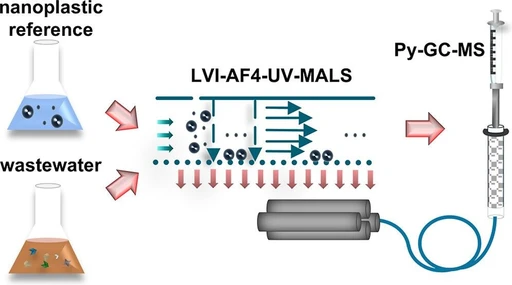
Although PLE has been applied for to solid samples, its application to filtered particles from aqueous samples remains limited. In this study, we adapted a dual-solvent PLE protocol, using methanol for matrix cleanup and THF for polymer solubilization, and collection of MPs on a solid material in the PLE collection vial. The solid material is then analyzed by a double-shot Py-GC/MS method for MP quantification. Calibration in both solid and liquid phases, enabled detection of PE, PP, PET, and PS in a realistic concentration range of 200 ng to 10 μg.
The method was applied to environmental samples collected from CSOs, a highly relevant but under-investigated source of MP pollution. These episodic discharges, triggered by intense rainfall, can introduce large volumes of particulate matter into receiving waters and are recognized as major contributors to urban MP loads. To date, no quantitative studies employing thermal analysis techniques have targeted these complex matrices. This study provides the first chemically resolved MP concentrations from CSO events, contributing novel insights into the role of urban drainage in plastic pollution.
Material and Methods
Py-GC/MS Method: Development and Final Protocol
Py-GC/MS method was developed and optimized for MP analysis, following an initial protocol where 5 mg of milled MP sample were placed in pyrovials and analyzed in a Gerstel TDU 2 (thermal desorption unit). The method employed a double-shot approach: thermal desorption at 300 °C to remove volatile and semivolatile compounds, followed by pyrolysis at 625 °C for MP degradation and analysis of pyrolyzates.
The initial method (10) applied pyrolysis at 600 °C for 20 s, injecting pyrolysis products at a 1:20 split ratio, followed by another 1:20 split (total 1:400 split). A split vent flow controlled the transfer through the TDU, while a second split was applied during column injection. The temperature between the pyrolysis unit and the injection port was maintained at 300 °C. Mass spectra were acquired on an Agilent 5975C inert XL MSD, with an interface temperature of 320 °C.
To improve sensitivity and prevent MSD saturation, particularly for PS, the split ratio was refined. The final optimized method maintained the double-shot approach, with thermal desorption at 300 °C (100 s hold) followed by pyrolysis at 625 °C (40 s hold, plus 1 min postpyrolysis transfer). Helium was supplied at 51.1 mL/min, with a 1:10 split ratio and a 10 mL/min purge flow. The CIS (cooled injection system) trapped analytes at 30 °C, then ramped to 300 °C at 12 °C/s, holding for 3 min before column transfer.
Separation was performed on an Agilent 7890A GC equipped with a Zebron ZB5 column (5% phenyl methyl siloxane, 30 m × 250 μm × 0.25 μm). The oven program started at 35 °C, ramping at 15 °C/min to 320 °C, followed by a 6 min hold. The helium flow was 1.1 mL/min, with detection in SIM mode (six ions per retention time window, 30 ms dwell time, 4.89 scans/s) or scan mode (m/z 10–400, 3.66 scans/min). The ion source and quadrupole were kept at 230 and 150 °C, respectively.
Through this methodological refinement, the final Py-GC/MS protocol ensured detection of all polymer types, optimizing split ratios to prevent signal saturation while maintaining high analytical sensitivity and reproducibility.
The method was validated using six-point calibration curves (200 ng–10 μg) with replicates (n = 2–3), internal standard correction, blank vials between samples, and preanalysis cleaning of pyrolysis interfaces. R2 values, 95% CI, and carryover tests are provided in SI6–SI8.
Result and Discussion
Influence of Temperature and Time on Pyrolysis Efficiency
Before analyzing real samples, we focused on selecting the pyrolysis temperature to ensure complete polymer degradation and consistent signals responses across samples with identical polymer quantities. Various pyrolysis technologies exists, (24−26) and previous studies (11) have identified effective pyrolysis conditions to minimize interlaboratory discrepancies.
A preliminary study on PS pyrolysis duration found that extending the time from 20 to 40 s resulted in higher peak areas. Based on this, a pyrolysis time of 40 s was selected for further temperature optimization without additional refinements.
The effect of pyrolysis temperature on the abundance of target pyrolyzates was evaluated for all four MPs. Six temperatures, ranging from 550 to 675 °C, were tested using a 40-s pyrolysis time, a 1:50 split ratio, and a CIS transfer temperature of 250 °C. Each temperature was tested in triplicate across three batches, with batch orders varied (low to high, high to low, and random), and cleaning steps performed between runs.
Results (Figure 2) showed that PE pyrolysis was most efficient at 625 °C, with C10–C14 α-alkene peaks nearly doubling compared to other temperatures. A similar trend was observed in another study, (11) where selected 600 °C to maximize PE detection in biosolid matrices using Pyr-GC/MS. PET pyrolyzates showed high temperature sensitivity; while vinyl benzoate remained constant, biphenyl and benzophenone increased 8–10 times between 550 and 675 °C, in line with thermal decomposition profiles described in pyrolysis reviews. (1,9,27) PP pyrolyzates, particularly the early eluting trimer “2,4-dimethyl-1-hept-1-ene(126)” and the “2,4,6,8-tetramethyl-1-undecene (111)” peaks, remained stable between 550 and 625 °C but decreased at higher temperatures. For PS, styrene levels remained consistent across temperatures, while the PS-dimer “3-buten-1,3-diyldibenzene (91)” and 2,5-diphenyl-1,5-hexadiene (234) showed slight decreases at higher temperatures.
 Anal. Chem. 2025, 97, 27, 14321–14330: Figure 2. Normalized peak areas of selected pyrolyzates for PE, PET, PP, and PS at different pyrolysis temperatures. The x-axis represents the pyrolysis temperature (°C), while the y-axis shows the normalized peak areas relative to 675 °C. Pyrolyzate names and their corresponding extracted ion (m/z) values are indicated in the legends below each chart. Error bars represent the 95% confidence interval (n = 3), with relative span percentages displayed above or within the bars for each temperature condition.
Systematic comparison of six pyrolysis temperatures between 550 and 675 °C showed compound-specific responses, such as a sharp increase in biphenyl and benzophenone from PET, and a decline in PP trimers above 625 °C. The selected 40 s pyrolysis time was validated through preliminary tests on PS and is consistent with results from another study (11) who reported no signal suppression using 20–40 s in their double-shot setup.
Influence of Inorganic Matrix in Pyrolysis-Vials
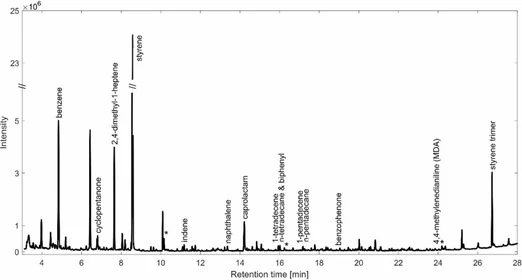
Under standard pyrolysis conditions without a matrix, PS pyrolysis primarily produces styrene (monomer), 3-butene-1,3-diyldibenzene (dimer), and 5-hexene-1,3,5-triyltribenzene (trimer), with the highest signals observed for the monomer, trimer, and dimer. Additional byproducts include α-methylstyrene, benzene, and xylene. (28,29)
The presence of an inorganic matrix significantly alters the yield of these characteristic PS pyrolysis products, even with identical PS amounts. For PET, the addition of silica gel caused a near-complete suppression of diagnostic peaks, suggesting that silica gel interacts with analytes or decomposes key markers such as benzoates and terephthalates. (30)
Comparative tests using three inert matrices and PS showed varying effects on styrene peak areas. Silica gel caused the most deviation, glass beads produced values closer to pure PS, and Hydromatrix provided the most stable pyrolysatogram (Figure S6), making it the preferred inorganic matrix in our study. These results is comparable with those obtained in a similar study, (30) who observed a reduced signal intensity of PS marker compounds when pyrolyzed with silica. However, our study extends this comparison by simultaneously evaluating three matrices under controlled conditions and by monitoring multiple PS markers (monomer, dimer, trimer). Notably, Hydromatrix provided the best reproducibility, measured as relative standard deviation (RSD), with values as low as 0.7% for styrene, compared to 31.9% with silica gel, 9.2% with glass beads, and 7.5% with no matrix. Similarly, lower RSDs were observed for the PS dimer (4.9%) and trimer (14.0%) with Hydromatrix, confirming its superior consistency. These results contrast with the greater variability reported in a previous study (31) for both alumina and silica (see Figure 3).
 Anal. Chem. 2025, 97, 27, 14321–14330: Figure 3. Influence of inorganic matrices on PS pyrolysis products. All values are normalized to the highest detected signal. Peak areas of styrene monomer (m/z 78), 3-butene-1,3-diyldibenzene (m/z 208) and 5-hexene-1,3,5-triyltribenzene (m/z 91) for PS pyrolysis with different inorganic matrices: silica gel, Hydromatrix, glass beads, and no matrix. Equal sample amounts were analyzed, with error bars representing relative standard deviations and mean peak areas shown. Silica gel yielded the highest peak area for monomer and dimer, while Hydromatrix ensured consistent results.
Wastewater Samples
MP analysis in wastewater samples from Avedøre (Denmark) and Pontedera (Italy) (SI1 and Figure S1) revealed significant MP concentration differences, reflecting site-specific variations commonly reported in wastewater studies (Table 3). The quantification of MPs in samples from both Avedøre and Pontedera, was made using calibration curves from solubilized PE, PET, PP, and PS, considered more reliabeble compared to the solid calibration curve (Table 1). In Avedøre, the mean PE concentration was 99.4 μg/L, while Pontedera exhibited substantially higher levels at 749.0 μg/L. These elevated concentrations in Pontedera are likely to result from higher wastewater volumes and industrial discharges, which are known to contribute to increased MP loads in WWTP influents.
PET concentrations varied between sites, with Avedøre at 16.2 ± 13.3 μg/L and Pontedera at 56.7 ± 22.6 μg/L. The higher PET levels in Pontedera may be attributed to its persistence and accumulation in wastewater systems.
PP concentrations were 8.2 ± 4.2 μg/L in Avedøre and 16.9 ± 6.5 μg/L in Pontedera. The buoyancy of PP likely contributes to its retention in wastewater, resulting in moderate but consistent effluent levels.
PS concentrations were below the LOQ at both sites, a common finding in wastewater studies showing PS degradation nor removal during preliminary treatment stages. Its rapid breakdown and lower stability in wastewater systems often result in concentrations below DL.
In comparisonto other results, (11) influent PE concentrations in other WWTPs were reported at 2340, 1481, and 607 μg/L ─ 5 to 20 times higher than Avedøre samples but comparable to Pontedera. PP levels in Avedøre were below Okoffo’s LOQ of 8 μg/L.
These findings align with current wastewater research, demonstrating the influence of site-specific factors, influent wastewater composition, and operational differences in WWTPs on MP concentrations. The observed variability highlights the need for customized MP quantification protocols to accurately track MP distribution and behavior in wastewater systems.
Moreover, a detailed comparison between the quantified MP ratios and their expected confidence intervals is provided in the Supporting Information (Table S10). While most samples exhibited ratios consistent with expected ranges, PET and PP presented notable deviations, particularly in lake samples (A, B, and C). These discrepancies may be attributed to polymer degradation, (39) environmental accumulation patterns, (40,41) or matrix interferences affecting quantification. (30) Given the inherent variability in MP composition and the influence of additives and polymer aging, further refinement of calibration strategies and extraction protocols could enhance quantification accuracy. However, the overall consistency in PE and PS detection, along with the observed trends in wastewater and surface water samples, supports the robustness of the analytical approach applied in this study.
Conclusions
This study established a refined approach for isolating MPs─PE, PET, PP, and PS─in environmental and wastewater samples using double-shot pyrolysis-gas chromatography/mass spectrometry, with or without PLE. The method effectively addressed matrix interferences, by either thermal desorption to remove volatile and semivolatile compounds before pyrolysis and/or by pre-extraction with methanol using PLE.
Key findings provide valuable insights into critical parameters influencing MP quantification. The selected extraction strategy, whether using PLE with methanol pre-extraction followed by tetrahydrofuran or direct analysis via Py-GC/MS will reduce quantification biases and improve MP recovery. The final pyrolysis conditions, set at 625 °C for 40 s, delivered consistent sensitivity and reproducibility. The study also evaluated different quantification strategies, showing that solid MP calibration curves improved accuracy for PET and PP, while solubilized calibrations provided better linearity for PE and PS.
Tests of surface water from a lake in Copenhagen and wastewater from two sites in Italy and Denmark showed that PET and PE were the most abundant MPs, likely due to their stability and density, whereas PP and PS were detected at lower levels, influenced by their buoyancy and degradation potential. Variations observed between WWTPs showed the impact of influent composition and operational factors on MP concentrations.
Further efforts should focus on refining Py-GC/MS conditions and evaluating the necessity of PLE for different sample types to enhance detection limits and overall performance. Developing consistent calibration protocols to ensure comparability across laboratories and sample types – the study clearly showed the challenge with obtaining reliable calibration solution either solid or liquid.
This study presents a analytical strategy for MP monitoring, offering flexible approaches for effective extraction, pyrolysis, and quantification to support environmental assessments and regulatory initiatives.