News from LabRulezGCMS Library - Week 25, 2026
LabRulez / AI: News from LabRulezGCMS Library - Week 25, 2026
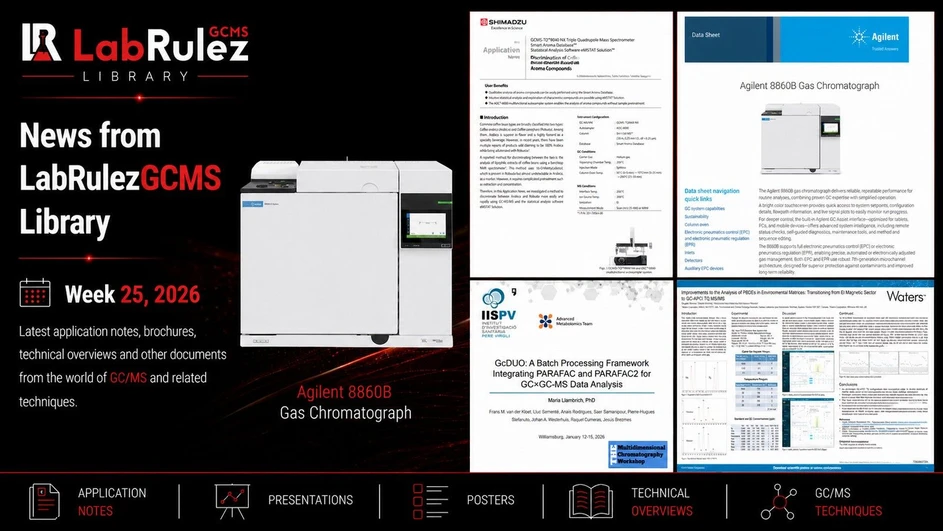
Our Library never stops expanding. What are the most recent contributions to LabRulezGCMS Library in the week of 15th June 2026? Check out new documents from the field of the gas phase, especially GC and GC/MS techniques!
👉 SEARCH THE LARGEST REPOSITORY OF DOCUMENTS ABOUT GCMS AND RELATED TECHNIQUES
👉 Need info about different analytical techniques? Peek into LabRulezLCMS or LabRulezICPMS libraries.
This week we bring you brochure by Agilent Technologies, application note by Shimadzu, presentation by MDCW / Institut d’Investigació Sanitària Pere Virgili and poster by Waters Corporation!
1. Agilent Technologies: Agilent 8860B Gas Chromatograph
- Brochure
- Full PDF for download
The Agilent 8860B gas chromatograph delivers reliable, repeatable performance for routine analyses, combining proven GC expertise with simplified operation. A bright color touchscreen provides quick access to system setpoints, configuration details, flowpath information, and live signal plots to easily monitor run progress. For deeper control, the built‑in Agilent GC Assist interface—optimized for tablets, PCs, and mobile devices—offers advanced system intelligence, including remote status checks, self‑guided diagnostics, maintenance tools, and method and sequence editing. The 8860B supports full electronic pneumatics control (EPC) or electronic pneumatics regulation (EPR), enabling precise, automated or electronically adjusted gas management. Both EPC and EPR use robust 7th‑generation microchannel architecture, designed for superior protection against contaminants and improved long-term reliability.
GC system capabilities
- Retention time repeatability: < 0.03% or 0.003 minutes
- Area repeatability:
- < 1.0% RSD
- The 8860B display comes with physical start/stop buttons for manual analysis
- Easy access to maintenance and service modes from the GC Assist interface, including autonomous leak checks
- The GC Assist interface provides remote connectivity enabling you to monitor your smart GC system, check system logs, and perform diagnostics tests, from inside or outside the laboratory
- Atmospheric pressure and temperature compensation are built into every system, so results do not change, even when the laboratory environment does.
- Simultaneously supports
- Two inlets
- Three detectors
- Support for up to any combination of three valves total:
- Up to four heated gas sample valves
- Up to two liquid sampling valves
- Dual sample introduction capabilities:
- Supports two 7693A autoinjectors with capacity for 16 sample vials
- Supports one 7693A autoinjector and automatic sampler tray with capacity for 150 sample vials
- Supports one 7650A autoinjector with capacity for 50 sample vials with one 7693A with capacity for 16 sample vials
- Supports one PAL3 autosampler
- Instrument dimensions
- Height: 49 cm (19.2 in)
- Width: 58 cm (22.9 in), 68 cm with side-mounted detector
- Depth: 54 cm (21.3 in)
- Typical weight: 51 kg (112 lb)
2. MDCW / Institut d’Investigació Sanitària Pere Virgili: GcDUO: A Batch Processing Framework Integrating PARAFAC and PARAFAC2 for GC×GC-MS Data Analysis
- Presentation
- Full PDF for download
The presentation introduces GcDUO, an open-source batch-processing framework developed for the analysis of comprehensive two-dimensional gas chromatography–mass spectrometry (GC×GC-MS) data. The tool was designed to address one of the main challenges in GC×GC-MS workflows: extracting meaningful chemical information from highly complex multidimensional datasets while reducing dependence on proprietary software. GcDUO combines the strengths of PARAFAC and PARAFAC2 chemometric algorithms to perform automated peak detection, deconvolution, compound annotation, and quantification across large batches of samples.
The workflow begins with raw GC×GC-MS data imported from CDF files and converted into a four-dimensional matrix. Regions of interest (ROIs) are automatically selected using a watershed algorithm, allowing relevant chromatographic features to be isolated from the background. PARAFAC decomposition is then applied to separate overlapping compounds into their individual first-dimension retention times, second-dimension retention times, and mass spectra. Compound identification is performed using spectral similarity calculations, retention index information, and comparison against reference libraries, creating a consensus-based annotation strategy that improves confidence in identifications.
To further improve quantitative performance, GcDUO incorporates a constrained PARAFAC2 approach that can model chromatographic peak shifts between samples while preserving accurate peak integration. The framework was evaluated using benchmark GC×GC datasets containing fragrances, allergens, food-related compounds, and breath-analysis samples. Validation studies showed strong detection and annotation performance, including successful identification of most compounds in independent datasets such as FruityBeer and BreathMix. Quantitative comparisons with the widely used ChromaTOF software demonstrated highly comparable retention times and peak areas for a range of volatile compounds, indicating that GcDUO can deliver results similar to established commercial platforms.
The authors conclude that GcDUO provides a powerful open-source alternative for GC×GC-MS data processing. The framework supports automated deconvolution, annotation, and quantification without requiring strict trilinearity assumptions often associated with traditional chemometric approaches. Although computational cost and user expertise remain important considerations, GcDUO offers performance comparable to gold-standard commercial software while expanding access to advanced GC×GC-MS data analysis for metabolomics, environmental, food, fragrance, and other analytical applications. The software is freely available through GitHub, supporting broader adoption and further development by the scientific community.
3. Shimadzu: Discrimination of Coffee Bean Species Based on Aroma Compounds
- Application note
- Full PDF for download
User Benefits
- Qualitative analysis of aroma compounds can be easily performed using the Smart Aroma Database.
- Intuitive statistical analysis and exploration of characteristic compounds are possible using eMSTAT Solution.
- The AOC -6000 multifunctional autosampler system enables the analysis of aroma compounds without sample pretreatment.
Common coffee bean types are broadly classified into two types: Coffea arabica (Arabica) and Coffea canephora (Robusta). Among them, Arabica is superior in flavor and is highly favored as a specialty beverage. However, in recent years, there have been multiple reports of products sold claiming to be 100% Arabica while being adulterated with Robusta1). A reported method for discriminating between the two is the analysis of lipophilic extracts of coffee beans using a benchtop NMR spectrometer1). This method uses 16-O-Methylcafestol, which is present in Robusta but almost undetectable in Arabica, as a marker. However, it requires complicated pretreatment such as extraction and concentration.
Therefore, in this Application News, we investigated a method to discriminate between Arabica and Robusta more easily and rapidly using GC-MS/MS and the statistical analysis software eMSTAT Solution.
Sample and Analytical Methods
Commercially available coffee beans roasted at the same roastery were used as samples. Four brands of Arabica (Kilimanjaro, Brazil Bourbon, Mandheling G1, Brazil No.2 #18) and two brands of Robusta (Vietnam Robusta, Java Robusta) were prepared (Table 1). Each brand was individually crushed with a mill, and 1 g was weighed and sealed in a screw vial.
Volatile compounds were concentrated and introduced into the GC-MS using the HS-SPME method and then analyzed under the conditions registered in the GC-MS(/MS) Smart Aroma Database (Table 2). The GCMS-TQTM8040 NX and the AOC-6000 multifunctional autosampler system were used as the analytical instruments (Fig. 1). To verify whether rapid analysis is possible, a temperature ramp of 10˚C/min was adopted, and a low-polarity column was used to obtain stable retention times for each compound. Data acquisition was performed in Scan mode or MRM mode, and each sample was analyzed three times.
Exploration of Characteristic Aroma Compounds for Arabica and Robusta
Next, we investigated which compounds contribute to the discrimination between Arabica and Robusta. The PCA score plot (Fig. 4) reflects the differences in the tendencies of each group, with Arabica distributed on the left side and Robusta on the right side, clearly separated along the first principal component (PC1) axis. Referring to the corresponding loading plot, compounds located on the left side of the origin tend to have higher area values in Arabica, which is also positioned on the left in the score plot. On the other hand, compounds on the right side tend to show higher values in Robusta, which is located on the right in the score plot. In other words, the difference in the balance of these compoundsisthe main factorseparating the two groups. First, Arabica was commonly rich in compounds such as 5-Methyl furfural, Acetoin, and Furaneol acetate. MS chromatograms analyzed using LabSolutions Insight GCMS are shown in Fig. 7. In eMSTAT Solution, not only score plots and loading plots but also box plots can be easily drawn, making it possible to easily visualize and compare the distribution tendencies of each compound. From the box plots of the above compounds (Fig. 8), it was visually confirmed that all of them are contained in abundance in Arabica. These compounds are sometimes described as having a roasted or creamy quality, and it can be inferred that this result supports the characteristics of Arabica, which issuperior in aroma and acidity.
On the other hand, a compound found in abundance in Robusta was p-Vinylguaiacol. This compound is known to cause an offflavor similar to a medicinal odor in sake, and its content was low in Arabica. From this, it was suggested that p-Vinylguaiacol may be one of the compounds contributing to the bitterness and offtastes characteristic of Robusta.
Conclusion
In this Application News, we investigated the discrimination of coffee bean types based on aroma compounds using the triple quadrupole gas chromatograph mass spectrometer GCMSTQ8040 NX and the GC-MS(/MS) Smart Aroma Database for aroma analysis.
Four types of Arabica and two types of Robusta were analyzed as samples. Analysis using Scan data confirmed a tendency for the two types to separate. Subsequently, data was acquired in MRM mode, which offers higher sensitivity and selectivity, and detailed analysis was performed using the statistical analysis software eMSTAT Solution. As a result, the two groups were clearly separated in PCA and cluster analysis, demonstrating the effectiveness of discrimination by this method. Additionally, a discrimination model was developed and validated, confirming that highly accurate discrimination is possible.
From the above results, we conclude that the discrimination of coffee beans by aroma compound analysisis highly feasible using this method. Furthermore, this method enables a comprehensive workflow, from discrimination to the identification of characteristic compoundsfor each type.
4. Waters Corporation: Improvements to the Analysis of PBDEs in Environmental Matrices: Transitioning from EI Magnetic Sector to GC-APCI TQ MS/MS
- Poster
- Full PDF for download
This poster evaluates the transition of polybrominated diphenyl ether (PBDE) analysis in environmental samples from traditional electron ionization high-resolution magnetic sector GC-MS to a modern GC-APCI triple quadrupole MS/MS (GC-APCI TQ MS/MS) workflow. PBDE flame retardants are highly regulated due to their environmental persistence and potential health risks, making accurate and reliable analytical methods essential. The study investigated whether a GC-APCI MS/MS approach could match or exceed the performance of established GC-HRMS methods while offering greater flexibility and modernization opportunities.
The method was developed on a Waters Xevo TQ Absolute mass spectrometer equipped with APCI ionization and an Agilent 8890 GC. A key innovation was the use of nitrogen as the carrier gas instead of helium, helping laboratories reduce dependence on helium supplies and mitigate increasing helium costs. By applying nitrogen flow ramping, the authors maintained chromatographic resolution and runtime comparable to the reference helium-based method without requiring changes in column dimensions. The approach also reduced the risk of thermal degradation of highly brominated compounds such as BDE 209 and achieved faster elution while preserving peak shape and separation quality.
For quantitative analysis, up to six MRM transitions per analyte were monitored, taking advantage of the characteristic isotope patterns of brominated compounds. The use of multiple transitions improved selectivity and sensitivity, while Waters waters_connect software enabled summation of MRM signals to enhance signal-to-noise ratios near detection limits. Excellent calibration performance was achieved across more than three orders of magnitude, with correlation coefficients above 0.999 for all analytes. Internal standards and recovery standards demonstrated strong reproducibility, and quality control samples showed precision typically below 15% RSD and acceptable accuracy across low, medium, and high concentration levels.
The authors conclude that an all-nitrogen GC-APCI TQ MS/MS configuration can successfully meet the performance criteria established for PBDE analysis by reference EI GC-HRMS methods. The workflow maintains critical chromatographic separations, delivers accurate quantitative results, and offers a platform that could potentially combine PBDE determination with other halogenated flame retardants in a single analytical method. These findings demonstrate that GC-APCI TQ MS/MS represents a robust and practical modernization strategy for environmental PBDE analysis.


_s.webp)