Developing Quick Screening Method to Identify Rice Cultivars with Unique Aromatic Features
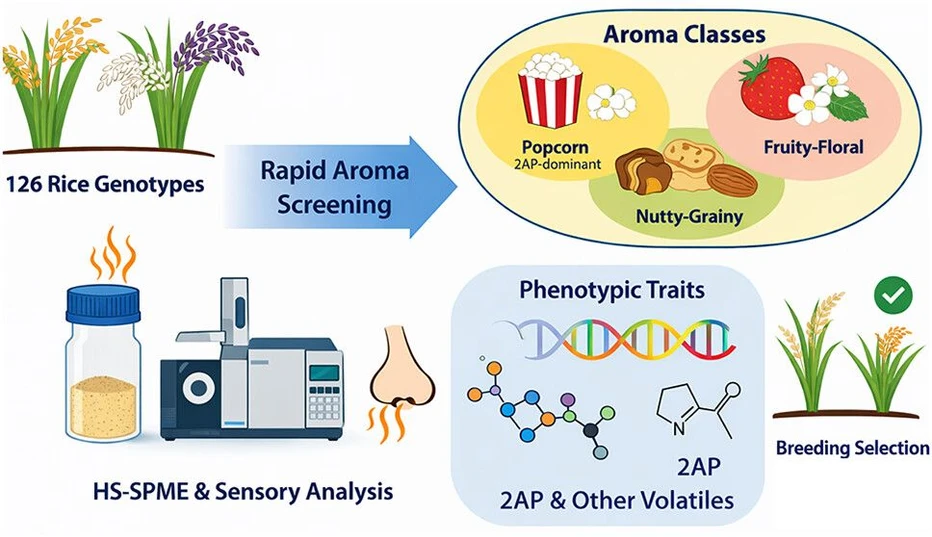
ACS Omega 2026: Graphical abstract
This study presents a rapid sensory phenotyping approach for screening rice aroma directly from paddy rice without milling or cooking. Combining sensory evaluation with HS-SPME-GC-MS/MS analysis of 164 volatile compounds enabled quantitative assessment of aroma intensity and characterization of aroma quality across 126 rice genotypes.
The results identified five distinct aroma classes, including popcorn, fruity-floral, nutty-grainy, woody-floral, and oxidation-related profiles. While 2-acetyl-1-pyrroline (2AP) remained a key contributor to popcorn aroma, several highly aromatic cultivars exhibited strong sensory characteristics driven by other volatile compounds. The method offers breeders an efficient tool for identifying rice cultivars with diverse and desirable aroma traits at early breeding stages.
The original article
Developing Quick Screening Method to Identify Rice Cultivars with Unique Aromatic Features
Heena Rani, Rahul Sen, Christian De Guzman, and Scott Lafontaine*
ACS Omega 2026
https://doi.org/10.1021/acsomega.6c02582
licensed under CC-BY 4.0
Selected sections from the article follow. Formats and hyperlinks were adapted from the original.
Rice (Oryza sativa L.) is one of the most important crops worldwide, serving as the primary food for over half of the global population. (1) In 2025, world rice production reached a record high of approximately 551 million tonnes, reflecting rice’s critical role in global food security (FAO 2025). Asia remains the largest producing and consuming region, but rice is also significant in the United States, both as a food and an agricultural commodity. The U.S. produces a smaller share of the world’s rice (roughly 2%) yet consistently ranks among the top exporters (USDA ERS 2025). Within the U.S., rice is economically vital in several states especially Arkansas, which is the nation’s leading rice producer. Arkansas alone accounted for about 49% of U.S. rice production in 2023, underlining the crop’s importance to both the regional economy and national food supply. (2)
Beyond agronomic performance, rice quality is defined by several traits, among which aroma has emerged as a dominant driver of consumer perception and preference. A growing body of recent literature reports that the aromatic profile of rice strongly influences consumer choice, market differentiation, and perceived eating quality. (3−5) Even small differences in aromatic composition can determine consumer acceptance or rejection of a rice cultivar, (3,6) elevating aroma from a secondary trait to a primary criterion distinguishing rice varieties in both domestic and global markets.
High-quality aromatic varieties, especially Basmati and Jasmine rice, often command price premiums in the marketplace due to their desirable aroma. Basmati rice, prized for its characteristic popcorn-like aroma, can retail at prices nearly twice those of conventional nonaromatic rice, illustrating the strong economic value associated with superior aroma. (7) However, reliance on traditional aromatic varieties is not universally viable. These cultivars evolved under specific photoperiod, climate, and agronomic conditions and are largely confined to production regions in Asia, (8) when grown outside their native environments, these cultivars frequently exhibit reduced yield, inconsistent aroma expression, or compromised grain quality. (9) Consequently, much of the growing U.S. demand for aromatic rice has historically been met through imports. To reduce dependence on imports and cater to local preferences, U.S. breeders have responded by developing locally adapted aromatic cultivars. Early efforts began with the release of “Della” in Louisiana in 1973, followed by improved derivatives such as “Dellrose” that retained aroma while improving agronomic performance. (10) Subsequent breeding efforts expanded aromatic rice production across the southern U.S., including the release of including jasmine-type releases in Texas (Jasmine 85). (11) California-developed basmati- and jasmine-type cultivars (e.g., A-201, (12) Calmati-201, (13) Calmati-202, (14) Calaroma-201 (15)), and a series of jasmine-style cultivars from the LSU AgCenter (“Jazzman,” (16) “Jazzman-2,” (17) and “CLJ01” (18)). More recently, Arkansas’s breeding program introduced “ARoma 22” a Jasmine-type aromatic long-grain cultivar adapted to the U.S. Mid-South environment. (19)
Despite these advances, domestically developed aromatic varieties often still fall short of matching the sensory quality and consistency of the best imported rice, limiting their competitiveness in the premium markets. As a result, breeding programs face increasing pressure to continually enhance aroma quality and diversify aromatic profiles. Progress toward this goal is constrained by a fundamental bottleneck: the lack of rapid, less labor-intensive phenotyping tools capable of capturing aroma intensity and quality across breeding populations at the early selection stages. Addressing this gap is essential for accelerating the identification and deployment of next-generation aromatic rice cultivars.
Current methods for evaluating rice aroma, however, present significant challenges in breeding context. A review of rice aroma literature conducted as part of this study shows that the majority of published sensory evaluations or aroma composition analysis rely on milled rice or cooked form using relatively large sample quantities (Table S1), reflecting an emphasis on end-point consumer acceptance rather than early generation screening suitability. (20) This prevailing focus introduces practical limitations for breeding applications. First, cooked-rice evaluations require prior milling (dehusking and polishing), adding an additional processing step that is often impractical or infeasible when seed quantities are limited as this process reduces measurable weights by 20–30% and standardized milling equipment is needed. Second, standardized cooking protocols demand relatively large grain quantities (Table S1), which are rarely available for early generation lines. Third, cooking-based sensory assessments are time and labor-intensive, limiting throughput. Finally, physiological constraints such as olfactory fatigue, (21) which reduce even trained panelists’ capacity to reliably evaluate several samples per session. (22)
At early stages of selection, breeders require a rapid yet informative screening tool that enables the identification of promising lines based on aroma presence, relative intensity, and general sensory character. Breeding programs have historically favored simple, low-cost assays that can be deployed across large populations, as exemplified by the long-standing use of the 1.7% KOH test. (23) However, the binary nature of this assay severely limits its ability to discriminate among genotypes differing in aroma intensity or qualitative profiles. The absence of rapid, small-sample screening approaches that combine high throughput with semiquantitative and descriptive sensory resolution represents a critical methodological gap. To address this gap, we developed a novel aroma phenotyping method that captures both aroma intensity and sensory character using only 1 g of ground paddy rice samples, eliminating the need for milling and significantly reducing sample preparation losses. Furthermore, the absence of cooking steps reduces both the processing time and labor, allowing rapid sample turnaround and increased throughput. The workflow relies on minimal sample preparation (grinding and controlled heating) and does not require specialized milling equipment, making it more accessible and scalable across breeding programs with varying resource availabilities. Collectively, these features enable efficient screening of large germplasm populations while preserving limited seed material, representing a substantial improvement over conventional cooked-rice evaluation methods.
Beyond methodological efficiency, this study also seeks to reframe how superior rice aromas are defined. Aromatic rice breeding has historically emphasized the popcorn-like note associated with 2-acetyl-1-pyrroline (2AP), yet rice aroma is inherently complex and arises from diverse volatile compounds spanning multiple chemical classes that contribute floral, nutty, grainy, woody, and other sensory attributes. (24) We hypothesize that high-aroma intensity and consumer appeal are not exclusively linked to the classic popcorn profile and that cultivars expressing alternative aromatic signatures may be equally or even more desirable. By integrating rapid sensory screening with descriptor-based evaluation and confirmatory HS-SPME-GC-MS analysis, this study aims to identify rice genotypes in which a strong aroma intensity is driven by distinct aromatic features beyond 2AP alone. These genotypes offer opportunities to expand aromatic diversity in breeding programs and highlight the need to define rice aroma based on integrated sensory and chemical attributes rather than relying on a single marker compound.
2. Materials and Methods
2.3. Extraction of Volatiles by HS-SPME
2.3.2. HS-SPME GC-MS/MS Quantitative Volatile Analysis
Targeted quantitative GC-MS/MS analysis was performed to characterize volatile profiles of paddy rice samples in duplicate, following the method described by Sen, Hope, Bell, and Lafontaine (26) with minor optimization. Analyses were conducted using a Shimadzu Nexis GC-2030 (Shimadzu, Japan) system equipped with a GCMS-TQ8050NX triple-quadruple mass selective detector and AOC-6000 plus autosampler (Shimadzu, Japan). Volatiles were separated on a 30 m × 0.25 mm × 0.25 μm HP-5MS UI Agilent J&W GC column. To optimize volatile absorption on the fiber various incubation temperatures, durations, and fiber exposure times were tested. Optimal conditions were identified when rice samples were incubated at 80 °C for 15 min with continuous agitation at 250 rpm, followed by solid phase micro extraction for 15 min using a divinylbenzene/carboxen/polydimethylsiloxane (DVB/CAR/PDMS) SPME fiber at 80 °C. Volatiles were then desorbed in the inlet at 240 °C for 3 min. Helium was used as the carrier gas at a flow rate of 1 mL/min, with a constant inlet pressure of 46.7 kPa. The GC oven temperature program was as follows: 35 °C (5 min), ramped to 100 °C at 5 °C min–1, then to 150 °C at 3 °C min–1, followed by 160 °C at 8 °C min–1, and finally to 250 °C at 25 °C min–1, with a final hold of 5 min, resulting in a total run time of 39.5 min.
3. Results and Discussion
3.1. Sensory Aroma Intensity Variation across Rice Genotype
Sensory aroma intensity was evaluated using a continuous linear scale (0 = no detectable aroma; 100 = extremely intense) (Table S4), enabling quantitative differentiation among genotypes with substantially higher resolution than binary classification approaches such as the traditional 1.7% KOH test. (23) This scale was selected because the study aimed to quantify aroma intensity rather than consumer preference, continuous scales provide greater sensitivity for detecting subtle differences among samples and facilitate integration with quantitative volatile data. A reference control cultivar, ARoma 22 (R127), was included in every evaluation session to serve as an internal benchmark and to monitor panel consistency across days. The inclusion of this control enabled bias adjustment and improved the reliability of comparisons across the 16-day evaluation period.
Across the evaluated panel (n = 126), substantial phenotypic diversity in perceived aroma expression was observed, with unadjusted aroma intensity values ranging from 24.2 to 67.0, representing an approximately 2.8-fold difference between the lowest and highest aroma intensity genotypes (Table S4; Figure 1). This wide phenotypic range indicates that the sensory method was sufficiently sensitive to discriminate among genotypes spanning weak to very strong aroma expression, supporting its utility for both forward selection of high-aroma lines and counter-selection against low-aroma backgrounds in breeding populations. Least-squares mean (LSMean) separation of unadjusted aroma intensity revealed clear and statistically significant differences among genotypes (p < 0.05; Table S4). ARoma 22 (R127) exhibited high-aroma intensity (LSMean = 61.7) and grouped within the highest LSD class (“A”), confirming its suitability as a high-aroma intensity control. Twenty-four genotypes were assigned to this top intensity class, while an additional 18 genotypes formed the next highest class (“B”), reflecting significantly lower but still elevated aroma intensity relative to the top group (p < 0.05). The remaining genotypes were distributed across progressively lower LSD classes corresponding to weak/moderate aroma expressions. Overall, approximately 33% of the evaluated genotypes fell within the top two aroma intensity classes, indicating that substantial genetic diversity for strong aroma expression exists beyond the limited set of commercially available aromatic cultivars.
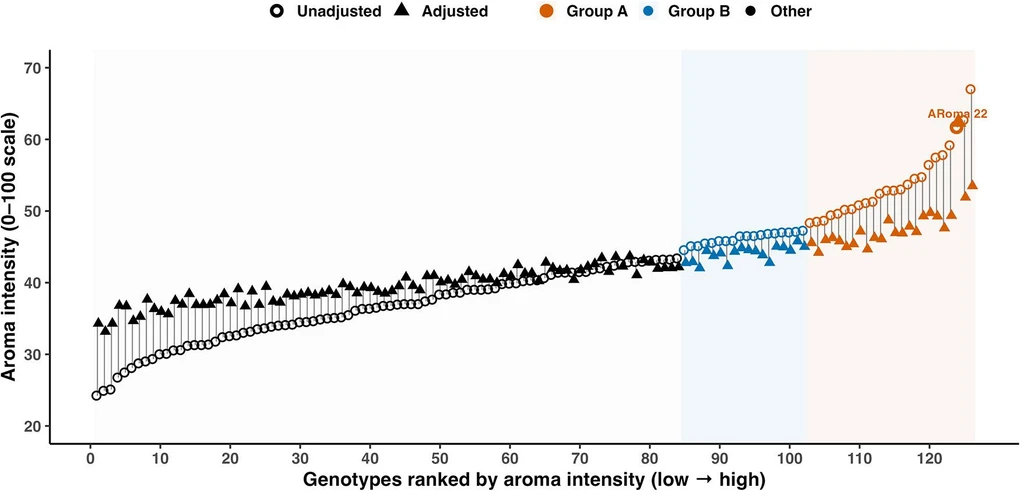 ACS Omega 2026: Figure 1. Comparison of unadjusted and bias-adjusted aroma intensity across rice genotypes.
To reduce experimental noise inherent to sensory testing, aroma intensity values were bias-adjusted by using a linear mixed-effects model with day and panelist included as random effects. Bias-adjusted aroma intensity values ranged from 33.2 to 62.4 (Figure 1), representing a modest compression of the range relative to unadjusted values. Importantly, bias adjustment had minimal impact on genotype ranking as unadjusted and bias-adjusted aroma intensity values were strongly correlated (Pearson r = 0.96, p < 0.001). This result indicates that bias adjustment primarily improved measurement precision rather than altering conclusions regarding genotype performance while also validating the internal consistency of the sensory panel. As bias-adjusted values provide more accurate effect-size estimates for breeding value prediction, they were used for all subsequent multivariate and correlation analyses.
3.4.2. Cluster II: Fruity-Floral Genotypes Dominated by Esters and Alcohols
Cluster II was characterized by the highest mean intensities for fruity and floral sensory attributes among all clusters, distinguishing it clearly from the popcorn-dominant cluster I. Three genotypes within this cluster R31, R42, and R7 ranked among the top 20 for overall aroma intensity despite lacking the characteristic popcorn aroma (Figure 3). This finding challenges the current assumption that high-aroma intensity in rice is synonymous with popcorn character and demonstrates that alternative sensory profiles driven by different chemical compositions can achieve an equally strong overall aroma perception.
The fruity-floral sensory profile of cluster II genotypes corresponded with elevated concentrations of volatile esters and alcohols commonly associated with pleasant fruit and floral notes across diverse food systems. Some of these compounds may also originate from outer grain tissues, which have been shown to contain diverse odor-active compounds including lactones and alcohols. (37) Genotype R31, which ranked third in overall aroma intensity, exhibited exceptionally high levels of short- and medium-chain fatty acid ethyl esters, specifically ethyl hexanoate (0.204 ppm) and ethyl octanoate (0.032 ppm) (Table S5 and Figure 4). These esters are known to possess low odor thresholds (44) and are known to impart sweet, fruity, pineapple, and banana-like notes. (45) In addition to esters, R31 showed elevated concentrations of primary alcohols, including 1-hexanol (6.67 ppm) and 1-pentanol (1.605 ppm), alcohols associated with fresh, green, and fruity nuances. These compounds might be acting synergistically with ketones such as 2-pentanone (0.059 ppm) and 2-heptanone (0.155 ppm) to enhance overall fruity perception. (45) R31 also contained markedly higher levels of 2-pentylfuran (0.349 ppm), a compound previously reported to contribute floral, fruity, nutty, and caramel-like notes in rice (Hinge et al., 2016). 2-Pentylfuran is formed through thermal degradation and oxidation of lipids and has been identified as an important biomarker for the aroma of cooked rice. Additionally, heptanal, which has been associated with sweet, fresh, and penetrating fruity-like aromas in rice, was present at elevated levels in both R31 and R42 (0.039 ppm) compared with the other genotypes evaluated. (45,46) Interestingly, even genotypes with comparatively lower overall aroma intensity, such as R71, were perceived as strongly fruity, likely driven by high concentrations of specific esters including ethyl 2-butenoate and methyl hexanoate (Figure S3). Similarly, genotypes R72, R73, and R74, which also exhibited strong fruity perception, were characterized by elevated ester abundance relative to other chemical classes (Figure S3).
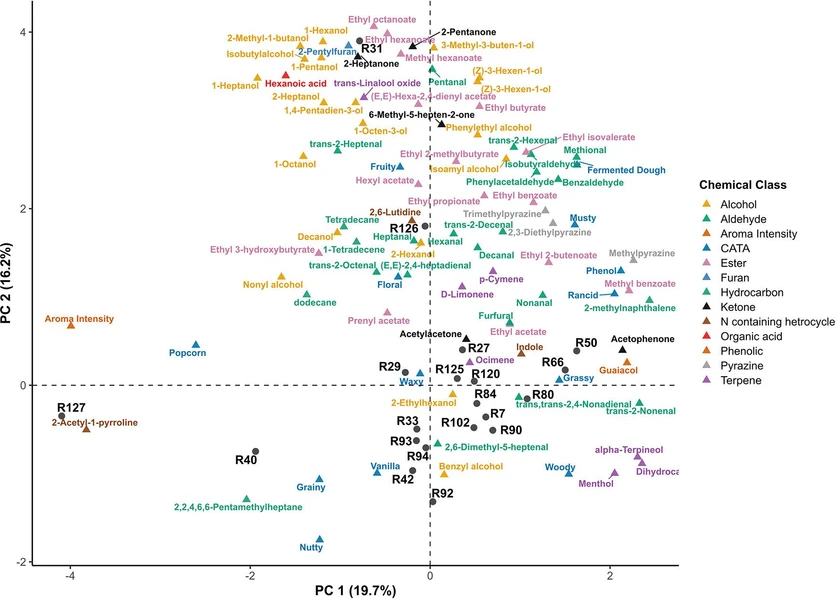 ACS Omega 2026: Figure 4. Multiple factor analysis (MFA) of the top 20 rice genotypes with the highest overall aroma intensity, integrating sensory aroma attributes and volatile compound data.
Within cluster II, two genotypes (R110 and R57) exhibited the highest floral intensity among all evaluated genotypes. Floral perception in these genotypes is likely associated with elevated levels of 2-ethylhexanol, a compound known for its sweet, citrus-like, oily, and fresh floral aroma. (47) Genotype R110 contained the highest concentration of 2-ethylhexanol observed in the entire panel (0.168 ppm), while R57 also contained this compound at levels (0.117 ppm) within its reported odor threshold range (0.075–0.138 ppm). (48) The presence of 2-ethylhexanol at these concentrations likely contributed substantially to the pronounced floral perception in these genotypes. In raw milled rice, the concentration of 2-ethylhexanol had been reported to be approximately 26–32 ppb, (47) whereas in the present study concentrations ranged from 17 to 168 ppb across the panel. This broader range and higher maximum concentration suggest that, in addition to endosperm-derived sources, contributions from outer grain tissues (e.g., hull or bran) may influence 2-ethylhexanol abundance, warranting further investigation into its biochemical origin, stability across environments, and potential suitability as a target trait in rice aroma-focused breeding programs.
4. Conclusions and Practical Implications
The phenotyping approach developed in this study enables the direct evaluation of rice aroma from paddy grain, eliminating the need for milling and cooking while requiring minimal sample quantities. This allows simultaneous assessment of aroma intensity and qualitative attributes, providing a practical alternative to conventional cooked-grain sensory evaluations and binary screening methods. By shifting from binary classification to relative ranking of aroma intensity and descriptor profiles, the framework supports more informed selection decisions in breeding programs, enabling prioritization of lines with desirable sensory characteristics while excluding those dominated by off-aromas.
A key advantage of this approach is its adaptability across breeding programs with different levels of infrastructure. In low-resource settings, it can be applied as a sensory-based, high-throughput screening tool for early generation materials. In contrast, programs with analytical capacity can incorporate targeted volatile profiling to resolve the chemical basis of the aroma variation. In addition, the use of whole paddy rice provides a diagnostic advantage by capturing volatile contributions from the outer grain layers. The observed association between lipid oxidation-derived aldehydes and rancid, phenolic, or musty attributes suggests that this approach may enable early identification of genotypes prone to rapid quality deterioration with implications for storage stability and end-use quality.
Application of this framework across a genetically diverse rice panel demonstrated that aromatic expression is not governed by a single chemical determinant. While 2AP remains a key contributor to classical popcorn aroma, several genotypes exhibited strong and desirable aroma profiles in the absence of elevated 2AP levels, supported instead by distinct combinations of esters, alcohols, indole, α-diketone, and other related volatiles. These findings challenge the long-standing reliance on 2AP as the primary selection target in aromatic rice breeding and highlight alternative biochemical routes to high-quality aroma expression
Despite their various advantages, several limitations should be considered. The sensory evaluation was conducted using a trained panel and a descriptive intensity-based approach, which enables sensitive discrimination among genotypes but does not directly reflect the consumer preference. In addition, aroma was assessed from heated ground paddy rice rather than cooked, milled rice and therefore represents a screening proxy rather than a direct measure of eating quality. Furthermore, because whole paddy rice was used, the resulting volatile profiles reflect combined contributions from husk, bran, and endosperm, which may differ from the aroma profile of edible milled rice. Accordingly, this method should be considered a rapid screening tool, and advanced selections require validation under conventional cooking conditions and consumer-based evaluation. Additionally, future work should focus on genetic mapping of non-2AP aroma drivers, evaluation of their stability across environments and postharvest conditions, and integration with consumer preference studies. Overall, this framework provides a foundation for developing next-generation aromatic rice cultivars with an improved sensory diversity and commercial relevance.