The Plant of Many Scents: Unraveling the Odorant Composition of Selected CBD Hemp Cultivars
J. Agric. Food Chem. 2025, 73, 38, 24314–24325: Graphical abstract
This study provides the first comprehensive sensory-guided analysis of odor-active compounds in dried hemp (Cannabis sativa L.) flowers. Using gas chromatography-olfactometry (GC-O) with aroma extract dilution analysis (AEDA), researchers identified 52 odorants across six CBD-rich cultivars. Of these, 38 compounds were detected in dried hemp for the first time, and six had never been reported in any hemp material.
Terpenes such as α-pinene, myrcene, and linalool consistently exhibited high flavor dilution (FD) factors, indicating significant sensory impact beyond their known abundance. Potent sulfur-containing compounds—including 3-methylbut-2-ene-1-thiol and 4-methyl-4-sulfanylpentan-2-one—were identified at high FD levels for the first time in dried hemp, confirming their strong aromatic relevance. Additional impactful odorants such as p-cresol, eugenol, methyl anthranilate, Furaneol, and sotolon contributed to distinct cultivar-specific scent signatures. These results establish foundational knowledge of hemp’s odorant composition and support future quantitative and reconstitution studies.
The original article
The Plant of Many Scents: Unraveling the Odorant Composition of Selected CBD Hemp Cultivars
Thi Khanh Linh Tran, Tatiana Avellaneda, Amandine André, Elodie Gillich, Martin Steinhaus, Dániel Árpád Carrera, Leron Katsir, and Irene Chetschik*
J. Agric. Food Chem. 2025, 73, 38, 24314–24325
https://doi.org/10.1021/acs.jafc.5c07208
licensed under CC-BY 4.0
Selected sections from the article follow. Formats and hyperlinks were adapted from the original.
Hemp (Cannabis sativa L.) belongs to the Cannabaceae family, which includes other aromatic plants such as hops (Humulus lupulus L.). (1) Hemp is rich in phytochemicals, including phytocannabinoids such as tetrahydrocannabinol (THC) and cannabidiol (CBD), as well as terpenoids, flavonoids, and sterols, all of which contribute to its biological activity and sensory properties. (2) Traditionally, hemp was cultivated primarily for textiles and food sources due to the rich fiber content of its stems and the high oil content in its seeds. (3,4) The inflorescence of hemp gained attention as a source of the nonpsychoactive CBD only in recent decades. The legal definition of hemp varies by country and is rooted in the context of historical prohibition. For instance, in the United States, hemp is legally defined as Cannabis sativa containing less than 0.3% THC by weight, (5) whereas in Switzerland, hemp is classified with a maximum allowable THC content of 1% by weight. (6) Due to global prohibition and regulatory restrictions throughout the 20th century, (7) scientific exploration of hemp has been limited. In recent years, however, the expanding legalization of medicinal and recreational cannabis has renewed interest in hemp - particularly in its characteristic aroma - and has prompted more detailed studies into the volatile compounds that shape its sensory characteristics.
Aroma, rather than cannabinoids such as CBD or THC, has been shown to be the strongest predictor of consumer appeal in cannabis, highlighting its importance in perceived product quality. (8) Consequently, aroma is increasingly prioritized as a key selection trait by breeders of both high-THC and CBD-dominant hemp cultivars. Terpenes have long been associated with the aroma of hemp, exhibiting similar volatile profiles to hops. (4) However, recent research (9−11) suggests that compounds from other substance classes such as sulfur-containing compounds – as well as lipid degradation products, methoxypyrazines and esters also play a crucial role in shaping the aroma of cannabis. A gas chromatography-olfactometry (GC-O) analysis on different cultivars of fresh fiber-type hemp flowers revealed 33 odor-active compounds, which includes not only terpenes but also other substance classes: lipid degradation products, methoxypyrazines, esters and sulfur-containing compounds such as 3-methylbut-2-ene-1-thiol and 4-methyl-4-sulfanylpentan-2-one. (12) The presence of two latter compounds was subsequently confirmed in cannabis rosin extracts (9) using comprehensive two-dimensional gas chromatography (GC × GC) analysis. This study further suggested the existence of additional prenylated volatile sulfur compounds, which were assumed as important for the characteristic sulfurous odor of cannabis rosin extract obtained from mechanically separated trichomes. In a follow-up investigation, the same group reported various esters, anthranilates, indoles, and thiols, further emphasizing the complexity of cannabis volatile fraction. (9,10) However, the true impact of these detected volatiles on the overall cannabis aroma has not yet been investigated.
Due to the fact that only a small fraction of volatiles contribute to a product’s overall aroma, sensory-guided methods such as GC-O combined with aroma extract dilution analysis (AEDA) (13,14) is essential in determining the relevance of volatile compounds in hemp. This approach integrates analytical techniques with human odor perception and has been extensively applied to identify key aroma compounds in various food raw materials and spices. (15−17) AEDA analysis is performed by stepwise dilution of the volatile fraction and evaluating each dilution by GC-O, until no odorant is perceivable at the sniffing port. The flavor dilution (FD) factor refers to the highest dilution at which the compound can be smelled, revealing the first insight into the contribution of the odorant to the overall aroma impression. By means of this methodology, it was proven that only a small fraction of the volatiles contributes to the overall aroma perception of foods and food raw materials. (18) For example for hops, the GC-O AEDA revealed that only 23 volatile compounds are odor-active in the FD factor range of 16–1024. (19)
However, application of GC-O in combination with AEDA has not been applied to dried hemp flowers and products thereof. To date, only odor-active compounds in fresh hemp flower (12) and high-THC cannabis flowers (20) were assessed by GC-O, leaving the odor-active constituents of dried flowers largely unexplored. In addition, mostly THC-containing materials such as rosin extracts and flowers have been previously analyzed, leaving hemp underexplored in terms of their volatile composition and the characterization of the most important contributors to the overall scent of dried cannabis flowers.
To address the aforementioned gaps, this study aimed to investigate the key odorant composition of dried hemp flowers - selectively bred for enriched CBD content and appealing aroma - using gas chromatography-olfactometry (GC-O) combined with aroma extract dilution analysis (AEDA). Terpene quantitation was additionally performed to provide a preliminary comparison with AEDA results. This represents the first application of AEDA to cannabis, which sought to identify the important molecular drivers, beyond terpenes and terpenoids, underlying the distinct aroma characteristics of different dried hemp cultivars and to gain the first insights into their contribution to the overall odor perception.
Materials and Methods
Gas Chromatography-Olfactometry (GC-O) and Aroma Extraction Dilution Analysis (AEDA)
To screen for key odorants, 10 g of dried hemp flowers were frozen with liquid nitrogen and ground finely prior to being weighed into 250 mL Erlenmeyer flasks. All ground hemp flowers were extracted with 150 mL diethyl ether by vigorous stirring with a magnetic stirrer (IKA-Werke GmbH & Co. KG, Staufen, Germany) at room temperature (20 ± 2 °C) for 3 h. During extraction, the flasks were sealed with stoppers and covered with aluminum foil. After extraction, the diethyl ether phase was filtered through filter paper (185 mm, Whatman, Germany), then directly subjected to solvent-assisted flavor evaporation (SAFE) with instrumental settings as previously described. (15) The thawed distillates were dehydrated using anhydrous sodium sulfate, concentrated on a Vigreux column to 5 mL, and then reduced to a final volume of 300 μL under a gentle stream of nitrogen.
The GC-O system was described in a previous study. (15) The AEDA was performed in the same manner and using the same parameters as described previously. (15) Sample distillates were diluted stepwise in diethyl ether from 1:2 up to 1:1024, then subjected to GC-O for evaluation. The original extract was evaluated by three trained panelists, and one trained panelist subsequently carried out the AEDA dilutions.
Compound Identification by Heart-Cut Two-Dimensional Gas Chromatography with High-Resolution Mass Spectrometry (GC-GC-HRMS)
The identification of 3-methylbut-2-ene-1-thiol (3MBT), 4-methyl-4-sulfanylpentan-2-one (4MSP), 3-sulfanylhexyl acetate (3SHA), 3-sulfanylhexan-1-ol (3SH) and isoborneol was performed by heart-cut two-dimensional gas chromatography with high-resolution mass spectrometry (GC-GC-HRMS). The system consisted of a Trace 1310 gas chromatograph (Thermo Fisher Scientific) equipped with a TriPlus RSH autosampler, a programmed temperature vaporizing (PTV) injector, an FID (250 °C base temperature), and a custom-made sniffing port with a base temperature of 230 °C. (21) The separation was achieved using a DB-FFAP capillary column (30 m × 0.25 mm i.d., 0.25 μm film thickness; Agilent) with helium as the carrier gas at a constant flow rate of 1.0 mL/min. The injection volume was 1 μL. The initial oven temperature was set at 40 °C and hold for 2 min, followed by a temperature ramp of 6 °C/min to 230 °C, which was held for 5 min. The end of the column was connected to a Deans switch (Trajan; Ringwood, Australia) used for heartcutting. Depending on the programmed timing, analytes were directed via deactivated fused silica capillaries (0.1 mm i.d.) either simultaneously to the FID and the sniffing port or to a second GC column (DB-1701 column, 30 m × 0.25 mm i.d., 0.25 μm film thickness; Agilent) in a second Trace 1310 GC system. Transfer to the secondary system occurred through a heated hose (250 °C) and a liquid nitrogen-cooled trap for analyte reconcentration. The second GC oven operated under the same initial conditions (40 °C, 2 min hold), followed by a temperature ramp of 6 °C/min to 240 °C, with a final hold of 5 min. The outlet of the second column was interfaced with a Q Exactive GC orbitrap mass spectrometer (Thermo Fisher Scientific), operated in the high-resolution EI mode over a scan range of m/z 35–250. Data acquisition and analysis were performed using Xcalibur software (Thermo Fisher Scientific). Detailed information on the identified compounds can be found in the Supporting Information (Table S3).
Compound Identification by Gas Chromatography with Mass Spectrometry (GC-MS) and Two-Dimensional Gas Chromatography with Mass Spectrometry (GC-GC-MS)
The identification of Furaneol was done with two-dimensional gas chromatography with mass spectrometry (GC-GC-MS), and that of other compounds was done with a gas chromatograph with mass spectrometry (GC-MS). The instrumental setting for both were described in a previous study, (15) except for the mass spectrometer of GC-MS was operated with a scan range of m/z 35–250, while GC-GC-MS was operated in selected ion monitoring mode with individual quantifier ions of each target compound.
Quantitation of Terpenes and Terpenoids in Dried Hemp Flowers by Gas Chromatography with Flame Ionization Detection (GC-FID)
Given the expected abundance of terpenes and terpenoids in the hemp samples based on AEDA results (Table 1), the quantity of major terpenes and terpenoids was analyzed by a Gas Chromatography (GC) system (Thermo Trace GC Ultra, Brechbühler, Schlieren, Switzerland) with Flame Ionization Detection (FID). Ground dried hemp flower (1 g) was weighed into a plastic centrifuge tube (15 mL), followed by an addition of 6 mL diethyl ether, and 3 mL ultrapure water. Methyl nonanoate (1202 μg) was added as an internal standard corresponding to the expected terpene content. Extraction was performed for 2 h using an overhead shaker, followed by centrifugation at 4000 rpm (3220 g) for 15 min (Eppendorf, Hamburg, Germany). The resulting supernatant was utilized for subsequent quantitation with the GC-FID system, comprising a GC Trace Ultra (Thermo Fisher Scientific, Brechbühler, Schlieren, Switzerland) and a DB-FFAP capillary column (length 30 m, diameter 0.32 mm, film 1 μm) (Agilent Technologies Inc., Basel, Switzerland). The injection volume was 1 μL with a split flow at 50 mL/min and a split ratio of 1:18. The temperature program started at 40 °C and the temperature was held for 3 min, then increased by 8 °C/min to 240 °C and finally held constant for 10 min. Helium was used as carrier gas at a constant flow of 2.8 mL/min. For calibration, three different concentrations of target terpenes and terpenoids were each prepared in diethyl ether and added with the same amount of methyl nonanoate (1202 μg) as in the samples. All calibration solutions were then subjected to GC-FID analysis as mentioned in the instrumental setting. The Supporting Information provides details on the linear regressions used for quantitation. (Table S2)
Results and Discussion
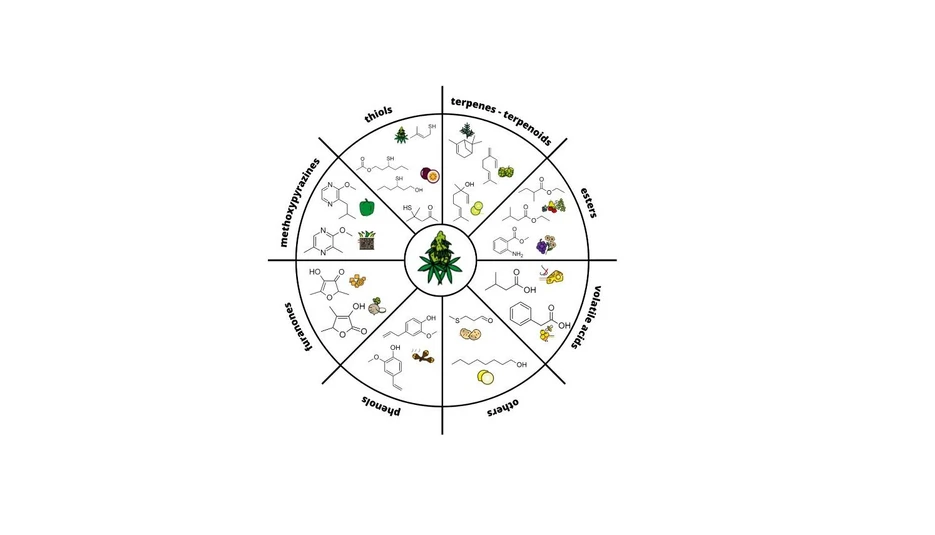
This study represents the first application of GC-O in combination with AEDA on dried hemp flowers from different cultivars. The result revealed a total of 52 odor-active compounds (Table 1) from various chemical classes as presented in Figure 1. Although many of the compounds identified in this study have been reported before in other hemp and nonhemp materials, (9,12,22,23) their occurrence as odor-active constituents in dried hemp flowers was reported here for the first time. The distribution of FD factors of each compound across the different samples is visualized in Principal Component Analysis (Figure 3). Beyond terpenes, terpenoids and thiols, compounds such as 2- and 3-methylbutanoic acid, methyl anthranilate, eugenol and 3-hydroxy-4,5-dimethylfuran-2(5H)-one (sotolon) were detected in all cultivars, albeit with varying FD factors. Their occurrence suggests their integral role to the overall odorant profiles of hemp flowers.
 J. Agric. Food Chem. 2025, 73, 38, 24314–24325: Figure 1. Odor-active compounds of dried hemp flowers, with an FD factor ≥ 128 in at least one of the six analyzed cultivars.
 J. Agric. Food Chem. 2025, 73, 38, 24314–24325: Figure 3. Principal component analysis of odor-active compounds in dried hemp flowers. Odor attributes corresponding to each compound are provided in Table 1.
Discovery of Odor-Active Furanones in Hemp
The identification of furaneol (4-hydroxy-2,5-dimethylfuran-3(2H)-one) and sotolon (3-hydroxy-4,5-dimethylfuran-2(5H)-one) in dried hemp flowers significantly broadens the known hemp odorant profile, introducing caramel-like and seasoning nuances that have been only partially reported in fresh hemp (12) or rosin extracts. (10) This study provides the first confirmation of Furaneol and sotolon as odor-active compounds in dried hemp flowers, indicating a relatively high impact on the overall odor properties of these compounds in some cultivars based on their FD factors. Furaneol was detected exclusively in PG074, PG075.1 (Figure 4) and PG076 cultivars, with FD factors ranging from 128 to 1024, demonstrating a cultivar-dependent expression. The highest FD factor was observed in indoor-cultivated PG075.1 (FD 1024), followed by outdoor-cultivated PG074 (FD 128) and PG076 (FD 128). Furaneol is widely recognized as a key aroma compound in fruits such as strawberries (50,51) and mangoes, (30) contributing to ripe, cooked fruit, and caramel-like nuances. The formation of Furaneol occurs via both enzymatic and nonenzymatic pathways, primarily through sugar degradation via Maillard reactions and quinone oxidoreductase (FaQR)-mediated enzymatic conversion as in strawberries. (52) Hence, its exclusive presence in PG074 and PG075.1 and PG076 hemp cultivars further supports the hypothesis that a similar enzymatic mechanism may be active in certain hemp cultivars, subsequently enhancing the fruity-like odor impression of these cultivars. Furaneol was previously identified in hops (31) with caramel-like aroma characteristics. While both hops and hemp belong to the Cannabaceae family, their furaneol content may differ based on genetic and environmental factors, with drying and enzymatic activity likely contributing to its higher odor impact in selected hemp cultivars. Furthermore, the absence of furaneol in fresh hemp and its presence in dried flowers supports the assumption that drying may enhance its formation.
 J. Agric. Food Chem. 2025, 73, 38, 24314–24325: Figure 4. Detection of furaneol in PG074 cultivar via GC-GC-MS analysis: (A.1) Retention time and (A.2) mass spectrum (m/z 128) of furaneol reference standard; (B.1) Peak in the chromatogram and (B.2) mass spectrum matching furaneol (m/z 128) in the hemp cultivar extract.
Similarly, sotolon, which was first detected in fresh hemp flowers, (12) has now been confirmed in dried hemp samples. Sotolon was found in all dried cannabis cultivars, exhibiting the highest FD factor (FD 512) in PG074. The presence of sotolon in dried hemp might also be linked to its formation via the Maillard reaction. Its previous identification in hops (31) supports its broader relevance in plant-derived aromatic matrices.
Molecular Composition of the Scent of the Analyzed Hemp Flowers
As a complementary visualization of odor-active compounds distribution across cultivars, Principal Component Analysis (Figure 3) was performed based on FD factors obtained through AEDA, highlighting differences in sensory profiles and the molecular compositions between cultivars. The first two principal components (PC1 and PC2) explained 29.4% and 22.9% of the total variance, respectively. PG074 and PG075.1 are grouped together in the lower right quadrant, being associated with fruity and tropical-smelling odorants such as esters, acids, Furaneol, and thiols, reflecting their strawberry-like aroma. PG071 and PG073 were also nearby fruity esters, but PG071 associated more closely with other sweaty-smelling odorants like 3-methylbutanoic acid and butanoic acid. Meanwhile, PG073 aligns more with β-caryophyllene, skatole, and linalool, reflecting earthy, herbal, and slightly sweet characteristics. PG076 clustered separately, driven by citrusy and terpene-like compounds such as β-pinene and α-humulene. PG072 was positioned in the upper left region and associated with compounds like p-cresol, and 2-methoxyphenol, suggesting its turpentine-like and spicy description.
In summary, the present study provides the first comprehensive sensory-guided investigation into the composition of the odor-active compounds of dried hemp flowers, revealing the intricate interplay between terpenes, esters, sulfur compounds, and previously underexplored odorants such as phenolic compounds, volatile acids, and furanones. Through AEDA analysis, 52 odor-active compounds have been identified. There are 38 odorants that had not been reported in dried hemp flowers before and six that were identified in hemp material for the first time. The presence of these new odor-active components further supports the idea that certain odorants may be formed or released during drying and curing. Future research is needed to explore how enzymatic or oxidative pathways contribute to these transformations. The findings of the study underline the importance of the use of sensory-guided techniques such as the GC-O in combination with AEDA as an unequivocal step to understanding odor impressions on a molecular level. To fully understand the contribution of these odor-active odorants, future studies need to be performed with the aim to quantitate these key odorants by stable isotope dilution assays (SIDA) to accurately determine their dose-over-threshold (DoT) values. Furthermore, reconstitution and omission studies will be necessary to assess the precise impact of individual compounds and their synergies in the hemp aroma space. Ultimately, these insights lay the groundwork for breeding strategies aimed at enhancing specific aroma attributes in hemp cultivars. By deepening the knowledge of cannabis secondary metabolism, targeted breeding efforts could optimize the production of desirable odorant compounds, catering to distinct market preferences in food, fragrance, and cannabis-based consumer products.