Mapping Metabolomic Relationships of Hop Cultivars in an Ancestral Lineage Context
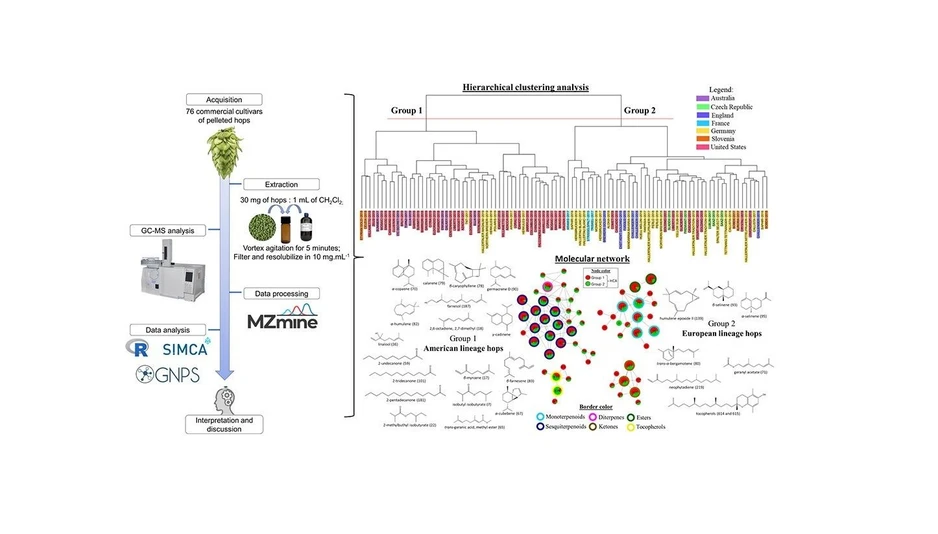
ACS Omega 2025, 10, 40, 47281–47291: Graphical abstract
Hops (Humulus lupulus) are essential for brewing due to their resins and aromatic oils. In this study, the chemical profiles of 76 commercial hop cultivars were analyzed using GC–MS and metabolomic approaches to explore their ancestral relationships. Unsupervised statistical analyses revealed distinct clustering between North American and European lineages.
Molecular networking enabled the annotation of 26 metabolites that distinguished the two groups. American hops were characterized by mono- and sesquiterpenoids, ketones, and esters, while European varieties showed higher abundances of selinenes, trans-α-bergamotene, humulene epoxide II, neophytadiene, and tocopherols. These results establish metabolomic signatures as reliable markers for hop cultivar differentiation and enhance understanding of their chemical diversity and lineage-based classification.
The original article
Mapping Metabolomic Relationships of Hop Cultivars in an Ancestral Lineage Context
Guilherme Silva Dias, Marília Elias Gallon, Leonardo Gobbo-Neto*
ACS Omega 2025, 10, 40, 47281–47291
https://doi.org/10.1021/acsomega.5c06162
licensed under CC-BY 4.0
Selected sections from the article follow. Formats and hyperlinks were adapted from the original.
Highly valued in the global brewing industry, hops are perennial, dioecious, herbaceous, liana-like plants that belong to the Rosales order and to the Cannabaceae family. (1,2) The genus Humulus, which consists of three species─Humulus lupulus L. (H. lupulus, common hops), Humulus japonicus Siebold & Zucc., and Humulus yunnanensis Hu─ is believed to have originated in China, although wild populations of H. lupulus are known to be widely distributed across the Northern Hemisphere. (3,4) Accordingly, the history of hops along with their domestication and use in brewing remains surrounded by uncertainties. (1,4,5)
Humulus lupulus is the most economically and culturally significant species within the genus, having been used in beer production for centuries. (3) Initial hop cultivars were derived through the selective breeding of wild European populations. (6,7) A general agreement posits that North American and European wild varieties diverged from a common ancestor more than a million years ago. (4,8) Currently, five geographically and morphologically distinct botanical varieties of H. lupulus are recognized: var. humulus (Europe and Asia), var. cordifolius (East Asia, particularly Japan), var. neomexicanus (southwestern North America), var. pubescens (eastern and north-central USA), and var. lupuloides (northeastern North America and Canada). (5,9) Over time, cultivar development has evolved from open-pollinated crosses to controlled hybridization, incorporating North American germplasm and thus broadening the genetic base. (7)
The importance of hop cultivation is highlighted by global production, which ranges from 80,000 to 130,000 tons annually, with Germany and the United States being the world’s largest producers. (10,11) The increasing demand for aromatic hops, driven by the American craft beer revolution dating back to the 1980s, has accelerated the development of new cultivars. Currently, approximately 300 commercial cultivars are available in the brewing market. (12−14) Beyond imparting bitterness, flavor, and aroma, hops also exhibit antimicrobial and antioxidant properties, playing a crucial role in the organoleptic stability of beer. (15−17)
The main compounds in hops that are valuable for beer production are biosynthesized and accumulated in the inflorescences (strobiles, also referred as cones) of female plants, specifically in the glandular trichomes (lupulin glands) located at the bases of the bracteoles of the cones. (2,3) The resins contain compounds and precursors that contribute to the bitterness of beer (e.g., α-acids and β-acids), while the essential oils are the main contributors to the aromatic profile, especially in beer styles that emphasize hop character. (18) The amount of essential oils in hops can range from 0.5 to 4.0% of the dry cone weight and is primarily composed of terpenes (up to 90% of the essential oil), aliphatic hydrocarbons, oxygenated compounds (such as terpenoid, ester, ketone, alcohol, carboxylic acid, aldehyde, and epoxide derivatives), and organosulfur compounds. (19−21)
Analytical approaches such as gas chromatography coupled to mass spectrometry (GC-MS), liquid chromatography coupled to ultraviolet detectors and/or mass spectrometry (LC-UV-MS), and nuclear magnetic resonance (NMR) have been widely employed for hop characterization. (22−26) For aroma profiling and quality control, GC-MS techniques are employed to analyze volatile compounds, whereas LC-UV-MS techniques are used to characterize bitter acids, polyphenols, and flavonoids. (22) Volatile and semivolatile metabolites in hops are largely determined by genetic factors and, therefore, define characteristic phytochemical profiles for each hop cultivar. (2,27−29) In this regard, a comprehensive GC-MS approach encompassing a wide variety of metabolites is essential for capturing lineage-associated differences in metabolite composition that may be overlooked by traditional workflows focusing solely on volatile compounds. (21,30)
Metabolomic approaches are powerful tools for investigating the chemotaxonomic diversity, including that of hop cultivars from various geographical origins. (26,31−33) Despite the commercial significance of hop cultivars, comprehensive studies utilizing metabolomic techniques to analyze a broad spectrum of commercial varieties remain scarce. Given that beer quality is intrinsically linked to the chemical composition of its raw materials and ingredients (malted barley, hops, yeast, and water), comprehensive analyses of hop metabolites are helpful in selecting the best varieties to produce beers with desirable flavor profiles, balanced bitterness, and optimal aroma intensity. In this context, such metabolomic knowledge may provide valuable support for the brewing industry in cultivar selection, quality standardization, and product development. In this study, 76 hop cultivars, marketed in a pelletized form, were analyzed by using GC-MS metabolomic profiling. The resulting data were subjected to multivariate statistical analyses and molecular network techniques to identify chemotaxonomic patterns linked to the cultivars’ geographical origins. These findings provided novel insights into the chemical diversity of hops and offered frameworks for mapping relationships among cultivars based on their metabolomic signatures.
Methods
Extract Preparation and GC-MS Analysis
The methodologies used for extract preparation and the GC-MS analytical conditions were the same as those previously employed by our research group. (74) Blank samples (dichloromethane) and hydrocarbon standard solution (C8–C40, Supelco, Sigma-Aldrich, St. Louis, MO, USA) were also injected during the chromatographic analysis.
Analyses were conducted using a gas chromatograph coupled to a quadrupole mass spectrometer (QP2010 Ultra, Shimadzu Corporation, Kyoto, Japan). The chromatograms and mass spectra were visualized using GC Solutions software (version 4.20 for Windows, Shimadzu Corp., Kyoto, Japan).
Results and Discussion
Exploring the Hop Chemical Content
To explore variations in the chemical profiles of hops based on the clustering patterns observed in the HCA, a molecular network was generated using the same GC-MS data (Figure S2, Supporting Information). Each node in the network represents a detected metabolite, which are arranged into clusters according to their MS spectral similarities. This approach enabled the annotation of key metabolites responsible for differentiation between the two main groups observed in the dendrogram.
The clusters containing the major annotated metabolites are shown in Figure 4. The largest cluster is primarily composed of sesquiterpenoids (dark blue border), one diterpenoid (pink border), and several unidentified metabolites. Other clusters are composed of monoterpenoids (light blue border), aliphatic esters (green border), ketones (brown border), and tocopherols (yellow border).
 ACS Omega 2025, 10, 40, 47281–47291: Figure 4. Clusters containing annotated metabolites selected from the molecular network. The numerical labels inside the nodes indicate the respective identification numbers (node IDs). The nodes are colored according to the groups obtained from the unsupervised hierarchical cluster analysis (HCA), and the border colors correspond to the metabolite classes.
Twenty-six metabolites were annotated in level 2 of confidence according to the minimum reporting standards for chemical analysis (Table 1). (65,66) The group 1 of the HCA dendrogram, composed predominantly of North American hops and their descendants, was characterized by a higher abundance of monoterpenoids, sesquiterpenoids, aliphatic esters, and methyl ketones, annotated as β-myrcene (17), 2,6-octadiene, 2,7-dimethyl (18), trans-geranic acid, methyl ester (65), linalool (36), calarene (79), α-cubebene (67), α-copaene (70), β-caryophyllene (78), α-humulene (82), β-farnesene (83), germacrene D (90), γ-cadinene (110), farnesol (187), isobutyl isobutyrate (7), 2-methylbutyl isobutyrate (22), 2-undecanone (59), 2-tridecanone (101), and 2-pentadecanone (181). The group 2, consisting of European hops and their descendants, was distinguished by higher prevalence of the monoterpenoid geranyl acetate (71), the sesquiterpenoids α- and β-selinene (95 and 93), trans-α-bergamotene (80), humulene epoxide II (139), the diterpenoid neophytadiene (219), and β- and γ-tocopherols (614 and 615).
Group 1 hop cultivars were mainly characterized by the presence of the sesquiterpenoids α-humulene and β-caryophyllene, as well as the monoterpene β-myrcene. These three compounds are recognized as the main constituents of hop essential oils and account together for up to 90% of the total composition, depending on the cultivar. (2) The predominance of β-myrcene in North American hops, consistently reported in the literature, was confirmed in this study. (67) Alongside β-myrcene, a higher concentration of linalool was also observed, a monoterpenoid with floral aromatic properties that shares the same biosynthetic pathway as β-myrcene, (68) which explains their co-occurrence and prominence in the North American lineage group.
In addition to this chemical profile, the presence of several other sesquiterpenoids (calarene, α-cubebene, α-copaene, germacrene D, γ-cadinene, and farnesol) was also observed in group 1 hops. The biosynthesis of sesquiterpenes generates a wide diversity of chemical structures, which are primarily modulated by genetic factors through the action of specific sesquiterpene synthase enzymes. (69) The biosynthetic transformation pathway of this metabolite class may explain the simultaneous and abundant presence of these compounds within the same group, corresponding to hops of North American lineage.
Also, group 1 cultivars exhibited high levels of β-farnesene, a sesquiterpene initially isolated from the Czech hop Saaz and traditionally reported as a chemical marker of European hops. (67,70) Despite this long-standing association, the presence of this metabolite is highly variable among hop cultivars, and its absence has been documented in several traditional European varieties such as Hallertau, Goldings, and Fuggles. (19) Our results, comprising 76 different hop cultivars, revealed a high predominance of β-farnesene in the group of North American hops. Nevertheless, the results are consistent with previous research demonstrating an inverse relationship between farnesene and selinene levels in hops. These findings were also observed in our study, considering that α- and β-selinenes were predominantly detected in the European hop group. (67) Interestingly, selinenes have been described as effective chemical markers for the identification of hop cultivars, with several studies reporting high concentrations of these compounds in hops of European genetic background. (41,51,67,70−72) Thus, our findings reinforce the evidence that selinenes are potential metabolites for distinguishing hops from European lineages.
Conclusions
Our metabolomic approach of hops cultivars based on GC-MS analyses and unsupervised statistical methods demonstrated a consistent correlation with their genetic origin (North American and European lineages). Molecular networking analysis enabled the annotation of 26 metabolites that contributed to differentiating North American from European lineage hop cultivars. Overall, hops of North American lineage exhibited chemical profiles characterized by mono- and sesquiterpenoids, ketones, and esters. Furthermore, the results reinforced the evidence supporting selinenes as relevant markers for European-derived hops and highlighted trans-α-bergamotene as an important chemical marker. This metabolomic technique proved to be an effective strategy for mapping relationships among hops based on their chemical profiles and provided a powerful and comprehensive scientific foundation for the characterization of different hop cultivars commercially available to the brewing industry.