SPE Troubleshooting: Understanding and Resolving Low Recovery in Solid Phase Extraction
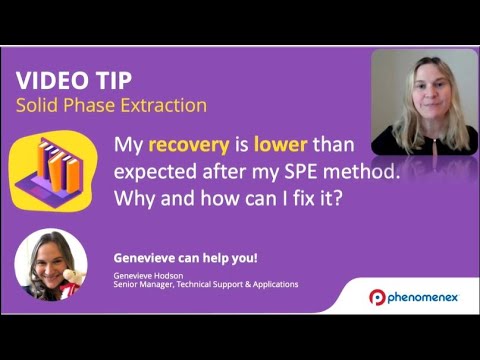
- Photo: Phenomenex: SPE Troubleshooting: Understanding and Resolving Low Recovery in Solid Phase Extraction
- Video: Phenomenex: How to Fix Low Recovery in Solid Phase Extraction | SPE Tip
Low analyte recovery is one of the most common challenges encountered during Solid Phase Extraction (SPE) sample preparation. In this Phenomenex Video Tip, Genevie Hodson, Senior Manager of Technical Support and Applications at Phenomenex, explains a practical troubleshooting approach for situations where analyte recovery after an SPE procedure is lower than expected.
The key objective of troubleshooting is not simply to identify that recovery is low, but to determine exactly where the analyte was lost during the extraction process. Once the point of loss has been identified, corrective actions can be implemented systematically.
Fundamental Principle of SPE Recovery Troubleshooting
Determine Where the Analyte Is Going
The most important step when troubleshooting low recovery is to identify the location of the missing analyte.
The process begins with the assumption that the sample originally contained 100% of the target analyte. If the final recovery is lower than expected, some portion of the analyte has been lost during SPE processing.
To identify the loss point, each fraction generated during the SPE procedure must be collected and analyzed separately.
Fractions to Collect
During the SPE workflow, the following fractions should be collected individually:
- Load fraction (flow-through)
- Wash fraction(s)
- Elution fraction
Each collected fraction is transferred into a vial and analyzed using the laboratory’s analytical method.
The analytical results reveal whether the analyte is:
- Present in the load fraction
- Present in one of the wash fractions
- Present in the elution fraction
- Missing from all collected fractions
The location of the analyte provides direct information about the root cause of the recovery problem and guides the next troubleshooting steps.
Scenario 1: Analyte Detected in the Load Fraction
What It Means
- If the analyte appears in the load fraction, it was not retained by the SPE sorbent during sample loading.
- Instead of binding to the stationary phase, the analyte passed directly through the cartridge.
Possible Causes
- Incorrect Phase Selection
- The selected SPE sorbent may not be appropriate for the analyte being extracted.
- If the analyte cannot interact effectively with the sorbent chemistry, retention will not occur.
- Excessively Strong Sample Solvent
- The sample may be dissolved in a solvent that is too strong.
- A strong sample solvent can prevent proper interaction between the analyte and the sorbent, causing breakthrough during loading.
- Incorrect pH Conditions
- Retention often depends on maintaining the analyte in the correct ionization state.
- If the sample pH is not appropriate, the analyte may not interact correctly with the sorbent and therefore will not be retained.
- Sorbent Overload
- The SPE cartridge may have received:
- Too much analyte
- Too much sample matrix
- When sorbent capacity is exceeded, analytes can break through the cartridge and appear in the load fraction.
Corrective Action
When overload is suspected, increasing the amount of sorbent can improve analyte retention and prevent breakthrough.
Scenario 2: Analyte Detected in the Wash Fraction
What It Means
If the analyte appears in the wash fraction, it was initially retained but subsequently removed during the washing step.
Possible Causes
- Wash Solvent Too Strong
- The most common cause is an overly aggressive wash solvent.
- A wash solution with excessive elution strength can remove the analyte before the intended elution step.
- Incorrect pH During Washing
- When pH control is required for retention, the same conditions must be maintained throughout the process.
- A pH change during washing may alter analyte retention and cause premature elution.
Corrective Action
Review:
- Wash solvent composition
- Wash solvent strength
- pH conditions during washing
Adjustments should ensure that the analyte remains retained until the elution step.
Scenario 3: Analyte Missing from All Fractions
What It Means
- If the analyte is not found in the load fraction, wash fractions, or elution fraction, it is likely still retained on the SPE sorbent.
- In this situation, the analyte has not been effectively eluted from the cartridge.
Possible Cause
Elution Solvent Not Strong Enough
- The final elution solvent may lack sufficient strength to remove the analyte from the sorbent.
- As a result, the analyte remains bound to the stationary phase and never reaches the collection vial.
Corrective Action
- Increase the strength of the elution solvent during the final SPE elution step.
- A stronger solvent can improve analyte desorption and recovery.
Summary of Low Recovery Troubleshooting Strategy
The recommended troubleshooting workflow consists of four steps:
1. Collect All SPE Fractions
Gather:
- Load fraction
- Wash fraction(s)
- Elution fraction
2. Analyze Each Fraction Separately
Use the analytical method to determine where the analyte is located.
3. Identify the Root Cause
Analyte Location / Likely Cause
- Load fraction: Incorrect phase, strong sample solvent, incorrect pH, sorbent overload
- Wash fraction: Wash solvent too strong, incorrect pH
- Not found in any fraction: Incomplete elution from sorbent
4. Apply Corrective Measures
Modify:
- Sorbent selection
- Sample solvent composition
- pH conditions
- Sorbent amount
- Wash solvent strength
- Elution solvent strength
Other Common SPE Issues
In addition to low recovery, several other SPE-related problems are commonly encountered.
These include:
- Contamination
- Reproducibility Problems
- Flow-Related Issues
Conclusion
Successful troubleshooting of low SPE recovery depends on identifying where the analyte is lost during the extraction process. Collecting and analyzing individual SPE fractions provides a systematic method for locating the analyte and determining the underlying cause of poor recovery.
Whether the analyte passes through during loading, elutes during washing, or remains bound to the sorbent after extraction, fraction-based investigation enables targeted corrective actions. This structured approach allows SPE methods to be optimized efficiently and helps restore acceptable analyte recovery.