Author
Phenomenex
Phenomenex
Phenomenex is a global technology leader committed to developing novel analytical chemistry solutions that solve the separation and purification challenges of researchers in industrial, government and academic laboratories.
Tags
Article
Academy
LinkedIn Logo

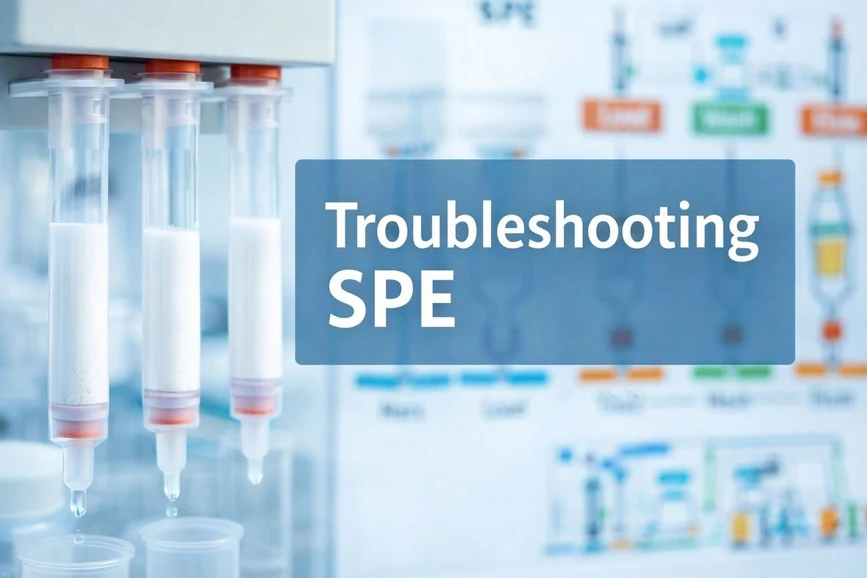
Troubleshooting SPE

We, 14.1.2026
| Original article from: Phenomenex
A technical guide to troubleshooting low analyte recovery in SPE. Explains relative vs. absolute recovery and provides practical solutions for conditioning, loading, and sorbent selection.
<p><strong>Phenomenex: </strong>Troubleshooting SPE</p>

Phenomenex: Troubleshooting SPE

This technical tip explores some issues encountered with Solid Phase Extraction and in particular to Analyte Recovery. Recovery relates to the percentage of analyte captured and retrieved through SPE. 
A couple of other commonly used terms relating to recovery, which may be of interest are:

Relative Recovery: Indirect determination of analyte capture and retrieval during the extraction process based on the recovery of an internal standard (which is a compound with a structure similar to the target analyte) that is added to the crude sample/matrix prior to the actual extraction procedure.

Absolute Recovery: Quantitative method for the determination of the actual amount of analyte captured and retrieved during the extraction process. Analyte recovery is based on an external standard that is added to the eluant at the end of the extraction procedure (rather than being based on an internal standard that is co-extracted with the analyte).

Symptom
  • Analyte recovery is less than 100%.
Clue
  • Analysis of the unretained fraction (void volume) indicates that the analyte is present in the “flow through”.
Problem
  • Analyte binding is not quantitative during the sample loading step.
Cause / Solutions / Suggestions

A. Column conditioning is improper, incorrect, or not optimized.:

  1. Condition column with methanol or isopropanol.
  2. Use sufficient methanol or isopropanol to wet the entire sorbent bed; allow more than two column volumes to percolate slowly under low vacuum.
  3. Follow the methanol or isopropanol directly with one column volume of a solution with a composition similar to the actual sample (pH adjusted) but without the analyte(s).
  4. Do not use too much of this second “conditioning solvent” in (3) above, or allow it to remain in the column for too long.
  5. Do not over-dry the column during or after conditioning (use low vacuum for ~1 minute).

B. Sample/matrix is in (or contains) a solvent which is “too strong”.:

  1. Dilute the sample in a “weaker” solvent/solution to promote binding (less polar for Normal Phase, more polar for Reversed Phase, less salt, buffered and/or pH adjusted for Ion-Exchange.
  2. Increase the sample dilution with a “weak” solvent.
  3. Load less sample.
  4. Increase the sorbent mass.
  5. Decrease the flow rate during sample loading.
  6. Use a “stronger” sorbent with a higher affinity for the analyte.
  7. Add an organic modifier (or adjust the pH) to enhance binding affinity for the analyte(s).
  8. Adjust the sample pH so that the analyte is neutral for Reversed Phase or charged for Ion-Exchange.
  9. Add salt (5 to 10% NaCl) to increase the solvent polarity and to enhance the retention of highly polar analytes in Reversed Phase.
  10. Add an ion-pair reagent to enhance binding of charged analytes in Reversed Phase.

C. Column “mass overload” (column is too small and/or the total mass of bound solutes/components is too large).:

  1. Decrease the volume of sample loaded.
  2. Increase the sorbent mass.
  3. Use a sorbent with higher surface area.
  4. Use a “stronger” sorbent.
  5. Decrease the flow rate during loading (to enhance “diffusion”).
  6. Decrease the column inner diameter but use the same sorbent mass (to increase the pressure drop, reduce flow, and enhance “diffusion”).
  7. Dilute the sample in a “weaker” solvent to improve capacity.

D. Flow rate is too high during the sample loading step.:

  1. Decrease the flow rate during loading.
  2. Increase the sorbent mass.
  3. Decrease the column inner diameter to reduce flow.
  4. Use a sorbent with a higher surface area.

E. Sorbent is “too weak” (has poor or low affinity for the analyte relative to the sample/matrix and/or the dilution solvent).:

  1. Switch to a “stronger” sorbent, to one with a higher ligand density, from a non-endcapped to an endcapped sorbent (or vice versa).
  2. See “Solutions/Suggestions” for Cause C (“Column mass overload..”), above.
  3. See Solutions/Suggestions for Cause B (“Sample/matrix is in (or contains) a solvent which is “too strong””), above.

F. Conditioning solvent is “washed away” with large sample volumes.:

  1. Add 2% methanol or isopropanol to the sample to prevent alkyl chain collapse during the sample loading step.
Phenomenex
LinkedIn Logo
 

Related content

Alcohol Determination of Sanitizer Gel Using Nexis GC-2060

Applications
| 2026 | Shimadzu
Instrumentation
GC
Manufacturer
Shimadzu
Industries
Pharma & Biopharma

Sensitive and Reproducible Determination of Nitrosamines by GC/MSD

Applications
| 2026 | Agilent Technologies
Instrumentation
GC/MSD, GC/SQ
Manufacturer
Agilent Technologies
Industries
Environmental

High-Throughput BTEX Analysis in Nail Products by SPME and GC/TQ

Applications
| 2026 | Agilent Technologies
Instrumentation
GC/MSD, GC/MS/MS, GC/QQQ, SPME
Manufacturer
Agilent Technologies
Industries
Materials Testing

Accurate multi-component blast furnace gas analysis maximizes iron production and minimizes coke consumption

Applications
| 2026 | Thermo Fisher Scientific
Instrumentation
GC/MSD
Manufacturer
Thermo Fisher Scientific
Industries
Energy & Chemicals

Gas Chromatograph Nexis GC-2060

Brochures and specifications
| 2026 | Shimadzu
Instrumentation
GC
Manufacturer
Shimadzu
Industries
Other
 

Related articles

Generic SPE Method by Retention Mechanism
Article | Product

Generic SPE Method by Retention Mechanism

Explore solvent and pH conditions for Reversed Phase, Normal Phase, and Strong Ion-Exchange SPE. Guidelines cover analyte types, sample matrices, and key steps from conditioning to elution.
Phenomenex
tag
share
more
I am getting low recovery in my SPE method, how do I fix the problem?
Article | Academy

I am getting low recovery in my SPE method, how do I fix the problem?

Practical troubleshooting guide for low recovery in SPE methods. Learn how to identify problems with solvents, flow rate, pH, or sorbent choice step by step.
Phenomenex
tag
share
more
Why are my recoveries greater than 100%?
Article | Academy

Why are my recoveries greater than 100%?

Although 100% recovery is expected in SPE, values above 100% are sometimes observed. This article explains the most common causes and provides practical guidance on how to identify and resolve them.
Phenomenex
tag
share
more
Selection, Optimization, and Validation of Thermal Desorption for analysis of VOCs and PAHs in Combustion Emissions (Caleb Marx, MDCW 2026)
Presentation | Video

Selection, Optimization, and Validation of Thermal Desorption for analysis of VOCs and PAHs in Combustion Emissions (Caleb Marx, MDCW 2026)

Thermal desorption coupled with GC×GC offers a powerful approach for wildfire smoke analysis, capturing gas-phase VOCs and complex organic profiles beyond conventional filter sampling.
The Multidimensional Chromatography Workshop
tag
share
more
 

Related content

Alcohol Determination of Sanitizer Gel Using Nexis GC-2060

Applications
| 2026 | Shimadzu
Instrumentation
GC
Manufacturer
Shimadzu
Industries
Pharma & Biopharma

Sensitive and Reproducible Determination of Nitrosamines by GC/MSD

Applications
| 2026 | Agilent Technologies
Instrumentation
GC/MSD, GC/SQ
Manufacturer
Agilent Technologies
Industries
Environmental

High-Throughput BTEX Analysis in Nail Products by SPME and GC/TQ

Applications
| 2026 | Agilent Technologies
Instrumentation
GC/MSD, GC/MS/MS, GC/QQQ, SPME
Manufacturer
Agilent Technologies
Industries
Materials Testing

Accurate multi-component blast furnace gas analysis maximizes iron production and minimizes coke consumption

Applications
| 2026 | Thermo Fisher Scientific
Instrumentation
GC/MSD
Manufacturer
Thermo Fisher Scientific
Industries
Energy & Chemicals

Gas Chromatograph Nexis GC-2060

Brochures and specifications
| 2026 | Shimadzu
Instrumentation
GC
Manufacturer
Shimadzu
Industries
Other
 

Related articles

Generic SPE Method by Retention Mechanism
Article | Product

Generic SPE Method by Retention Mechanism

Explore solvent and pH conditions for Reversed Phase, Normal Phase, and Strong Ion-Exchange SPE. Guidelines cover analyte types, sample matrices, and key steps from conditioning to elution.
Phenomenex
tag
share
more
I am getting low recovery in my SPE method, how do I fix the problem?
Article | Academy

I am getting low recovery in my SPE method, how do I fix the problem?

Practical troubleshooting guide for low recovery in SPE methods. Learn how to identify problems with solvents, flow rate, pH, or sorbent choice step by step.
Phenomenex
tag
share
more
Why are my recoveries greater than 100%?
Article | Academy

Why are my recoveries greater than 100%?

Although 100% recovery is expected in SPE, values above 100% are sometimes observed. This article explains the most common causes and provides practical guidance on how to identify and resolve them.
Phenomenex
tag
share
more
Selection, Optimization, and Validation of Thermal Desorption for analysis of VOCs and PAHs in Combustion Emissions (Caleb Marx, MDCW 2026)
Presentation | Video

Selection, Optimization, and Validation of Thermal Desorption for analysis of VOCs and PAHs in Combustion Emissions (Caleb Marx, MDCW 2026)

Thermal desorption coupled with GC×GC offers a powerful approach for wildfire smoke analysis, capturing gas-phase VOCs and complex organic profiles beyond conventional filter sampling.
The Multidimensional Chromatography Workshop
tag
share
more
 

Related content

Alcohol Determination of Sanitizer Gel Using Nexis GC-2060

Applications
| 2026 | Shimadzu
Instrumentation
GC
Manufacturer
Shimadzu
Industries
Pharma & Biopharma

Sensitive and Reproducible Determination of Nitrosamines by GC/MSD

Applications
| 2026 | Agilent Technologies
Instrumentation
GC/MSD, GC/SQ
Manufacturer
Agilent Technologies
Industries
Environmental

High-Throughput BTEX Analysis in Nail Products by SPME and GC/TQ

Applications
| 2026 | Agilent Technologies
Instrumentation
GC/MSD, GC/MS/MS, GC/QQQ, SPME
Manufacturer
Agilent Technologies
Industries
Materials Testing

Accurate multi-component blast furnace gas analysis maximizes iron production and minimizes coke consumption

Applications
| 2026 | Thermo Fisher Scientific
Instrumentation
GC/MSD
Manufacturer
Thermo Fisher Scientific
Industries
Energy & Chemicals

Gas Chromatograph Nexis GC-2060

Brochures and specifications
| 2026 | Shimadzu
Instrumentation
GC
Manufacturer
Shimadzu
Industries
Other
 

Related articles

Generic SPE Method by Retention Mechanism
Article | Product

Generic SPE Method by Retention Mechanism

Explore solvent and pH conditions for Reversed Phase, Normal Phase, and Strong Ion-Exchange SPE. Guidelines cover analyte types, sample matrices, and key steps from conditioning to elution.
Phenomenex
tag
share
more
I am getting low recovery in my SPE method, how do I fix the problem?
Article | Academy

I am getting low recovery in my SPE method, how do I fix the problem?

Practical troubleshooting guide for low recovery in SPE methods. Learn how to identify problems with solvents, flow rate, pH, or sorbent choice step by step.
Phenomenex
tag
share
more
Why are my recoveries greater than 100%?
Article | Academy

Why are my recoveries greater than 100%?

Although 100% recovery is expected in SPE, values above 100% are sometimes observed. This article explains the most common causes and provides practical guidance on how to identify and resolve them.
Phenomenex
tag
share
more
Selection, Optimization, and Validation of Thermal Desorption for analysis of VOCs and PAHs in Combustion Emissions (Caleb Marx, MDCW 2026)
Presentation | Video

Selection, Optimization, and Validation of Thermal Desorption for analysis of VOCs and PAHs in Combustion Emissions (Caleb Marx, MDCW 2026)

Thermal desorption coupled with GC×GC offers a powerful approach for wildfire smoke analysis, capturing gas-phase VOCs and complex organic profiles beyond conventional filter sampling.
The Multidimensional Chromatography Workshop
tag
share
more
 

Related content

Alcohol Determination of Sanitizer Gel Using Nexis GC-2060

Applications
| 2026 | Shimadzu
Instrumentation
GC
Manufacturer
Shimadzu
Industries
Pharma & Biopharma

Sensitive and Reproducible Determination of Nitrosamines by GC/MSD

Applications
| 2026 | Agilent Technologies
Instrumentation
GC/MSD, GC/SQ
Manufacturer
Agilent Technologies
Industries
Environmental

High-Throughput BTEX Analysis in Nail Products by SPME and GC/TQ

Applications
| 2026 | Agilent Technologies
Instrumentation
GC/MSD, GC/MS/MS, GC/QQQ, SPME
Manufacturer
Agilent Technologies
Industries
Materials Testing

Accurate multi-component blast furnace gas analysis maximizes iron production and minimizes coke consumption

Applications
| 2026 | Thermo Fisher Scientific
Instrumentation
GC/MSD
Manufacturer
Thermo Fisher Scientific
Industries
Energy & Chemicals

Gas Chromatograph Nexis GC-2060

Brochures and specifications
| 2026 | Shimadzu
Instrumentation
GC
Manufacturer
Shimadzu
Industries
Other
 

Related articles

Generic SPE Method by Retention Mechanism
Article | Product

Generic SPE Method by Retention Mechanism

Explore solvent and pH conditions for Reversed Phase, Normal Phase, and Strong Ion-Exchange SPE. Guidelines cover analyte types, sample matrices, and key steps from conditioning to elution.
Phenomenex
tag
share
more
I am getting low recovery in my SPE method, how do I fix the problem?
Article | Academy

I am getting low recovery in my SPE method, how do I fix the problem?

Practical troubleshooting guide for low recovery in SPE methods. Learn how to identify problems with solvents, flow rate, pH, or sorbent choice step by step.
Phenomenex
tag
share
more
Why are my recoveries greater than 100%?
Article | Academy

Why are my recoveries greater than 100%?

Although 100% recovery is expected in SPE, values above 100% are sometimes observed. This article explains the most common causes and provides practical guidance on how to identify and resolve them.
Phenomenex
tag
share
more
Selection, Optimization, and Validation of Thermal Desorption for analysis of VOCs and PAHs in Combustion Emissions (Caleb Marx, MDCW 2026)
Presentation | Video

Selection, Optimization, and Validation of Thermal Desorption for analysis of VOCs and PAHs in Combustion Emissions (Caleb Marx, MDCW 2026)

Thermal desorption coupled with GC×GC offers a powerful approach for wildfire smoke analysis, capturing gas-phase VOCs and complex organic profiles beyond conventional filter sampling.
The Multidimensional Chromatography Workshop
tag
share
more
Other projects
LCMS
ICPMS
Follow us
FacebookX (Twitter)LinkedInYouTube
More information
WebinarsAbout usContact usTerms of use
LabRulez s.r.o. All rights reserved. Content available under a CC BY-SA 4.0 Attribution-ShareAlike