One Year Observation of Microplastic Concentrations in the River Rhine
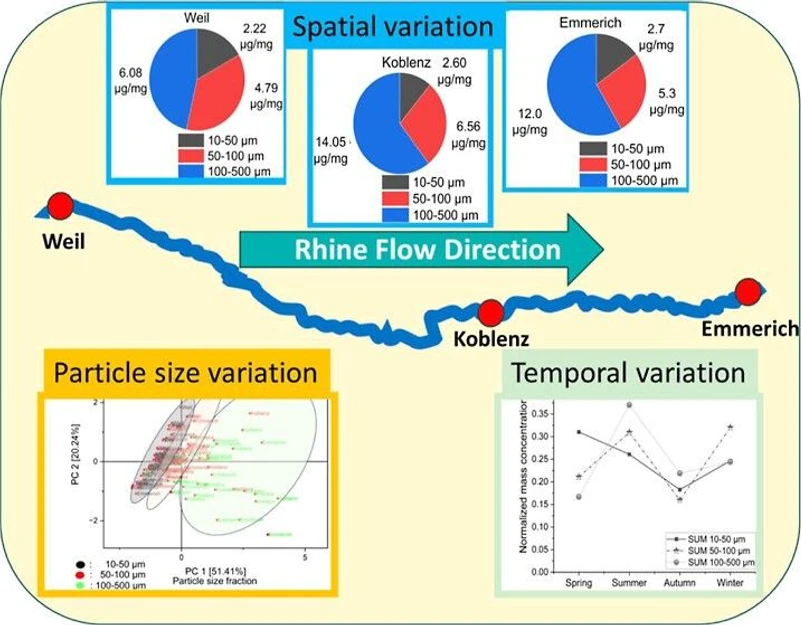
ACS EST Water 2026, 6, 2, 639–648: Graphical abstract
This study presents a one-year assessment of microplastic concentrations in the River Rhine, analyzing samples from three locations and across multiple size fractions using TED-GC/MS. Dominant polymers included polyethylene, polypropylene, polystyrene, styrene–butadiene rubber, and natural rubber.
Statistical analysis revealed size-dependent distributions, minor seasonal variation, and spatial differences, highlighting the role of sources such as tire abrasion. The findings provide valuable data for environmental monitoring, ecotoxicological research, and regulatory frameworks related to water quality.
The original article
One Year Observation of Microplastic Concentrations in the River Rhine
Yosri Wiesner, Paul Eisentraut, and Korinna Altmann*
ACS EST Water 2026, 6, 2, 639–648
https://doi.org/10.1021/acsestwater.5c00530
licensed under CC-BY 4.0
Selected sections from the article follow. Formats and hyperlinks were adapted from the original.
As microplastics (MPs) are found all over the world and no comprehensive knowledge is available yet, extensive monitoring campaigns are required to gain a full understanding of their occurrence, transportation and fate. (1,2) In particular, MP abundance in freshwater systems has still not been sufficiently investigated. (3,4) Additionally, the question of the toxicological potential of MPs has been the subject of numerous studies for many years, (5,6) leading to more precise and complex experimental set-ups and results. However, there is still a need for more acurate data on environmental MP concentrations in order to make ecotoxicological tests even more detailed and realistic. The lack of certainty for exposure concentrations in the risk assessment frame of MPs leads to the precautionary principle being applied by politicians and regulators worldwide. Both the EU drinking water directive and the wastewater directive call for monitoring of MPs within the next few years. It is important to establish suitable analytical methods for sampling, sample preparation and detection that must now be fast, robust and fit for purpose in order to obtain representative and valid results depending on mass or particle number. (7−9)
MPs are solid particles with a size of 1–1000 μm mainly consisting of polymers (ISO/TR 21960, 2020) and can, for example, result from industrial production in the form of small particles that are designed as additives and change the properties of products, or from plastic parts that have been released into the environment. Major sources of MPs today are paints, tires, packaging materials, pellet waste and textiles. (10−12) These macroplastic products can form MP particles as a result of degradation factors such as photooxidation, hydrolysis and mechanical abrasion. (13,14)
The River Rhine has its origin in Switzerland and then flows through Liechtenstein, Austria, Germany and France until it discharges into the North Sea in The Netherlands. At 1233 km and a catchment area of about 185 000 km2, the Rhine is one of the largest river systems in Europe and, due to its expanse, forms the ecological basis for a large number of animal species. Around 30 million people in Germany are supplied with drinking water from the Rhine.
It is hardly possible to assess the occurrence of MPs if either a limited sampling volume is used or only individual samples are taken. It is therefore essential that different volumes are sampled depending on whether the water to be sampled contains many or few MP particles. It is recommended to sample at least 5 m3 for drinking water samples and 1 m3 for surface water, whereas raw wastewater contains so many particles that only a few liters need to be sampled. (15) Although sampling of these water volumes leads to a representative sample from the analytic point of view, it is questionable, if the result measured is representative for the location. Previous studies have shown that the composition in terms of MP masses in a water body can change at one location with each individual sample independently whether several samples are analyzed in 1 day or spread over several days. (16) Fractionated filtration and sedimentation boxes as active and passive sampling methods have proven themselves in the sampling of freshwater systems. In active sampling, water is fractionally filtered using a pump and a sieve tower with different mesh sizes. (17) Passive sampling can be carried out using sedimentation boxes. (18) In a sedimentation box, the flow velocity of the medium flowing through is reduced by using several baffle plates. Due to the reduced velocity and energy, particles up to a certain size are forced to sediment by the now predominant gravitational force. Such boxes can remain in the water for several weeks and therefore collect a cross-section of the suspended particles including MP over a certain period of time.
Mass and number-based methods have emerged as suitable detection methods for MPs. (19) Number-based methods such as μ-Raman, μ-FTIR or LDIR are well advanced to evaluate the polymer identity, particle number concentration and shape, (20,21) but are still time-consuming in terms of sample preparation. In regulatory approaches or for simulations, usually the MP mass is needed. MP polymer identity and masses can be detected by thermoanalytical methods like pyrolysis-GC/MS (Py-GC/MS) or thermal extraction desorption-GC/MS (TED-GC/MS). Especially TED-GC/MS seems to be suitable for monitoring purses of suspended particulate matter, because there is no need for additional sample preparation others than filtration and homogenization. Up to 50 mg of suspended particulate matter can be directly measured in one run, giving representative subsamples for precise measurements exceeding the limit of quantification. Furthermore, styrene–butadiene rubber (SBR) and natural rubber (NR) as indication for tire wear can be detected in the same sample run next to thermoplastics such as polyethylene (PE), polypropylene (PP), polyethylene terephthalate (PET), polystyrene (PS), polyamide 6 or polyacrylates.
This work provides a comprehensive data set of MP concentrations of the River Rhine over one year sampling at three different locations starting near the source in Weil via Koblenz and Emmerich. Sampling was done with sedimentation boxes with monthly withdrawal and fractioned filtration of the collected particles afterward. The size fractions 10–50 μm, 50–100 μm and 100–500 μm were provided by the Federal Institute of Hydrology (BfG, Germany) and analyzed at the Federal Institute of Material Research and Testing (BAM, Germany) funded by a national project from the Federal Ministry for the Environment, Nature Conservation, Nuclear Safety and Consumer Protection (BMUV, Germany, 3719 22301 0). Detection was performed with TED-GC/MS in routine mode, proven as a fast and robust detection method. (2,16,22) Data can be used, for example, for water monitoring or as reference values for future risk assessment scenarios and experiments.
2. Materials and Methods
2.2. TED-GC/MS
TED-GC/MS is a multistage detection technique combining the thermal sample extraction by thermogravimetric analysis (TGA) with chromatographic separation of the individual decomposition gases and detection by trace analysis with gas chromatography/mass spectrometry (GC/MS). Sample material in 150 μL alumina crucibles was pyrolyzed in a TGA2 thermobalance (MettlerToledo, Gieβen, Germany) under a nitrogen flow of 30 mL/min from 200 to 500 °C with a heating rate of 10 K/min. Typical sample intake was between 10 to 50 mg depending on the organic content. The decomposition gases were collected on a solid phase (SorbStar, Envea, Vohenstrauβ, Germany) in the typical polymer decomposition temperature range between 200 and 500 °C via a heated coupling module (240 °C, Gerstel, Mülheim an der Ruhr, Germany). The loaded solid phase was transported to the thermodesorption unit (TDU)-GC/MS by an autosampler (MultiPurposeSampler 2 (MPS2), Gerstel, Mühlheim an der Ruhr). The desorption of the decomposition products took place in the TDU (50–200 °C, 5 min isothermal, He gas, Gerstel), the cryofocusing in the cold injection system (−100 °C, Gerstel). Injection was carried out from there by rapid heating (−100–270 °C, 12 K/s) onto the separation column (HP5 ms, 1 mL/min He, 40–300 °C, Agilent, Palo Alto, USA) in the GC system (7890 B Agilent). After chromatographic separation, detection was performed in a mass spectrometer (EI, 70 eV, scan-mode, 5977 B, Agilent).
3. Results and Discussion
A summary of the identified polymer types and their corresponding mass concentrations per sampling location is provided in Figure 1. All individual results are presented in Table S1 of the Supporting Information. With a few exceptions, the polymers PE, PP, PS, SBR and NR were detected. To cope with the large amount of measurement data and to obtain an overview of possible correlations, the data was evaluated using statistical and mathematical algorithms. Only the five polymers named above provide enough input data and are therefore used as the basis for the data analysis. The individual results were sorted according to various aspects that are included in the data set as independent variables:
(I) Particle size fractions
(II) Temporal variation
(III) Spatial variation due to the sampling locations
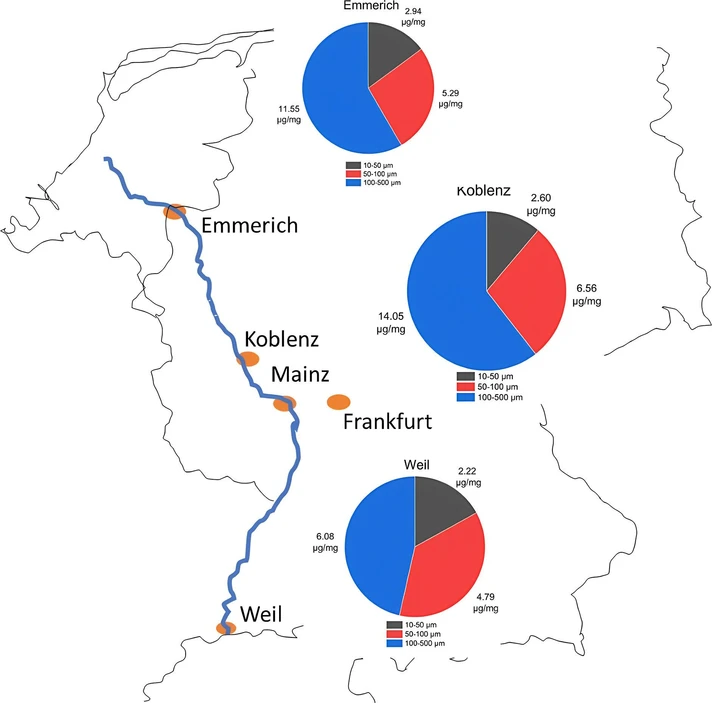 ACS EST Water 2026, 6, 2, 639–648: Figure 1. Overview of sampling locations along the German part of the River Rhine and sum of identified median mass concentrations.
The concentrations of the various polymers in the suspended matter serve as input values. The riverine balancing and material transport based on the total masses (polymer mass in total suspended solids mass) is carried out explicitly and will be published at Umweltbundesamt as part of the project report by the BfG (Ternes, final project report, 2023).
3.1. Particle Size Fractions
This section describes the possible correlation of the polymer mass concentration with the size of the measured particles regardless of the sampling location. Therefore, the generated samples were sorted by sieving into different size fractions of 10–50, 50–100 and 100–500 μm. The relative mean values of the individual fractions are calculated (Figure S2) to obtain the shares of the different polymer types in the total amount of MP. PE is the dominant polymer in all size fractions with 68–76%, followed by PS (10–15%), SBR (4–13%), PP (2–5%) and NR (2–4%). Obviously, all polymer types are approximately evenly distributed across the size fractions, with SBR being less present in the 100–500 μm fraction.
In general, it can be determined that PE accounts for the highest proportion of MP. PS makes up the second highest proportion, followed by SBR. Next in line are PP and NR. The polymer findings are in good agreement with previous MP studies of the Rhine. PE, PP and PS in particular are the most frequently detected polymers. (3) The relative abundance of PE, PP and PS is also relatively similar to Skalska et al., even when the particle number was considered here. (26) Especially in comparison with the results of Mani et al. significant similarities to the ratios of PE, PP and PS can be found. Data on SBR from tire abrasion in the Rhine is difficult to find in existing studies, as such particles cannot easily be identified using vibrational methods due to the IR absorbing properties and the intense fluorescence of the accompanying soot. However, a comparison with suspended particulate matter samples from the Danube is possible, as here the detection was also carried out using TED-GC/MS. (2) The relative ratios of PE, PP, PS, SBR and NR are comparable and support the plausibility of the results.
Total MP mass concentrations are presented in Figure S3 for individual polymer types, showing highest mass concentrations in the size fraction 100–500 μm. The median varies from 0.17 to 6.80 μg/mg depending on the polymer type. In absolute terms, the PE mass concentrations are significantly higher than those of all other polymers. PP and PS show a strong mass increase in the 100–500 μm fraction, together with higher uncertainty compared to 10–50 μm and 50–100 μm. With a variation of 0.27–0.32 μg/mg across all particle size fractions, the mass contents of SBR are relatively constant, while NR mass concentration seems to increase more linearly. The high mass concentrations and the strong scattering of the 100–500 μm fractions could be due to the presence or absence of large but few particles. Basically, the larger a particle is, the higher its contribution to the mass concentration. In contrast, the larger a particle is, the lower the probability of an equal distribution in all samples.
If other regions associated with the Rhine are considered, comparable ratios of mass concentration in the various particle size fractions are found in Rhine floodplains. (27)
At the beginning of the data analysis, a Principal Component Analysis (PCA) is carried out to identify parameters that have a high influence on the mass content. This analysis identified that the particle size has the greatest influence on the mass concentration (Figure 2). The first principal component (PC 1) was identified as the particle size fraction and explains over 50% of the differences in the data.
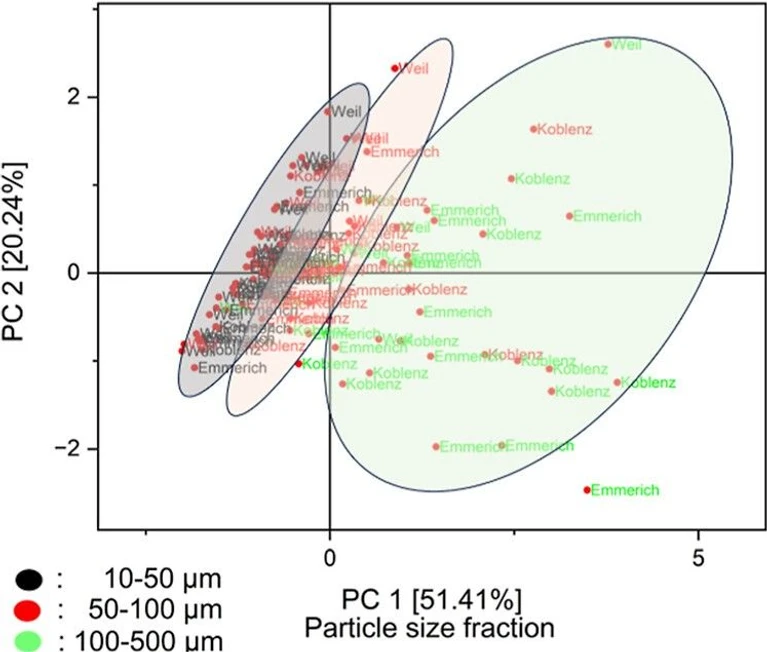 ACS EST Water 2026, 6, 2, 639–648: Figure 2. PCA Score plot of mass concentrations of the different polymers.
4. Conclusion
This study demonstrated that long-term sampling of the Rhine is possible and provides plausible results, which is important for future MP monitoring campaigns, as required by the Urban Waste Water Treatment Directive for the EU. Although the MP concentrations in the Rhine are relatively constant, seasonal and downstream differences were observed. In order to confirm these possible trends, further sampling campaigns are needed to identify possible differences on an annual scale. Furthermore, the influences of urban proximity and land use must be examined in greater detail by increasing the number of measuring points. Additional sample sites are needed to identify possible sources of input. This would be particularly important to clarify the PS concentrations, which show a high correlation between the different particle size fractions in almost all seasons and could indicate a possible common source. SBR is the only polymer to show a relatively constant concentration across all particle sizes and seasons, independent of the river course. Since it is a tire component, constant road traffic could be part of the explanation. However, a different particle ratio must be assumed here compared to the other polymers. The fragmentation mechanism and/or another transport mechanism needs to be clarified.
Although PE constitutes the majority of the total MP concentration, there may be an overestimation due to false positive signals. To exclude or confirm this, further studies must be conducted to analyze the organic components of the riverine suspended matter in detail.
A comparison with other studies reveals similar occurrences of the same polymer types and in parts also similar seasonal fluctuations and a slight downstream increase. The differentiated presentation of results in polymer type, particle size fraction and range of mass concentrations can provide a valuable basis for more complex and realistic exposure tests for ecotoxicological studies on freshwater organisms. In particular, the large database for SBR as a tire component could be of special interest, as the toxicity of tire particles due to their chemical composition has already been shown in other studies. In studies using FTIR-based detection methods, these values are usually missing due to the high absorbance of the black tire particles.