News from LabRulezGCMS Library - Week 48, 2025
LabRulez: News from LabRulezGCMS Library - Week 48, 2025
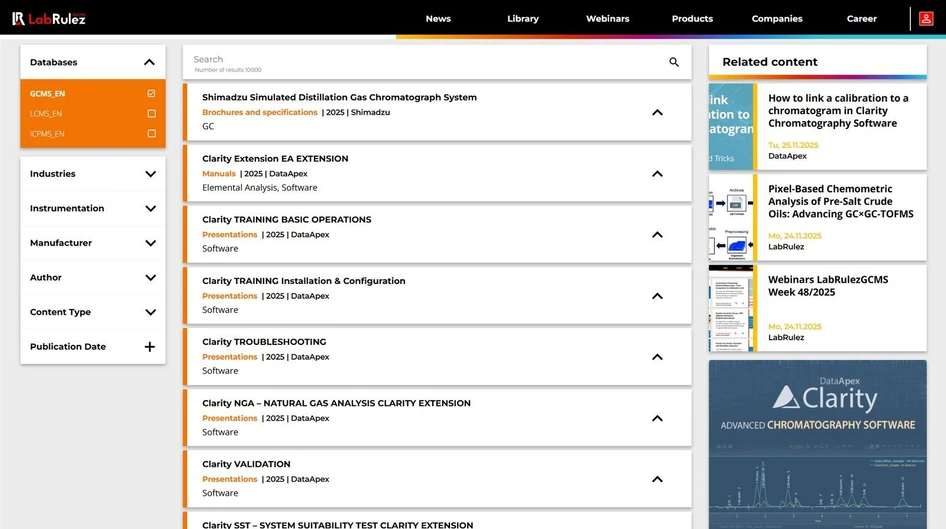
Our Library never stops expanding. What are the most recent contributions to LabRulezGCMS Library in the week of 24th November 2025? Check out new documents from the field of the gas phase, especially GC and GC/MS techniques!
👉 SEARCH THE LARGEST REPOSITORY OF DOCUMENTS ABOUT GCMS AND RELATED TECHNIQUES
👉 Need info about different analytical techniques? Peek into LabRulezLCMS or LabRulezICPMS libraries.
This week we bring you brochure by Agilent Technologies, poster by LECO /MDCW, and application notes by Shimadzu and Thermo Fisher Scientific!
1. Agilent Technologies: GC workflows for hydrogen vehicles and natural gas blending - Hydrogen Fuel Testing Solutions
- Brochure
- Full PDF for download
Agilent’s Hydrogen Fuel Testing Solutions compendium highlights the growing importance of reliable impurity analysis as hydrogen becomes a key clean-energy fuel. Because contaminants such as moisture, sulfur compounds, ammonia, oxygen, or organics can compromise fuel-cell performance and safety, the brochure emphasizes that hydrogen purity must be monitored throughout the entire supply chain—from production to storage, transport, and final distribution. Hydrogen blended into natural gas introduces additional challenges, since existing pipeline infrastructure was not originally designed for hydrogen, making rigorous analytical control essential for preventing corrosion, equipment malfunction, and safety issues.
To address these challenges, Agilent presents a comprehensive suite of GC-based hydrogen testing workflows. The compendium showcases key analytical instruments—such as the Agilent 8890 GC, 8355 SCD, 8255 NCD, 5977C GC/MSD, and portable 990 Micro GC—each tailored for detecting critical impurities at trace levels in accordance with ISO 14687-2019, SAE J2719, and other global standards. Featured application notes demonstrate capabilities including ultratrace ammonia monitoring, analysis of sulfides and halides, sulfur speciation, and fast impurity screening for hydrogen and natural gas streams.
Beyond instrumentation, the brochure outlines Agilent’s service ecosystem supporting method deployment, instrument verification, sustainability strategies, and lab operations management through CrossLab services and OpenLab software. These include preventive maintenance programs, financial solutions, certified pre-owned instruments, and consulting for analytical method development.
Finally, the brochure connects hydrogen-fuel purity testing with broader sustainability goals. Agilent encourages laboratories to adopt circular-economy practices—reducing waste, extending instrument lifecycles, and improving energy efficiency—emphasizing that clean hydrogen starts with responsible, efficient, and reliable laboratory workflows.
2. LECO / MDCW: BOOSTING NON-TARGETED ANALYSIS WITH COMPREHENSIVE TWO-DIMENSIONAL GAS CHROMATOGRAPHY AND HIGH-RESOLUTION MASS SPECTROMETRY
- Poster
- Full PDF for download
The presentation by Sebastiano Panto (LECO EATC Berlin) focuses on demonstrating how comprehensive two-dimensional gas chromatography coupled with high-resolution time-of-flight mass spectrometry (GC×GC-HR-TOFMS) significantly enhances non-targeted and targeted screening workflows, particularly in environmental analysis. Using liver extracts from Glaucous gulls (Larus hyperboreus) from the Svalbard region as a case study, the work aims to reveal contamination patterns and improve compound identification confidence.
Sample preparation included homogenization, lipid removal, and multi-step cleanup involving GPC/SEC chromatography and Florisil fractionation, yielding separate non-polar and polar fractions for analysis (page 4). Analytical separations were performed on an Agilent 8890 GC equipped with a dual-column GC×GC setup (Rxi-5SilMS and Rxi-17SilMS), cryogenic modulation, and Helium carrier gas. Detection used the LECO Pegasus® HRT+4D HR-TOFMS with multiple ionization modes—EI, PCI, and ECNI—enabling simultaneous acquisition of structural, isotopic, and exact-mass information (page 5).
The results highlight the advantages of GC×GC-HR-TOFMS in non-target screening: improved separation patterns, higher library match scores, exact-mass confirmation, and enhanced structural elucidation. Electron ionization (EI) provided clean spectra with high match scores for classic pollutants (e.g., PCBs, DDE), while electron capture negative ionization (ECNI) greatly improved selectivity and sensitivity for halogenated contaminants such as toxaphenes and brominated flame retardants, enabling confident identification even when EI spectra were ambiguous (pages 6–13). The instrument’s high mass accuracy and isotopic fidelity are shown to be essential for distinguishing closely related halogenated compounds.
The study concludes that combining GC×GC separation power with HR-TOFMS accurate-mass detection and complementary ionization modes offers a robust discovery platform for environmental exposomics. This analytical workflow supports more confident annotation of persistent organic pollutants (POPs) and emerging contaminants in complex biological matrices, ultimately helping assess ecological risks in sensitive Arctic ecosystems where these avian species reside (page 15).
3. Shimadzu: High-Sensitivity Gas Analysis Using the GCMS-QP2050 and GI-30 Auto Gas Injector
- Application note
- Full PDF for download
Gas analysis is conducted across a wide range of fields, including resources, energy, and the environment. Typical targets include inorganic gases such as H2, CO, and CO2, and light hydrocarbon gases starting with CH4, with analyses primarily performed using GC. In Application News No. 01- 00858, examples of gas sample analysis using TCD and BID installed on the Brevis GC-2050 were presented.
However, qualitative analysis by GC requires standard substances, making the identification of unknown impurities in gas samples difficult. Furthermore, in inorganic gas analysis, complete chromatographic separation of peaks can be challenging, and when GC fails to fully separate them, both qualitative and quantitative analysis become difficult.
In contrast, gas analysis using GC-MS enables qualitative identification of unknown components without standard substances through mass spectral library searches. Quantitation in GC-MS is performed using mass chromatograms, allowing accurate measurements even when peaks overlap.
In this Application News, high-sensitivity analysis of inorganic gases and light hydrocarbon gases was performed using the compact yet high-performance GCMS-QP2050. Gas samples were introduced using the GI-30 Auto Gas Injector, enabling automated, continuous analysis and delivering higher reproducibility than manual sample injection.
Instrument Configuration and Analytical Conditions
A 10 ppm standard mixed gas sample in a cylinder was analyzed using the GCMS-QP2050. Gas sample injection into the GC-MS was performed with the GI-30 Auto Gas Injector (P/N: S221- 89755-41). The instrument configuration is shown in Fig. 1. The analytical conditions used are summarized in Table 1. Under typical ionization settings (ionization voltage 70 V and emission current 60 µA), ionization of the helium carrier gas generates a significant signal at m/z 2, making detection of H2 (monitor ion: m/z 2) difficult. Therefore, for analysis in SIM mode, the ionization voltage was set to 20 V and the emission current to 20 µA to suppress He ionization.
Automated Continuous Analysis Using the GI-30
The GI-30 Auto Gas Injector is a sample pretreatment device that automatically introduces a fixed volume of gas into the GC. It is used by connecting either a gas cylinder or a sample bag. When the GI-30 is connected to a gas cylinder, automated, continuous analysis of gassamples becomes possible.
The GI-30 is equipped with an optional valve purge mechanism. Purging the internal valve with gas reduces the ingress of ambient air. This is effective for analyzing components in ambient air, such as N2 and O2, as well as for measuring tracelevel components.
Table 2 shows the peak-area repeatability (%RSD) obtained when a 10 ppm standard mixed gas was analyzed automatically and continuously in SIM mode. As an example, an overlay of the CH4 SIM chromatograms is shown in Fig. 3. Because the GI-30 meters a fixed volume of gas into the GC via a sample loop, excellent reproducibility was achieved for all compounds.
Conclusion
Using the GCMS-QP2050, high-sensitivity analysis of inorganic gases, such as H2, and light hydrocarbons was achieved. Gas sample injection was performed with the GI-30 Auto Gas Injector, enabling automated, continuous analysis and delivering higher reproducibility compared with manual sample injection. The compact, high-performance GCMS-QP2050, together with the GI-30, enables automation and high-precision gas analysis, and supports greater efficiency in GC-MS-based gas analysis.
4. Thermo Fisher Scientific: Trace analysis of epichlorohydrin in drinking water using GC-MS coupled with purge and trap
- Application note
- Full PDF for download
Epichlorohydrin (ECH) is a versatile starting material in the production of drugs and polymers and is also used as an insect fumigant and solvent for organic synthesis reactions. ECH-based polymer pipes are commonly used in the production of drinking water due to their durability and resistance to corrosion. However, ECH is known for its high reactivity and toxicity, which poses significant health risks if it contaminates drinking water. Exposure to ECH can cause respiratory issues, skin irritation, and has been classified as a probable human carcinogen.
Due to these risks, many countries have imposed strict limits on the amount of ECH allowed in drinking water. Recently, Europe set a minimum detection limit (MDL) of 30 parts per trillion (ppt) for ECH in drinking water.2 Whereas typically required detection limits for most compounds mandated for analysis in Europe can be achieved using methods based on static headspace, the stringent MDL required for ECH requires preconcentration, for example using purge and trap (P&T) technology.3,4 This technology involves purging the water sample with an inert gas to release volatile organic compounds (VOCs), which are then trapped and concentrated for analysis, ensuring reliable detection at very low concentrations. In the United States, the analysis of VOCs in drinking water is mandated by the Environmental Protection Agency (EPA). The EPA requires the use of P&T technology for drinking water analysis to ensure that even trace amounts of harmful compounds like ECH are detected and managed appropriately.
The following evaluation describes the use of the ISQ 7610 Single Quadrupole MS system coupled with the Thermo Scientific™ TRACE™ 1610 GC with the Thermo Scientific™ HeSaver-H2 Safer™ split/splitless injector and Teledyne LABS Tekmar Lumin P&T concentrator combined with the AQUATek LVA autosampler for the analysis of ECH in drinking water.
Experimental
GC-MS parameters
A TRACE 1610 GC was coupled to the ISQ 7610 MS equipped with the Thermo Scientific™ NeverVent ™ vacuum probe interlock (VPI) and an ExtractaBrite ion source. A Thermo Scientific™ TraceGOLD™ TG-VMS column, 30 m × 0.25 mm, 1.4 µm film (P/N 26080-3320) was used for compound separation. The HeSaver-H2 Safer SSL injector was utilized to reduce the carrier gas consumption by decoupling the gas used for the chromatographic separation from the gas used to pressurize the inlet and maintain split and purge flows. The critical separations were maintained with a run time of under 15 minutes.
For this analysis, the ISQ 7610 MS was operated in Selected Ion Monitoring (SIM) mode for increased selectivity, as required for this application. Extended method parameters for the ISQ 7610 MS are shown in Table 2.
Instrument control and data processing
Data was acquired, processed, and reported using the Thermo Scientific™ Chromeleon™ Chromatography Data System (CDS). This software can control both the GC-MS system and the Tekmar Lumin P&T with the AQUATek LVA. This allows a single software to be utilized for the full workflow, simplifying the instrument operation. This application note is available for download via the Thermo Scientific™ AppsLab Library, which contains all the parameters needed to acquire, process, and report the analytical data for analysis of ECH.5
Conclusion
This study demonstrates the capability of the Tekmar Lumin P&T with the AQUATek LVA system connected to the ISQ 7610 Single Quadrupole GC-MS to detect and quantify low-level ECH in drinking water samples, in compliance with EPA requirements.
- Utilizing the Tekmar Lumin P&T’s ability to purge with nitrogen, along with using the HeSaver-H₂Safer SSL injector, nearly four times less helium was consumed during the analysis without sacrificing system performance.
- The linearity of the calibration curve from 30 ppt to 5,000 ppt passed method requirements.
- The application proved robust during an extended study with 20 samples of a 1,000 ppt ECH standard injected over a series of 124 injections, obtaining 4.4% precision and 118% accuracy of the recovery.