Exploring PFAS in consumer goods using GCxGC-high-resolution mass spectrometry (David Alonso, MDCW 2026)
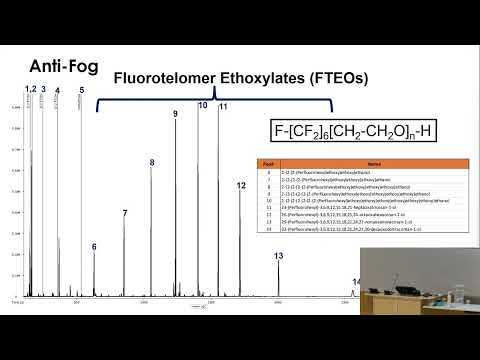
- Photo: MDCW: Exploring PFAS in Consumer Goods Using GCxGC and High-Resolution Mass Spectrometry (David Alonso, MDCW 2026)
- Video: LabRulez: David Alonso: Exploring PFAS in consumer goods using GCxGC-high-resolution mass spectrometry (MDCW 2026)
🎤 Presenter: David E. Alonso (LECO Corporation)
Abstract
Enormous quantities of Polyfluoro- and perfluoroalkyl substances (PFAS) have been produced through telomerization and electrochemical fluorination since the late 1940s. PFAS are a group of anthropogenic chemicals produced to improve the physical and chemical characteristics of products such as food packaging, cookware, textiles, paints, flame retardants, and stain-resistant clothing. PFAS increase heat, water, and oil resistance in these consumer products. Humans can be exposed to these harmful substances through ingestion and inhalation. Therefore, it is crucial that researchers screen these toxic chemicals on a regular basis. Unfortunately, monitoring hazardous chemicals such as persistent organic pollutants (POPs) is challenging due to the complexity of sample matrices. The goal of this study was to develop an analytical methodology for the comprehensive screening of complex samples for volatile and semi-volatile PFAS, as well as additional emerging contaminants.
The protocol included the application of effective sample introduction techniques, as well as the design of general data acquisition and processing strategies for quick analysis of a wide variety of consumer goods. Different ionization modes: 1) Electron Ionization (EI), 2) Positive Chemical Ionization (PCI), and 3) Negative Chemical Ionization (NCI). The rich GCxGC-HRTOFMS data were used to annotate different classes of PFAS and additional harmful chemicals.
Video Transcription
1) Background and objective
The presentation focuses on screening and characterizing PFAS-related compounds (including PFOS/PFAS components and related xenobiotics) in consumer products and consumables using GC, GC×GC, and high-resolution time-of-flight mass spectrometry.
PFAS-type chemicals are widely used in industry and are increasingly recognized as environmentally and health-relevant contaminants. The speaker’s broader work includes screening materials such as ski wax, specialty lubricants, dental floss, chewing gum, and anti-fog solutions.
The overall goal is to show:
- why high-resolution accurate-mass TOF is powerful for unknown identification, and
- how combining HRTOF-MS + GC×GC + advanced software tools enables fast, confident screening in complex matrices.
2) Instrumentation and sample preparation approach
Instruments used
- LECO Pegasus BTX (initial experiments)
- LECO Pegasus HRT (high-resolution TOF for accurate mass and improved confidence)
Sample preparation philosophy
The speaker emphasizes minimal sample manipulation, using:
- “Dilute and shoot” for liquid samples
- Thermal desorption, followed by pyrolysis (in separate steps) for solid/complex materials
3) Case study A: Anti-fog solutions (PFAS concerns and unknowns)
Motivation
Anti-fog products are commonly used (lab work, sports such as hockey/skiing). Prior reports suggested some anti-fog solutions may contain PFAS-related components.
Initial GC-MS results (BTX)
A simple chromatogram can appear “clean,” but deeper evaluation shows:
- multiple organic classes (e.g., alkanes/alkenes)
- a set of unknown major components, which became the key focus
- limited library coverage for PFAS at the time (NIST version constraints were mentioned)
The speaker identified a handful of compounds through automated processing, but many peaks remained unidentified (not found in NIST/Wiley/ChemSpider).
Why high resolution was needed
One compound of interest (“X”) produced:
- poor library match quality (“ridiculous” similarity score)
- insufficient spectral clarity for confident identification
HRTOF-MS advantages highlighted
With HRTOF-MS the speaker gains:
- accurate mass (high precision mass values)
- ability to compute elemental formulas for ions/fragments
- RDBE / ring double bond equivalence to support structural reasoning
- multiple ionization modes:
- EI (electron ionization)
- CI (chemical ionization), positive and negative
Key step: Switching to CI for molecular ion information
The speaker notes EI spectra may be “skinny” (limited informative ions), while CI can provide:
- a strong protonated molecular ion with excellent mass accuracy
- useful methane-CI adduct patterns (e.g., M+29, M+41)
- isotopic fidelity scoring (confidence metric; values above a high threshold indicate strong agreement between theoretical and observed isotope patterns)
External database search to propose structure
Even with formula confidence, structure identification required:
- literature context (a specific paper was used as a clue)
- searching the EPA CompTox library
- narrowing to a small set of candidate structures
- combining evidence from formula + fragmentation patterns (including signs of glycol-like substructures such as repeated CH₂CH₂O motifs)
Extending logic to other unknowns
Once compound “X” was tentatively assigned, related unknowns (e.g., peaks 6–14) could be approached systematically by:
- analyzing recurring fragment motifs
- applying complementary CI data
- assigning consistent series behavior
The speaker reports annotating the unknown series as polyfluorinated ethoxylate-type compounds, based on combined evidence and pattern relationships.
4) Case study B: Chewing gum (extreme matrix complexity and false positives)
Why chewing gum?
Chewing gum was unexpectedly complex and served as a strong example of:
- heavy thermal degradation (especially for sugar-containing gums)
- a wide concentration dynamic range
- analytes of interest present at very low levels, making screening difficult
A key lesson: Library matches can mislead
The speaker reports seeing apparent PFAS hits with decent match scores (around the “confidence” range many users might accept), but calls them false positives due to:
- “skinny” spectra lacking molecular ion evidence
- insufficient confirmation without accurate-mass + ionization support and advanced screening logic
5) The “ultimate” workflow: HRTOF-MS + GC×GC + software-driven screening
The speaker describes the strongest approach as a combination of:
- GC×GC (better separation and pattern recognition in complex mixtures)
- HR accurate mass (formula-level confidence)
- software tools that enable fast triage without manual peak-table review
Screening strategy (needle-in-a-haystack)
Instead of relying purely on automated peak finding (often unreliable for trace levels), the speaker uses a multi-step spectral approach:
- Sum ions across the GC×GC contour plot to capture the full complexity
- Build a mass defect plot:
- y-axis: mass defect
- x-axis: accurate mass
- Target entire PFAS fragment series at once:
- uses known spacing (e.g., CF₂ repeat patterns with consistent mass spacing)
- targets both “tail” fragments and “head” fragments (e.g., acrylate-related head groups)
- Use specialized visualization (e.g., scaled mass defect plots) to make the PFAS-related ion series appear clearly aligned and easy to spot
After locating candidate signals, the workflow moves to confirmation.
6) Confirmation logic: EI + CI (positive and negative) in “discovery mode”
The speaker’s standard operational mode is:
- acquire EI, then automatically acquire CI positive and CI negative
- if EI lacks a molecular ion, CI often provides:
- protonated molecular ion
- isotope-pattern confirmation via isotopic fidelity
- accurate-mass formula confirmation
If needed, final confirmation can be achieved by:
- purchasing and running a reference standard, when available
7) Results from chewing gum screening
Using the described approach, the speaker reports:
- identifying many gum constituents (sweeteners, flavor compounds such as terpenes in spearmint gum, softeners like glycerol and glycerides, and lipid-related compounds)
- probing the gum base by increasing thermal conditions (e.g., higher temperatures revealing polymer degradation products)
- evidence consistent with gum-base polymer components (example given: degradation products associated with polyisobutylene, such as isobutene and oligomers)
PFAS conclusion for gum samples
For the gum samples tested (including gum, wrapper, and box):
- PFAS-related compounds were not detected (good news)
8) Take-home messages
- HRTOF-MS is essential for unknown characterization, especially when libraries are incomplete.
- EI alone can be misleading, particularly for trace components and when spectra are information-poor (“skinny”).
- CI (positive/negative) adds decisive molecular-ion and formula confidence.
- GC×GC + HR accurate mass + mass defect workflows enable rapid screening for PFAS (and other POPs) without manually grinding through peak tables.
- The workflow is broadly applicable for screening PFAS and other trace pollutant classes such as PCBs and persistent organic pollutants.
This text has been automatically transcribed from a video presentation using AI technology. It may contain inaccuracies and is not guaranteed to be 100% correct.
-Workshop-LOGO_s.webp)