Webinars LabRulezGCMS Week 09/2026
LabRulez: Webinars LabRulezGCMS Week 09/2026
In the week of February 23, the following webinars await you in the field of gas / solid phase and especially Raman, FTIR, GC and GC/MS.
👉 DETAILS AND REGISTRATION IN THE WEBINARS SECTION
👉 Search and filter in the largest global database with over 5 500 GC, LC, MS and spectroscopy webinars.
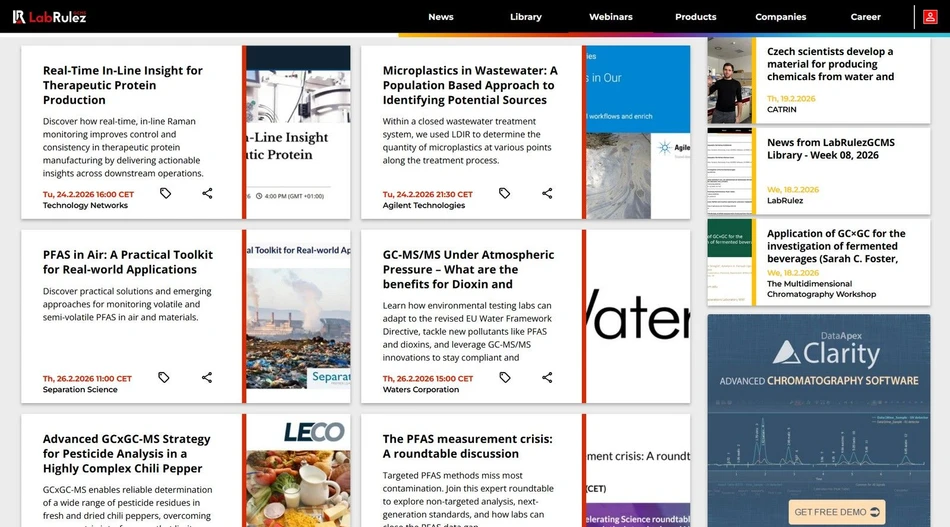
1. Technology Networks: Real-Time In-Line Insight for Therapeutic Protein Production
- Tu, 24.2.2026 16:00 CET
- Registration
Discover how real-time, in-line Raman monitoring improves control and consistency in therapeutic protein manufacturing by delivering actionable insights across downstream operations.
2. Agilent Technologies: Microplastics in Wastewater – A Population Based Approach to Identifying Potential Sources
- Tu, 24.2.2026 21:30 CET
- Registration
Using LDIR within a closed wastewater treatment system, this webinar explores how microplastics are quantified at multiple treatment stages to identify potential contamination sources.
3. Separation Science: PFAS in Air – A Practical Toolkit for Real-World Applications
- Th, 26.2.2026 11:00 CET
- Registration
Discover practical solutions and emerging approaches for monitoring volatile and semi-volatile PFAS in air and materials.
4. Waters Corporation: GC-MS/MS Under Atmospheric Pressure – Benefits for Dioxin and Pyrethroid Analysis
- Th, 26.2.2026 15:00 CET
- Registration
Learn how environmental labs can adapt to revised EU Water Framework Directive requirements, address pollutants like PFAS and dioxins, and leverage GC-MS/MS innovations.
5. LECO: Advanced GC×GC-MS Strategy for Pesticide Analysis in a Highly Complex Chili Pepper Matrix
- Th, 26.2.2026 16:00 CET
- Registration
Discover how GC×GC-MS enables reliable determination of pesticide residues in complex chili pepper matrices by overcoming severe interferences that limit conventional GC-MS/MS.
6. SelectScience: The PFAS Measurement Crisis – A Roundtable Discussion
- Fr, 27.2.2026 17:00 CET
- Registration
Join this expert roundtable to discuss limitations of targeted PFAS methods, non-targeted analysis strategies, next-generation standards, and closing the PFAS data gap.