GCMS
More information
WebinarsAbout usContact usTerms of use
LabRulez s.r.o. All rights reserved. Content available under a CC BY-SA 4.0 Attribution-ShareAlike
Author
Phenomenex
Phenomenex
Phenomenex is a global technology leader committed to developing novel analytical chemistry solutions that solve the separation and purification challenges of researchers in industrial, government and academic laboratories.
Tags
Article
Academy
LinkedIn Logo

Why Is It Necessary to Dry the SPE Sorbent Before Elution?

We, 18.2.2026
| Original article from: Phenomenex
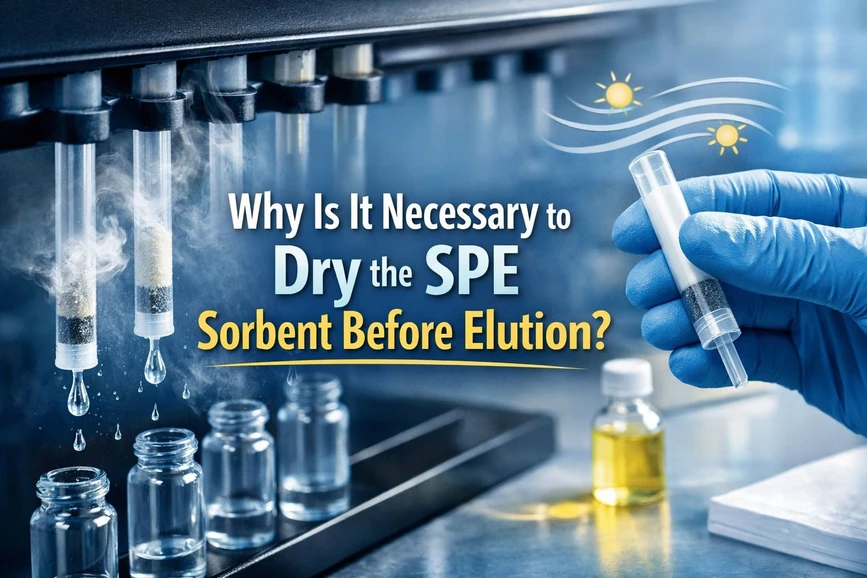
Proper drying of the SPE sorbent is a critical step to achieve high sensitivity, good reproducibility, and maximum analyte recovery, especially for complex sample matrices.
<p><strong>Phenomenex:</strong> Why Is It Necessary to Dry the SPE Sorbent Before Elution?</p>

Phenomenex: Why Is It Necessary to Dry the SPE Sorbent Before Elution?

Solid Phase Extraction (SPE) is one of the most highly selective sample preparation methods, meaning that the targeted analytes and their matrices must be considered when choosing the correct SPE sorbent and format. Drying down the sorbent before elution is an important step.

  • Wash solvents are used to flush out unwanted compounds (i.e., contaminants). If the wash solvent is not completely removed, then residual wash solvent could contaminate the final elution.
  • If you do not dry the SPE sufficiently, it could make the final solution less concentrated and result in a reduction in sensitivity.
  • Drying helps physically break down the interactions between the sorbent and analyte for a more concentrated extract.

After the wash solvent has been passed through the cartridge, continue to apply negative pressure (vacuum) or positive pressure. Use this pressure to dry the cartridge for 2 to 5 minutes (or until dry). Turn off the pressure and wipe the tips of the manifold needles to remove any residual solvent.

Notes
  1. Reproducibility: Drying removes traces of residual sample/matrix and wash solvent from the sorbent. This produces a more concentrated final extract with a consistent volume and composition and yields better reproducibility and higher recoveries.
  2. Immiscibility: Drying is especially critical when using elution solvents that are immiscible with water (e.g. hexane, ethyl acetate, and methylene chloride). Residual water in the sorbent bed may prevent dissolution of the analyte in the elution solvent, resulting in low recoveries and irreproducibility.
  3. Over-drying: Avoid over-drying the sorbent, since in some cases, analyte recovery may decrease with excessive vacuum or drying times above 5 minutes. Dry cartridges look distinctly different from moist ones. Make a note of the cartridge appearance before and after conditioning. Also, you could touch the cartridge while it is drying; wet cartridges feel colder than dry cartridges. 
Phenomenex
LinkedIn Logo
 

Related content

Analysis of Aroma Components in Apples Using the Smart Aroma Database

Applications
| 2026 | Shimadzu
Instrumentation
GC/MSD, GC/SQ, HeadSpace
Manufacturer
Shimadzu
Industries
Food & Agriculture

Analysis of Acetaldehyde and Limonene in Recycled PET Using an HS-GCMS System (Carrier Gas: H2)

Applications
| 2026 | Shimadzu
Instrumentation
GC/MSD, GC/SQ, HeadSpace
Manufacturer
Shimadzu
Industries
Energy & Chemicals

What Causes GC Capillary Column Performance Degradation, and How Can I Prevent It?

Technical notes
| 2026 | Agilent Technologies
Instrumentation
Consumables, GC columns
Manufacturer
Agilent Technologies
Industries
Other

Aromatic Component Analysis of Gasoline According to ASTM D5580 Using the Brevis GC- 2050 Gas Chromatograph

Applications
| 2025 | Shimadzu
Instrumentation
GC
Manufacturer
Shimadzu
Industries
Energy & Chemicals

Micro GC Analysis of Permanent Gas Impurities in PEM Fuel Cell-Grade Hydrogen

Applications
| 2025 | Agilent Technologies
Instrumentation
GC
Manufacturer
Agilent Technologies
Industries
Energy & Chemicals
 

Related articles

Hexane in Food: When Processing Chemistry Meets Public Health
Article | Health

Hexane in Food: When Processing Chemistry Meets Public Health

Hexane remains a key food extraction solvent, but EFSA now calls for re-evaluation of its long-term safety. Robust GC-FID and GC-MS methods are critical for reliable residue detection and risk assessment.
Thermo Fisher Scientific
tag
share
more
Introducing Headspace Gas Chromatography–Mass Spectrometry to Undergraduate Chemistry Students from a Forensic Toxicology Perspective
Scientific article | Science and research

Introducing Headspace Gas Chromatography–Mass Spectrometry to Undergraduate Chemistry Students from a Forensic Toxicology Perspective

This undergraduate experiment teaches headspace GC–MS using forensic toxicology analysis of volatiles, integrating calibration, data evaluation, and real-world analytical workflows.
LabRulez
tag
share
more
Application of GC×GC for the investigation of fermented beverages (Sarah C. Foster, MDCW 2026)
Presentation | Video

Application of GC×GC for the investigation of fermented beverages (Sarah C. Foster, MDCW 2026)

GC×GC-TOFMS reveals how yeast strain and honey concentration shape mead aroma. Learn the workflow from headspace sampling to PCA/PCoA/HCA, plus key VOC trends across fermentations.
The Multidimensional Chromatography Workshop
tag
share
more
News from LabRulezGCMS Library - Week 08, 2026
Article | Application

News from LabRulezGCMS Library - Week 08, 2026

This week we bring you technical note by Agilent Technologies, presentation by MDCW / C³AL and application notes by BaySpec and Shimadzu!
LabRulez
tag
share
more
 

Related content

Analysis of Aroma Components in Apples Using the Smart Aroma Database

Applications
| 2026 | Shimadzu
Instrumentation
GC/MSD, GC/SQ, HeadSpace
Manufacturer
Shimadzu
Industries
Food & Agriculture

Analysis of Acetaldehyde and Limonene in Recycled PET Using an HS-GCMS System (Carrier Gas: H2)

Applications
| 2026 | Shimadzu
Instrumentation
GC/MSD, GC/SQ, HeadSpace
Manufacturer
Shimadzu
Industries
Energy & Chemicals

What Causes GC Capillary Column Performance Degradation, and How Can I Prevent It?

Technical notes
| 2026 | Agilent Technologies
Instrumentation
Consumables, GC columns
Manufacturer
Agilent Technologies
Industries
Other

Aromatic Component Analysis of Gasoline According to ASTM D5580 Using the Brevis GC- 2050 Gas Chromatograph

Applications
| 2025 | Shimadzu
Instrumentation
GC
Manufacturer
Shimadzu
Industries
Energy & Chemicals

Micro GC Analysis of Permanent Gas Impurities in PEM Fuel Cell-Grade Hydrogen

Applications
| 2025 | Agilent Technologies
Instrumentation
GC
Manufacturer
Agilent Technologies
Industries
Energy & Chemicals
 

Related articles

Hexane in Food: When Processing Chemistry Meets Public Health
Article | Health

Hexane in Food: When Processing Chemistry Meets Public Health

Hexane remains a key food extraction solvent, but EFSA now calls for re-evaluation of its long-term safety. Robust GC-FID and GC-MS methods are critical for reliable residue detection and risk assessment.
Thermo Fisher Scientific
tag
share
more
Introducing Headspace Gas Chromatography–Mass Spectrometry to Undergraduate Chemistry Students from a Forensic Toxicology Perspective
Scientific article | Science and research

Introducing Headspace Gas Chromatography–Mass Spectrometry to Undergraduate Chemistry Students from a Forensic Toxicology Perspective

This undergraduate experiment teaches headspace GC–MS using forensic toxicology analysis of volatiles, integrating calibration, data evaluation, and real-world analytical workflows.
LabRulez
tag
share
more
Application of GC×GC for the investigation of fermented beverages (Sarah C. Foster, MDCW 2026)
Presentation | Video

Application of GC×GC for the investigation of fermented beverages (Sarah C. Foster, MDCW 2026)

GC×GC-TOFMS reveals how yeast strain and honey concentration shape mead aroma. Learn the workflow from headspace sampling to PCA/PCoA/HCA, plus key VOC trends across fermentations.
The Multidimensional Chromatography Workshop
tag
share
more
News from LabRulezGCMS Library - Week 08, 2026
Article | Application

News from LabRulezGCMS Library - Week 08, 2026

This week we bring you technical note by Agilent Technologies, presentation by MDCW / C³AL and application notes by BaySpec and Shimadzu!
LabRulez
tag
share
more
 

Related content

Analysis of Aroma Components in Apples Using the Smart Aroma Database

Applications
| 2026 | Shimadzu
Instrumentation
GC/MSD, GC/SQ, HeadSpace
Manufacturer
Shimadzu
Industries
Food & Agriculture

Analysis of Acetaldehyde and Limonene in Recycled PET Using an HS-GCMS System (Carrier Gas: H2)

Applications
| 2026 | Shimadzu
Instrumentation
GC/MSD, GC/SQ, HeadSpace
Manufacturer
Shimadzu
Industries
Energy & Chemicals

What Causes GC Capillary Column Performance Degradation, and How Can I Prevent It?

Technical notes
| 2026 | Agilent Technologies
Instrumentation
Consumables, GC columns
Manufacturer
Agilent Technologies
Industries
Other

Aromatic Component Analysis of Gasoline According to ASTM D5580 Using the Brevis GC- 2050 Gas Chromatograph

Applications
| 2025 | Shimadzu
Instrumentation
GC
Manufacturer
Shimadzu
Industries
Energy & Chemicals

Micro GC Analysis of Permanent Gas Impurities in PEM Fuel Cell-Grade Hydrogen

Applications
| 2025 | Agilent Technologies
Instrumentation
GC
Manufacturer
Agilent Technologies
Industries
Energy & Chemicals
 

Related articles

Hexane in Food: When Processing Chemistry Meets Public Health
Article | Health

Hexane in Food: When Processing Chemistry Meets Public Health

Hexane remains a key food extraction solvent, but EFSA now calls for re-evaluation of its long-term safety. Robust GC-FID and GC-MS methods are critical for reliable residue detection and risk assessment.
Thermo Fisher Scientific
tag
share
more
Introducing Headspace Gas Chromatography–Mass Spectrometry to Undergraduate Chemistry Students from a Forensic Toxicology Perspective
Scientific article | Science and research

Introducing Headspace Gas Chromatography–Mass Spectrometry to Undergraduate Chemistry Students from a Forensic Toxicology Perspective

This undergraduate experiment teaches headspace GC–MS using forensic toxicology analysis of volatiles, integrating calibration, data evaluation, and real-world analytical workflows.
LabRulez
tag
share
more
Application of GC×GC for the investigation of fermented beverages (Sarah C. Foster, MDCW 2026)
Presentation | Video

Application of GC×GC for the investigation of fermented beverages (Sarah C. Foster, MDCW 2026)

GC×GC-TOFMS reveals how yeast strain and honey concentration shape mead aroma. Learn the workflow from headspace sampling to PCA/PCoA/HCA, plus key VOC trends across fermentations.
The Multidimensional Chromatography Workshop
tag
share
more
News from LabRulezGCMS Library - Week 08, 2026
Article | Application

News from LabRulezGCMS Library - Week 08, 2026

This week we bring you technical note by Agilent Technologies, presentation by MDCW / C³AL and application notes by BaySpec and Shimadzu!
LabRulez
tag
share
more
 

Related content

Analysis of Aroma Components in Apples Using the Smart Aroma Database

Applications
| 2026 | Shimadzu
Instrumentation
GC/MSD, GC/SQ, HeadSpace
Manufacturer
Shimadzu
Industries
Food & Agriculture

Analysis of Acetaldehyde and Limonene in Recycled PET Using an HS-GCMS System (Carrier Gas: H2)

Applications
| 2026 | Shimadzu
Instrumentation
GC/MSD, GC/SQ, HeadSpace
Manufacturer
Shimadzu
Industries
Energy & Chemicals

What Causes GC Capillary Column Performance Degradation, and How Can I Prevent It?

Technical notes
| 2026 | Agilent Technologies
Instrumentation
Consumables, GC columns
Manufacturer
Agilent Technologies
Industries
Other

Aromatic Component Analysis of Gasoline According to ASTM D5580 Using the Brevis GC- 2050 Gas Chromatograph

Applications
| 2025 | Shimadzu
Instrumentation
GC
Manufacturer
Shimadzu
Industries
Energy & Chemicals

Micro GC Analysis of Permanent Gas Impurities in PEM Fuel Cell-Grade Hydrogen

Applications
| 2025 | Agilent Technologies
Instrumentation
GC
Manufacturer
Agilent Technologies
Industries
Energy & Chemicals
 

Related articles

Hexane in Food: When Processing Chemistry Meets Public Health
Article | Health

Hexane in Food: When Processing Chemistry Meets Public Health

Hexane remains a key food extraction solvent, but EFSA now calls for re-evaluation of its long-term safety. Robust GC-FID and GC-MS methods are critical for reliable residue detection and risk assessment.
Thermo Fisher Scientific
tag
share
more
Introducing Headspace Gas Chromatography–Mass Spectrometry to Undergraduate Chemistry Students from a Forensic Toxicology Perspective
Scientific article | Science and research

Introducing Headspace Gas Chromatography–Mass Spectrometry to Undergraduate Chemistry Students from a Forensic Toxicology Perspective

This undergraduate experiment teaches headspace GC–MS using forensic toxicology analysis of volatiles, integrating calibration, data evaluation, and real-world analytical workflows.
LabRulez
tag
share
more
Application of GC×GC for the investigation of fermented beverages (Sarah C. Foster, MDCW 2026)
Presentation | Video

Application of GC×GC for the investigation of fermented beverages (Sarah C. Foster, MDCW 2026)

GC×GC-TOFMS reveals how yeast strain and honey concentration shape mead aroma. Learn the workflow from headspace sampling to PCA/PCoA/HCA, plus key VOC trends across fermentations.
The Multidimensional Chromatography Workshop
tag
share
more
News from LabRulezGCMS Library - Week 08, 2026
Article | Application

News from LabRulezGCMS Library - Week 08, 2026

This week we bring you technical note by Agilent Technologies, presentation by MDCW / C³AL and application notes by BaySpec and Shimadzu!
LabRulez
tag
share
more
Other projects
LCMS
ICPMS
Follow us
FacebookX (Twitter)LinkedInYouTube
More information
WebinarsAbout usContact usTerms of use
LabRulez s.r.o. All rights reserved. Content available under a CC BY-SA 4.0 Attribution-ShareAlike