News from LabRulezGCMS Library - Week 07, 2026
LabRulez: News from LabRulezGCMS Library - Week 07, 2026
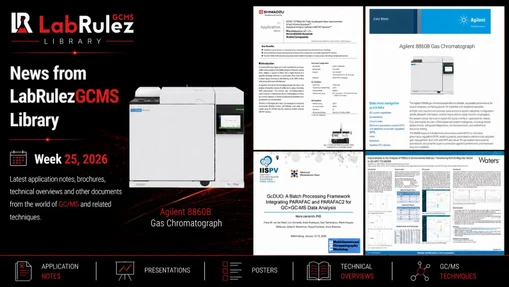
Our Library never stops expanding. What are the most recent contributions to LabRulezGCMS Library in the week of 9th February 2026? Check out new documents from the field of the gas phase, especially GC and GC/MS techniques!
👉 SEARCH THE LARGEST REPOSITORY OF DOCUMENTS ABOUT GCMS AND RELATED TECHNIQUES
👉 Need info about different analytical techniques? Peek into LabRulezLCMS or LabRulezICPMS libraries.
This week we bring you technical note by Agilent Technologies, presentation by MDCW / University of Copenhagen and application notes by Shimadzu and Thermo Fisher Scientific!
1. Agilent Technologies: What Causes Spots on PLOT Columns? Will It Affect the Performance of the Column?
- Technical note
- Full PDF for download
Spots on porous layer open tubular (PLOT) columns are caused by small voids in the stationary phase coating inside the tube. These spots are areas where there is an uneven coating or lack of phase. It is normal to find some voids in the phase coating of PLOT columns. The stationary phase in PLOT columns is an opaque, solid, and porous material. In many Agilent PLOT columns such as the GS-Alumina phases, molecular sieves, porous polymers (Q and U), and the GS-OxyPLOT, the stationary phase is visible as a white powder. For many PLOT columns, the stationary phase fill solution is a viscous suspension of particles that are less than 10 microns in diameter. The phase is coated using a dynamic process in which a plug of fill solution is pushed through the tubing, and the plug’s speed and viscosity determines the thickness of the stationary phase layer. Once the PLOT’s stationary phase is deposited, it is held in place by electrostatic charge, chemical interactions between particles, and/or binding agents. In wall‑coated open tubular (WCOT) columns, stationary phases such as polysiloxanes or polyethylene glycols are immobilized by chemical bonding to the glass surface and cross-linking between polymer strands. Because this type of bonding and cross‑linking is not possible with PLOT phases, the result is a stationary phase layer that is both fundamentally different and inherently less stable in PLOT columns than in WCOT columns.
2. MDCW / University of Copenhagen: One-shot tensor decomposition of full-scale GC×GC-VUV datasets for resolving petrochemical groups
- Presentation
- Full PDF for download
The presentation introduces a novel all-samples-at-once, shift-invariant tri-linear tensor decomposition approach for the analysis of full-scale GC×GC-VUV datasets, aimed at resolving and quantifying petrochemical groups. Traditional template-based or pixel-based methods struggle with retention-time shifts and co-eluting compounds, often requiring manual intervention and prior chemical knowledge. The proposed approach leverages the intrinsic low-rank structure of GC×GC-VUV data to enable robust, automated group-level analysis across multiple samples simultaneously.
At the core of the method is a shift-invariant tri-linear model, conceptually related to PARAFAC and multivariate curve resolution, but extended using frequency-domain (FFT-based) modeling to explicitly account for chromatographic peak shifts. By decomposing the entire dataset in one step, the model provides accurate estimates of peak landscapes, VUV spectra, and relative peak areas, while remaining agnostic to retention-time variability. Importantly, the approach requires only a small number of tunable parameters, making it practical for routine use.
The method was demonstrated on a case study involving 14 petrochemical gas-oil samples, including straight-run, hydrotreated, hydroconverted, coker, and light cycle oils. Extracted VUV spectra showed excellent agreement with reference spectra from a VUV spectral database, enabling confident assignment of components to chemical groups such as saturates, olefins, and mono- to poly-aromatics. Quantitative results exhibited high repeatability (RSD typically 3–9%) and strong correlation with established template-based reference methods.
Overall, the work demonstrates that one-shot, shift-invariant tensor decomposition provides a powerful and scalable alternative to conventional GC×GC data-analysis strategies. By combining chemical interpretability, robustness to chromatographic shifts, and strong quantitative performance, the approach opens new opportunities for automated, high-confidence group-level analysis of complex petrochemical samples and beyond.
3. Shimadzu: Py-Screener Ver. 3: Simultaneously Test for Substances Regulated Under RoHS, TSCA, and POPs
- Application note
- Full PDF for download
User Benefits
- In just one analysis, Py-Screener Ver. 3 can determine levels of phthalate esters, brominated flame retardants (PBBs, PBDEs), PIP (3:1), UV-328, dechlorane plus (DP), short-chain chlorinated paraffins (SCCPs), and medium-chain chlorinated paraffins (MCCPs).
- It can also test for SCCPs and MCCPs by electron ionization (EI) instead of negative chemical ionization (NCI).
- PIP (3:1), UV-328, DP, and SCCPs and MCCPs can be screened without the need for corresponding reference materials.
Countries and regulatory bodies worldwide are introducing increasingly stringent regulations on the chemical substances used in electronic devices and industrial products. The RoHS Directive and REACH regulations in the EU, the Toxic Substances Control Act (TSCA) in the USA, and the Stockholm Convention on Persistent Organic Pollutants (POPs) are also targeting an increasingly broad range of substances. Therefore, manufacturers are required to accurately identify regulated substances in their products and comply with each regulation. While Py-Screener Ver. 2 can screen for seven phthalate esters and brominated flame retardants, including substances regulated under the RoHS Directive, version 3 can also screen for PIP (3:1), which is regulated under the TSCA, as well as UV328, DP, and SCCPs and MCCPs , which are regulated under the Stockholm Convention on POPs. A list of supported substances isshown in Table 1. This article introduces the simultaneous analysis of multiple regulated substances and a case study of testing specific regulated substances in samples, using Py-Screener Ver. 3.
Analysis Process
Py-Screener Ver. 3 can determine levels of phthalate esters and brominated flame retardants contained in products in accordance with the international analytical standards IEC62321-8 and IEC62321-3-3. It can also test for specific regulated substances (Table 1) under the same conditions and in the same analysis. In this test, background intensity and instrument sensitivity (S/N) were verified before analyzing samples. These parameters are prescribed by IEC62321-8 to ensure the accuracy of the methods used. Background intensity and instrument sensitivity were determined using a reference material (PN: 225-31003- 91) *1 that consisted of a plastic sheet that was spiked with seven phthalate esters. The results met the criteria for both parameters.
The testing workflow is shown in Fig. 1. Before testing samples, calibration curves were prepared by analyzing the 1000 mg/kg phthalate ester reference material and polypropylene spiked with brominated flame retardants (ERM-EC591). A hole puncher was used to punch out two discs at a time of the phthalate ester reference material, and a cutter was used to obtain pieces of the other materials. Each material was weighed in a sample cup for analysis. During the analysis of samples, phthalate esters and some of the regulated brominated flame retardants were quantitated using a one-point calibration curve. The remaining brominated flame retardants and specific regulated substances were quantitated using the correction factor database*2 that is included with Py-Screener Ver. 3.
Conclusion
Py-Screener Ver. 3 successfully determined in samples the concentrations of the regulated substances PIP (3:1), UV-328, DP, and SCCPs and MCCPs. Normally, SCCP and MCCP levels are tested using NCI, but Py-Screener Ver. 3 uses EI. This enables it to test for not only SCCPs and MCCPs but also phthalate esters, brominated flame retardants, and other regulated substances in just one analysis. In addition, by using the relative correction factors linked to DEHP in the phthalate ester reference material, the levels of these regulated substances were determined without the need for the corresponding reference materials. Py-Screener Ver. 3 can also create a screening program that addresses substance restrictions under the RoHS Directive, the US TSCA, and the POPs Convention.
4. Thermo Fisher Scientific: Improving low carbon steel production in specialty steel processes
- Application note
- Full PDF for download
World crude steel production reached 1,691 million tonnes in 2017, up by 5.3% compared to 2016.1 While much of this capacity is still produced in primary steel processes such as basic oxygen furnaces and electric arc furnaces, the need for refined steel with greater durability and resistance to heat and corrosion has led to the increased use of vacuum degassing processes, such as VOD and RH, in secondary steel production. These processes are able to achieve ultra-low levels of residual carbon, while at the same time retaining desired levels of other alloy materials. If these processes are to achieve the required level of steel product quality, they need fast, continuous gas analysis of the furnace exhaust gas. Without accurate information on the composition of the gas leaving the furnace, any variations in the decarburization process are only detected after the event, resulting in the production of out-of-specification steel.
Advantages of mass spectrometry
Traditional Non-Dispersive Infra-Red (NDIR) analyzers are used in many conventional steelmaking processes to measure CO and CO2 , but they can only sample at atmospheric pressure. In vacuum steelmaking the process pressure changes dramatically, typically from atmospheric pressure down to less than 1 mbar, over the 20-30 minutes of the melt. So NDIR analyzers have to sample some distance downstream from the process. Analytical data is updated several minutes after the gas leaves the melt and the control system is forced to operate on historic rather than real-time data.
Paramagnetic analyzers can be used to measure O2 , while thermal conductivity analyzers can be used to measure H2 . These analyzers also suffer from slow response, while the need to operate three different types of analyzers adds to the plant maintenance burden. Moreover, the three analyzers cannot analyze inert gases, so N2 is calculated by difference, a result that suffers from the sum of the errors of the three analytical techniques.
Mass spectrometry operates at high vacuum so it is ideal for monitoring vacuum processes. It is also able to monitor all seven components in Table 1 in seconds rather than minutes, ensuring the plant control model is frequently updated with accurate compositional data.
Precision of analysis
At the heart of the Thermo Scientific™ Prima PRO Mass Spectrometer (MS) is a magnetic sector analyzer which offers unrivalled precision and accuracy compared with other mass spectrometers. Thermo Fisher Scientific manufactures both quadrupole and magnetic sector mass spectrometers; over thirty years of industrial experience have shown the magnetic sector based analyzer offers the best performance for industrial on-line gas analysis.
Key advantages of magnetic sector analyzers include improved precision, accuracy, long intervals between calibrations, and resistance to contamination. Typically, analytical precision is between 2 and 10 times better than a quadrupole analyzer, depending on the gases analyzed and complexity of the mixture.
A unique feature of the Prima PRO magnet is that it is laminated. Its analysis times are similar to a quadrupole analyzer, offering the unique combination of rapid analysis and high stability. This allows the rapid and extremely stable analysis of an unlimited number of user-defined gases. The scanning magnetic sector is controlled with 24-bit precision using a magnetic flux measuring device for extremely stable mass alignment.
The ion source is an enclosed type for high sensitivity, minimum background interference, and maximum contamination resistance. This is a high-energy (1000 eV) analyzer that offers extremely rugged performance in the presence of gases and vapors that have the potential for contaminating the analyzer. Typical performance specifications for the Prima PRO MS are shown in Table 1. Analytical performance is demonstrated by analyzing the calibration bottle over 1 hour following calibration, with an analysis time of just 6 seconds. Standard deviations measured on the calibration cylinder will be equal to or better than the stated values.