Analysis of fresh and used aircraft oil: Exposure possibility to pollutants (Kevin Hayes, MDCW 2026)
- Photo: MDCW: AN ANALYSIS OF FRESH AND USED AIRCRAFT OIL: AN INDICATION OF EXPOSURE PATHWAY POSSIBILITY TO INORGANIC AND ORGANIC POLLUTANTS (Kevin Hayes, MDCW 2026)
- Video: LabRulez: Kevin Hayes: Analysis of fresh and used aircraft oil: Exposure possibility to pollutants (MDCW 2026)
🎤 Presenter: Kevin Hayes (Mount Royal University)
Abstract
An elemental analysis was conducted on matched pairs of new and used aircraft engine oils for various aircraft engine types (piston, turboprop, and jet). The analysis aimed to determine what, if any, accumulation or loss of oil and fuel additives may occur with engine use. Losses in elemental loadings from new to used oils imply that there may be a possibility for the element-containing compounds to enter the pneumatic system of bleed air pressurized aircraft at a higher rate than that of oil attrition and potentially impact cabin air quality. Inductively Coupled Plasma Optical Emission Spectroscopy (ICP OES) was employed to complete the elemental analysis, and results describe a greater than twenty percent loss of phosphorus from new to used jet oils and a significant accumulation of lead in the oil of piston aircraft (Range: below LOD to 6821 ± 83 mg kg-1 ; n=2).
In an effort to speciate and identify compounds of concern, the oil samples were introduced to a flow modulated GCxGC-TOFMS (SepSolv BenchTOF). Data was analyzed utilizing Chromspace and Analyzer Pro XD. The new and used oils were compared, and compounds exclusive to the used oils were screened to determine the possibility of increased risk associated with hazardous accumulations in the used oil. This used oil, which is adulterated by either amendment or contamination, is not fully described to individuals who may interact with the product, and therefore an apparent risk is potentially unmitigated.
Video transcription
2. Background: Aircraft Engine Oils
Aircraft engine oils are chemically complex and vary depending on:
- Manufacturer
- Aircraft type
- Engine type
2.1 Piston Engine Oils
- Typically mineral oil-based
- Simpler formulations
- Lower temperature and pressure requirements
2.2 Jet and Turboprop Oils
- Often based on pentaerythritol esters
- Contain organophosphate additives
- Designed to withstand high temperatures and pressures
- May include aftermarket additives (sometimes required by FAA airworthiness directives)
3. Engine Types and Fuels
The study included oils from:
- Jet aircraft
- Turboprop aircraft
- Piston engine aircraft
3.1 Fuel Differences
- Jet and turboprop aircraft
- Jet A (U.S.)
- Jet A-1 (international)
- Jet B (naphtha-based, cold climates)
- Kerosene-based fuels
- Piston aircraft
- Use aviation gasoline (avgas)
- Notably contains tetraethyl lead (anti-knock additive)
3.2 Engine Construction Differences
- Jet/turboprop engines:
- Contain superalloys (steel alloys with molybdenum, nickel, etc.)
- Piston engines:
- Simpler construction
- No need for high-temperature superalloys
4. Purpose of the Study
The research aimed to determine:
- Whether compounds are lost from oils during use
- Whether oils accumulate new compounds during service
- Whether these changes pose occupational health risks
- Whether lost compounds could enter aircraft cabins via bleed air pathways (jet/turboprop engines)
5. Elemental Analysis (ICP-OES)
5.1 Sample Collection
- Used oils from:
- University aviation fleet (piston aircraft)
- Airport partners (turboprop)
- European business jet operator (limited jet samples)
5.2 Analytical Technique
- Inductively Coupled Plasma Optical Emission Spectroscopy (ICP-OES)
6. Results: Wear Metals
Fresh oil:
- No wear metals detected (as expected)
Used piston oils:
- Increased iron and nickel (expected wear metals)
- Cadmium detected (potential concern)
Used jet/turboprop oils:
- Lower wear metals overall
- Presence of molybdenum (consistent with superalloys)
7. Unexpected Findings
7.1 Sulfur
- Increased sulfur in piston oils
- Expected due to aviation fuel allowances
7.2 Lead (Major Finding)
- Extremely high levels (>6000 mg/kg)
- Lead content 7–8× higher in oil than in avgas
- Oil actively accumulates lead from combustion
Source:
- Tetraethyl lead in aviation gasoline
8. Phosphorus Trends
8.1 Piston Engines
- ~600 ppm phosphorus detected
- Source unclear (likely additive-related)
8.2 Jet and Turboprop Engines
- Phosphorus levels decreased during use
- Likely linked to organophosphate additive depletion
- Important because:
- Phosphorus stabilizes oil at high temperatures
- Loss may indicate additive degradation
- Possible availability to bleed air pathway
Note: Large jet aircraft often do not undergo traditional oil changes; oil is replenished continuously.
9. GC×GC Analysis
9.1 Method
- Oil diluted in hexane
- High split ratio
- Instrumentation:
- Agilent 7890 GC
- Insight flow modulator
- Benchtop mass spectrometer
- Hard ionization (70 eV)
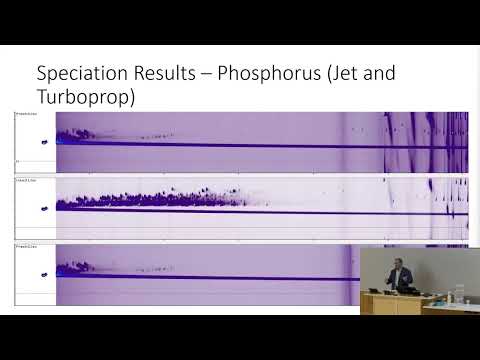
10. Organo-Phosphate Speciation
10.1 Jet and Turboprop Oils
Detected:
- Tricresyl phosphate (TCP) isomers
- Tri-meta-cresyl phosphate
- Tri-para-cresyl phosphate
Unknown peaks:
- Likely additional TCP isomers
Important:
- No confirmation yet of ortho-TCP
- Ortho-TCP is neurotoxic
- Historically responsible for "Jake Leg Syndrome"
Conclusion:
Phosphorus loss likely linked to degradation of TCP molecules.
11. Oil Complexity After Use
Used oils showed:
- Increased chromatographic complexity
- More peaks in early chromatogram
- Likely degradation/pyrolysis products of pentaerythritol esters
Work ongoing to identify these products.
12. Lead Speciation
12.1 Tetraethyl Lead Behavior
Characteristics:
- Early elution (low boiling point)
- Distinctive fragmentation pattern
- Easy to identify
Finding:
- No tetraethyl lead detected in used oils
Implication:
- Likely fully degraded during combustion
- Remaining species likely lead oxide
- Still toxic, but less dermally bioavailable than tetraethyl lead
13. Phosphorus in Piston Oils
Expected:
- Tricresyl phosphate (TCP)
Observed:
- Triphenyl phosphate
- Possibly tert-butyl phenyl diphenyl phosphate (tentative identification)
Significance:
- Different compound than expected
- Less hazardous than ortho-TCP
- 2D separation critical to avoid misidentification
14. Overall Conclusions
- Aircraft engine oils are chemically dynamic
- Oils change significantly during service
- Accumulation (e.g., lead) and depletion (e.g., phosphorus additives) both occur
- Used oil composition differs from safety data sheet composition
- ICP-OES provides screening-level insight
- GC×GC enables detailed compound-level resolution
The aviation oil space remains a promising area for continued research.
This text has been automatically transcribed from a video presentation using AI technology. It may contain inaccuracies and is not guaranteed to be 100% correct.
-Workshop-LOGO_s.webp)


_s.webp)