GCMS
More information
WebinarsAbout usContact usTerms of use
LabRulez s.r.o. All rights reserved. Content available under a CC BY-SA 4.0 Attribution-ShareAlike
Author
The Multidimensional Chromatography Workshop
The Multidimensional Chromatography (MDC) Workshop draws experts in this exciting field to share and discuss their research.
Tags
Presentation
Video
LinkedIn Logo

Discovery analysis for GCxGC trends using alteration and 2D correlation (Chris Freye, MDCW 2026)
We, 11.2.2026
| Original article from: The Multidimensional Chromatography (MDC) Workshop
Advanced chemometric methods reveal subtle, statistically significant changes in complex GC×GC-MS and LC-MS data. Learn how Alteration Analysis and 2D correlation turn massive datasets into actionable insights.
Video placeholder
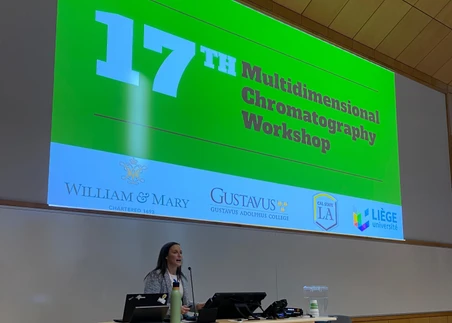
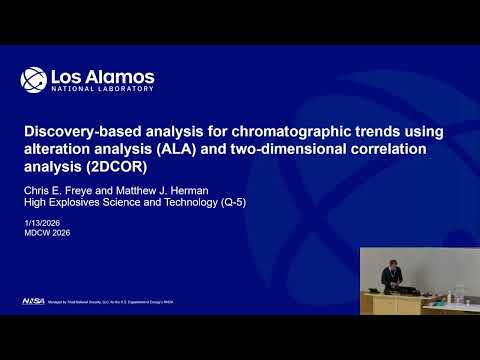
  • Photo: MDCW: Discovery-based analysis for chromatographic trends using alteration analysis (ALA) and two-dimensional correlation analysis (2DCOR) (Chris Freye, MDCW 2026)
  • Video: LabRulez: Chris Freye: Discovery analysis for GCxGC trends using alteration and 2D correlation (MDCW 2026)

🎤 Presenter: Christopher Freye (Los Alamos National Laboratory)

💾 PDF presentation

Abstract

Two-dimensional gas chromatography (GC×GC) when coupled with mass spectrometry (MS) especially high-resolution mass spectrometry (HRMS) provides the ideal technique to discover minute chemical changes. However, GC×GC analyses result in extremely large datasets (GBs of information) wherein the statistically significant chemical changes are buried within the background chemical matrix. To combat these issues, many chemometric techniques have been developed or applied. Recently we introduced a new chemometric technique for GC-MS termed alteration analysis (ALA) and two-dimensional correlation (2DCOR) which can be used to discover statistically significant chemical changes across a series of chromatograms and understand the relationship between the statistically relevant changes. ALA generates three sets of information, the basic alteration map (BAM) which is the magnitude of the change, the synchronous alteration map (SAM) which describes the linear change, and the asynchronous alteration map (AAM) which describes the non-linear change. 2DCOR can then be used to understand the relationship between the chemical changes but 2DCOR can also resolve the sequence of the changes. A workflow for GC×GC-MS will be demonstrated. Special attention will be given to what differentiates the GC×GC work flow from GC for both the ALA and 2DCOR.

Video Transcription

The presentation focuses on how advanced mathematical and chemometric methods can be used to extract meaningful information from highly complex chromatographic data, especially in multidimensional chromatography coupled with mass spectrometry (GC×GC-MS, LC-MS).

Why traditional data analysis falls short

Modern multidimensional chromatography generates extremely large datasets, often containing billions of data points. Visual inspection, peak tables, or classical identification-based workflows are impractical—especially when:

  • Samples are highly complex (e.g. petroleum, metabolomics, high explosives)
  • Most compounds are unknown unknowns
  • The key question is not what the compounds are, but whether samples differ and how

Program managers and decision-makers are primarily interested in detecting statistically significant changes, not exhaustive compound identification.

Introduction of Alteration Analysis (ALA)

To address subtle, trend-based changes across series of chromatograms, the speaker introduces Alteration Analysis (ALA), a chemometric approach adapted from spectroscopy and applied to chromatography.

ALA quantitatively evaluates how individual data points change across multiple samples, allowing detection of:

  • Extremely subtle trends
  • Overlapping peaks
  • Changes hidden in noise or baseline interference

Key ALA outputs include:

  • BAM (Basic Alteration Map): magnitude of change
  • SAM (Systematic Alteration Map): linear changes
  • AM (Alteration Map): nonlinear changes

Even changes as small as 1% per sample can be detected reliably, including peaks that are heavily overlapped.

Beyond detection: understanding relationships with 2D Correlation

Once statistically significant changes are identified, two-dimensional correlation analysis (2D-COR) is used to understand relationships between changing compounds, including:

  • Whether compounds are correlated or anti-correlated
  • The sequence of changes over time (which changes happen first)

This is especially critical for degradation and aging studies, where intermediate species may appear and disappear before the final state—information that traditional methods like Fisher ratio or PCA often miss.

Solving GC×GC challenges with tiling

GC×GC data introduces additional challenges due to:

  • Peak misalignment
  • Exponential data growth during correlation calculations

The presenter explains how tile-based approaches reduce data dimensionality, overcome alignment issues, and make ALA and 2D correlation computationally feasible—even for massive GC×GC-MS datasets.

Real-world application: explosive aging studies

The methodology was applied to aging and decomposition of high explosives, where:

  • Over 250 chemical changes were identified
  • Many intermediate species would have been missed using traditional comparisons
  • ALA combined with 2D correlation enabled reconstruction of degradation pathways
  • The most significant change was not necessarily the first change, a critical insight for risk assessment and stability studies

Key takeaway

By combining Alteration Analysis and 2D correlation, the approach:

  • Detects statistically guaranteed chemical changes
  • Handles subtle, overlapped, and noisy signals
  • Determines magnitude, type, interrelationships, and order of changes
  • Shifts chromatographic data analysis from identification-driven to decision-driven

This math-driven workflow enables faster, more reliable interpretation of complex chromatographic datasets and provides actionable insights for applications such as explosive aging, pharmaceutical degradation, and complex mixture analysis.

This text has been automatically transcribed from a video presentation using AI technology. It may contain inaccuracies and is not guaranteed to be 100% correct.

The Multidimensional Chromatography Workshop
LinkedIn Logo
 

Related content

Analysis of Aroma Components in Apples Using the Smart Aroma Database

Applications
| 2026 | Shimadzu
Instrumentation
GC/MSD, GC/SQ, HeadSpace
Manufacturer
Shimadzu
Industries
Food & Agriculture

Analysis of Acetaldehyde and Limonene in Recycled PET Using an HS-GCMS System (Carrier Gas: H2)

Applications
| 2026 | Shimadzu
Instrumentation
GC/MSD, GC/SQ, HeadSpace
Manufacturer
Shimadzu
Industries
Energy & Chemicals

What Causes GC Capillary Column Performance Degradation, and How Can I Prevent It?

Technical notes
| 2026 | Agilent Technologies
Instrumentation
Consumables, GC columns
Manufacturer
Agilent Technologies
Industries
Other

Aromatic Component Analysis of Gasoline According to ASTM D5580 Using the Brevis GC- 2050 Gas Chromatograph

Applications
| 2025 | Shimadzu
Instrumentation
GC
Manufacturer
Shimadzu
Industries
Energy & Chemicals

Micro GC Analysis of Permanent Gas Impurities in PEM Fuel Cell-Grade Hydrogen

Applications
| 2025 | Agilent Technologies
Instrumentation
GC
Manufacturer
Agilent Technologies
Industries
Energy & Chemicals
 

Related articles

How to Protect Your GC Column - Part 2
Article | Academy

How to Protect Your GC Column - Part 2

How can you extend GC column lifetime and prevent contamination? Part 2 focuses on using liners with glass wool and proper column bake-out to maintain separation performance.
Phenomenex
tag
share
more
ISC 2026 Short Course 3 - Interpretation of Mass Spectra: Basic Introduction for Chromatographers
Article | Events

ISC 2026 Short Course 3 - Interpretation of Mass Spectra: Basic Introduction for Chromatographers

Short Course 3 at ISC 2026 offers a practical introduction to LC–MS spectral interpretation for chromatographers, covering ESI, APCI, APPI, adducts, isotope patterns, and MS/MS fundamentals.
International Symposium on Chromatography - (ISC)
tag
share
more
Eurachem/CITAC Workshop on Quality in Analytical Measurements 2026
Article | Events

Eurachem/CITAC Workshop on Quality in Analytical Measurements 2026

Eurachem Week 2026 brings training and workshops on measurement uncertainty, quality in analytical measurements, and results interpretation, combining theory, practical cases, and expert-led discussions.
Eurachem
tag
share
more
News from LabRulezGCMS Library - Week 07, 2026
Article | Application

News from LabRulezGCMS Library - Week 07, 2026

This week we bring you technical note by Agilent Technologies, presentation by MDCW/University of Copenhagen and application notes by Shimadzu and Thermo Fisher Scientific!
LabRulez
tag
share
more
 

Related content

Analysis of Aroma Components in Apples Using the Smart Aroma Database

Applications
| 2026 | Shimadzu
Instrumentation
GC/MSD, GC/SQ, HeadSpace
Manufacturer
Shimadzu
Industries
Food & Agriculture

Analysis of Acetaldehyde and Limonene in Recycled PET Using an HS-GCMS System (Carrier Gas: H2)

Applications
| 2026 | Shimadzu
Instrumentation
GC/MSD, GC/SQ, HeadSpace
Manufacturer
Shimadzu
Industries
Energy & Chemicals

What Causes GC Capillary Column Performance Degradation, and How Can I Prevent It?

Technical notes
| 2026 | Agilent Technologies
Instrumentation
Consumables, GC columns
Manufacturer
Agilent Technologies
Industries
Other

Aromatic Component Analysis of Gasoline According to ASTM D5580 Using the Brevis GC- 2050 Gas Chromatograph

Applications
| 2025 | Shimadzu
Instrumentation
GC
Manufacturer
Shimadzu
Industries
Energy & Chemicals

Micro GC Analysis of Permanent Gas Impurities in PEM Fuel Cell-Grade Hydrogen

Applications
| 2025 | Agilent Technologies
Instrumentation
GC
Manufacturer
Agilent Technologies
Industries
Energy & Chemicals
 

Related articles

How to Protect Your GC Column - Part 2
Article | Academy

How to Protect Your GC Column - Part 2

How can you extend GC column lifetime and prevent contamination? Part 2 focuses on using liners with glass wool and proper column bake-out to maintain separation performance.
Phenomenex
tag
share
more
ISC 2026 Short Course 3 - Interpretation of Mass Spectra: Basic Introduction for Chromatographers
Article | Events

ISC 2026 Short Course 3 - Interpretation of Mass Spectra: Basic Introduction for Chromatographers

Short Course 3 at ISC 2026 offers a practical introduction to LC–MS spectral interpretation for chromatographers, covering ESI, APCI, APPI, adducts, isotope patterns, and MS/MS fundamentals.
International Symposium on Chromatography - (ISC)
tag
share
more
Eurachem/CITAC Workshop on Quality in Analytical Measurements 2026
Article | Events

Eurachem/CITAC Workshop on Quality in Analytical Measurements 2026

Eurachem Week 2026 brings training and workshops on measurement uncertainty, quality in analytical measurements, and results interpretation, combining theory, practical cases, and expert-led discussions.
Eurachem
tag
share
more
News from LabRulezGCMS Library - Week 07, 2026
Article | Application

News from LabRulezGCMS Library - Week 07, 2026

This week we bring you technical note by Agilent Technologies, presentation by MDCW/University of Copenhagen and application notes by Shimadzu and Thermo Fisher Scientific!
LabRulez
tag
share
more
 

Related content

Analysis of Aroma Components in Apples Using the Smart Aroma Database

Applications
| 2026 | Shimadzu
Instrumentation
GC/MSD, GC/SQ, HeadSpace
Manufacturer
Shimadzu
Industries
Food & Agriculture

Analysis of Acetaldehyde and Limonene in Recycled PET Using an HS-GCMS System (Carrier Gas: H2)

Applications
| 2026 | Shimadzu
Instrumentation
GC/MSD, GC/SQ, HeadSpace
Manufacturer
Shimadzu
Industries
Energy & Chemicals

What Causes GC Capillary Column Performance Degradation, and How Can I Prevent It?

Technical notes
| 2026 | Agilent Technologies
Instrumentation
Consumables, GC columns
Manufacturer
Agilent Technologies
Industries
Other

Aromatic Component Analysis of Gasoline According to ASTM D5580 Using the Brevis GC- 2050 Gas Chromatograph

Applications
| 2025 | Shimadzu
Instrumentation
GC
Manufacturer
Shimadzu
Industries
Energy & Chemicals

Micro GC Analysis of Permanent Gas Impurities in PEM Fuel Cell-Grade Hydrogen

Applications
| 2025 | Agilent Technologies
Instrumentation
GC
Manufacturer
Agilent Technologies
Industries
Energy & Chemicals
 

Related articles

How to Protect Your GC Column - Part 2
Article | Academy

How to Protect Your GC Column - Part 2

How can you extend GC column lifetime and prevent contamination? Part 2 focuses on using liners with glass wool and proper column bake-out to maintain separation performance.
Phenomenex
tag
share
more
ISC 2026 Short Course 3 - Interpretation of Mass Spectra: Basic Introduction for Chromatographers
Article | Events

ISC 2026 Short Course 3 - Interpretation of Mass Spectra: Basic Introduction for Chromatographers

Short Course 3 at ISC 2026 offers a practical introduction to LC–MS spectral interpretation for chromatographers, covering ESI, APCI, APPI, adducts, isotope patterns, and MS/MS fundamentals.
International Symposium on Chromatography - (ISC)
tag
share
more
Eurachem/CITAC Workshop on Quality in Analytical Measurements 2026
Article | Events

Eurachem/CITAC Workshop on Quality in Analytical Measurements 2026

Eurachem Week 2026 brings training and workshops on measurement uncertainty, quality in analytical measurements, and results interpretation, combining theory, practical cases, and expert-led discussions.
Eurachem
tag
share
more
News from LabRulezGCMS Library - Week 07, 2026
Article | Application

News from LabRulezGCMS Library - Week 07, 2026

This week we bring you technical note by Agilent Technologies, presentation by MDCW/University of Copenhagen and application notes by Shimadzu and Thermo Fisher Scientific!
LabRulez
tag
share
more
 

Related content

Analysis of Aroma Components in Apples Using the Smart Aroma Database

Applications
| 2026 | Shimadzu
Instrumentation
GC/MSD, GC/SQ, HeadSpace
Manufacturer
Shimadzu
Industries
Food & Agriculture

Analysis of Acetaldehyde and Limonene in Recycled PET Using an HS-GCMS System (Carrier Gas: H2)

Applications
| 2026 | Shimadzu
Instrumentation
GC/MSD, GC/SQ, HeadSpace
Manufacturer
Shimadzu
Industries
Energy & Chemicals

What Causes GC Capillary Column Performance Degradation, and How Can I Prevent It?

Technical notes
| 2026 | Agilent Technologies
Instrumentation
Consumables, GC columns
Manufacturer
Agilent Technologies
Industries
Other

Aromatic Component Analysis of Gasoline According to ASTM D5580 Using the Brevis GC- 2050 Gas Chromatograph

Applications
| 2025 | Shimadzu
Instrumentation
GC
Manufacturer
Shimadzu
Industries
Energy & Chemicals

Micro GC Analysis of Permanent Gas Impurities in PEM Fuel Cell-Grade Hydrogen

Applications
| 2025 | Agilent Technologies
Instrumentation
GC
Manufacturer
Agilent Technologies
Industries
Energy & Chemicals
 

Related articles

How to Protect Your GC Column - Part 2
Article | Academy

How to Protect Your GC Column - Part 2

How can you extend GC column lifetime and prevent contamination? Part 2 focuses on using liners with glass wool and proper column bake-out to maintain separation performance.
Phenomenex
tag
share
more
ISC 2026 Short Course 3 - Interpretation of Mass Spectra: Basic Introduction for Chromatographers
Article | Events

ISC 2026 Short Course 3 - Interpretation of Mass Spectra: Basic Introduction for Chromatographers

Short Course 3 at ISC 2026 offers a practical introduction to LC–MS spectral interpretation for chromatographers, covering ESI, APCI, APPI, adducts, isotope patterns, and MS/MS fundamentals.
International Symposium on Chromatography - (ISC)
tag
share
more
Eurachem/CITAC Workshop on Quality in Analytical Measurements 2026
Article | Events

Eurachem/CITAC Workshop on Quality in Analytical Measurements 2026

Eurachem Week 2026 brings training and workshops on measurement uncertainty, quality in analytical measurements, and results interpretation, combining theory, practical cases, and expert-led discussions.
Eurachem
tag
share
more
News from LabRulezGCMS Library - Week 07, 2026
Article | Application

News from LabRulezGCMS Library - Week 07, 2026

This week we bring you technical note by Agilent Technologies, presentation by MDCW/University of Copenhagen and application notes by Shimadzu and Thermo Fisher Scientific!
LabRulez
tag
share
more
Other projects
LCMS
ICPMS
Follow us
More information
WebinarsAbout usContact usTerms of use
LabRulez s.r.o. All rights reserved. Content available under a CC BY-SA 4.0 Attribution-ShareAlike