GCMS
More information
WebinarsAbout usContact usTerms of use
LabRulez s.r.o. All rights reserved. Content available under a CC BY-SA 4.0 Attribution-ShareAlike
Author
RECETOX - Centrum pro výzkum toxických látek v prostředí
RECETOX (Research Centre for Toxic Compounds in the Environment) is an independent department of the Faculty of Science of Masaryk University in Brno, which has been established in 1983. RECETOX is focused on the research and education in cross-cutting area of Environment and Health. It addresses interactions among chemicals, environment, and biological systems, including consequences at local, regional, and global levels.
Tags
Article
Health
LinkedIn Logo

Revealing hidden chemicals at sea
We, 4.2.2026
| Original article from: RECETOX
Flame retardants were found throughout cruise ship interiors, with some areas showing much higher levels. A new RECETOX and NIVA study explores potential exposure risks for crew and passengers.
<p><strong>RECETOX: </strong>Revealing hidden chemicals at sea</p>

RECETOX: Revealing hidden chemicals at sea

Flame retardant chemicals help prevent fires and save lives. They are widely used in indoor spaces—from homes and offices to airplanes and cars. However, one environment has largely escaped scientific attention: the inside of cruise ships. These floating cities are packed with furniture, electronics, and synthetic materials, yet little is known about the chemicals passengers and crew may be exposed to during long voyages. 

In the largest study of its kind, researchers from RECETOX and the Norwegian Institute of Water Research (NIVA) examined indoor dust from three expedition cruise ships in the North Atlantic Ocean. The ships differed in age and renovation history. Dust samples were collected from a range of locations on each vessel, including cabins, common areas, and workspaces. Scientists analyzed dozens of flame retardants, including older chemicals that are now restricted in many countries and newer replacements that are still widely used. 

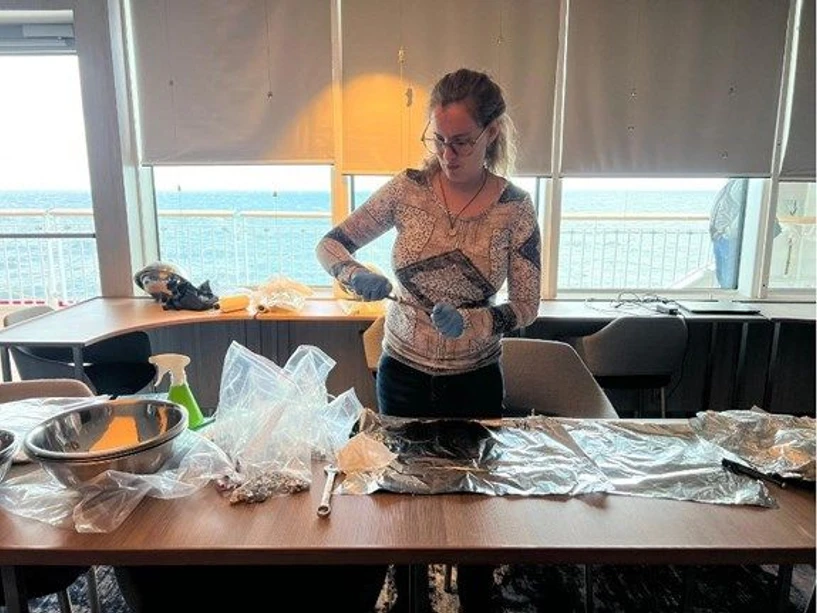
RECETOX: Revealing hidden chemicals at sea: A makeshift laboratory onboard to assemble passive air samplers.RECETOX: Revealing hidden chemicals at sea: A makeshift laboratory onboard to assemble passive air samplers.

The results revealed that flame retardants were present everywhere - but not evenly distributed. Some areas contained levels up to ten times higher than others, particularly spaces filled with electronics or soft furnishings. The most abundant chemicals were organophosphate flame retardants, especially one called TCIPP, which reached extremely high concentrations in some samples. 

“Older ships had overall higher levels of flame retardants than the newer vessels, which likely reflects the types of materials used in the past and earlier fire‑safety standards. Using exposure models, we also estimated how much of these chemicals people on board may be ingesting or absorbing each day. The estimates suggest that crew members, who spend many months living and working on the ships, may experience higher exposure during routine activities - for example through contact with surfaces or the unintentional ingestion of dust,” says the study’s lead author, Veronica van der Schyff.

RECETOX: Revealing hidden chemicals at sea: Outdoor air sampler setup.RECETOX: Revealing hidden chemicals at sea: Outdoor air sampler setup.

While strict fire-safety standards are mandatory for ships, there are currently no rules limiting which flame retardant chemicals can be used or how much is allowed. This study highlights an important gap in maritime safety regulations and raises questions about long-term chemical exposure in enclosed ship environments. 

RECETOX: Revealing hidden chemicals at sea: Dust collection with a vacuum cleaner.RECETOX: Revealing hidden chemicals at sea: Dust collection with a vacuum cleaner.

As cruise tourism, and the maritime industry, continues to grow, the findings underscore the need for closer monitoring and smarter regulation; ensuring that protecting ships from fire does not come at the cost of crew and passenger health. 

The original article

Flame retardants in dust from the indoor environments of expedition cruise ships

Veronica van der Schyff, Verena Meraldi, Andrew Luke King, Simona Rozárka Jílková, Ondřej Audy, Petr Kukučka, Jiří Kohoutek, Lisa Melymuk

Environ. Sci.: Adv., 2026,5, 86-97

https://doi.org/10.1039/D5VA00257E

licensed under CC-BY 3.0

Abstract

Flame retardants (FRs) are widely used in indoor environments to meet fire safety requirements. One understudied environment with respect to indoor chemical exposure to FRs is the maritime environment, particularly the indoor environments of cruise ships. This study presents the first comprehensive assessment of FRs in indoor dust collected from three expedition cruise ships of varying ages and refitting histories. Ten polybrominated diphenyl ethers (PBDEs), 23 alternative halogenated flame retardants (AHFRs), and 16 organophosphate esters (OPEs) were analyzed in dust from 12–16 locations per ship. OPEs, especially tris(1-chloro-2-propyl)phosphate (TCIPP), dominated the chemical profile, with concentrations reaching up to 1786 µg g−1. Concentrations of FRs in different areas on the same ships differed greatly, sometimes by an order of magnitude. Older ships exhibited significantly higher FR levels compared to the newer vessel. Estimated daily intake (EDI) modeling indicated that ship crew members—particularly those working in heavily furnished or electronic-rich areas—may experience elevated exposures through ingestion and dermal contact. Strict performance-based fire test procedures are mandatory for all products onboard ships, but no regulations exist concerning the type of FR used or the concentrations thereof. These findings underscore the need for targeted regulation and further monitoring of chemical exposures in maritime environments, especially given the extended periods that crew members spend onboard.

Instrumental analyses

Out of 16 OPEs that were analyzed for (Table S1), 15 were detected in the samples at least once: TDCIPP, TCIPP, CDP, EHDPP, oTMPP, ip-TPP, m/p TMPP, TBOEP, TCEP, TEHP, TEP, TiBP, TnBP, TnPP, TPHP. The full list of target OPEs with compound names and identifiers is given in Table S1. OPEs were quantified using an Agilent 1290 Infinity high-performance liquid chromatograph (HPLC) coupled to an Agilent 6495 triple quadrupole mass spectrometer operating in positive electrospray ionization mode (ESI+). Chromatographic separation was achieved on an ACQUITY BEH C18 column (2.1 mm × 100 mm, 1.7 µm) with a mobile phase gradient of 0.1% formic acid in water and methanol at a flow rate of 0.2 mL min−1. Quantification was performed in multiple reaction monitoring (MRM) mode using isotope dilution with 13C- or deuterium-labeled standards for TPHP, TnBP, TDCIPP, and TnPP.

Ten PBDE congeners were detected (BDEs-28, 47, 66, 99, 100, 153, 154, 183, and 209) and 16 out of 23 AHFRs (HBB, BEH-TEBP, PBBZ, PBT, PBEB, TBP-DBPE, EH-TBB, DBDPE, TBP-AE, aDBE-DBCH, bDBE-DBCH, gdDBE-DBCH, BTBPE, sDP and aDP) were detected in the samples. The full list of PBDEs and AHFRs is given in Table S1. PBDEs and AHFRs were analyzed using an Agilent 7890A gas chromatograph equipped with an RTX-1614 column (15 m × 0.25 mm, 0.10 µm) and coupled to a Waters AutoSpec Premier high-resolution mass spectrometer operated in electron impact ionization (EI+) and selected ion monitoring (SIM) mode with a resolving power greater than 10 000. BDE-209 was analyzed at a reduced resolution of >5000 to improve sensitivity. While PBDEs and AHFRs were measured using the same instrumental setup, distinct GC oven temperature programs and injection conditions were applied for each compound group. Full analytical parameters are provided in the SI (Text S3; Tables S4–S8) and example chromatographs presented in Fig. S3–S7.

RECETOX - Centrum pro výzkum toxických látek v prostředí
LinkedIn Logo
 

Related content

Analysis of Acetaldehyde and Limonene in Recycled PET Using an HS-GCMS System (Carrier Gas: H2)

Applications
| 2026 | Shimadzu
Instrumentation
GC/MSD, GC/SQ, HeadSpace
Manufacturer
Shimadzu
Industries
Energy & Chemicals

What Causes GC Capillary Column Performance Degradation, and How Can I Prevent It?

Technical notes
| 2026 | Agilent Technologies
Instrumentation
Consumables, GC columns
Manufacturer
Agilent Technologies
Industries
Other

Aromatic Component Analysis of Gasoline According to ASTM D5580 Using the Brevis GC- 2050 Gas Chromatograph

Applications
| 2025 | Shimadzu
Instrumentation
GC
Manufacturer
Shimadzu
Industries
Energy & Chemicals

Micro GC Analysis of Permanent Gas Impurities in PEM Fuel Cell-Grade Hydrogen

Applications
| 2025 | Agilent Technologies
Instrumentation
GC
Manufacturer
Agilent Technologies
Industries
Energy & Chemicals

Quantification of 8 Disinfection Byproducts from Water by Liquid-Liquid Extraction and Gas Chromatography-MassSpectrometry

Applications
| 2025 | Shimadzu
Instrumentation
GC/MSD, GC/SQ
Manufacturer
Shimadzu
Industries
Environmental
 

Related articles

JUNIOR STAR Grants at UCT Prague: Two talented women from abroad driving innovation in science
Article | Scientists

JUNIOR STAR Grants at UCT Prague: Two talented women from abroad driving innovation in science

Two outstanding early-career researchers at UCT Prague, Filipa Oliveira and Stella Gonsales, received prestigious GAČR JUNIOR STAR grants for innovative research in materials science and sustainable chemistry.
UCT Prague
tag
share
more
How to Protect Your GC Column - Part 1
Article | Academy

How to Protect Your GC Column - Part 1

Dirty samples can quickly damage your GC column and shorten its lifetime. Learn simple, proven ways to protect your column, improve performance, and reduce downtime. Part 1 focuses on smart sample preparation.
Phenomenex
tag
share
more
News from LabRulezGCMS Library - Week 06, 2026
Article | Application

News from LabRulezGCMS Library - Week 06, 2026

This week we bring you technical note by Agilent Technologies and application notes by BaySpec, Metrohm and Shimadzu!
LabRulez
tag
share
more
Research from IOCB Prague reveals a previously unknown mechanism of genetic transcription
Article | Science and research

Research from IOCB Prague reveals a previously unknown mechanism of genetic transcription

Scientists at IOCB Prague reveal a previously unknown mechanism that initiates gene transcription. Using cryo-EM, they uncover how alarmone molecules enable RNA synthesis under stress.
Institute of Organic Chemistry and Biochemistry of the Czech Academy of Sciences
tag
share
more
 

Related content

Analysis of Acetaldehyde and Limonene in Recycled PET Using an HS-GCMS System (Carrier Gas: H2)

Applications
| 2026 | Shimadzu
Instrumentation
GC/MSD, GC/SQ, HeadSpace
Manufacturer
Shimadzu
Industries
Energy & Chemicals

What Causes GC Capillary Column Performance Degradation, and How Can I Prevent It?

Technical notes
| 2026 | Agilent Technologies
Instrumentation
Consumables, GC columns
Manufacturer
Agilent Technologies
Industries
Other

Aromatic Component Analysis of Gasoline According to ASTM D5580 Using the Brevis GC- 2050 Gas Chromatograph

Applications
| 2025 | Shimadzu
Instrumentation
GC
Manufacturer
Shimadzu
Industries
Energy & Chemicals

Micro GC Analysis of Permanent Gas Impurities in PEM Fuel Cell-Grade Hydrogen

Applications
| 2025 | Agilent Technologies
Instrumentation
GC
Manufacturer
Agilent Technologies
Industries
Energy & Chemicals

Quantification of 8 Disinfection Byproducts from Water by Liquid-Liquid Extraction and Gas Chromatography-MassSpectrometry

Applications
| 2025 | Shimadzu
Instrumentation
GC/MSD, GC/SQ
Manufacturer
Shimadzu
Industries
Environmental
 

Related articles

JUNIOR STAR Grants at UCT Prague: Two talented women from abroad driving innovation in science
Article | Scientists

JUNIOR STAR Grants at UCT Prague: Two talented women from abroad driving innovation in science

Two outstanding early-career researchers at UCT Prague, Filipa Oliveira and Stella Gonsales, received prestigious GAČR JUNIOR STAR grants for innovative research in materials science and sustainable chemistry.
UCT Prague
tag
share
more
How to Protect Your GC Column - Part 1
Article | Academy

How to Protect Your GC Column - Part 1

Dirty samples can quickly damage your GC column and shorten its lifetime. Learn simple, proven ways to protect your column, improve performance, and reduce downtime. Part 1 focuses on smart sample preparation.
Phenomenex
tag
share
more
News from LabRulezGCMS Library - Week 06, 2026
Article | Application

News from LabRulezGCMS Library - Week 06, 2026

This week we bring you technical note by Agilent Technologies and application notes by BaySpec, Metrohm and Shimadzu!
LabRulez
tag
share
more
Research from IOCB Prague reveals a previously unknown mechanism of genetic transcription
Article | Science and research

Research from IOCB Prague reveals a previously unknown mechanism of genetic transcription

Scientists at IOCB Prague reveal a previously unknown mechanism that initiates gene transcription. Using cryo-EM, they uncover how alarmone molecules enable RNA synthesis under stress.
Institute of Organic Chemistry and Biochemistry of the Czech Academy of Sciences
tag
share
more
 

Related content

Analysis of Acetaldehyde and Limonene in Recycled PET Using an HS-GCMS System (Carrier Gas: H2)

Applications
| 2026 | Shimadzu
Instrumentation
GC/MSD, GC/SQ, HeadSpace
Manufacturer
Shimadzu
Industries
Energy & Chemicals

What Causes GC Capillary Column Performance Degradation, and How Can I Prevent It?

Technical notes
| 2026 | Agilent Technologies
Instrumentation
Consumables, GC columns
Manufacturer
Agilent Technologies
Industries
Other

Aromatic Component Analysis of Gasoline According to ASTM D5580 Using the Brevis GC- 2050 Gas Chromatograph

Applications
| 2025 | Shimadzu
Instrumentation
GC
Manufacturer
Shimadzu
Industries
Energy & Chemicals

Micro GC Analysis of Permanent Gas Impurities in PEM Fuel Cell-Grade Hydrogen

Applications
| 2025 | Agilent Technologies
Instrumentation
GC
Manufacturer
Agilent Technologies
Industries
Energy & Chemicals

Quantification of 8 Disinfection Byproducts from Water by Liquid-Liquid Extraction and Gas Chromatography-MassSpectrometry

Applications
| 2025 | Shimadzu
Instrumentation
GC/MSD, GC/SQ
Manufacturer
Shimadzu
Industries
Environmental
 

Related articles

JUNIOR STAR Grants at UCT Prague: Two talented women from abroad driving innovation in science
Article | Scientists

JUNIOR STAR Grants at UCT Prague: Two talented women from abroad driving innovation in science

Two outstanding early-career researchers at UCT Prague, Filipa Oliveira and Stella Gonsales, received prestigious GAČR JUNIOR STAR grants for innovative research in materials science and sustainable chemistry.
UCT Prague
tag
share
more
How to Protect Your GC Column - Part 1
Article | Academy

How to Protect Your GC Column - Part 1

Dirty samples can quickly damage your GC column and shorten its lifetime. Learn simple, proven ways to protect your column, improve performance, and reduce downtime. Part 1 focuses on smart sample preparation.
Phenomenex
tag
share
more
News from LabRulezGCMS Library - Week 06, 2026
Article | Application

News from LabRulezGCMS Library - Week 06, 2026

This week we bring you technical note by Agilent Technologies and application notes by BaySpec, Metrohm and Shimadzu!
LabRulez
tag
share
more
Research from IOCB Prague reveals a previously unknown mechanism of genetic transcription
Article | Science and research

Research from IOCB Prague reveals a previously unknown mechanism of genetic transcription

Scientists at IOCB Prague reveal a previously unknown mechanism that initiates gene transcription. Using cryo-EM, they uncover how alarmone molecules enable RNA synthesis under stress.
Institute of Organic Chemistry and Biochemistry of the Czech Academy of Sciences
tag
share
more
 

Related content

Analysis of Acetaldehyde and Limonene in Recycled PET Using an HS-GCMS System (Carrier Gas: H2)

Applications
| 2026 | Shimadzu
Instrumentation
GC/MSD, GC/SQ, HeadSpace
Manufacturer
Shimadzu
Industries
Energy & Chemicals

What Causes GC Capillary Column Performance Degradation, and How Can I Prevent It?

Technical notes
| 2026 | Agilent Technologies
Instrumentation
Consumables, GC columns
Manufacturer
Agilent Technologies
Industries
Other

Aromatic Component Analysis of Gasoline According to ASTM D5580 Using the Brevis GC- 2050 Gas Chromatograph

Applications
| 2025 | Shimadzu
Instrumentation
GC
Manufacturer
Shimadzu
Industries
Energy & Chemicals

Micro GC Analysis of Permanent Gas Impurities in PEM Fuel Cell-Grade Hydrogen

Applications
| 2025 | Agilent Technologies
Instrumentation
GC
Manufacturer
Agilent Technologies
Industries
Energy & Chemicals

Quantification of 8 Disinfection Byproducts from Water by Liquid-Liquid Extraction and Gas Chromatography-MassSpectrometry

Applications
| 2025 | Shimadzu
Instrumentation
GC/MSD, GC/SQ
Manufacturer
Shimadzu
Industries
Environmental
 

Related articles

JUNIOR STAR Grants at UCT Prague: Two talented women from abroad driving innovation in science
Article | Scientists

JUNIOR STAR Grants at UCT Prague: Two talented women from abroad driving innovation in science

Two outstanding early-career researchers at UCT Prague, Filipa Oliveira and Stella Gonsales, received prestigious GAČR JUNIOR STAR grants for innovative research in materials science and sustainable chemistry.
UCT Prague
tag
share
more
How to Protect Your GC Column - Part 1
Article | Academy

How to Protect Your GC Column - Part 1

Dirty samples can quickly damage your GC column and shorten its lifetime. Learn simple, proven ways to protect your column, improve performance, and reduce downtime. Part 1 focuses on smart sample preparation.
Phenomenex
tag
share
more
News from LabRulezGCMS Library - Week 06, 2026
Article | Application

News from LabRulezGCMS Library - Week 06, 2026

This week we bring you technical note by Agilent Technologies and application notes by BaySpec, Metrohm and Shimadzu!
LabRulez
tag
share
more
Research from IOCB Prague reveals a previously unknown mechanism of genetic transcription
Article | Science and research

Research from IOCB Prague reveals a previously unknown mechanism of genetic transcription

Scientists at IOCB Prague reveal a previously unknown mechanism that initiates gene transcription. Using cryo-EM, they uncover how alarmone molecules enable RNA synthesis under stress.
Institute of Organic Chemistry and Biochemistry of the Czech Academy of Sciences
tag
share
more
Other projects
LCMS
ICPMS
Follow us
More information
WebinarsAbout usContact usTerms of use
LabRulez s.r.o. All rights reserved. Content available under a CC BY-SA 4.0 Attribution-ShareAlike