GCMS
More information
WebinarsAbout usContact usTerms of use
LabRulez s.r.o. All rights reserved. Content available under a CC BY-SA 4.0 Attribution-ShareAlike
Author
International Symposium on Chromatography - (ISC)
The International Symposium on Chromatography (ISC) represents the oldest conference series focussing on separation science. ISC symposia have been organised since 1956 in each even year. ISC is internationally recognised as one of the premier meeting series for discussion of all modes of chromatography and separation science with a broad coverage of techniques and applications.
Tags
Article
Events
LinkedIn Logo

ISC 2026 - Registration and Abstract Submission Open!

Tu, 20.1.2026
| Original article from: International Symposium on Chromatography (ISC)
Registration and abstract submission for ISC 2026 are now open. Join the leading chromatography symposium in Prague, submit your abstract, and benefit from early-bird registration until 15 May 2026.
<p>ISC 2026</p>

ISC 2026

ABOUT ISC 2026

The International Symposium on Chromatography (ISC) represents the oldest conference series on separation science. ISC symposia have been organised since 1956 in each even year. ISC is one of the premier meetings series for discussion of all modes of chromatography and separation science with a broad coverage of techniques and applications.

The major focus of the symposium will be on the impact of chromatography and separation science to meet the needs of the pharmaceutical, environmental, food and health industry, as well as science and medicine. The symposium programme will reflect these themes and highlight new challenges and emerging opportunities for the science and marketing of separation and detection systems and methods.

As an integral part of the scientific programme of lectures and poster sessions, an international exhibition and vendor seminars on instrumentation and services for chromatography, separation science and mass spectrometry will be organised. ISC 2026 will provide the perfect forum for attendees from academia, industry and government research institutions for scientific exchange and networking.

ISC 2026 SYMPOSIUM KEY DATES

6-10 SEPTEMBER 2026

  • 15 January 2026: Opening of Early-bird Registration & Abstract submission
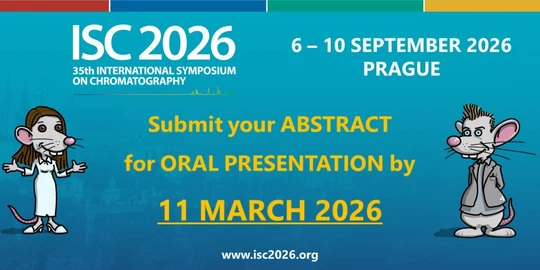
  • 11 March 2026: Deadline for abstract submission (orals)
  • 21 April 2026: Sending acceptance letters (orals)
  • 15 May 2026: Deadline of early-bird registration and payment & Author registration deadline (orals)
  • 1 June 2026: Preliminary detailed program on web
  • 1 June 2026: Deadline for abstract submission (posters)
  • 16 June 2026: Sending acceptance letters (posters)
    • Authors who submit their abstracts with a poster preference by 5 May 2026 will be notified of the outcome by 12 May 2026 and will have the opportunity to register at the early-bird rate until 15 May 2026.
  • 30 June 2026: Author registration deadline (posters)
  • 30 July 2026: Deadline for abstract submission (late-breaking posters)
    • without the possibility of competing for the Best Poster Award
  • 11 August 2026: Sending acceptance letters (late-breaking posters)
  • 18 August 2026: Author registration deadline (late-breaking posters)
  • 25 August 2026: Deadline for late registration & payment 
  • 6-10 September 2026: Symposium

REGISTRATION

👉Register HERE for the ISC 2026

REGISTRATION FEES in EUR including VAT 

Early-Bird Registration (until 15 May 2026)
  • Industry: 850
  • Academic, Government: 650
  • Student*: 290
  • Student* + 3 short courses: 390
  • Short Courses**: 190
  • Accompanying Persons: 190
  • Gala Dinner: 100
Late Registration
  • Industry: 1,000
  • Academic, Government: 780
  • Student*: 340
  • Student* + 3 short courses: -
  • Short Courses**: 230
  • Accompanying Persons: 190
  • Gala Dinner: 100
Onsite Registration
  • Industry: 1,150
  • Academic, Government: 890
  • Student*: 390
  • Student* + 3 short courses: -
  • Short Courses**: 270
  • Accompanying Persons: 190
  • Gala Dinner: 100

*The student fee applies only to full-time students. This does not include individuals who are employed and pursuing a PhD or other degree part-time. Participants registering under this category are required to upload a valid proof of full time student status (e.g., confirmation from the university or a student ID) directly in the registration form.

**The price covers up to 3 short courses for a single flat rate.

All the above fees are in EUR and include a local VAT of 21 %.

FULL REGISTRATION FEES INCLUDE: 

  • Access to oral and poster sessions 
  • Access to the exhibition hall 
  • Welcome Reception on Sunday, 6 September 2026 
  • Scheduled lunches and coffee breaks as per the programme 
  • Electronic Book of Abstracts 
  • Prague public transportation pass 

ACCOMPANYING PERSON FEES INCLUDE: 

  • Access to the exhibition hall 
  • Welcome Reception on Sunday, 6 September 2026 
  • Scheduled lunches and coffee breaks as per the programme 

The accompanying persons do not have access to the scientific programme. 

ABSTRACT SUBMISSION

👉Submit your Abstract HERE

GENERAL INFORMATION & DEADLINES 

  • Abstracts must be submitted electronically via the Online Portal.
    The abstract submission deadlines depend on the authors’ presentation preference and are as follows:
    • Oral Presentation: 11 March 2026
    • Poster Presentation: 1 June 2026
    • Late-Breaking Poster: 30 July 2026

The submitted abstracts can be modified until 11 March 2026 for oral presentations and 1 June 2026 for poster presentations to be included in the preliminary program. After the submission deadlines, all abstracts will automatically be considered final.

Abstracts received by e-mail or after the deadlines will not be considered for the ISC 2026 Symposium.

  • Abstracts must be submitted under one of the designated scientific topics, categorized into three parallel program tracks.
  • The abstracts with oral presentation preference will be reviewed by the ISC 2026 Scientific Committee, which will assess both their formal aspects and scientific content. The abstracts with poster preference will be reviewed by the Local Organising Committee, which will decide which abstracts are accepted and may reconsider the final presentation type if necessary.
  • All presenting authors who selected the oral presentation preference will receive an acceptance or rejection notification via e-mail by 21 April 2026. Authors who submit their abstracts with a poster preference by 5 May 2026 will be notified of the outcome by 12 May 2026 and will have the opportunity to register at the early-bird rate until 15 May 2026. 
    All the other abstracts with poster preference submitted after 5 May 2026 will be notified of the outcome by 16 June 2026, and by 11 August 2026 for late-breaking poster presentations.
  • Accepted and registered abstracts will be published in the Abstract Book. Please ensure that your abstract has been carefully checked for correct spelling, punctuation, grammar, and formal structure. Authors are fully responsible for the abstract content. The organizer reserves the right to edit the accepted abstracts prior to publication if necessary. Please note that late-breaking posters will not be included in the electronic Abstract Book.
  • All oral presenting authors are required to register by 15 May 2026. Any oral presentation whose presenting author is not registered by this date will be withdrawn from the program. The author registration deadline is 30 June 2026 for accepted poster authors and 18 August 2026 for accepted late-breaking poster authors.
  • The number of abstracts submitted per presenting author is limited to one. Once the submission is completed, the system will not allow additional abstracts to be submitted. You may be listed as a co-author on other abstracts but not as the presenting author.
  • Submission of an abstract constitutes a commitment to attend the symposium or to send a qualified substitute who is capable of presenting the work and answering related questions.
  • An invitation to submit an abstract does not constitute an offer to cover travel, accommodation, or registration expenses associated with the symposium.

ABSTRACT FORMATTING GUIDELINES

  • All abstracts must be written in English.
  • A preferred presentation type must be selected during submission from the following options:
    • Oral Presentation
    • Oral Presentation or Poster Presentation
    • Poster Presentation
  • The abstract title is limited to 180 characters and must use Sentence case – capitalizing only the first word and any proper nouns, while keeping all other words in lowercase (e.g., This is the title of my abstract).
  • Up to 16 authors may be listed for one abstract (including the presenting author).
  • The first author listed is considered the main author.
  • The abstract text must not exceed 400 words.
  • Figures or images are not permitted in the abstract text.
  • Adding references is optional. If you wish to include references in your abstract, please note that they count toward the abstract word limit, and you are requested to use the following citation style (see example):
    • [1] J. van der Geer, T. Handgraaf, R.A. Lupton, J. Sci. Commun. 163 (2020) 51 – 59.

Destination

THE CZECH REPUBLIC

The Czech Republic is a rather small but charming country situated in the very heart of Europe. Since medieval times it has been a crossroad of intellectual, artistic and culinary influences but also a centre of conflicts.

The official language is Czech. It is very similar to Slovak and Polish. They all belong to the group of West Slavic languages. Czech is a particularly difficult language to learn, since the endings of words change due to many different grammar rules.

PRAGUE

The capital city of the Czech Republic is poetically considered to be the heart of the European continent. The history is deeply rooted in every building and you can feel the cultural spirit in every step. Different architectural styles have been preserved throughout the wars and years of the communist era so the visitors may compose their own image of Prague. With the Prague Castle, the largest castle complex in the world on one side, facing the Dancing House representing the contemporary architectural tendencies on the other side, visitors can appreciate the centuries of history embedded in the buildings. Prague is not only a city of historical monuments, but also a city for living, where culture is an integral part of things. It is not surprising to find that it has been a source of inspiration for famous Prague residents and personalities, such as Einstein, Kafka, Mozart, van Beethoven.

At the same time, growing since the Velvet Revolution, Prague, the meeting point of Eastern and Western Europe has quickly become a site to host multiple scientific conferences and cultural events. The same goes for movie makers who just love coming to Prague and making it the scene of their movies. You may have seen Prague in motion pictures such as The Bourne Identity (2002), The Illusionist (2006), Casino Royale (2006), Mission: Impossible (1996), and Amadeus (1984).

VENUE

PRAGUE – A ONE STOP SOLUTION

With all of the key requirements in one reconstructed building and just 5 minutes to the city centre using the complimentary public transport ticket, Prague provides a fantastically convenient solution for all ISC delegates.

ISC 2026: Prague Congress CentreISC 2026: Prague Congress Centre

International Symposium on Chromatography - (ISC)
LinkedIn Logo
 

Related content

Analysis of Aroma Components in Apples Using the Smart Aroma Database

Applications
| 2026 | Shimadzu
Instrumentation
GC/MSD, GC/SQ, HeadSpace
Manufacturer
Shimadzu
Industries
Food & Agriculture

Analysis of Acetaldehyde and Limonene in Recycled PET Using an HS-GCMS System (Carrier Gas: H2)

Applications
| 2026 | Shimadzu
Instrumentation
GC/MSD, GC/SQ, HeadSpace
Manufacturer
Shimadzu
Industries
Energy & Chemicals

What Causes GC Capillary Column Performance Degradation, and How Can I Prevent It?

Technical notes
| 2026 | Agilent Technologies
Instrumentation
Consumables, GC columns
Manufacturer
Agilent Technologies
Industries
Other

Aromatic Component Analysis of Gasoline According to ASTM D5580 Using the Brevis GC- 2050 Gas Chromatograph

Applications
| 2025 | Shimadzu
Instrumentation
GC
Manufacturer
Shimadzu
Industries
Energy & Chemicals

Micro GC Analysis of Permanent Gas Impurities in PEM Fuel Cell-Grade Hydrogen

Applications
| 2025 | Agilent Technologies
Instrumentation
GC
Manufacturer
Agilent Technologies
Industries
Energy & Chemicals
 

Related articles

Webinars LabRulezGCMS Week 07/2026
Article | Webinars

Webinars LabRulezGCMS Week 07/2026

3 webinars: AI in manufacturing, fermentation, functional food, mAb production, metabolite monitoring, process Raman, process analytics
LabRulez
tag
share
more
QuEChERS Combined with Low-Temperature Partitioning and GC–MS as an Analytical Strategy for the Determination of Multiclass Pesticide Residues in Cocoa Beans
Scientific article | Science and research

QuEChERS Combined with Low-Temperature Partitioning and GC–MS as an Analytical Strategy for the Determination of Multiclass Pesticide Residues in Cocoa Beans

This study combines QuEChERS and low-temperature partitioning with GC–MS to determine multiclass pesticide residues in cocoa beans with good sensitivity and recoveries.
LabRulez
tag
share
more
ISC 2026 Short Course 3 - Interpretation of Mass Spectra: Basic Introduction for Chromatographers
Article | Events

ISC 2026 Short Course 3 - Interpretation of Mass Spectra: Basic Introduction for Chromatographers

Short Course 3 at ISC 2026 offers a practical introduction to LC–MS spectral interpretation for chromatographers, covering ESI, APCI, APPI, adducts, isotope patterns, and MS/MS fundamentals.
International Symposium on Chromatography - (ISC)
tag
share
more
Eurachem/CITAC Workshop on Quality in Analytical Measurements 2026
Article | Events

Eurachem/CITAC Workshop on Quality in Analytical Measurements 2026

Eurachem Week 2026 brings training and workshops on measurement uncertainty, quality in analytical measurements, and results interpretation, combining theory, practical cases, and expert-led discussions.
Eurachem
tag
share
more
 

Related content

Analysis of Aroma Components in Apples Using the Smart Aroma Database

Applications
| 2026 | Shimadzu
Instrumentation
GC/MSD, GC/SQ, HeadSpace
Manufacturer
Shimadzu
Industries
Food & Agriculture

Analysis of Acetaldehyde and Limonene in Recycled PET Using an HS-GCMS System (Carrier Gas: H2)

Applications
| 2026 | Shimadzu
Instrumentation
GC/MSD, GC/SQ, HeadSpace
Manufacturer
Shimadzu
Industries
Energy & Chemicals

What Causes GC Capillary Column Performance Degradation, and How Can I Prevent It?

Technical notes
| 2026 | Agilent Technologies
Instrumentation
Consumables, GC columns
Manufacturer
Agilent Technologies
Industries
Other

Aromatic Component Analysis of Gasoline According to ASTM D5580 Using the Brevis GC- 2050 Gas Chromatograph

Applications
| 2025 | Shimadzu
Instrumentation
GC
Manufacturer
Shimadzu
Industries
Energy & Chemicals

Micro GC Analysis of Permanent Gas Impurities in PEM Fuel Cell-Grade Hydrogen

Applications
| 2025 | Agilent Technologies
Instrumentation
GC
Manufacturer
Agilent Technologies
Industries
Energy & Chemicals
 

Related articles

Webinars LabRulezGCMS Week 07/2026
Article | Webinars

Webinars LabRulezGCMS Week 07/2026

3 webinars: AI in manufacturing, fermentation, functional food, mAb production, metabolite monitoring, process Raman, process analytics
LabRulez
tag
share
more
QuEChERS Combined with Low-Temperature Partitioning and GC–MS as an Analytical Strategy for the Determination of Multiclass Pesticide Residues in Cocoa Beans
Scientific article | Science and research

QuEChERS Combined with Low-Temperature Partitioning and GC–MS as an Analytical Strategy for the Determination of Multiclass Pesticide Residues in Cocoa Beans

This study combines QuEChERS and low-temperature partitioning with GC–MS to determine multiclass pesticide residues in cocoa beans with good sensitivity and recoveries.
LabRulez
tag
share
more
ISC 2026 Short Course 3 - Interpretation of Mass Spectra: Basic Introduction for Chromatographers
Article | Events

ISC 2026 Short Course 3 - Interpretation of Mass Spectra: Basic Introduction for Chromatographers

Short Course 3 at ISC 2026 offers a practical introduction to LC–MS spectral interpretation for chromatographers, covering ESI, APCI, APPI, adducts, isotope patterns, and MS/MS fundamentals.
International Symposium on Chromatography - (ISC)
tag
share
more
Eurachem/CITAC Workshop on Quality in Analytical Measurements 2026
Article | Events

Eurachem/CITAC Workshop on Quality in Analytical Measurements 2026

Eurachem Week 2026 brings training and workshops on measurement uncertainty, quality in analytical measurements, and results interpretation, combining theory, practical cases, and expert-led discussions.
Eurachem
tag
share
more
 

Related content

Analysis of Aroma Components in Apples Using the Smart Aroma Database

Applications
| 2026 | Shimadzu
Instrumentation
GC/MSD, GC/SQ, HeadSpace
Manufacturer
Shimadzu
Industries
Food & Agriculture

Analysis of Acetaldehyde and Limonene in Recycled PET Using an HS-GCMS System (Carrier Gas: H2)

Applications
| 2026 | Shimadzu
Instrumentation
GC/MSD, GC/SQ, HeadSpace
Manufacturer
Shimadzu
Industries
Energy & Chemicals

What Causes GC Capillary Column Performance Degradation, and How Can I Prevent It?

Technical notes
| 2026 | Agilent Technologies
Instrumentation
Consumables, GC columns
Manufacturer
Agilent Technologies
Industries
Other

Aromatic Component Analysis of Gasoline According to ASTM D5580 Using the Brevis GC- 2050 Gas Chromatograph

Applications
| 2025 | Shimadzu
Instrumentation
GC
Manufacturer
Shimadzu
Industries
Energy & Chemicals

Micro GC Analysis of Permanent Gas Impurities in PEM Fuel Cell-Grade Hydrogen

Applications
| 2025 | Agilent Technologies
Instrumentation
GC
Manufacturer
Agilent Technologies
Industries
Energy & Chemicals
 

Related articles

Webinars LabRulezGCMS Week 07/2026
Article | Webinars

Webinars LabRulezGCMS Week 07/2026

3 webinars: AI in manufacturing, fermentation, functional food, mAb production, metabolite monitoring, process Raman, process analytics
LabRulez
tag
share
more
QuEChERS Combined with Low-Temperature Partitioning and GC–MS as an Analytical Strategy for the Determination of Multiclass Pesticide Residues in Cocoa Beans
Scientific article | Science and research

QuEChERS Combined with Low-Temperature Partitioning and GC–MS as an Analytical Strategy for the Determination of Multiclass Pesticide Residues in Cocoa Beans

This study combines QuEChERS and low-temperature partitioning with GC–MS to determine multiclass pesticide residues in cocoa beans with good sensitivity and recoveries.
LabRulez
tag
share
more
ISC 2026 Short Course 3 - Interpretation of Mass Spectra: Basic Introduction for Chromatographers
Article | Events

ISC 2026 Short Course 3 - Interpretation of Mass Spectra: Basic Introduction for Chromatographers

Short Course 3 at ISC 2026 offers a practical introduction to LC–MS spectral interpretation for chromatographers, covering ESI, APCI, APPI, adducts, isotope patterns, and MS/MS fundamentals.
International Symposium on Chromatography - (ISC)
tag
share
more
Eurachem/CITAC Workshop on Quality in Analytical Measurements 2026
Article | Events

Eurachem/CITAC Workshop on Quality in Analytical Measurements 2026

Eurachem Week 2026 brings training and workshops on measurement uncertainty, quality in analytical measurements, and results interpretation, combining theory, practical cases, and expert-led discussions.
Eurachem
tag
share
more
 

Related content

Analysis of Aroma Components in Apples Using the Smart Aroma Database

Applications
| 2026 | Shimadzu
Instrumentation
GC/MSD, GC/SQ, HeadSpace
Manufacturer
Shimadzu
Industries
Food & Agriculture

Analysis of Acetaldehyde and Limonene in Recycled PET Using an HS-GCMS System (Carrier Gas: H2)

Applications
| 2026 | Shimadzu
Instrumentation
GC/MSD, GC/SQ, HeadSpace
Manufacturer
Shimadzu
Industries
Energy & Chemicals

What Causes GC Capillary Column Performance Degradation, and How Can I Prevent It?

Technical notes
| 2026 | Agilent Technologies
Instrumentation
Consumables, GC columns
Manufacturer
Agilent Technologies
Industries
Other

Aromatic Component Analysis of Gasoline According to ASTM D5580 Using the Brevis GC- 2050 Gas Chromatograph

Applications
| 2025 | Shimadzu
Instrumentation
GC
Manufacturer
Shimadzu
Industries
Energy & Chemicals

Micro GC Analysis of Permanent Gas Impurities in PEM Fuel Cell-Grade Hydrogen

Applications
| 2025 | Agilent Technologies
Instrumentation
GC
Manufacturer
Agilent Technologies
Industries
Energy & Chemicals
 

Related articles

Webinars LabRulezGCMS Week 07/2026
Article | Webinars

Webinars LabRulezGCMS Week 07/2026

3 webinars: AI in manufacturing, fermentation, functional food, mAb production, metabolite monitoring, process Raman, process analytics
LabRulez
tag
share
more
QuEChERS Combined with Low-Temperature Partitioning and GC–MS as an Analytical Strategy for the Determination of Multiclass Pesticide Residues in Cocoa Beans
Scientific article | Science and research

QuEChERS Combined with Low-Temperature Partitioning and GC–MS as an Analytical Strategy for the Determination of Multiclass Pesticide Residues in Cocoa Beans

This study combines QuEChERS and low-temperature partitioning with GC–MS to determine multiclass pesticide residues in cocoa beans with good sensitivity and recoveries.
LabRulez
tag
share
more
ISC 2026 Short Course 3 - Interpretation of Mass Spectra: Basic Introduction for Chromatographers
Article | Events

ISC 2026 Short Course 3 - Interpretation of Mass Spectra: Basic Introduction for Chromatographers

Short Course 3 at ISC 2026 offers a practical introduction to LC–MS spectral interpretation for chromatographers, covering ESI, APCI, APPI, adducts, isotope patterns, and MS/MS fundamentals.
International Symposium on Chromatography - (ISC)
tag
share
more
Eurachem/CITAC Workshop on Quality in Analytical Measurements 2026
Article | Events

Eurachem/CITAC Workshop on Quality in Analytical Measurements 2026

Eurachem Week 2026 brings training and workshops on measurement uncertainty, quality in analytical measurements, and results interpretation, combining theory, practical cases, and expert-led discussions.
Eurachem
tag
share
more
Other projects
LCMS
ICPMS
Follow us
More information
WebinarsAbout usContact usTerms of use
LabRulez s.r.o. All rights reserved. Content available under a CC BY-SA 4.0 Attribution-ShareAlike