
GCMS
More information
WebinarsAbout usContact usTerms of use
LabRulez s.r.o. All rights reserved. Content available under a CC BY-SA 4.0 Attribution-ShareAlike
Author
LabRulez
LabRulez
Everything from the world of analytical chemistry in one place. We connect people in solving their problems. At Labrulez you will find all the necessary information easily, quickly and clearly. Stop searching and start finding.
Tags
Article
Application
LinkedIn Logo

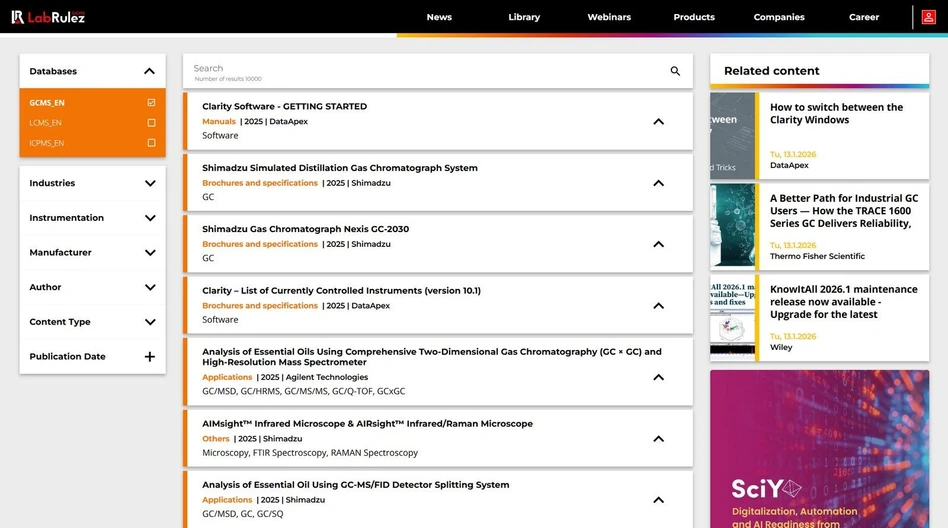
News from LabRulezGCMS Library - Week 03, 2026
We, 14.1.2026
| Original article from: LabRulezGCMS Library
This week we bring you application notes by Agilent Technologies, Shimadzu and brochure by Thermo Fisher Scientific!
<p><strong>LabRulez:</strong> News from LabRulezGCMS Library - Week 03, 2026</p>

LabRulez: News from LabRulezGCMS Library - Week 03, 2026

Our Library never stops expanding. What are the most recent contributions to LabRulezGCMS Library in the week of 12th January 2026? Check out new documents from the field of the gas phase, especially GC and GC/MS techniques!

👉 SEARCH THE LARGEST REPOSITORY OF DOCUMENTS ABOUT GCMS AND RELATED TECHNIQUES

👉 Need info about different analytical techniques? Peek into LabRulezLCMS or LabRulezICPMS libraries.

This week we bring you application notes by Agilent Technologies, Shimadzu and brochure by Thermo Fisher Scientific!

1. Agilent Technologies: Volatile PFAS in Cosmetics Using PAL3 Coupled with Triple Quadrupole GC/MS

Per- and polyfluoroalkyl substances (PFAS) are a large family of synthetic organic chemicals containing carbon chains where most or all the hydrogen atoms are replaced by fluorine. Due to the strength and stability of the carbon‑fluorine bond, PFAS tend to be very stable and chemically inert, which makes them both very useful in various applications and resistant to degradation. This persistence causes environmental contamination and bioaccumulation in humans and wildlife; as a result, PFAS are often labeled "forever chemicals".1 

In cosmetics, PFAS are valued for their functional properties, including emulsification, stabilization, and water or sweat resistance. Despite these benefits, concerns have grown over their safety due to direct exposure from repeated use through skin, eyes, and mouth. The OECD's 2024 report underscores the risks associated with PFAS in cosmetic formulations, particularly given their potential for long-term health and environmental impacts.2,3 Regulators around the world are taking decisive steps to ban or restrict PFAS in cosmetics. For example, in the EU, various types of PFAS have been regulated under REACH and POPs regulations that span most industries, including cosmetics.4,5 EU Cosmetics Regulation (EC) No. 1223/2009 has listed the five types of PFAS as the substances prohibited.6 A broader EU-wide ban is underway, with France having passed its own ban on PFAS in cosmetics effective 1 January 2026, as part of a larger proposal to ban PFAS in consumer products.7,8 The US has not banned the use of PFAS in cosmetics at the federal level yet. The USFDA has been evaluating the use of PFAS in cosmetics under the authority of the Cosmetic Regulatory Modernization Act (MoCRA), and is expected to release a report on safety and risk by the end of 2025.9 Although the federal government is still on the sidelines, many states in the US have been rapidly enacting or implementing the ban and reporting requirements for PFAS in cosmetics, with effective dates ranging from 2025 to 2032.10-13 Canada has proposed a ban on the use of PFAS in various consumer products, including cosmetics.14 South Korea has added 12 PFAS into a restricted substances list for cosmetic products in 2024.15 The Environmental Protection Authority (EPA) of New Zealand has officially announced a ban on the use of PFAS in cosmetic products, effective from 31 December 2026.16 

As regulations surrounding PFAS continue to evolve, developing a sensitive and robust analytical method is crucial to meet stringent guidelines. The objective of this study was to demonstrate a fully automated workflow using PAL3 Series 2 RTC autosampler coupled with an Agilent 7010D triple quadrupole GC/MS to quantify more than 30 volatile PFAS analytes in cosmetics. The automation method performance includes sensitivity, accuracy, and precision studies.

Experimental

Instrumentation 

An Agilent 8890 GC with a 7010D GC/TQ equipped with HES 2.0 ion source, coupled with a PAL3 Series 2 RTC autosampler, was used for this analysis. An MMI inlet and splitless liner (part number 5190-2293) were used and chromatographic separation was performed using an Agilent J&W DB-624, 30 m × 0.25 mm, 1.40 μm column (part number 122-1334UI). The instrument setup is shown in Figure 1. The acquisition method for 34 native PFAS and four ISTDs, including GC condition, TQ parameters were described in a previous application note.17

Sample analysis 

Seven cosmetic samples from various brands—including foundations, lipsticks, and mascaras—were analyzed. One liquid foundation was designated as a quality control (QC) sample, while the remaining six were treated as unknowns. According to the OECD report published in 2024, cosmetic products such as shampoo, eye makeup, foundation, facial cleansers, lipsticks, and lip glosses may contain PFAS, which serve functional or performance-enhancing roles.2,19 In this study, several PFAS compounds were detected above the method detection limit (MDL) in the unknown samples, including 10:2 FTOH, MeFHxSA, MeFOSE, EtOSE and 1H,1H‑perfluorooctyl acrylate. The results also demonstrated that the automated workflow is effective for PFAS extraction and quantitation in cosmetic matrices.

Conclusion 

An accurate and robust automated workflow was successfully developed using the PAL3 Series 2 RTC autosampler coupled with the Agilent 7010D GC/TQ system for the analysis of volatile PFAS in cosmetic products. Most PFAS targets achieved an LOQ of 50 µg/kg and MDL below 1.5 µg/kg, with recoveries falling within the acceptable range of 60% to 110%. These results demonstrate excellent extraction efficiency and reliability of the automated workflow. Furthermore, automation significantly reduces human error and enhances productivity, while maintaining high sensitivity in PFAS analysis.

2. Shimadzu: Simplifying Multicomponent Quantitative Analysis of Organic Compounds with the Polyarc Microreactor for GC

User Benefits 

  • The Polyarc system converts organic compounds eluting from the column into methane, enabling sensitivity to be normalized to carbon concentrations. 
  • Even for compounds containing heteroatoms or unsaturated bonds, which tend to show lower sensitivity with FID, the Polyarc reduces response differences. 
  • Because the response is normalized, fewer calibration curves are required even for multicomponent sample analysis.

The Flame Ionization Detector (FID), the most widely used detector for GC, is used for quantitative analysis across a wide range of fields because it can detect almost all organic compounds. However, FID can exhibit sensitivity differences depending on the compound type, such as compounds containing heteroatoms (e.g., oxygen or nitrogen) or those with unsaturated bonds (for details, refer to Application News No.01-01033-EN). As a result, conventional quantitative methods using calibration curves— including external standard methods— typically require a separate calibration curve for each target analyte. This application introduces a case study analyzing a mixed solution of eleven compounds with different functional groups using the Polyarc, a GC microreactor. While compounds exhibit varying sensitivity with FID detection, the Polyarc system reduces sensitivity differences between compounds and facilitates quantitative analysis through simplified calibration curve creation.

Overview of the Polyarc

The Polyarc is a post-column microreactor installed between the column and the FID. The main unit is mounted on the GC’s top panel. A schematic isshown in Fig. 1. Organic compounds introduced into the Polyarc via the column are fully converted to methane in two steps—oxidation followed by reduction (Fig. 2)—and are ultimately detected by FID. Because the FID detects methane, sensitivity is determined by the number of carbons, regardless of the original organic compound’s functional groups. For example, 1 mol of 1- propanol (C3H8O) is detected as 3 mol of methane.

Analytical Conditions 

In this application, the sample was prepared by dissolving nheptane, cyclohexane, toluene, o-xylene, methyl ethyl ketone (MEK), tetrahydrofuran (THF), N,N-dimethylformamide (DMF), butyl acetate, propylene glycol monomethyl ether acetate (PMA), pyridine, and 1,2-dichloroethane in methanol so that each compound was 500 ppm (v/v%). Analytical conditions are shown in Table 1. The instrument used was a Nexis GC-2030 equipped with the Polyarc Ultra was used.(Fig. 3) Polyarc can be installed on both the Nexis GC-2030 and the Brevis GC-2050. Additionally, in this application, N2 was used as the carrier gas for affordability and safety, enabling cost-effective analysis.

Conclusion 

Analyzing multicomponent samples with a Polyarc confirmed that sensitivity differences due to functional groups can be reduced. Compounds containing heteroatoms or unsaturated bonds can be analyzed with relative response comparable to hydrocarbons when a Polyarc is used. Peak area reproducibility was excellent, with %RSD < 1. Additionally, it was confirmed that analyzing at least one compound of known concentration enables quantitation of compounds with unknown concentration—i.e., calibration curve preparation can be omitted.

Table 5 summarizes the benefits of using a Polyarc system. The Polyarc simplifies multicomponent quantitative analysis and enables high-sensitivity analysis of compounds that are poorly detected by FID. Note that for certain compounds, adsorption in the inlet or similar effects may prevent achieving a relative response equivalent to that of saturated hydrocarbons.

3. Thermo Fisher Scientific: Targeted MS quantitation - Controlled and accessed from anywhere (Thermo Scientific™ Chromeleon™ 7.4 software)

Thermo Scientific™ Chromeleon™ 7.4 software is presented as a centralized, server-based data system designed to consolidate mass spectrometry laboratories by connecting instruments, users, and data within a single, scalable platform. It enables secure access to data and instruments from anywhere, while centrally managing methods, templates, and reports to streamline daily laboratory operations.

The software is fully optimized for targeted MS quantitation workflows, offering native control of Thermo Scientific single and triple quadrupole as well as high-resolution accurate mass (HRAM) MS instruments. Advanced data processing tools support targeted quantitation, screening, intact mass deconvolution, MSⁿ library searching, and customizable reporting, making Chromeleon suitable for biopharma, environmental, and food safety applications.

A strong emphasis is placed on compliance and data integrity. Chromeleon 7.4 supports GxP, ISO, and 21 CFR Part 11 requirements through granular user controls, audit trails, electronic signatures, and versioned results. Built-in network failure protection, centralized databases, and secure remote access ensure high availability, resilience, and scalability from small on-premise installations to multi-site or cloud deployments.

The brochure also highlights Chromeleon’s role in advanced bioanalysis and environmental workflows, including intact protein characterization, multi-attribute methods (HR-MAM), PFAS analysis, pesticides, dioxins, and PCBs. Integration with complementary Thermo Scientific software further enables end-to-end workflows from compliant data acquisition to targeted processing, reporting, and long-term data management.

LabRulez
LinkedIn Logo
 

Related content

Analysis of Aroma Components in Apples Using the Smart Aroma Database

Applications
| 2026 | Shimadzu
Instrumentation
GC/MSD, GC/SQ, HeadSpace
Manufacturer
Shimadzu
Industries
Food & Agriculture

Analysis of Acetaldehyde and Limonene in Recycled PET Using an HS-GCMS System (Carrier Gas: H2)

Applications
| 2026 | Shimadzu
Instrumentation
GC/MSD, GC/SQ, HeadSpace
Manufacturer
Shimadzu
Industries
Energy & Chemicals

What Causes GC Capillary Column Performance Degradation, and How Can I Prevent It?

Technical notes
| 2026 | Agilent Technologies
Instrumentation
Consumables, GC columns
Manufacturer
Agilent Technologies
Industries
Other

Aromatic Component Analysis of Gasoline According to ASTM D5580 Using the Brevis GC- 2050 Gas Chromatograph

Applications
| 2025 | Shimadzu
Instrumentation
GC
Manufacturer
Shimadzu
Industries
Energy & Chemicals

Micro GC Analysis of Permanent Gas Impurities in PEM Fuel Cell-Grade Hydrogen

Applications
| 2025 | Agilent Technologies
Instrumentation
GC
Manufacturer
Agilent Technologies
Industries
Energy & Chemicals
 

Related articles

JUNIOR STAR Grants at UCT Prague: Two talented women from abroad driving innovation in science
Article | Scientists

JUNIOR STAR Grants at UCT Prague: Two talented women from abroad driving innovation in science

Two outstanding early-career researchers at UCT Prague, Filipa Oliveira and Stella Gonsales, received prestigious GAČR JUNIOR STAR grants for innovative research in materials science and sustainable chemistry.
UCT Prague
tag
share
more
Revealing hidden chemicals at sea
Article | Health

Revealing hidden chemicals at sea

Flame retardants were found throughout cruise ship interiors, with some areas showing much higher levels. A new RECETOX and NIVA study explores potential exposure risks for crew and passengers.
RECETOX - Centrum pro výzkum toxických látek v prostředí
tag
share
more
News from LabRulezGCMS Library - Week 06, 2026
Article | Application

News from LabRulezGCMS Library - Week 06, 2026

This week we bring you technical note by Agilent Technologies and application notes by BaySpec, Metrohm and Shimadzu!
LabRulez
tag
share
more
Research from IOCB Prague reveals a previously unknown mechanism of genetic transcription
Article | Science and research

Research from IOCB Prague reveals a previously unknown mechanism of genetic transcription

Scientists at IOCB Prague reveal a previously unknown mechanism that initiates gene transcription. Using cryo-EM, they uncover how alarmone molecules enable RNA synthesis under stress.
Institute of Organic Chemistry and Biochemistry of the Czech Academy of Sciences
tag
share
more
 

Related content

Analysis of Aroma Components in Apples Using the Smart Aroma Database

Applications
| 2026 | Shimadzu
Instrumentation
GC/MSD, GC/SQ, HeadSpace
Manufacturer
Shimadzu
Industries
Food & Agriculture

Analysis of Acetaldehyde and Limonene in Recycled PET Using an HS-GCMS System (Carrier Gas: H2)

Applications
| 2026 | Shimadzu
Instrumentation
GC/MSD, GC/SQ, HeadSpace
Manufacturer
Shimadzu
Industries
Energy & Chemicals

What Causes GC Capillary Column Performance Degradation, and How Can I Prevent It?

Technical notes
| 2026 | Agilent Technologies
Instrumentation
Consumables, GC columns
Manufacturer
Agilent Technologies
Industries
Other

Aromatic Component Analysis of Gasoline According to ASTM D5580 Using the Brevis GC- 2050 Gas Chromatograph

Applications
| 2025 | Shimadzu
Instrumentation
GC
Manufacturer
Shimadzu
Industries
Energy & Chemicals

Micro GC Analysis of Permanent Gas Impurities in PEM Fuel Cell-Grade Hydrogen

Applications
| 2025 | Agilent Technologies
Instrumentation
GC
Manufacturer
Agilent Technologies
Industries
Energy & Chemicals
 

Related articles

JUNIOR STAR Grants at UCT Prague: Two talented women from abroad driving innovation in science
Article | Scientists

JUNIOR STAR Grants at UCT Prague: Two talented women from abroad driving innovation in science

Two outstanding early-career researchers at UCT Prague, Filipa Oliveira and Stella Gonsales, received prestigious GAČR JUNIOR STAR grants for innovative research in materials science and sustainable chemistry.
UCT Prague
tag
share
more
Revealing hidden chemicals at sea
Article | Health

Revealing hidden chemicals at sea

Flame retardants were found throughout cruise ship interiors, with some areas showing much higher levels. A new RECETOX and NIVA study explores potential exposure risks for crew and passengers.
RECETOX - Centrum pro výzkum toxických látek v prostředí
tag
share
more
News from LabRulezGCMS Library - Week 06, 2026
Article | Application

News from LabRulezGCMS Library - Week 06, 2026

This week we bring you technical note by Agilent Technologies and application notes by BaySpec, Metrohm and Shimadzu!
LabRulez
tag
share
more
Research from IOCB Prague reveals a previously unknown mechanism of genetic transcription
Article | Science and research

Research from IOCB Prague reveals a previously unknown mechanism of genetic transcription

Scientists at IOCB Prague reveal a previously unknown mechanism that initiates gene transcription. Using cryo-EM, they uncover how alarmone molecules enable RNA synthesis under stress.
Institute of Organic Chemistry and Biochemistry of the Czech Academy of Sciences
tag
share
more
 

Related content

Analysis of Aroma Components in Apples Using the Smart Aroma Database

Applications
| 2026 | Shimadzu
Instrumentation
GC/MSD, GC/SQ, HeadSpace
Manufacturer
Shimadzu
Industries
Food & Agriculture

Analysis of Acetaldehyde and Limonene in Recycled PET Using an HS-GCMS System (Carrier Gas: H2)

Applications
| 2026 | Shimadzu
Instrumentation
GC/MSD, GC/SQ, HeadSpace
Manufacturer
Shimadzu
Industries
Energy & Chemicals

What Causes GC Capillary Column Performance Degradation, and How Can I Prevent It?

Technical notes
| 2026 | Agilent Technologies
Instrumentation
Consumables, GC columns
Manufacturer
Agilent Technologies
Industries
Other

Aromatic Component Analysis of Gasoline According to ASTM D5580 Using the Brevis GC- 2050 Gas Chromatograph

Applications
| 2025 | Shimadzu
Instrumentation
GC
Manufacturer
Shimadzu
Industries
Energy & Chemicals

Micro GC Analysis of Permanent Gas Impurities in PEM Fuel Cell-Grade Hydrogen

Applications
| 2025 | Agilent Technologies
Instrumentation
GC
Manufacturer
Agilent Technologies
Industries
Energy & Chemicals
 

Related articles

JUNIOR STAR Grants at UCT Prague: Two talented women from abroad driving innovation in science
Article | Scientists

JUNIOR STAR Grants at UCT Prague: Two talented women from abroad driving innovation in science

Two outstanding early-career researchers at UCT Prague, Filipa Oliveira and Stella Gonsales, received prestigious GAČR JUNIOR STAR grants for innovative research in materials science and sustainable chemistry.
UCT Prague
tag
share
more
Revealing hidden chemicals at sea
Article | Health

Revealing hidden chemicals at sea

Flame retardants were found throughout cruise ship interiors, with some areas showing much higher levels. A new RECETOX and NIVA study explores potential exposure risks for crew and passengers.
RECETOX - Centrum pro výzkum toxických látek v prostředí
tag
share
more
News from LabRulezGCMS Library - Week 06, 2026
Article | Application

News from LabRulezGCMS Library - Week 06, 2026

This week we bring you technical note by Agilent Technologies and application notes by BaySpec, Metrohm and Shimadzu!
LabRulez
tag
share
more
Research from IOCB Prague reveals a previously unknown mechanism of genetic transcription
Article | Science and research

Research from IOCB Prague reveals a previously unknown mechanism of genetic transcription

Scientists at IOCB Prague reveal a previously unknown mechanism that initiates gene transcription. Using cryo-EM, they uncover how alarmone molecules enable RNA synthesis under stress.
Institute of Organic Chemistry and Biochemistry of the Czech Academy of Sciences
tag
share
more
 

Related content

Analysis of Aroma Components in Apples Using the Smart Aroma Database

Applications
| 2026 | Shimadzu
Instrumentation
GC/MSD, GC/SQ, HeadSpace
Manufacturer
Shimadzu
Industries
Food & Agriculture

Analysis of Acetaldehyde and Limonene in Recycled PET Using an HS-GCMS System (Carrier Gas: H2)

Applications
| 2026 | Shimadzu
Instrumentation
GC/MSD, GC/SQ, HeadSpace
Manufacturer
Shimadzu
Industries
Energy & Chemicals

What Causes GC Capillary Column Performance Degradation, and How Can I Prevent It?

Technical notes
| 2026 | Agilent Technologies
Instrumentation
Consumables, GC columns
Manufacturer
Agilent Technologies
Industries
Other

Aromatic Component Analysis of Gasoline According to ASTM D5580 Using the Brevis GC- 2050 Gas Chromatograph

Applications
| 2025 | Shimadzu
Instrumentation
GC
Manufacturer
Shimadzu
Industries
Energy & Chemicals

Micro GC Analysis of Permanent Gas Impurities in PEM Fuel Cell-Grade Hydrogen

Applications
| 2025 | Agilent Technologies
Instrumentation
GC
Manufacturer
Agilent Technologies
Industries
Energy & Chemicals
 

Related articles

JUNIOR STAR Grants at UCT Prague: Two talented women from abroad driving innovation in science
Article | Scientists

JUNIOR STAR Grants at UCT Prague: Two talented women from abroad driving innovation in science

Two outstanding early-career researchers at UCT Prague, Filipa Oliveira and Stella Gonsales, received prestigious GAČR JUNIOR STAR grants for innovative research in materials science and sustainable chemistry.
UCT Prague
tag
share
more
Revealing hidden chemicals at sea
Article | Health

Revealing hidden chemicals at sea

Flame retardants were found throughout cruise ship interiors, with some areas showing much higher levels. A new RECETOX and NIVA study explores potential exposure risks for crew and passengers.
RECETOX - Centrum pro výzkum toxických látek v prostředí
tag
share
more
News from LabRulezGCMS Library - Week 06, 2026
Article | Application

News from LabRulezGCMS Library - Week 06, 2026

This week we bring you technical note by Agilent Technologies and application notes by BaySpec, Metrohm and Shimadzu!
LabRulez
tag
share
more
Research from IOCB Prague reveals a previously unknown mechanism of genetic transcription
Article | Science and research

Research from IOCB Prague reveals a previously unknown mechanism of genetic transcription

Scientists at IOCB Prague reveal a previously unknown mechanism that initiates gene transcription. Using cryo-EM, they uncover how alarmone molecules enable RNA synthesis under stress.
Institute of Organic Chemistry and Biochemistry of the Czech Academy of Sciences
tag
share
more
Other projects
LCMS
ICPMS
Follow us
More information
WebinarsAbout usContact usTerms of use
LabRulez s.r.o. All rights reserved. Content available under a CC BY-SA 4.0 Attribution-ShareAlike