News from LabRulezGCMS Library - Week 52, 2025
LabRulez: News from LabRulezGCMS Library - Week 52, 2025
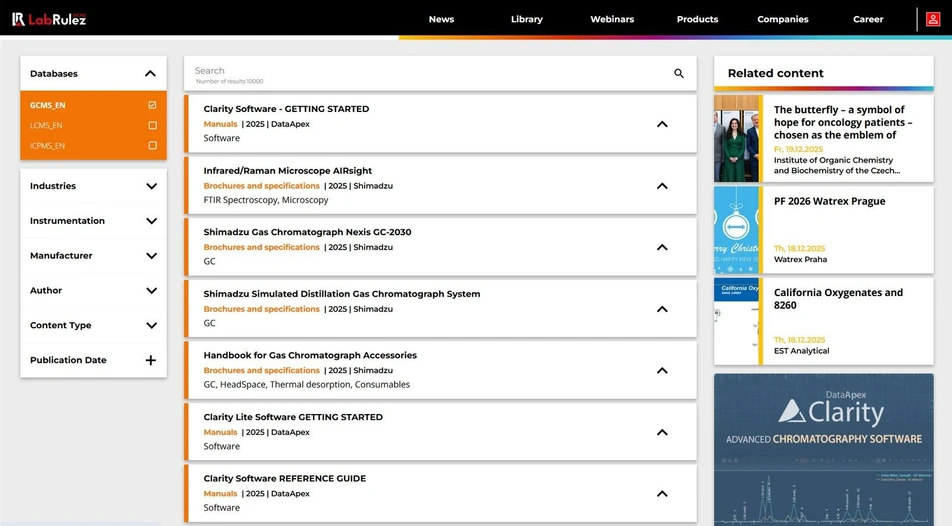
Our Library never stops expanding. What are the most recent contributions to LabRulezGCMS Library in the week of 22nd December 2025? Check out new documents from the field of the gas phase, especially GC and GC/MS techniques!
👉 SEARCH THE LARGEST REPOSITORY OF DOCUMENTS ABOUT GCMS AND RELATED TECHNIQUES
👉 Need info about different analytical techniques? Peek into LabRulezLCMS or LabRulezICPMS libraries.
This week we bring you application notes by Agilent Technologies, EST Analytical and Shimadzu!
1. Agilent Technologies: Analysis of Ethylene or Propylene Stream Cracking Gas Products
Using the Agilent 990 Micro GC
- Application note
- Full PDF for download
Ethylene or propylene cracking gas products are produced from various feedstocks, including naphtha, light naphtha, atmospheric diesel, depressurized diesel, hydrotreating tail oils, ethane, and liquefied petroleum gas, among others.
During gas cracking, yields of ethylene or propylene products should be monitored to measure the effectiveness of the process. The results of these analyses provide important process control data for optimizing cracking production and improving cracking yield—a key process parameter for cracking plants. Common cracking gas products are composed of hydrogen (H2 ), nitrogen (N2), and light hydrocarbons such as ethylene (C2H4), ethane (C2H6), propylene (C3H6), propane (C3H8), and 1-butene (C4H8), among others.
The Agilent 990 Micro GC enables fast and accurate detection of ethylene or propylene stream cracking gas products, a fundamental measure for determining the effectiveness of the cracking process. The system's demonstrated utility in refinery gas analysis further supports its suitability.
Conclusion
This study demonstrates the applicability of the Agilent 990 Micro GC for analyzing ethylene or propylene stream cracking gas products, providing essential process control data for optimizing cracking production and yield. Quantitation precision was evaluated through 10 consecutive analyses of calibration standard gases, showing retention time (RT) repeatability (%RSD) less than 0.1% and area repeatability (%RSD) less than 1.0% for all compounds. These results confirm the instrument's excellent performance in reliably qualifying and quantifying these stream cracking gas products.
2. EST Analytical: Purge and Trap Extraction of Tea Flavor Components
- Application note
- Full PDF for download
Purge and Trap (P&T) sampling is a universally accepted technique for the analysis of volatile compounds in water. The United States Environmental Protection Agency (USEPA), the World Health Organization (WHO) and the American Society for Testing and Materials (ASTM) have all published methods using P&T for water matrices. However, food and flavor manufacturers have yet to use this technique for the analysis of the volatile flavor components of their products. SPME has become the more accepted technique for flavor analysis.
Both SPME and P&T have their limitations. P&T is recommended for volatile analytes and does not work when compounds have higher boiling points. Still, P&T is a reliable technique that has the ability to purge out all of the volatile analytes of a system and detect very low concentrations of those analytes. On the other hand, SPME can be used for sampling a larger amount of semi-volatile compounds and fiber coating selection aids in better discrimination of analyte sampling. Yet, SPME is not an exhaustive sampling technique thus there are detection limitations to the technique. This application note will examine the analysis of white tea samples using P&T sampling.
Experimental
The EST Analytical Evolution Purge and Trap was set up with a Vocarb™ 3000 trap while the Centurion WS autosampler was set to run in soil mode. The sampling system was configured to an Agilent 7890A Gas Chromatograph (GC) and 5975C inert XL Mass Spectrometer (MS) for separation and analysis. As the compounds of interest for this analysis were volatile, a Restek Rxi® 624 Sil MS 30m X 0.25mm X 1.8um column was affixed in the GC. Sampling and analysis parameters were optimized and are listed in Tables 1 and 2.
Conclusions
Using purge and trap to evaluate the flavor compounds of the tea samples was a reliable sampling technique. The findings were repeatable and the chromatography was excellent. The resulting flavor compounds were easily purged out of the tea matrix and as the technique is exhaustive, there was excellent detection of the flavor compounds in the system. This sampling technique established purge and trap to be an exceptional method for the determination of volatile analytes in tea.
3. Shimadzu: Real-Time Measurement of CH4 and CO2 Concentrations for Estimating Methane Emissions from Rice Fields
- Application note
- Full PDF for download
User Benefits
- The portability of this gas analyzer means the user can decide where to place it, such as near a rice field, to continuously measure CH4 and CO2 emissions.
- The CGT-7100 analyzer unit has a built-in pump, filter, dehumidifier, and other sample pretreatment equipment, so it does not require other equipment to perform measurements.
- Data can be stored on a USB flash drive for easy editing on a computer or sharing with other departments.
CH4 is a gas that has a greenhouse effect about 28 times greater*1 than CO2. One source of CH4 gas emissions is flooded rice fields. They release the CH4 gases generated by microorganisms living in the soil into the atmosphere. Since CH4 emissions from rice fields account for a significant proportion of greenhouse gases emitted from the agriculture, forestry, and fishery industry, various measures are being implemented to reduce emissions, such as managing the water and soil used in rice fields and improvingthe fertilizers used.
The closed chamber method measures variations in gas concentrations due to gases exchanged with plants, such as rice. 1) In this article, a CGT-7100 portable gas analyzer measures the concentration of CH4 and CO2 generated inside a specialized chamber placed on the surface of rice paddy soil.
CH4 Emitted from Rice Fields
The amount of CO2 emitted from a rice field depends on the amount breathed (emitted) from the rice plant and photosynthesized (absorbed), whereas the amount of CH4 emitted depends on the microorganisms in the soil. Fig. 2 illustrates the process of CH4 emission from rice fields. The microorganisms generate CH4 by decomposing organic matter in the soil. When a rice field is flooded with water, the supply of oxygen to the soil stops and anaerobic microorganisms actively generate CH4. It is thought that the generated CH4 is emitted into the atmosphere via two pathways. One pathway is via the roots and stalks of the rice plants (pathway 1).2),3) Due to the functions of the microorganisms, CH4 concentrations in the soil become higher than inside the plant, resulting in a concentration gradient that dissolves into the root cells. The dissolved CH4 becomes a gas within the narrow gaps between cells and moves along the gaps to the leaf sheath above ground. Pores on the leaf surface then discharge the CH4 into the atmosphere. In the other pathway (pathway 2), CH4 in the soil forms bubbles that are released directly into the atmosphere without passing through the rice plant. Pathway 1 increases the CH4 concentration inside the chamber by a certain proportion, but the quantity and frequency of CH4 emissions via pathway 2 are not clearly known, so there is an element of uncertainty about the estimated quantity of CH4 emitted from rice fields4). Therefore, the frequency that bubbles formed was estimated by analyzing the CH4 concentration measurement results to determine how quickly the CH4 concentration increasedper unit area (methane flux).
CGT-7100 Portable Gas Analyzer
The CGT-7100 is an all-in-one portable continuous gas concentration measuring system (Fig. 3). Because the compact main unit includes a pretreatment unit with a built-in electronic cooler for removing water moisture, a filter for removing dust, and a pump for suctioning sample gas into the analyzer system, the analyzer can be operated independently*2. Up to three components can be selected for measurement. In addition to two of the CO2, CO, and CH4 components being measured by the non-dispersive infrared absorption (NDIR) method, one component can also be selected for measurement by an O2 analyzer (optional), based on the limiting current type zirconia method. Changes in concentrations over time can be monitored with a wide range of measurements, from ppm to vol%. With the minimum sample gas flowrate of 100 mL/min (optional), gas concentrations can be measured in small sample quantities, and the sample gas flowrate can be varied within the range of 100 to 400 mL/min. As shown in the measurement process flow diagram below, samples can also be measured without losses by including a recirculation system that returns the sample gas discharged from the analyzer to the measurementlocation (inside the chamberin this case).
Non-Dispersive Infrared Absorption (NDIR) Method
The CGT-7100 uses the non-dispersive infrared absorption (NDIR) method for measurements. CO2 and other heteronuclear gases have unique infrared light absorption spectra. Gas concentrations can be measured selectively by passing infrared light through the sample gas and using the detector to measure the quantity of infrared light in the absorption band that is unique to a given type of gas. Robust and reliable measurements are achieved with the optical system in the NDIR unit, which has an excellent track record among online gas analyzers.
Conclusion
This article describes an example of using a CGT-7100 portable gas analyzer to estimate the amount of CH4 and CO2 emitted from a rice field by continuously measuring CH4 and CO2 concentrationsinside the chamberplaced in a rice paddy.
Since the CGT-7100 is a continuous gas analyzer, it is ideal for measuringchangesin gas concentrationsin realtime. The CGT-7100 can be used to observe changes in the levels of CH4 and CO2 or the effects of bubble formation when implementing rice field water and soil management or fertilizer improvement measures.
With its built-in sample gas pretreatment and sampling functionality, gas concentrations can be conveniently measured without the need for additional equipment, and the portability of the analyzer means it can measure gas concentrations in a wide variety of locations. If used with a communication unit, measurement data can be viewed and saved remotely via a computer or tablet to accommodate a wide range of testing and research applications.