GCMS
More information
WebinarsAbout usContact usTerms of use
LabRulez s.r.o. All rights reserved. Content available under a CC BY-SA 4.0 Attribution-ShareAlike
Author
LabRulez
LabRulez
Everything from the world of analytical chemistry in one place. We connect people in solving their problems. At Labrulez you will find all the necessary information easily, quickly and clearly. Stop searching and start finding.
Tags
Article
Application
LinkedIn Logo

News from LabRulezGCMS Library - Week 43, 2025
We, 22.10.2025
| Original article from: LabRulezGCMS Library
This week we bring you applicaton notes by Agilent Technologies, EST Analytical, Shimadzu and Thermo Fisher Scientific!
<p><strong>LabRulez:</strong> News from LabRulezGCMS Library - Week 43, 2025</p>

LabRulez: News from LabRulezGCMS Library - Week 43, 2025

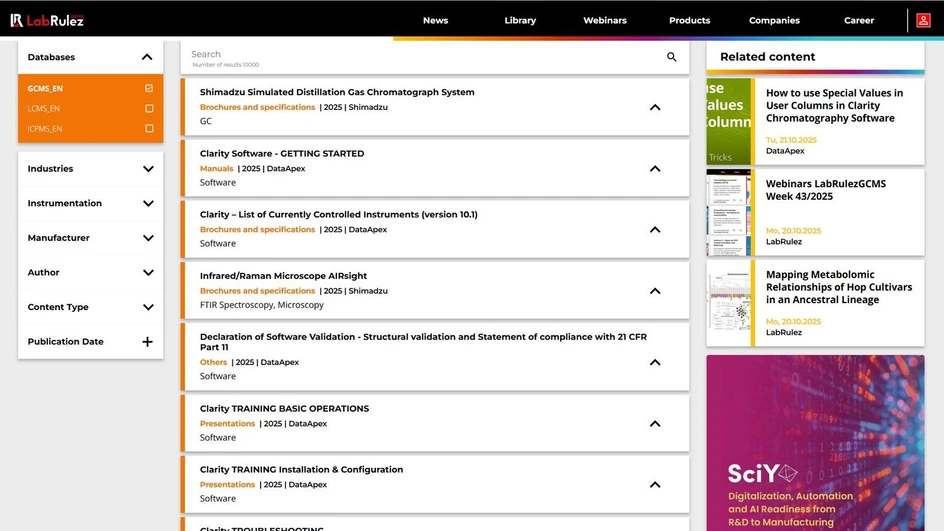
Our Library never stops expanding. What are the most recent contributions to LabRulezGCMS Library in the week of 20th October 2025? Check out new documents from the field of the gas phase, especially GC and GC/MS techniques!

👉 SEARCH THE LARGEST REPOSITORY OF DOCUMENTS ABOUT GCMS AND RELATED TECHNIQUES

👉 Need info about different analytical techniques? Peek into LabRulezLCMS or LabRulezICPMS libraries.

This week we bring you applicaton notes by Agilent Technologies, EST Analytical, Shimadzu and Thermo Fisher Scientific!

1. Agilent Technologies: FAMEs Analysis of Oils by GC-FID Coupled with Fully Automated Sample Preparation using a PAL3 Series 2 RTC

The analysis of fatty acid methyl esters (FAMEs) is a widely used technique for characterizing lipid profiles in various food products, including oils, meats, and seeds. Fats are composed of a complex mixture of saturated, monounsaturated, and polyunsaturated fatty acids, each with varying carbon chain lengths.2 This type of analysis is routinely performed in governmental, quality control (QC), and contract research laboratories worldwide. The resulting data often informs product labeling. Among the analytical techniques available, gas chromatography (GC) with flame ionization detection (GC-FID) is one of the most common methods for determining fatty acid composition in foods. 

This application note describes the use of automated sample preparation and analysis of FAMEs using the PAL3 Series 2 RTC Autosampler system coupled with Agilent 8890 GC system equipped with an FID. The results shown here focus on two different methods of derivatization for FAMEs extraction: (1) base catalyzed reactions using potassium hydroxide (KOH) (part number M5795-14000) and (2) base plus acid catalyzed reactions using boron trifluoride (BF3 ) 1 (part number M5795-14001). For ease of use, both processes have been transcribed into dedicated sample preparation methods. These methods are part of the Agilent automated sample preparation workflow suite of solutions. These workflows improve process safety, optimizes throughput, and minimizes errors.

Experimental 

The 37 component FAME mix standard was purchased from Sigma-Aldrich (part number CRM47885), and three consumer oil products were purchased from a local grocery store. The samples were prepared and injected into the GC using the PAL3 Series 2-RTC system. The analysis was performed using an 8890 GC equipped with an Agilent DB‑FastFAME GC column, 30 m × 250 µm, 0.25 µm, (part number G3903‑63011) and configured with an FID using Agilent OpenLab CDS v2.7+.

Conclusion 

In summary, the current study demonstrated excellent reproducibility and accuracy using automated sample preparation and analysis of FAMEs. Two different sample preparation methods were demonstrated, both delivering comparable and reliable results. The base-catalyzed method enables rapid analysis but is not suitable for samples containing free fatty acids. In contrast, the acid-catalyzed method, while more extensive, is compatible with a broader range of lipid classes, including free fatty acids, phosphoglycerides, and triglycerides. The Agilent automated sample preparation workflow suite of solutions deliver a comprehensive package by combining preconfigured hardware, optimized analytical methods, and the necessary consumables to ensure efficient and reliable results.

2. EST Analytical: Unregulated Contaminant Monitoring Rule 3 for USEPA Method 524.3 and 524.4

The third Unregulated Contaminant Monitoring Rule (UCMR 3) was finalized in April of 2012. UCMR 3 requires public water systems to monitor for a specific list of 30 contaminants under three separate lists: list one, assessment monitoring, list two, screening survey, and list three, pre-screen testing. This application note will address the volatile organic compounds found in list one, assessment monitoring contaminants. USEPA Method 524.3 and 524.4 will be the methods evaluated for sampling and analysis.

Discussion 

The amendments to the Safe Drinking Water Act (SDWA) require the EPA to list no more than 30 unregulated contaminants to be monitored by public water systems. Every five years, this list needs to be updated. List one contaminants include seven volatile organic compounds to be analyzed by USEPA Method 524.3. The detection limits for these compounds are much lower; therefore, Single Ion Monitoring (SIM) must be used for compound detection. USEPA Method 524.3 and 524.4 allow for modification of purge and trap parameters in order to take advantage of purge and trap improvements. Thus, method parameters can be modified in order to optimize purge and trap cycle times. Since the purge and trap parameters were established for these methods previously, refer to application note Drinking Water Analysis Conditions for USEPA Method 524.3 and the Newly Proposed Method 524.4, purge and trap method development was not required for this application. For this study, Helium and Nitrogen purge gases were compared utilizing the same purge volume then comparing experimental results for the linearity, precision, accuracy and overall compound response for the low level requirements set by UCMR 3. 

Experimental 

The EST Analytical Encon Evolution purge and trap concentrator and Centurion WS autosampler were interfaced to an Agilent 7890/5975 GC/MS. The purge and trap concentrator was configured with a Vocarb 3000 (K) analytical trap. A chiller unit capable of keeping the sample vials cooled below 10°C was installed on the Centurion WS autosampler. The experimental parameters are listed in Tables 1 and 2.

Conclusion

The Encon Evolution and Centurion WS in conjunction with the Agilent 7890/5975 GC/MS performed very well using both the Helium and Nitrogen purge gases and employing SIM for compound detection. The Nitrogen and the Helium purge gases met USEPA Method 524.3 curve linearity criteria and produced comparable results for precision and accuracy at the low and mid-levels of the calibration curve. Overall, the principal difference between the two purge gases was exhibited in the compound response. When examining the overall compound response factors over the curve range, it is evident that the analytes’ responses are slightly lower with the Nitrogen purge gas as opposed to the Helium purge gas.

3. Shimadzu: Comparison of Metabolites in Rice from Different Production Areas Using GC-MS/MS

Metabolomics is a research method for comprehensively analyzing metabolites contained in an organism. It is used for a wide variety of fields, such as medical science and food. Because food quality is affected by many components complexly, comprehensive analysis of metabolites can help improve food development and manufacturing processes. Rice contains metabolites, such as sugars, amino acids, and fatty acids. In recent years, development of more flavorful rice has been studied. 

This article describes simultaneous analysis of 502 metabolites and multivariate analysis of a variety of rice from different production areas. The GCMS-TQ8040 NX with the Smart Metabolites Database Ver. 2 was used for measurement. LabSolutions Insight was used for data processing, and eMSTAT Solution was used for multivariate analysis. The process flow, from pretreatment to data analysis, is shown in Fig. 1.

eMSTAT Solution 

eMSTAT Solution is statistical analysis software that enables multivariate and discriminant analysis of chromatogram data. For multivariate analysis, it can discriminate between samples, and it can search for the marker peaks that contribute to those differences. For discriminant analysis, it can create a discriminant model based on training data and use the model for discriminant analysis. Users can easily switch both modes with just a single click. Workflow of the data analysis is shown in Fig. 2.

Conclusion 

Metabolites in same variety of rice from different production areas were analyzed, and the differences between samples were identified by multivariate analysis. Score plots were used to visualize differences between the samples, and loading plots were used to confirm the characteristic compounds. Smart Metabolites Database Ver. 2, LabSolutions Insight, and eMSTAT Solution make metabolites analysis, data processing, and multivariate analysis easy for beginner users.

4. Thermo Fisher Scientific: Automated, multi-parameter gasoline characterization using GC-VUV and ASTM D8071

Gasoline is a complex hydrocarbon blend whose composition directly impacts combustion behavior, emissions, and regulatory compliance. Accurately quantifying components such as aromatics, olefins, ethanol, and benzene is critical, but traditional ASTM methods require multiple techniques (FIA, GC-FID, GC-MS, etc.) to measure all relevant parameters. Table 1 summarizes several test methods and their respective scopes. 

ASTM D8071 introduces a consolidated method using GC-VUV, offering improved precision, spectral resolution, and reduced operational burden. This approach is now recognized as an EPA- and CARB-approved alternative to several legacy test methods, including ASTM D1319, D5599, D5769, and D3606.

Experimental 

Gasoline samples were analyzed on the VUV Analyzer Platform for Fuels with no sample preparation required. The VUV Analyzer consists of the Thermo Scientific™ TRACE™ 1610 gas chromatograph coupled to the VGA-100™ spectrometer detector (VUV Analytics, Inc.). 

Data are acquired and processed with the VUVision™ Software and VUV Analyze™ Software (VUV Analytics, Inc), respectively, specifically configured to run ASTM D8071. 

Workflow overview 

The VUV Analyzer Platform for Fuels performs gasoline PIONA class analysis using a streamlined five-step workflow: 

  1. System validation – Verifies instrument performance using standard hydrocarbons. 
  2. Sample prep – No preparation required. 
  3. Data acquisition – Performed using VUVision Software. 
  4. Spectral matching – Automated deconvolution with VUV Analyze Software. 
  5. Quantitation – Volume % and mass % calculated with high accuracy using built-in response factors and density data.

Conclusion 

GC-VUV with ASTM D8071 enables complete hydrocarbon group and compound-level analysis of gasoline in a single method. Its ability to automate spectral deconvolution and report mass and volume percentages simplifies operations while meeting strict compliance standards. This solution not only enhances analytical accuracy and repeatability but also drastically reduces operating costs and lab complexity. 

  • Short analysis time with full gasoline class and compound profiling in 34 minutes 
  • Faster throughput with full automation from injection to reporting 
  • 12× lower cost-per-analysis, due to reduced labor, no calibration standards, and consolidated workflow
LabRulez
LinkedIn Logo
 

Related content

Analysis of Aroma Components in Apples Using the Smart Aroma Database

Applications
| 2026 | Shimadzu
Instrumentation
GC/MSD, GC/SQ, HeadSpace
Manufacturer
Shimadzu
Industries
Food & Agriculture

Analysis of Acetaldehyde and Limonene in Recycled PET Using an HS-GCMS System (Carrier Gas: H2)

Applications
| 2026 | Shimadzu
Instrumentation
GC/MSD, GC/SQ, HeadSpace
Manufacturer
Shimadzu
Industries
Energy & Chemicals

What Causes GC Capillary Column Performance Degradation, and How Can I Prevent It?

Technical notes
| 2026 | Agilent Technologies
Instrumentation
Consumables, GC columns
Manufacturer
Agilent Technologies
Industries
Other

Aromatic Component Analysis of Gasoline According to ASTM D5580 Using the Brevis GC- 2050 Gas Chromatograph

Applications
| 2025 | Shimadzu
Instrumentation
GC
Manufacturer
Shimadzu
Industries
Energy & Chemicals

Micro GC Analysis of Permanent Gas Impurities in PEM Fuel Cell-Grade Hydrogen

Applications
| 2025 | Agilent Technologies
Instrumentation
GC
Manufacturer
Agilent Technologies
Industries
Energy & Chemicals
 

Related articles

JUNIOR STAR Grants at UCT Prague: Two talented women from abroad driving innovation in science
Article | Scientists

JUNIOR STAR Grants at UCT Prague: Two talented women from abroad driving innovation in science

Two outstanding early-career researchers at UCT Prague, Filipa Oliveira and Stella Gonsales, received prestigious GAČR JUNIOR STAR grants for innovative research in materials science and sustainable chemistry.
UCT Prague
tag
share
more
Revealing hidden chemicals at sea
Article | Health

Revealing hidden chemicals at sea

Flame retardants were found throughout cruise ship interiors, with some areas showing much higher levels. A new RECETOX and NIVA study explores potential exposure risks for crew and passengers.
RECETOX - Centrum pro výzkum toxických látek v prostředí
tag
share
more
News from LabRulezGCMS Library - Week 06, 2026
Article | Application

News from LabRulezGCMS Library - Week 06, 2026

This week we bring you technical note by Agilent Technologies and application notes by BaySpec, Metrohm and Shimadzu!
LabRulez
tag
share
more
Research from IOCB Prague reveals a previously unknown mechanism of genetic transcription
Article | Science and research

Research from IOCB Prague reveals a previously unknown mechanism of genetic transcription

Scientists at IOCB Prague reveal a previously unknown mechanism that initiates gene transcription. Using cryo-EM, they uncover how alarmone molecules enable RNA synthesis under stress.
Institute of Organic Chemistry and Biochemistry of the Czech Academy of Sciences
tag
share
more
 

Related content

Analysis of Aroma Components in Apples Using the Smart Aroma Database

Applications
| 2026 | Shimadzu
Instrumentation
GC/MSD, GC/SQ, HeadSpace
Manufacturer
Shimadzu
Industries
Food & Agriculture

Analysis of Acetaldehyde and Limonene in Recycled PET Using an HS-GCMS System (Carrier Gas: H2)

Applications
| 2026 | Shimadzu
Instrumentation
GC/MSD, GC/SQ, HeadSpace
Manufacturer
Shimadzu
Industries
Energy & Chemicals

What Causes GC Capillary Column Performance Degradation, and How Can I Prevent It?

Technical notes
| 2026 | Agilent Technologies
Instrumentation
Consumables, GC columns
Manufacturer
Agilent Technologies
Industries
Other

Aromatic Component Analysis of Gasoline According to ASTM D5580 Using the Brevis GC- 2050 Gas Chromatograph

Applications
| 2025 | Shimadzu
Instrumentation
GC
Manufacturer
Shimadzu
Industries
Energy & Chemicals

Micro GC Analysis of Permanent Gas Impurities in PEM Fuel Cell-Grade Hydrogen

Applications
| 2025 | Agilent Technologies
Instrumentation
GC
Manufacturer
Agilent Technologies
Industries
Energy & Chemicals
 

Related articles

JUNIOR STAR Grants at UCT Prague: Two talented women from abroad driving innovation in science
Article | Scientists

JUNIOR STAR Grants at UCT Prague: Two talented women from abroad driving innovation in science

Two outstanding early-career researchers at UCT Prague, Filipa Oliveira and Stella Gonsales, received prestigious GAČR JUNIOR STAR grants for innovative research in materials science and sustainable chemistry.
UCT Prague
tag
share
more
Revealing hidden chemicals at sea
Article | Health

Revealing hidden chemicals at sea

Flame retardants were found throughout cruise ship interiors, with some areas showing much higher levels. A new RECETOX and NIVA study explores potential exposure risks for crew and passengers.
RECETOX - Centrum pro výzkum toxických látek v prostředí
tag
share
more
News from LabRulezGCMS Library - Week 06, 2026
Article | Application

News from LabRulezGCMS Library - Week 06, 2026

This week we bring you technical note by Agilent Technologies and application notes by BaySpec, Metrohm and Shimadzu!
LabRulez
tag
share
more
Research from IOCB Prague reveals a previously unknown mechanism of genetic transcription
Article | Science and research

Research from IOCB Prague reveals a previously unknown mechanism of genetic transcription

Scientists at IOCB Prague reveal a previously unknown mechanism that initiates gene transcription. Using cryo-EM, they uncover how alarmone molecules enable RNA synthesis under stress.
Institute of Organic Chemistry and Biochemistry of the Czech Academy of Sciences
tag
share
more
 

Related content

Analysis of Aroma Components in Apples Using the Smart Aroma Database

Applications
| 2026 | Shimadzu
Instrumentation
GC/MSD, GC/SQ, HeadSpace
Manufacturer
Shimadzu
Industries
Food & Agriculture

Analysis of Acetaldehyde and Limonene in Recycled PET Using an HS-GCMS System (Carrier Gas: H2)

Applications
| 2026 | Shimadzu
Instrumentation
GC/MSD, GC/SQ, HeadSpace
Manufacturer
Shimadzu
Industries
Energy & Chemicals

What Causes GC Capillary Column Performance Degradation, and How Can I Prevent It?

Technical notes
| 2026 | Agilent Technologies
Instrumentation
Consumables, GC columns
Manufacturer
Agilent Technologies
Industries
Other

Aromatic Component Analysis of Gasoline According to ASTM D5580 Using the Brevis GC- 2050 Gas Chromatograph

Applications
| 2025 | Shimadzu
Instrumentation
GC
Manufacturer
Shimadzu
Industries
Energy & Chemicals

Micro GC Analysis of Permanent Gas Impurities in PEM Fuel Cell-Grade Hydrogen

Applications
| 2025 | Agilent Technologies
Instrumentation
GC
Manufacturer
Agilent Technologies
Industries
Energy & Chemicals
 

Related articles

JUNIOR STAR Grants at UCT Prague: Two talented women from abroad driving innovation in science
Article | Scientists

JUNIOR STAR Grants at UCT Prague: Two talented women from abroad driving innovation in science

Two outstanding early-career researchers at UCT Prague, Filipa Oliveira and Stella Gonsales, received prestigious GAČR JUNIOR STAR grants for innovative research in materials science and sustainable chemistry.
UCT Prague
tag
share
more
Revealing hidden chemicals at sea
Article | Health

Revealing hidden chemicals at sea

Flame retardants were found throughout cruise ship interiors, with some areas showing much higher levels. A new RECETOX and NIVA study explores potential exposure risks for crew and passengers.
RECETOX - Centrum pro výzkum toxických látek v prostředí
tag
share
more
News from LabRulezGCMS Library - Week 06, 2026
Article | Application

News from LabRulezGCMS Library - Week 06, 2026

This week we bring you technical note by Agilent Technologies and application notes by BaySpec, Metrohm and Shimadzu!
LabRulez
tag
share
more
Research from IOCB Prague reveals a previously unknown mechanism of genetic transcription
Article | Science and research

Research from IOCB Prague reveals a previously unknown mechanism of genetic transcription

Scientists at IOCB Prague reveal a previously unknown mechanism that initiates gene transcription. Using cryo-EM, they uncover how alarmone molecules enable RNA synthesis under stress.
Institute of Organic Chemistry and Biochemistry of the Czech Academy of Sciences
tag
share
more
 

Related content

Analysis of Aroma Components in Apples Using the Smart Aroma Database

Applications
| 2026 | Shimadzu
Instrumentation
GC/MSD, GC/SQ, HeadSpace
Manufacturer
Shimadzu
Industries
Food & Agriculture

Analysis of Acetaldehyde and Limonene in Recycled PET Using an HS-GCMS System (Carrier Gas: H2)

Applications
| 2026 | Shimadzu
Instrumentation
GC/MSD, GC/SQ, HeadSpace
Manufacturer
Shimadzu
Industries
Energy & Chemicals

What Causes GC Capillary Column Performance Degradation, and How Can I Prevent It?

Technical notes
| 2026 | Agilent Technologies
Instrumentation
Consumables, GC columns
Manufacturer
Agilent Technologies
Industries
Other

Aromatic Component Analysis of Gasoline According to ASTM D5580 Using the Brevis GC- 2050 Gas Chromatograph

Applications
| 2025 | Shimadzu
Instrumentation
GC
Manufacturer
Shimadzu
Industries
Energy & Chemicals

Micro GC Analysis of Permanent Gas Impurities in PEM Fuel Cell-Grade Hydrogen

Applications
| 2025 | Agilent Technologies
Instrumentation
GC
Manufacturer
Agilent Technologies
Industries
Energy & Chemicals
 

Related articles

JUNIOR STAR Grants at UCT Prague: Two talented women from abroad driving innovation in science
Article | Scientists

JUNIOR STAR Grants at UCT Prague: Two talented women from abroad driving innovation in science

Two outstanding early-career researchers at UCT Prague, Filipa Oliveira and Stella Gonsales, received prestigious GAČR JUNIOR STAR grants for innovative research in materials science and sustainable chemistry.
UCT Prague
tag
share
more
Revealing hidden chemicals at sea
Article | Health

Revealing hidden chemicals at sea

Flame retardants were found throughout cruise ship interiors, with some areas showing much higher levels. A new RECETOX and NIVA study explores potential exposure risks for crew and passengers.
RECETOX - Centrum pro výzkum toxických látek v prostředí
tag
share
more
News from LabRulezGCMS Library - Week 06, 2026
Article | Application

News from LabRulezGCMS Library - Week 06, 2026

This week we bring you technical note by Agilent Technologies and application notes by BaySpec, Metrohm and Shimadzu!
LabRulez
tag
share
more
Research from IOCB Prague reveals a previously unknown mechanism of genetic transcription
Article | Science and research

Research from IOCB Prague reveals a previously unknown mechanism of genetic transcription

Scientists at IOCB Prague reveal a previously unknown mechanism that initiates gene transcription. Using cryo-EM, they uncover how alarmone molecules enable RNA synthesis under stress.
Institute of Organic Chemistry and Biochemistry of the Czech Academy of Sciences
tag
share
more
Other projects
LCMS
ICPMS
Follow us
More information
WebinarsAbout usContact usTerms of use
LabRulez s.r.o. All rights reserved. Content available under a CC BY-SA 4.0 Attribution-ShareAlike