News from LabRulezGCMS Library - Week 36, 2025
LabRulez: News from LabRulezGCMS Library - Week 36, 2025
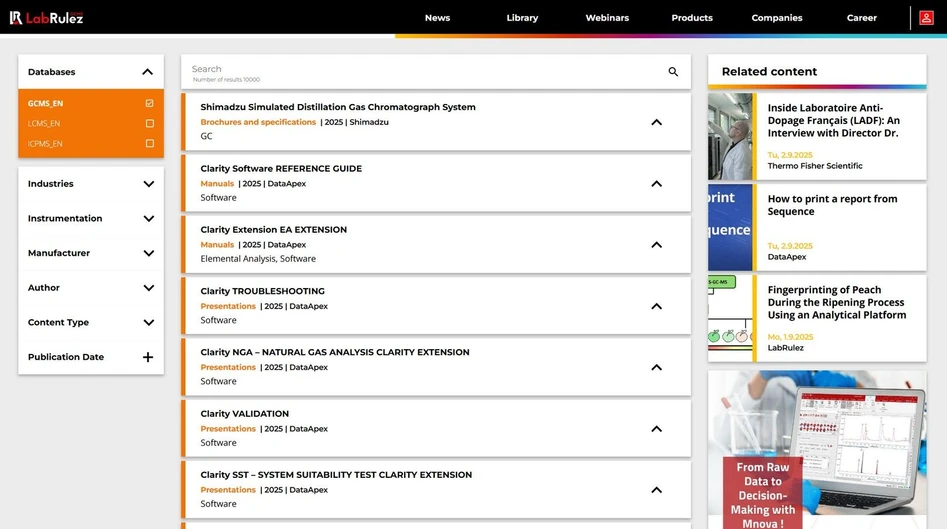
Our Library never stops expanding. What are the most recent contributions to LabRulezGCMS Library in the week of 1st September 2025? Check out new documents from the field of the gas phase, especially GC and GC/MS techniques!
👉 SEARCH THE LARGEST REPOSITORY OF DOCUMENTS ABOUT GCMS AND RELATED TECHNIQUES
👉 Need info about different analytical techniques? Peek into LabRulezLCMS or LabRulezICPMS libraries.
This week we bring you poster by Agilent Technologies / ASMS and application notes by EST Analytical and Shimadzu!
1. Agilent Technologies / ASMS: Analysis of Phthalates Using GC/MS With Hydrogen Carrier Gas: The Importance of Reducing Interferences and Contamination
- Poster
- Full PDF for download
Due to the price of helium (He), many laboratories are looking for alternative carrier gases for their gas chromatography/mass spectrometry (GC/MS) methods. This work describes the evaluation of a single quadrupole GC/MS method for the analysis of 19 phthalates using hydrogen carrier gas and an EI source 1 . The method provides excellent peak shape, resolution, sensitivity, and a 13 min run time. Calibration curves were linear for 16 of the phthalates, with the remaining 3 alkoxy phthalates requiring a quadratic fit. Except for DINP and DIDP (mixtures of isomers), all compounds could be quantitated at low pg levels. Specific attention to the consumables used and their preparation before use is discussed and is important for reaching the lowest calibration levels.
Experimental
- GC: Agilent 8890 GC with Agilent 7693A automatic liquid sampler and tray
- Column: Agilent HP-5MS UI 20 m x 0.18 mm id x 0.18 µm (p/n 19091S-577UI)
- MSD: Agilent 5977C Inert Plus GC/MSD
Conclusions
- The Agilent 5977C GC/MSD and 8890 GC, when used with the method described here, provide excellent peak shape, resolution, sensitivity, and a 13 min run time..
- The combination of hydrogen carrier and the Agilent J&W HP-5ms 180 µm diameter column allowed for reduced analysis time relative to helium and a 250 µm diameter column .
- Calibration curves were linear for 14 of the phthalates from 1 to 1,000 pg. DMEP and DBEP required quadratic curve fits, and DMEP and DEHP were calibrated from 2.5 to 1,000 pg. DINP and DIDP were calibrated from 50 to 20,000 pg with a linear fit.
- Specific attention to the consumables used and their preparation before use is important for reaching the lowest calibration levels.
2. EST Analytical: The Determination of Flavors in E-Liquids Using Purge and Trap Concentration
- Application note
- Full PDF for download
E-liquid can be composed of propylene glycol or vegetable glycerin alone or can be a combination of the two. Propylene glycol is less viscous and carries better flavor. It also acts as a preservative. However, it does produce less vapor and some people are allergic to it. Vegetable glycerin, on the other hand, is much denser, is super hypoallergenic and produces more vapor. The drawback to the vegetable glycerin is that it is not a preservative, so the vape liquid will not last as long. Both glycerin and propylene glycol readily dissolve in water, so preparing the samples to test by purge and trap was relatively easy. Conversely, as the E-liquid emitted a strong odor of the added flavors, only a small amount of the solution could be used for analysis. The volatile flavor components of the vape liquid were examined by dissolving the solution in water and sampling the water using purge and trap.
Experimental
The Evolution purge and trap concentrator was configured with a Vocarb 3000 trap. The trap was conditioned at 260ºC for one hour. The Centurion WS syringe autosampler was set in water mode in order to run 5 ml samples. Next, samples were prepared using 10ul of vape solution dissolved in 100mls of de-ionized water. The parameters for the autosampler/purge and trap concentrator and the Gas Chromatograph/Mass Spectrometer (GC/MS) are outlined in Tables 1 and 2.
Conclusions
Since vape solution readily dissolves into water, purge and trap sampling proved to be an excellent technique for the determination of the volatile compounds in the E-liquids. Purge and trap sampling is an exhaustive sampling technique, so the results were very reproducible and provided the sensitivity to determine the lower level compounds in the solution. Furthermore, it was found that nicotine addition to the solution has an effect some of the compounds in the solution. So, the taste of the vape liquid is affected by the amount nicotine in the mix.
3. Shimadzu: Determination of Nitrobenzene Compounds in Nifedipine by GCMS
- Application note
- Full PDF for download
User Benefits
- The direct dissolution protocol without pre-treatment, significantly enhancing analytical efficiency.
- The specificity of the method is ensured by monitoring the characteristic ions of nitrobenzene compounds in selected ion monitoring (SIM) mode, which provides robust resistance to interferences.
Nifedipine, a dihydropyridine calcium channel blocker with vasodilatory properties, is primarily indicated for the clinical management of hypertension and angina pectoris. Its synthetic route commences with 2-nitrotoluene as the starting material. Notably, the intermediate 2-nitrobenzyl alcohol, the byproduct 2- nitrobenzyl bromide, the reaction product 2-nitrobenzaldehyde, and potential impurities (3-nitrobenzaldehyde and 4- nitrobenzaldehyde) all contain nitrobenzene moieties, rendering them candidatesfor monitoring as potential genotoxic impurities. Previous studies have demonstrated that 2-nitrobenzaldehyde and 4-nitrobenzaldehyde exhibit mutagenicity in the Ames test, while 2-nitrotoluene has shown carcinogenicity in animal experiments. In accordance with the toxicological concern threshold (TTC) control approach specified in ICH M7, a threshold of 1.5 μg/day is recommended for genotoxic impurities in pharmaceuticals intended for lifelong administration. In this study, a method for the determination of six genotoxic impurities in nifedipine was developed using a Shimadzu GCMSQP2050 gas chromatography mass spectrometry. This method features simplified sample preparation, high sensitivity, and favorable repeatability, thereby enabling effective monitoring of the six nitrobenzene compounds as genotoxic impurities in nifedipine pharmaceutical.
Analytical Conditions
The analytical conditions are shown in Table1. GCMS-QP2050 system was used for this Application News.
Conclusion
A GC-MS method was established for the quantification of six nitrobenzene genotoxic impurities in nifedipine pharmaceuticals using a Shimadzu GCMS-QP2050 system. The calibration curves showed excellent linearity within the concentration range of 20-200 μg/L, with correlation coefficients (R>0.999). Precision was evaluated through six replicate injections of the 50 μg/L standard solution, and the relative standard deviations (RSDs) of peak areas for all analytes were less than 4%. Spike recovery experiments were performed at three concentration levels (0.005, 0.01, and 0.032 μg/g) in actual matrices, resulting in recovery rates ranging from 95.85% to 117.64%. This method is characterized by simplified sample preparation, high sensitivity (IDLs of 0.263-0.496 μg/L), and good repeatability. Overall, it provides a validated analytical strategy for quality control monitoring of the target genotoxic impurities.