Insecticide-Induced Perturbations in Sugar Metabolism and Alkaloid Biosynthesis in Coffea arabica (L.) Seedlings
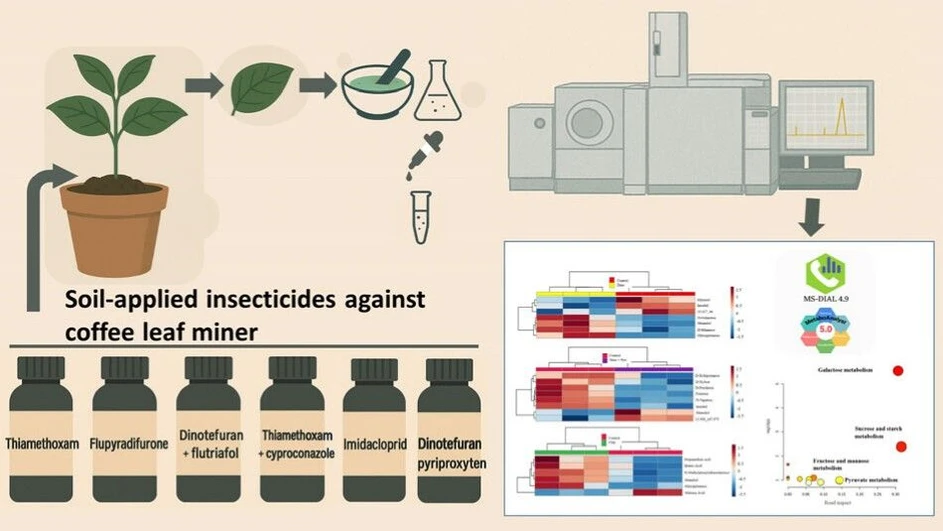
ACS Agric. Sci. Technol. 2025, 5, 11, 2152–2165: Graphical abstract
Soil-applied insecticides can induce unintended metabolic changes in coffee plants, yet these effects remain insufficiently characterized. This study used GC–MS-based metabolomics to evaluate biochemical responses in coffee seedlings treated with commonly used insecticides for coffee leaf miner control.
Distinct metabolomic profiles were observed across treatments, with neonicotinoids increasing free sugars and consistently reducing inositol levels, indicating a shared metabolic cost. In contrast, flupyradifurone triggered a unique response marked by accumulation of a neuroactive alkaloid, highlighting compound-specific biochemical impacts beyond pest management.
The original article
Insecticide-Induced Perturbations in Sugar Metabolism and Alkaloid Biosynthesis in Coffea arabica (L.) Seedlings
Carlos G. da Cruz, Brena R. M. Ikehara, Natália R. de Almeida, Erick A. A. Rocha, Wellington L. de Almeida, Frederico G. Pinto, Flávio L. Fernandes*
ACS Agric. Sci. Technol. 2025, 5, 11, 2152–2165
https://doi.org/10.1021/acsagscitech.5c00439
licensed under CC-BY 4.0
Selected sections from the article follow. Formats and hyperlinks were adapted from the original.
Modern pest management with insecticides has always been a subject of discussion in sustainability studies. (1) Recent studies increasingly focus on the possible impacts of insecticides on the host plants of insect pests. (2) The application of insecticides can directly impact plants, generating either positive or negative outcomes. (3) These impacts often manifest in a biphasic pattern, characterized as hormesis─a phenomenon in which sublethal concentrations of a chemical agent promote adaptive responses in plants. (4,5) This process involves changes in reactive oxygen species (ROS), influencing the balance of phytohormones and the biosynthesis of molecules essential for plant metabolism. (6,7)
In coffee plants, the application of systemic insecticides via soil─commonly used to control Leucoptera coffeella (Guérin-Mèneville and Perrottet) (Lepidoptera: Lyonetiidae)─has been associated with potential hormetic effects, including phytotonic impacts on plant development. (2) Plants possess a genetic capacity to synthesize secondary metabolites in response to environmental signals, which vary by species and environmental conditions, aiding in adaptation and survival. (8) These metabolites can affect regulatory, detoxification, transport, protection, and physiological support pathways. (9) Increases in ROS can lead to diverse effects. While some studies report benefits, such as improved growth and plant vigor, (2,10,11) others report adverse outcomes, including reduced germination, nutrient uptake, impaired carbohydrate metabolism, and reduced plant survival following the application of neonicotinoid and organophosphate insecticides. (6,12−14) In fact, reductions in the root systems of coffee seedlings exposed to neonicotinoids have already been reported. (15)
Despite advances in the understanding of the metabolic effects of insecticides, many studies do not addressed all phases of plant development. (10,16−18) More comprehensive analyses have been conducted in soybean and coffee crops. (2,3) However, research also underscores possible adverse impacts of insecticides on early coffee development, suggesting that these substances are unlikely to induce metabolic bioactivation in this crop. (15) Thus, characterizing metabolic responses in coffee plants is essential to anticipate impacts on plant vigor and to guide the selection of insecticides that are less disruptive to key metabolic processes in coffee plants within integrated pest management (IPM) frameworks. (14,15)
The metabolomic profile of coffee plants has been widely studied for purposes such as fruit classification by variety and origin, improvements in beverage quality, and the identification of pest-resistance compounds. (19−23) However, there is a scarcity of studies evaluating metabolic changes in coffee plants after insecticide application. (24−26) Metabolomic studies offers a thorough overview of environmental impacts, especially for emerging contaminants and pollutants. (27)
Given the economic importance of coffee in Brazil and the frequent use of insecticides in its cultivation, this study aimed to evaluate the metabolic profile of Coffea arabica ‘Catuaí Vermelho IAC 144’ seedlings treated with thiamethoxam, thiamethoxam + cyproconazole, dinotefuran, imidacloprid, dinotefuran + pyriproxyfen, and flupyradifurone using GC-MS.
2. Materials and Methods
2.3. Sample Analysis
The analysis was conducted using a gas chromatograph coupled to a mass spectrometer (GCMS-QP2010, Shimadzu, Kyoto, Japan), equipped with a DB-5MS capillary column (30 m × 250 μm internal diameter). The sample injection temperature was maintained at 250 °C. Chromatographic separation began at 80 °C for 2 min, followed by a temperature increase of 5 °C·min–1 until reaching 250 °C, which was held for 8 min. A constant helium gas flow of 1.0 mL·min–1 was maintained throughout the process. The injection volume was 1 μL with a split ratio of 20:1. Mass spectrum scanning was performed in the range of 40 to 650 m/z in full scan mode, with 5 scans per second. A solvent cut time of 3 min was applied, considering the retention time of pyridine used in the derivatization step. The interface and ion source temperatures were set at 280 °C. The detector voltage was 1.2 kV, and electron impact (EI) mode was selected for metabolite ionization at 70 eV.
An alkane standard mixture (C9–C30) was used for quality control and calculation of retention indices. Compound identification was performed using the NIST Mass Spectral Library 2017, accepting compounds with a similarity match of at least 85% and corresponding m/z values.
3. Results
3.1. Thiamethoxam + Cyproconazole (Thiam. + Cypr.)/Control
When comparing coffee leaf samples treated with Thiam. + Cypr. (Thiamethoxam + cyproconazole at 300 + 300 g a.i. ha–1) with the control, significant expression of 13 metabolites was observed. Among these, six exhibited higher intensities in the Thiam. + Cypr. treatment: galactose (p = 0.0006; FC= 1.666), d-glucose (p = 0.0011; FC= 1.527), mannitol (p = 0.004; FC= 1.339), d-mannose (p = 0.006; FC= 2.150), propanedioic acid (p = 0.018; FC= 1.495), and quinic acid (p = 0.033; FC= 1.182). On the other hand, seven metabolites were less intense, reflecting an increase in control treatment. These included: glycolic acid (p = 0.0003; FC= 0.493), malic acid (p = 0.004; FC= 0.575), inositol (p = 0.006; FC= 0.849), caffeine (p = 0.0004; FC= 0.0001), malonic acid (p = 0.043; FC= 0.413), and methyl-maleic acid (p = 0.044; FC= 0.458) (Figure 1A and B). Group separation was further supported by PLS-DA, with PC1 explaining 34.2% and PC2 25.9% of the variance (Figure S1).
 ACS Agric. Sci. Technol. 2025, 5, 11, 2152–2165: Figure 1. (A) Hierarchical clustering heatmap displaying the distribution of metabolites in coffee seedling samples treated with thiamethoxam + cyproconazole at 300 + 300 g a.i. ha–1 (purple, three columns on the left) and control (red, three columns on the right). (B) Comparative graphs showing the intensity of significantly different compounds between the two treatments. (Control = left bar; Thiam + Cypr. = right bar).
In total, 13 metabolic pathways were identified, but only the Galactose metabolism and C5-branched dibasic acid metabolism pathways were considered significant (Figure 2). The annotated metabolic pathways can be considered to have low and medium impact, respectively.
 ACS Agric. Sci. Technol. 2025, 5, 11, 2152–2165: Figure 2. Representation of the impact of thiamethoxam + cyproconazole at 300 + 300 g a.i. ha–1 on the metabolic pathways of coffee seedlings.
3.6. Dinotefuran + Pyriproxyfen (Dino. + Pyri.)/Control
Through the comparison of coffee leaf samples treated with Dino. + Pyri. (dinotefuran + pyriproxyfen at 150 + 37.5 g a.i. ha–1) with the control treatment, significant expression of six metabolites was identified. Among these, only one compound was found in higher intensity in the samples of seedlings treated with the insecticide, the unidentified compound (13.509_147.075) (p = 0.023; FC= 1.907). On the other hand, five metabolites were found in lower intensity in the Dino. + Pyri. treatment: inositol (p = 0.001; FC= 0.739), d-tagatose (p = 0.001; FC= 0.779), fructose (p = 0.009; FC= 0.812), d-psicose (p = 0.017; FC= 0.823), and d-xylose (p = 0.038; FC= 0.828) (Figure 11). Group separation was further supported by PLS-DA, with PC1 explaining 20.8% and PC2 30.5% of the variance (Figure S6).
 ACS Agric. Sci. Technol. 2025, 5, 11, 2152–2165: Figure 11. (A) Hierarchical clustering heatmaps displaying the distribution of metabolites in coffee seedling samples treated with dinotefuran + pyriproxyfen at 150 + 37.5 g a.i. ha–1 (blue, three columns on the left) and control (red, three columns on the right). (B) Comparative graphs showing the intensity of significantly different compounds between the two treatments. (Control = left bar; Dino. + Pyri. = right bar).
The pathway analysis for the dinotefuran + pyriproxyfen treatment identified six statistically significant metabolic pathways (Figure 12). These pathways, however, showed a clear hierarchy of biological impact. Fructose and mannose metabolism was the most prominent, with the highest pathway impact score (0.0670). Starch and sucrose metabolism showed a low, yet nonzero impact (0.0159). In contrast, the four other significant pathways─galactose metabolism, amino sugar and nucleotide sugar metabolism, pentose and glucuronate interconversions, and ascorbate and aldarate metabolism─all presented a pathway impact score of 0.0000, indicating a minimal topological impact despite their statistical significance.
 ACS Agric. Sci. Technol. 2025, 5, 11, 2152–2165: Figure 12. Representation of the impact of dinotefuran + pyriproxyfen at 150 + 37.5 g a.i. ha–1 on metabolic pathways in coffee seedlings.
4. Discussion
Metabolomics is a scientific field of study capable of providing thorough comprehension of biological mechanisms in response to external changes, capturing even subtle alterations that reflect the physiological state of an organism at the molecular level. (27,32,33) However, metabolomic studies on the effects of xenobiotics, such as insecticides, on coffee plants remains scarce. Given the extensive literature on the effects of insecticides, particularly neonicotinoids, on the morphophysiology and metabolome of plants, as well as their purported bioactivator activity in coffee plants, (2,34−36) it was decided to evaluate the metabolome of coffee seedlings subjected to the application of these commonly used insecticides for controlling the coffee leaf miner.
In coffee plants, galactose plays a multifaceted role in metabolism, being essential for growth, development, and caffeine production, as well as contributing to the plant’s resistance and adaptation to the environment. However, in the context of coffee, galactose studies focus mainly in fruit quality, (59) as it is a component of galactomannans, which constitute approximately 50% of the bean dry weight. (60) The composition of the cell wall is closely associated with the flavor and quality of the coffee beverage. (59,61) Another compound formed by galactose is galactinol, which can be used as a marker of beverage quality and provides an early screening method to assess beverage quality. (62)
Our results demonstrate that insecticides commonly used in the management of the coffee leaf miner (L. coffeella) also induce changes in the metabolism of host plants. These findings are particularly relevant in the context of Integrated Pest Management (IPM), as these insecticides have been the subject of scrutiny and frequent assumptions regarding their phytotonic effects, acting as bioactivators of plant development. Additionally, the persistence of neonicotinoid residues in plant tissues and the environment raises concerns regarding potential impacts on nontarget organisms and ecosystem health, underscoring the need for careful residue monitoring and environmental risk assessments. This raises concerns about the inappropriate use of this technology, which may have significant implications for coffee cultivation. (2,15) The results obtained in this study may help clarify several questions related to the use of insecticides in coffee crops, as well as provide a foundation for future research on Integrated Pest Management (IPM) in coffee cultivation.
In addition to carbohydrate metabolism, our data revealed alterations in organic acid profiles, including significant variations in malic, glycolic, and malonic acids. Malic acid is an integral component of the tricarboxylic acid (TCA) cycle, contributing directly to cellular energy production. (78) In contrast, glycolic and malonic acids are associated with other metabolic pathways: the former is linked to photorespiration and glyoxylate metabolism, while the latter is a known inhibitor of succinate dehydrogenase and may influence TCA cycle activity. (79,80) Alterations in these organic acids may reflect disturbances in primary metabolism associated with stress responses induced by insecticide application, potentially impacting plant vigor and adaptive capacity. (81)
In conclusion, this study reveals that soil-applied insecticides induce highly specific, rather than uniform, metabolic shifts in Coffea arabica seedlings. While neonicotinoids like thiamethoxam and imidacloprid generally upregulated sugar metabolism─particularly impacting the galactose pathway─formulation and dose played a critical role, with a higher thiamethoxam dose suppressing caffeine and a dinotefuran-pyriproxyfen combination suppressing sugars. In stark contrast, the butenolide flupyradifurone triggered a unique defensive pathway, marked by the substantial accumulation of the neuroactive alkaloid N-methylphenylethanolamine. These findings challenge the notion of a universal “phytotonic” effect, demonstrating that insecticide class, dose, and formulation dictate distinct metabolic outcomes. This work provides critical insights into the unintended biochemical consequences of these agrochemicals, underscoring the need to consider their specific impacts on plant defense, signaling, and primary metabolism within IPM frameworks. It is important to note that these insights are based on a GC-MS analysis of a single application, which does not consistently reflect field conditions involving multiple applications of xenobiotics. In this case, future multiplatform metabolomics studies under field conditions, with repeated exposures, are needed to explore the long-term metabolic impacts and effects on other metabolite classes.