Green Ultrasound-Assisted Dispersive Liquid–Liquid Microextraction Coupled to GC–MS for Simultaneous Determination of Lipid-Peroxidation- and Maillard-Derived Carbonyl Compounds in Plant-Based Beverages
ACS Meas. Sci. Au 2025: Graphical abstract
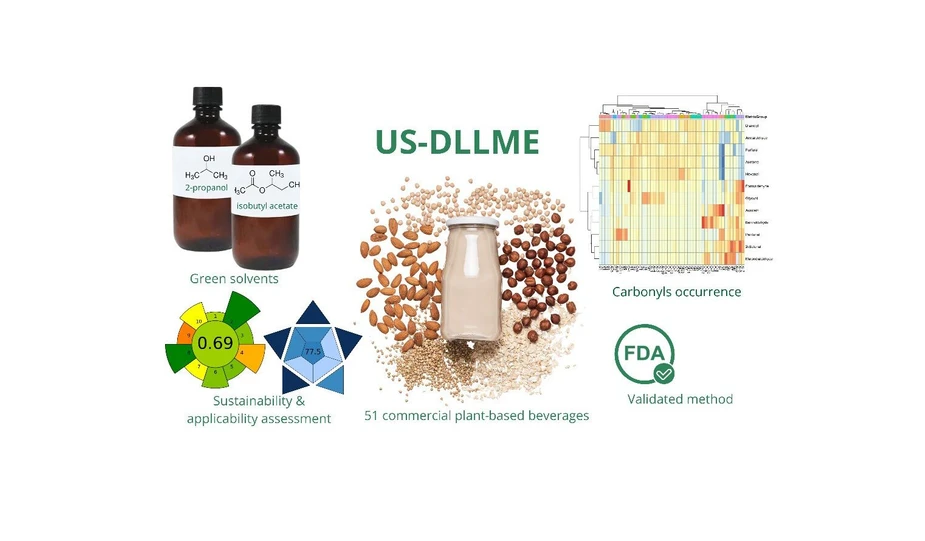
Carbonyl compounds arising from lipid peroxidation and Maillard reactions are important indicators of food quality and safety due to their toxicity and frequent occurrence in processed plant-based beverages. This study introduces a green ultrasound-assisted dispersive liquid–liquid microextraction (UA-DLLME) method using environmentally friendly solvents (isobutyl acetate and isopropanol) for the simultaneous determination of 12 carbonyls representing aldehydes, ketones, furans, and dicarbonyls. The workflow integrates in situ derivatization with PFBHA and GC–MS detection.
The method was optimized using multivariable experimental design and validated according to FDA guidelines, showing excellent linearity (r² ≥ 0.9991), accuracy (90–107%), precision (<7.5% RSD), and low detection limits suitable for complex matrices. Applied to 51 commercial plant-based beverages, the method demonstrated robust performance. Greenness assessment using AGREEprep (0.69/1) and BAGI (77.5/100) confirmed strong alignment with green chemistry principles. Overall, this sustainable approach offers a reliable tool for routine monitoring of carbonyl compounds in modern food systems.
The original article
Green Ultrasound-Assisted Dispersive Liquid–Liquid Microextraction Coupled to GC–MS for Simultaneous Determination of Lipid-Peroxidation- and Maillard-Derived Carbonyl Compounds in Plant-Based Beverages
Jorge A. Custodio-Mendoza*, Antía Villanueva, Agata Antoniewska-Krzeska, Rosa Pérez-Gregorio, Elena Martínez-Carballo, María Llompart, Antonia María Carro-Díaz
ACS Meas. Sci. Au 2025
licensed under CC-BY 4.0
Selected sections from the article follow. Formats and hyperlinks were adapted from the original.
Plant-based beverages (PBBs) are gaining growing importance in the food industry as alternatives to conventional dairy products, driven by consumer demand for more sustainable and health-oriented diets. (1) While dairy products remain nutritionally complete, PBBs are recognized for their content of bioactive phytochemicals, including antioxidants and anti-inflammatory agents, which may support cardiovascular and metabolic health. (2) Moreover, they stand as an alternative for individuals with lactose intolerance, milk protein allergies, or those following low-cholesterol diets. (3,4) In Spain, the consumption of PBBs has steadily increased in recent years. According to data from the Ministry of Agriculture, Fisheries and Food, (5) national consumption grew from approximately 226 million liters in 2017 to over 289 million liters by 2023. Notably, organic PBBs labeled as bio in accordance with European food labeling regulations (Regulation (EU) 2018/848 (6)) began to be recorded as a separate category in 2020, reaching over 31 million liters in their first year and maintaining a significant share of the market in subsequent years. This continued growth underscores Spain’s leading role in the European plant-based beverage sector, with national trends reflecting broader EU dietary shifts that position these products as functional, health-oriented alternatives. (4)
PBBs are typically produced from raw materials such as cereals, nuts, legumes, or seeds and undergo multistep processing to mimic the sensory and nutritional characteristics of dairy. (7) Standard operations include soaking, grinding, pasteurization, and, in many cases, Ultra-High Temperature (UHT, 135–150 °C for 2–4 s) treatment, while additional health treatments, such as roasting, are often employed to enhance flavor. (7−9) However, these thermal processes, together with extended storage, can compromise chemical stability by promoting nonenzymatic reactions such as the Maillard reaction and lipid peroxidation. These pathways are particularly relevant, as they contribute to the formation of reactive carbonyl species of toxicological concern. (9−11) Compounds encompassing saturated and unsaturated aldehydes, ketones, dicarbonyls, and furan derivatives (Table 1) are generated as byproducts of sugar degradation and lipid oxidation and have been associated with cytotoxic and genotoxic effects at elevated concentrations. (11−19) International agencies such as the International Agency for Research on Cancer (IARC) have classified several of these compounds based on the strength of evidence regarding their carcinogenicity, using a system that includes: Group 1 (carcinogenic to humans), Group 2A (probably carcinogenic to humans), Group 2B (possibly carcinogenic to humans), and Group 3 (not classifiable as to its carcinogenicity to humans). (12)
In this study, we developed and validated an ultrasound-assisted dispersive liquid─liquid microextraction method using sustainable solvents. The in situ PFBHA derivatization allowed for the simultaneous determination of 12 carbonyl compounds in PBBs by GC-MS. This green method was thoroughly validated according to Food and Drug Administration (FDA) guidelines, ensuring analytical reliability and accuracy. Moreover, we assessed the environmental and practical performance of this method using novel metrics for sustainability and applicability, thereby contributing novel insights into its feasibility for use in the food industry. This method was used to assess the occurrence of these carbonyls in 51 PBBs further proving their viability for quality control in these foods. This work aims to bridge the gap between experimental research and practical applications by offering a robust, reproducible, and greener extraction protocol that supports industrial implementation and standardization efforts.
Materials and Methods
Ultrasound-Assisted Dispersive Liquid–Liquid Microextraction
A schematic representation of the optimized method is provided in Figure 1. Briefly, 0.5 mL of sample was transferred to a 5 mL Eppendorf tube, followed by the addition of 1 mL of IPA (disperser solvent) and 1 mL of IBA (exclusively for defatting). The mixture was vortexed for 1 min and centrifuged at 3000 rpm for 5 min to achieve phase separation. Proteins precipitated to form a pellet at the bottom, while lipids were retained in the upper organic layer, which was discarded. The intermediate IPA phase, containing the analytes, was carefully transferred to a clean 2 mL glass vial. At this stage, a fresh aliquot of IBA (90 μL) was added as the extraction solvent. In parallel, the derivatization solution was prepared in a conical glass tube by combining 0.5 mL of PFBHA (4 mM in 0.1 M HCl) and 50 μL of IS solution and brought to a final volume of 5 mL with ultrapure water. The resulting solution presented a pH of 2.0, which is a condition required to ensure the complete derivatization of the target carbonyl compounds. The isopropanol/isooctane extract was then rapidly added to the derivatization solution using a Pasteur pipet. The resulting mixture was placed in an ultrasonic bath at 40 °C for 20 min to allow for simultaneous derivatization and extraction. After sonication, samples were centrifuged at 3500 rpm for 5 min to separate phases. The upper organic layer, containing the oxime derivatives, was carefully collected with a micro syringe and transferred to chromatographic vials with glass inserts for subsequent GC–MS analysis.
 ACS Meas. Sci. Au 2025: Figure 1. Scheme of the US-DLLME of carbonyl compounds from plant-based beverages (PBBs). IPA, isopropanol; IBA, isobutyl acetate; PFBHA, O-(2,3,4,5,6-pentafluorobenzyl) hydroxylamine hydrochloride; IS, internal standard; US, ultrasound.
Gas Chromatography–Mass Spectrometry
Gas chromatography–mass spectrometry (GC–MS) analyses were performed using an Agilent 7890B gas chromatograph coupled to a 5977B single quadrupole mass selective detector (Agilent Technologies, Santa Clara, CA, USA). Chromatographic separation was achieved using an HP-5MS capillary column (30 m × 0.25 mm i.d., 0.25 μm film thickness; Agilent J&W Scientific). Helium (99.999%) was used as the carrier gas at a constant flow rate of 1.5 mL/min. The injector was operated in splitless mode at 245 °C, equipped with an ultrainert double taper liner. The oven temperature program was as follows: initial temperature 100 °C (held for 2.5 min), increased at 100 °C/min to 230 °C (held for 3.3 min), then ramped at 35 °C/min to 280 °C (held for 4 min), resulting in a total runtime of 12.5 min. The interface temperature was maintained at 280 °C. The mass spectrometer operated under electron impact ionization (EI) at 70 eV in positive mode. The ion source temperature was set at 250 °C and the quadrupole at 120 °C. Detection was performed initially in full scan mode within 50–500 m/z to identify the specific ions for each derivatized carbonyl compound to then perform the analysis in selected ion monitoring (SIM) mode to enhance sensitivity and specificity for the analytes. Retention times and target ions for each analyte are detailed in the Analytical Figures of Merit section.
Results and Discussion
Sustainability and Viability Evaluation of the US-DLLME Procedure
The AGREEprep assessment, performed with the open-access AGREEprep software, was used to evaluate the environmental impact of our sample-preparation methods. This tool identifies strengths and weaknesses across green chemistry criteria and supports the design of more eco-friendly workflows. (29,30) In parallel, the practical applicability of the analytical method was evaluated using the BAGI online app, (31) which considers ten attributes grouped into two categories: analytical determination (e.g., type of analysis, number of analytes, required instrumentation) and sample preparation (e.g., sample-handling capacity, reagents used, degree of automation). Figure 8 presents the AGREEprep results for the environmental assessment (A) and the BAGI results (B) for the DLLME procedure.
 ACS Meas. Sci. Au 2025: Figure 8. Environmental impact assessment using the AGREEprep software (A) and practical applicability using the BAGI online tool (B) of the US-DLLME method. Scoring criteria are described in the text.
AGREEprep evaluates ten green analytical chemistry criteria: (1) in situ sample preparation, (2) use of safer solvents and reagents, (3) preference for sustainable, reusable, and renewable materials, (4) waste minimization, (5) reduced consumption of sample, chemicals, and materials, (6) maximized sample throughput, (7) integration of steps and promotion of automation, (8) minimized energy consumption, (9) selection of the greenest possible postsample-preparation configuration for analysis, and (10) operator safety. Scores range from 0 (least sustainable) to 1 (most sustainable), with higher values indicating a better environmental performance. The BAGI online tool considers ten attributes: (1) type of analysis, (2) number of analytes determined simultaneously, (3) analytical technique and instrumentation required, (4) number of samples that can be treated simultaneously, (5) sample-preparation process, (6) sample throughput per hour, (7) reagents and materials used, (8) need for preconcentration, (9) degree of automation, and (10) sample amount. Attributes are color-coded from white (low applicability, score 2.5) to dark blue (high applicability, score 10).
The US-DLLME-GC-MS method achieved an overall AGREEprep score of 0.69. Strong performance was observed for the absence of hazardous materials (score 1.0), the single-step design, and low energy consumption (score 1.0). Additional favorable factors were the economy of sample size (0.5 g; score 0.77), high sample throughput (up to 24 simultaneous experiments per hour; score 0.75), and the use of sustainable/renewable reagents and materials (>75%; score 0.75). Limitations were associated with the waste generated (5.79 mL per sample; score 0.35) and the use of mass spectrometry as the post-sample-preparation configuration (score 0.25).
Carbonyl Compounds Occurrence in Plant-Based Beverages
Occurrence results for the 12 target carbonyl compounds are summarized in Table S3. ACE was consistently detected in most matrixes (detection frequency 90–100%), with positive-only medians ranging from ∼790 ng/mL in minor crops to ∼1060 ng/mL in almond and coconut. FCHO, in contrast, was detected infrequently (≤30% of samples) and showed variable positive medians, from 518.8 ng/mL in mixed formulations to >1500 ng/mL in oat drinks and >1021 ng/mL in almond drinks. Several other carbonyls, including 2=C4Al, ACRL, and MDA, showed detection frequencies ≤40% in most groups and positive-only medians between ∼300 and 1600 ng/mL; their sporadic detection suggests a limited role in discriminating matrixes. Four analytes displayed clear matrix-dependent fingerprints. DA was detected in nearly all soy, almond, oat, and mixed samples (≥93–100% detection), with positive medians of ∼2915 ng/mL in soy, ∼1142 ng/mL in almond, ∼973 ng/mL in oat, and ∼1468 ng/mL in mixed formulations; coconut showed a lower median (784 ng/mL) with only 50% detection. FUR was detected across all groups and reached its highest positive median in coconut (∼2512 ng/mL), followed by soy (∼2016 ng/mL), rice (∼1824 ng/mL), oat (∼1556 ng/mL), mixed (∼1649 ng/mL), and almond (∼1254 ng/mL). HEX, a marker of lipid oxidation, was detected in almost all matrixes except mixed formulation, with positive medians around 350 ng/mL in almond, oat, and coconut and higher values in minor crops (∼593 ng/mL). GO distinguished almond and mixed formulations (positive medians ∼345 and ∼309 ng/mL; detection frequencies 80% and 43%, respectively), whereas soy, oat, coconut, rice, and minor crops showed either very low or no detections.
When compared with published data, the magnitude and distribution of some analytes were consistent while others diverged. Pucci et al. reported GO levels between 47 and 439 μg/100 mL across PBBs, in line with the values reported here, confirming GO as a robust discriminant for almond- and rice-based beverages. (9) By contrast, FUR was detected in only almond drinks (∼1 μg/100 mL) in that study, whereas our method quantified it in all matrixes at concentrations between 1254 and 2512 ng/mL, particularly enriched in coconut. Similarly, DA was quantified by Pucci et al. in soy and oat drinks at 9–73 μg/100 mL but at substantially lower levels than in our data set (973–2915 ng/mL). (9) In contrast, our positive-only medians for HEX (296–593 ng/mL) aligned well with the ranges reported by Manousi and Zachariadis for nut-based beverages (254–4494 ng/mL), supporting its role as a lipid oxidation marker. (49) Multivariate analysis of the log-relative profiles confirmed these tendencies (Figure 9).
 ACS Meas. Sci. Au 2025: Figure 9. Multivariate analysis of carbonyl profiles in plant-based beverages: (A) hierarchical clustering heatmap, (B) PCA loading plot, and (C) PCA score plot with 95% ellipses.
PCA accounted for 57% of the total variance in the first two dimensions and revealed clear tendencies: soy samples clustered toward diacetyl, coconut toward furfural, oat toward hexanal, and almond and rice toward glyoxal, while mixed formulations and minor crops showed no reproducible separation. The loading plot corroborated the discriminant role of these four carbonyls, in contrast with background aldehydes such as acrolein, 2-butenal, malondialdehyde, and formaldehyde, which contributed little to overall variance. The hierarchical clustering heatmap further supported this structure by grouping analytes into two main clusters: (i) discriminant markers including diacetyl, furfural, hexanal, and acetaldehyde and (ii) glyoxal/formaldehyde, while noninformative aldehydes were relegated to a secondary cluster. Importantly, nonparametric testing reinforced these patterns: Kruskal–Wallis and Dunn’s post hoc comparisons confirmed significant differences for diacetyl, furfural, hexanal, and glyoxal across matrixes (p < 0.05), and effect size analysis indicated moderate-to-strong discriminatory power. Finally, PERMANOVA demonstrated that the overall carbonyl fingerprints differed significantly between matrixes (R2 = 0.21, p = 0.009), confirming that, despite partial overlap, the carbonyl profile of plant-based beverages contains sufficient information for matrix classification.
Assessing the presence of reactive carbonyl species in plant-based beverages is a valuable approach for estimating their potential toxic impact on human health and well-being. Although many food contaminants have been extensively studied and maximum detection limits are established in European legislation, most carbonyl compounds are not covered by Regulation (EU) 2023/915 on maximum levels for certain contaminants in food. (50)
Some carbonyl contaminants arise in foods due to migration from packaging materials. In these cases, the specific migration limits (SMLs) are regulated under Regulation (EU) 10/2011 (specific for formaldehyde-15 mg/kg food and acetaldehyde-6 mg/kg food). (51) Given this context, it is important to monitor the presence of these compounds in food products and relate their concentrations to the available toxicological data. Accordingly, Table S4 summarizes the estimated daily intake of reactive carbonyl species in the average adult in Europe (assumed body weight: 75 kg) after consuming a 250 mL serving of the plant-based beverages studied. The levels detected appear to be safe, as they are significantly below the established TDI and ADI values (Table 1) and remain under No Observed Adverse Effect Level (NOAEL) thresholds. (13−19)
Conclusions
This work established an optimized US-DLLME–derivatization procedure for the simultaneous extraction of carbonyls from PBBs with a reduced environmental impact. Among the derivatization reagents tested, PFBHA was selected as the most suitable, providing consistently higher chromatographic responses and a better peak resolution. Acidification at pH 2 using a reduced amount of HCl was confirmed as the most effective condition, minimizing buffer interferences and ensuring stable oxime formation. Reaction temperature was shown to exert analyte-dependent effects, with 40 °C offering overall improved performance and stability, and was therefore adopted in the optimized protocol.
Evaluation of extraction solvents identified IBA as the best compromise between extraction efficiency and sustainability. Although DMC also provided strong signals, IBA consistently delivered superior responses across the analyte set and offered practical advantages when used as both an extractant and a defatting solvent. For dispersants, IPA outperformed ACN by yielding higher and more reproducible responses while also representing a greener option. Optimization of solvent volumes by CDD confirmed a robust operating window, with 90 μL of IBA and 1.0 mL of IPA selected as optimal conditions.
The optimized method demonstrated excellent analytical performance, with low limits of determination, high linearity, precision, and accuracy and recoveries consistently close to 100%. Comparison with previously reported DLLME procedures shows that this approach achieves similar or superior performance while incorporating greener solvent choices and reduced hazardous reagents. AGREEprep (score 0.69/1) and BAGI (score 77.5/100) assessments further highlighted the environmental and practical benefits of the method, with strong scores for low toxicity, energy efficiency, and sample throughput.
Occurrence analysis revealed that, although most carbonyls such as formaldehyde, 2-butanal, acrolein, and malondialdehyde were consistently detected at low or near-LOD levels, four analytes provided clear matrix-dependent fingerprints. Diacetyl was enriched in soy, furfural in coconut, hexanal in oat, and glyoxal in almond and rice. These discriminant patterns, supported by multivariate clustering, demonstrate that carbonyl profiles offer a useful chemical basis to differentiate plant-based beverages despite partial overlap among matrixes.
Overall, the developed US-DLLME-GC-MS method provides a selective, accurate, and reproducible strategy for carbonyl determination in PBBs, while advancing the principles of green analytical chemistry.