The 13th Conference of Czech Society for Mass Spectrometry & 11th Informal proteomic meeting - Day 3

CSMS: The 13th Conference of Czech Society for Mass Spectrometry & 11th Informal proteomic meeting - Day 3
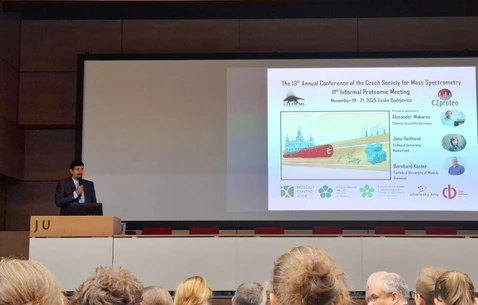
The final day of the conference opened with a highly anticipated plenary lecture by Prof. Jana Roithová (Radboud University), who presented innovative advances in using mass spectrometry for quantitative solution kinetics. She introduced the delayed reactant labeling approach, demonstrating how it enables the investigation of equilibria, mechanistic pathways, and reaction selectivity - overcoming limitations traditionally imposed by nonlinear ionization responses in MS.
The morning scientific session showcased a diverse range of applications of high-resolution mass spectrometry and imaging. Kateřina Grabicová presented extensive LC-HRMS monitoring of nearly 40 PFAS compounds in wild common bream across the Czech Republic, revealing widespread contamination and exceedances of EU limits. Lukáš Kučera followed with MALDI-FTICR imaging that uncovered how regenerating liver tissue repurposes ammonia into anabolic pathways essential for growth. Aneta Čechová demonstrated a validated LC-ICP-MS workflow for tracking anti-obesity lipopeptides labeled with lanthanide mass tags—highlighting the emerging impact of ICP-MS in peptide metabolism studies.
After sponsor lectures from Shimadzu and Bruker, Session VI provided insight into cutting-edge metabolomics, clinical applications, and large-scale exposomics. Tommaso Stefani presented a derivatization-based strategy enabling the analysis of ~600 gut microbiome metabolites using LC-MS. Karel Chalupský summarized the central role of MS in modern drug development, from early screening to pharmacokinetics. Pavlína Kyjaková showcased GC×GC-TOFMS profiling of human body odor to distinguish psychophysiological states such as stress or physical exertion. Finally, Kateřina Coufalíková introduced a fully automated liquid–liquid extraction system coupled to GC-Orbitrap MS, designed for population-scale exposomics across cohorts exceeding 1,000 samples.
The conference concluded with the announcement of awards, including top flash talks by Federico Brigante, Aninda Mazumdar, and Petr Lapčík, and the best poster prize awarded to Michaela Myšáková for her work on protein relocalization in leukemia. The scientific program closed with guided excursions to the Samson Brewery and Temelín Nuclear Power Plant.
Program
👉The complete program, including abstracts, can be downloaded here.
Friday November 21, 2025
09:00 - 09:50 Plenary Lecture III: Mass Spectrometry access to quantitative solution kinetics
- Prof. Jana Roithová (Radboud University)
Mass spectrometry is an established tool in reaction monitoring and studying reaction intermediates.[1] The nonlinear ionization response and, thus, the inability to obtain quantitative information about concentrations and kinetics partly cast a shadow on the advantage of the great sensitivity and large dynamic range of mass spectrometry in mechanistic research. To access the quantitative kinetic information about reactions in solution, we have been developing the delayed reactant labeling method.[2] In the lecture, I will introduce the method, explain possible applications, and show how we used the method to study equilibria in solution,[3] solve reaction mechanisms, and predict the reaction selectivity.[4]
 CSMS: 13th Czech Mass Spectrometry Conference 2025 and 11th Informal Proteomics Meeting - Day 3 - Thanks to Jana Roithová
09:50 - 10:50 Session V
09:50 - 10:10 FrO-15: Per- and polyfluorinated compounds (PFAS) in wild common bream
- Grabicová Kateřina
Per- and polyfluorinated compounds (PFAS) are persistent and, therefore, ubiquitous in the aquatic environment. The new legislation at the European Union level (Commission Regulation (EU) 2022/2388) adjusts the concentration of four selected PFAS, namely perfluorooctane sulfonic acid (PFOS), perfluorooctanoic acid (PFOA), perfluorononanoic acid (PFNA) and perfluorohexane sulfonic acid (PFHxS), in fish fillet used for human consumption. The sum of those four PFAS should be lower than 4 ng/g ww (wet weight). The study aimed to develop an analytical LC-HRMS method for monitoring the concentration of nearly 40 PFAS in wild common bream (Abramis brama) caught at ten localities in the Czech Republic. In the first step, a robust and multiresidual analytical method was developed to detect sub ng/g concentrations. In the fish fillet, 24 different PFAS were found at total concentrations up to 43 ng/g ww. Water reservoirs were more polluted than rivers. PFOS was the PFAS with the highest concentration. The limits of the four PFAS were exceeded at most of the sampled localities.
10:10 - 10:30 FrO-16: Spatial mapping of 15N-labeled ammonia with MALDI-FTICR imaging in regenerating liver tissue: Re-directing of toxic byproduct into anabolic pathways
- Kučera Lukáš
Liver is endowed with high regenerative activity, such that the tissue will regrow in the mouse after partial hepatectomy within days. We reasoned that this requires de novo pyrimidine synthesis to support rapid progression via the cell cycle. With MALDI imaging technique we revealed that suppression of de novo pyrimidine synthesis prevents proliferation in regenerating liver, suppressing liver regrowth. Tracing studies and spatial metabolomics revealed a metabolic shift such that ammonia, normally detoxified to urea in the periportal region under homeostasis, is redirected for generating aspartate and carbamoyl phosphate periportally, and glutamine pericentrally, and these products are utilized as precursors by the de novo pyrimidine synthesis pathway. This study uncovers a metabolic reprogramming leading to utilization of a toxic byproduct for anabolic pathways that are essential for liver regeneration.
10:30 - 10:50 FrO-17: LC-ICP-MS analysis of anti-obesity peptides and their metabolites labeled with lanthanide mass-tag
- Čechová Aneta
Neuropeptide prolactin-releasing peptide analogs (PrRP31) show promise for treating obesity and related diseases. Lipidization with fatty acids (palm11-PrRP31) improves peptide stability and reduces food intake and body weight in rodents, but its mechanism remains unclear. To track palm11-PrRP31 in vivo using the Wistar rats, we labeled it with a ClickZip lanthanide mass tag and quantified it using ICP-MS. The tag’s exceptional stability allowed precise detection in biological tissues1. To properly identify the metabolites of the administered palm11-PrRP31, we developed and validated
a reversed-phase LC-ICP-MS method, overcoming the incompatibility of organic solvents with ICP-MS by using 1,2-hexanediole. The optimized method met the EURACHEM validation guidelines and enabled the reliable determination of ClickZip-tagged anti-obesity lipopeptide and its metabolites in vivo2.
 CSMS: 13th Czech Mass Spectrometry Conference 2025 and 11th Informal Proteomics Meeting - Day 3 (LC-ICP-MS analysis of anti-obesity peptides and their metabolites labeled with lanthanide mass-tag, Aneta Čechová)
10:50 - 11:00 Sponsor Lecture Shimadzu: Advancing Structural Elucidation with Oxygen Attachment Dissociation (OAD)
- David Maxa
11:00 - 11:20 Coffee Break
11:20 - 11:40 Sponsor Lecture Bruker: Emerging applications of bottom up proteomics in clinical research
- Gary Kruppa
 CSMS: 13th Czech Mass Spectrometry Conference 2025 and 11th Informal Proteomics Meeting - Day 3 (Emerging applications of bottom up proteomics in clinical research, Gary Kruppa)
11:40 - 13:00 Session VI
11:40 - 12:00 FrO-18: Advancing Gut Microbiome Metabolomics: A Derivatization-Based Approach
- Stefani Tommaso
Microbiota-associated metabolites play a crucial role in host physiology and disease by mediating host-microbiota communication, providing essential nutrients, and regulating metabolism and immune functions. Understanding these interactions requires comprehensive chemical analysis of the metabolites. However, their low abundance, diverse physicochemical properties, and analysis in complex matrices present significant challenges, leaving us with no universal method to analyze them all. Chemical derivatization is a powerful approach, particularly for polar metabolites. Modifying the analyte structure decreases their polarity and makes them compatible with conventional reverse-phase liquid chromatography.
3-nitrophenylhydrazine (3NPH) is a widely used derivatization agent, which was previously employed in studies targeting well-known microbial metabolites such as Short Chain Fatty Acids (SCFA).[1] However, the potential of its applicability can be extended and go beyond to larger datasets, covering the majority of polar primary metabolites as well as known products of microbial metabolism.
Here, we present a large-scale analysis of nearly 600 gut microbiome-related chemical standards, derivatized using 3NPH. Standards were systematically classified based on structural similarities, biological relevance, and metabolic pathway associations using a Python-based automated categorization pipeline and public metabolomic databases. For streamlined identification, the recently introduced in-silico Derivatization Tool in MetaboScape by Bruker was employed for an automated targeted search.
To validate the applicability of this derivatization strategy, we utilized the library of derivatized standards for the targeted analysis of microbiota-associated metabolites in stool samples from mice with different statuses of microbial colonization, including germ-free models. Our results demonstrate the utility of this approach in providing valuable insights into host-microbiota metabolic interactions.
12:00 - 12:20 FrO-19: Mass Spectrometry in Drug Development: From Screening to Stability and Pharmacokinetics
- Chalupský Karel
The continuous emergence of new diseases, antimicrobial resistance, and unmet therapeutic needs highlight the urgent demand for novel drugs with improved safety and efficacy. Drug development is a complex and resource-intensive process requiring rapid, accurate, and sensitive analytical tools to guide decision-making from early discovery to clinical evaluation. Mass spectrometry (MS) has become a cornerstone technology across all stages of this pipeline. In the screening phase, MS-based assays enable high-throughput identification of bioactive compounds by directly monitoring enzymatic reactions, binding events, or metabolite formation with minimal labeling requirements. This accelerates hit validation and structure–activity relationship studies. During lead optimization and preclinical testing, MS provides precise molecular characterization and quantification of drug candidates and their metabolites. In stability studies, MS facilitates the detection of degradation products. Furthermore, MS plays a central role in pharmacokinetic (PK) and ADME (Absorption, Distribution, Metabolism, and Excretion) investigations, allowing sensitive quantification of drugs in biological matrices and elucidation of metabolic pathways that determine bioavailability and clearance. Coupled with liquid chromatography or implemented in miniaturized, high-throughput formats such as acoustic or droplet-based (ECHO-MS), it delivers unparalleled analytical power for both discovery and development. Altogether, mass spectrometry integrates chemical precision with biological insight, making it indispensable for the rational design and comprehensive evaluation of new therapeutic agents in modern drug development.
12:20 - 12:40 FrO-20: Mass spectrometry of human body odor: Signatures of psychophysiological states
- Kyjakova Pavlina
Human body odor carries rich information about our genetic background as well as our physiological and psychophysiological states, including various diseases and pathologies. This seemingly simple statement is well supported by both everyday experience and extensive research — most of which has relied on olfactory perception studies using human raters or trained dogs. However, empirical knowledge about the chemical foundations of body odor differences remains limited, primarily due to past technical challenges in detecting and separating the hundreds of small molecules emitted by the human body.
With the recent advances in gas-phase metabolomics, many previously inaccessible questions regarding human body odor have become realistic research targets. In this study, we combined olfactory perception ratings with comprehensive two-dimensional gas chromatography coupled with mass spectrometry (GC×GC-TOFMS) to investigate axillary body odor patterns associated with different psychophysiological states in healthy male donors. Specifically, we examined odor changes following physical exercise, exposure to psychosocial stress, and sexual arousal stimuli.
In my presentation, I will demonstrate that both perception ratings and chemical analyses effectively distinguished control samples from those collected after exercise and stress exposure. In contrast, we did not observe a systematic shift in body odor patterns in response to sexual arousal. I will also present candidate analytes that appear to underline these body odor differences across psychophysiological states.
12:40 - 13:00 FrO-21: Population-scale human chemical exposomics by automated liquid-liquid extraction coupled to gas chromatography – Orbitrap mass spectrometry
- Coufalíková Kateřina
Profiling chemical exposure in large-scale human population studies is analytically challenging in terms of robustness and reproducibility, as well as laboriousness of the entire procedure. Few academic settings conduct routine analysis of studies comprising > 1000 samples. Manual sample preparation is time consuming, requires high solvent consumption, and contributes to sample-to-sample variation. Sequential on-line sample preparation offers a solution, but adoption is currently lacking in routine application.
Within the framework of ERIENE-CZ, we have developed a fully automated sample preparation workflow coupled to gas chromatography - Orbitrap mass spectrometry (GC-Orbitrap MS) for large-scale screening of chemical exposure agents in blood serum and plasma. A fully automated liquid-liquid extraction of blood (100 µL) has been developed using a cartesian autosampler coupled to GC-Orbitrap MS. In brief, analytes are separated on a Rxi-5Sil MS column with ~14 min temperature gradient (80 °C to 330 °C), electron ionisation at 70eV, and mass spectra recorded from 70-700 m/z at 60K resolving power. Quality assurance and quality control (QA/QC) includes the analysis of certified mixtures of alkanes and polychlorinated biphenyls, alongside the standard reference materials (SRM) NIST 1950, NIST 1957, NIST 1958 in each analytical batch.
We shall present i) a critical appraisal of the implemented method, including the interventional maintenance schedule and systematically recorded errors, such as vial drop rates; ii) updates on the status of multi-country, multi-site method standardisation and harmonisation; and iii) report on application to multiple cohort studies, each comprising > 1000 samples.
13:00 - 13:10 Closing Remarks and Awards
Flash talks
1st Federico Brigante (Tomáš Pluskal research group, IOCB): Mass Spectral Library Network (MERLIN) To Streamline The Generation Of Public Spectral Libraries
2nd Aninda Mazumdar: A Comprehensive timsTOF MS/MS Spectral Library
for Improving Metabolite Annotation in Non-Targeted Metabolomics
3rd Petr Lapčík: LC-MS/MS-based terminomics unravels role of
carboxypeptidase B1 in luminal A breast cancer
 CSMS: 13th Czech Mass Spectrometry Conference 2025 and 11th Informal Proteomics Meeting – Day 3 (Federico Brigante – 1st place flash talk)
Poster
1st Michaela Myšáková (Kristýna Glocpimková research group, First Faculty of Medicine UK, Biocev): Decoding Therapy-Induced Protein Subcellular Relocalization in Leukemia
13:10 - 14:00 Lunch
14:00 - 17:40 Guided Tour – Samson Brewery / Temelín Nuclear Power Plant
 CSMS: 13th Czech Mass Spectrometry Conference 2025 and 11th Informal Proteomics Meeting - Day 3 - Temelín Nuclear Power Plant