News from LabRulezGCMS Library - Week 45, 2025
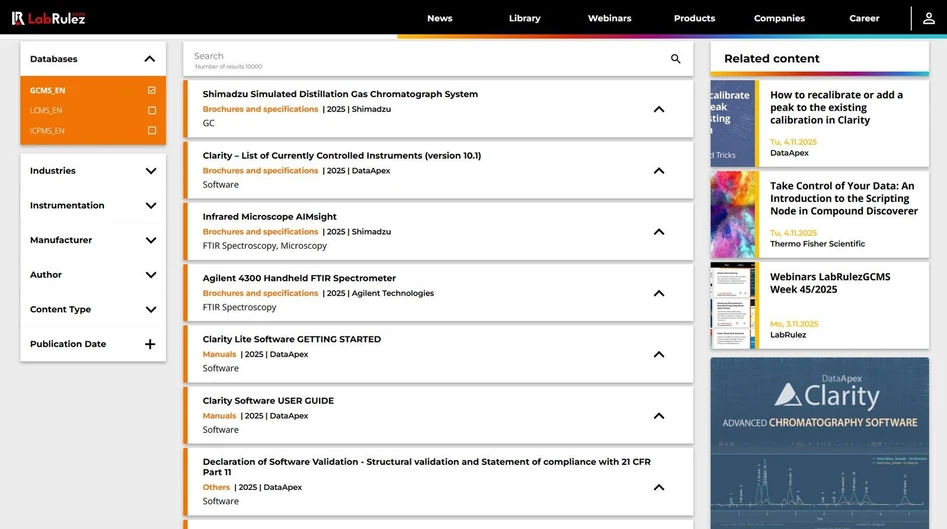
LabRulez: News from LabRulezGCMS Library - Week 45, 2025
Our Library never stops expanding. What are the most recent contributions to LabRulezGCMS Library in the week of 3rd November 2025? Check out new documents from the field of the gas phase, especially GC and GC/MS techniques!
👉 SEARCH THE LARGEST REPOSITORY OF DOCUMENTS ABOUT GCMS AND RELATED TECHNIQUES
👉 Need info about different analytical techniques? Peek into LabRulezLCMS or LabRulezICPMS libraries.
This week we bring you applicaton notes by Agilent Technologies, EST Analytical and Thermo Fisher Scientific and poster by Shimadzu!
1. Agilent Technologies: Estimation of Methyl Bromide Residues in Food
Using the Agilent 8890 GC and Agilent 7010 triple quadrupole GC/MS system with Agilent 8697 headspace sampler
- Application note
- Full PDF for download
Bromomethane (methyl bromide) is a halogenated hydrocarbon with a boiling point of 3.6 °C. It is widely used as a fumigant due to its strong fumigation and penetration effects, effectively controlling pests.1 However, methyl bromide is harmful to the ozone layer, causes environmental pollution, and is harmful to humans.2 By 2015, most countries phased out its production and application, except for essential uses such as port quarantine. China stopped agricultural use of methyl bromide by the end of 2018.2 Despite its high volatility, residues of methyl bromide can persist in foods such as nuts and seeds. Therefore, quantitative methods for determining these residues are important. Gas chromatography (GC) is commonly used for analysis, either directly with headspace sampling, or with sample pretreatment methods including solvent extraction and solid phase microextraction. Various detectors are used with GC, such as the flame ionization detector, electron capture detector, and electron ionization. Detection can also be performed by mass spectrometer, using an electron ionization (EI) source. The maximum residue limit for methyl bromide in the EU is 10 ng/g, according to EU Regulation number 396/2005.
In this application note, an Agilent 8697 headspace sampler was used for sample introduction to an Agilent 8890 GC system coupled with an Agilent 7010 triple quadrupole GC/MS for quantification of methyl bromide residues.
Results and discussion
Calibration
Figures 1 through 3 show the linearity of the methyl bromide calibration curve in rice, cumin powder, and red chili powder, respectively. The R2 obtained was above 0.998.
Repeatability
The repeatability of this method was demonstrated by injecting six replicates of rice, cumin, and red chili powder spiked with 10 ng/g of methyl bromide. The area %RSD and retention time %RSD results are shown in Table 3.
Recovery
Methyl bromide was spiked in samples of rice, cumin, and red chili powder at concentration levels of 10 ng/g. Acceptable recoveries were obtained by quantification through prespike matrix-based calibration. Results are highlighted in Table 4.
Conclusion
An accurate and rugged method was developed which meets the requirements of the EURL for the maximum residue limit of methyl bromide in foodstuffs. This ranges from 10 to 100 ng/g, depending on the commodity (Reg. (EC) number 396/2005) for the analysis of pesticides in rice, cumin powder, and red chili powder. The LOQ of the method was demonstrated at 5 ng/g for all tested matrices. Repeatable results were found for six successive replicates of matrix‑based standards at 10 ng/g concentration levels. Sufficient recoveries were obtained in all tested matrices at 10 ng/g spiked concentration levels. Thus, this study demonstrates the applicability of this method for routine analysis of food samples for methyl bromide at trace levels.
2. EST Analytical: Effect of Split Ratio on USEPA Method 8260 Compounds
- Application note
- Full PDF for download
Injection size on a GC column is dictated by the diameter of the GC column. Packed columns are usually shorter in length and larger in diameter and are usually filled with a packing coated with stationary phase. Due to their large diameter, packed columns can handle much larger injections. However, since packed columns are shorter in length, compound resolution is more difficult. Capillary columns, on the other hand, are much longer with much smaller diameters. A capillary column has a stationary phase that is coated onto the column wall which in turn makes the diameter even smaller. Overloading is a common problem with capillary columns, thus smaller injections and higher dilutions are required when using a capillary column.
The benefit of a capillary column is that it has substantially more theoretical plates than a packed column. Increasing the number of theoretical plates enhances column efficiency because peaks are narrowed and peak resolution is improved. The disadvantage of the capillary column is column overloading. This is where a split injection is greatly beneficial. A split injection can limit sample overload while taking advantage of the efficiency of the capillary column.
Discussion:
Purge and trap sampling is the method used for purging volatile compounds out of a water matrix for USEPA Method 8260. Due to the large number of analytes and the lower detection limits required in this method, a capillary column is needed for detection and separation. Split injections provide a method to control moisture from the purge and trap sampling while preventing column overloading with the capillary column. However, due to the detection limits required of the method, if the split injection is too large, the detection limits of the method may not be met. On the other hand, if the split injection is too small, there can be moisture problems with the mass spectrometer. This application will provide a comparison of several different split rates and their effect on compound detection for USEPA Method 8260.
Experimental:
The sampling system used for this study was the EST Analytical Evolution concentrator and the Centurion WS autosampler. The concentrator was affixed with a Vocarb 3000 trap and connected to an Agilent 7890A GC and 5975C inert XL MS. The GC was configured with a Restek Rxi-624 Sil MS 30m x 0.25mm x 1.4µm column. Three different split ratios were used for this study. Refer to Table 1 for the sampling method parameters and Table 2 for GC/MS parameters.
Conclusions:
As USEPA Methods require lower and lower detection limits, split ratios will play a large factor in reaching these new requirements. This study demonstrated that all three split ratios met USEPA Method 8260 requirements for linearity, compound response and method detection limits. However, there was a remarkable difference in compound detection limits as the split ratio was increased. The 40 to 1 split rate had much lower detection limits due to an increase in compound response. The Encon Evolution purge and trap concentrator has a unique feature for moisture control using an eight port valve to avoid desorbing through the moisture trap. This feature enables better moisture control when using a lower split rate, thus using a larger split rate to control moisture is unnecessary.
3. Shimadzu / AOAC: Simultaneous analysis of residual contaminants in drinking water using Programmed Temperature Vaporization (PTV) for Large Volume Injection (LVI) and GC-MS/MS
- Poster
- Full PDF for download
This study aimed to develop a single analytical method for the simultaneous analysis of over 60 residual contaminants, including Poly-Aromatic Hydrocarbons (PAH), Poly-Chlorinated Biphenyls (PCB), and pesticides, in drinking water. Traditionally, multiple methods are being employed for analyzing these contaminants. Most common ones include, extraction using solvents in large separating funnel or SPE cartridge followed by volume concentration by evaporation. These methods require huge sample and solvent quantities. Due to these factors like large sample size handling, concentration steps etc., method may show poor reproducibility.
By utilizing Programmed Temperature Vaporization (PTV) for Large Volume Injection (LVI), the method significantly reduces the initial sample amount required for preparation, pre-treatment steps, and solvent consumption compared to conventional approaches, while eliminating the need for final sample concentration. The optimized procedure achieved limits of quantification (LOQs) as low as 0.005 ppb and 0.05 ppb, demonstrating high sensitivity without compromising efficiency. Validation parameters like specificity, linearity, recovery and precision were studied as per SANTE guidelines[1] . For linearity and recovery study, matrix match calibration was used.
Materials and methods
For this study, reference standard mixtures of over 60 contaminants regulated in drinking water were procured from Restek® Corporation. It included PAH, PCB and GC amenable pesticides. Drinking water sample was extracted and used to prepare matrix-matched calibration standards and spiked samples. This method was validated for criteria mentioned in SANTE Guidelines. GCMS-TQ8040 NX (Figure 2), manufactured by Shimadzu Corporation Japan, was used to quantify residual contaminants in drinking water sample.
Conclusion
- This study shows that the extraction of reduced sample quantity combined with LVI of 50 μL on GC-MS/MS system is a reliable and efficient tool to simultaneously quantify residual contaminants like PAH, PCB and pesticides in drinking water sample.
- Also, highly sensitive Shimadzu GC-MS/MS allows trace level detection even without the need of evaporating & concentrating the sample. This helps in ruggedness resulting in reproducible detection of analytes.
- The combination of sensitive instrument and reproducible extraction method enables its use in testing laboratories for residual contaminants analysis in drinking water.
4. Thermo Fisher Scientific: Automated liquid-liquid extraction workflow for direct ultra-trace analysis of pesticides and PAHs in water matrices using GC-MS/MS
- Application note
- Full PDF for download
Ensuring high standards of water quality is a fundamental priority within the European Union. This is highlighted through stringent EU regulations, such as the Water Framework Directive and the Drinking Water Directive,1 where protection of the environment and safeguarding public health are of utmost importance. As such, regular monitoring of both surface and drinking water for hazardous semi-volatile organic compounds, such as polyaromatic hydrocarbons (PAHs) and pesticides, is needed.1,2
To meet regulatory compliance, laboratories are required to reach ultra-trace levels (i.e., parts per-trillion (ng/L)), while maintaining analytical method performance criteria outlined under EU Directive 2020/2184.3 To reach required concentration limits, laboratories typically need to extract large sample volumes using solvent (i.e., liquid-liquid) or sorbent-based (i.e., solid-phase) extraction techniques with additional preconcentration.
Such techniques involve manual operations, which are costly in terms of consumables and time. However, automated sample preparation and extraction can reduce such costs while helping to eliminate systematic errors to improve data quality and lab efficiency.
The aim of this work was to evaluate the sensitivity, precision, and robustness of the TriPlus RSH SMART autosampler in performing automated liquid-liquid extraction and on-line analysis of polyaromatic hydrocarbons (PAHs) and pesticides in drinking and surface water using triple quadrupole GC-MS/MS. This study will demonstrate that the developed automated workflow is compliant with EU regulation criteria and greatly increases laboratory productivity by reducing laboratory costs and time.
Experimental
Instrument and method setup
A Thermo Scientific™ TRACE™ 1610 GC equipped with a Thermo Scientific™ TraceGOLD™ TG5-SilMS (30 m × 0.25 mm I.D. × 0.25 µm film) capillary column with a 5 m integrated SafeGuard retention gap (P/N 26096-1425) was used to perform the chromatographic separation. The TriPlus RSH SMART autosampler was configured to perform automated sample preparation, liquid-liquid extraction, and on-line injection for GC-MS/MS analysis. The automated workflow was designed using the Thermo Scientific™ TriPlus™ RSH Sampling Workflow Editor Software (P/N 1R77010-1200) and imported into the Thermo Scientific™ Chromeleon™ 7.3.2 Chromatography Data System (CDS) software. This integration allows sample preparation, acquisition, and data processing to be carried out within a single software. The automated workflow involved the following steps: internal standard addition, extraction solvent addition (pentane) and vortexing for extraction, addition of solvent for emulsion removal (isopropyl alcohol), addition of syringe standard prior to analysis, and large volume injection into the GC-MS. Parameter settings for the automated workflow are outlined in Table 1 with a visual overview provided in Figure 1. A list of accessories needed to configure the TriPlus RSH SMART autosampler is provided in the appendix (Table A2).
After sample extraction was completed, a 30 μL aliquot of the pentane layer was directly injected into a programmable temperature vaporization (PTV) inlet. Injection and oven program conditions can be found described in Tables 1 and 2. Data acquisition was carried out using selected reaction monitoring (SRM) with a Thermo Scientific™ TSQ™ 9610 triple quadrupole GC-MS equipped with an Advanced Electron Ionization (AEI) source. Method parameters for data acquisition are summarized in Table 2 with optimized SRM transitions outlined in the appendix (Table A3).
Conclusions
Maintaining water quality is of both human and environmental health importance. However, due to the physical chemical properties of various organic substances, analytical methods require ultra-trace sensitivity and accuracy to quantify hazardous risks within both drinking and environmental surface waters. The results presented demonstrate that the developed automated workflow for online liquid-liquid extraction and analysis of water samples can meet these requirements:
- Ultra-trace sensitivity combining large volume injection with highly sensitive triple quadrupole GC-MS/MS, with over 70% of targeted analytes having limits of quantification below 2 ng/L
- Compliant extraction recovery at part per trillion concentrations
- Robust method precision over extended analysis time
- Improved laboratory efficiency and productivity while reducing environmental impact with limited solvent consumption
- Workflow customization capability through the Sampling Workflow Editor software