News from LabRulezGCMS Library - Week 44, 2025
LabRulez: News from LabRulezGCMS Library - Week 44, 2025
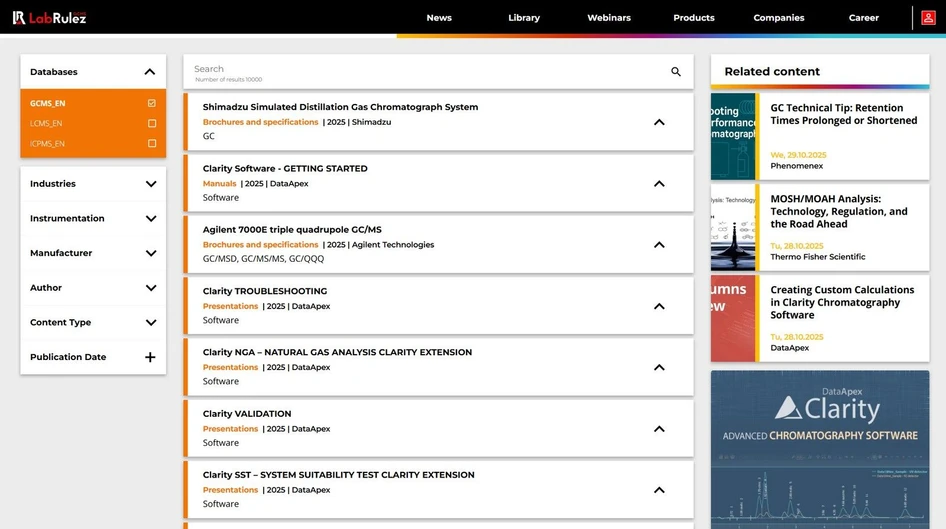
Our Library never stops expanding. What are the most recent contributions to LabRulezGCMS Library in the week of 27th October 2025? Check out new documents from the field of the gas phase, especially GC and GC/MS techniques!
👉 SEARCH THE LARGEST REPOSITORY OF DOCUMENTS ABOUT GCMS AND RELATED TECHNIQUES
👉 Need info about different analytical techniques? Peek into LabRulezLCMS or LabRulezICPMS libraries.
This week we bring you applicaton notes by Agilent Technologies, EST Analytical, Shimadzu and Thermo Fisher Scientific!
1. Agilent Technologies: Analysis of Total Aromatic Content in Motor Gasoline by ASTM D5769 Using an Agilent 8850/5977C GC/MSD System
- Application note
- Full PDF for download
This application note demonstrates the rapid quantification of total aromatics in gasoline by ASTM D5769 using an 8850 GC with a 5977C GC/MSD and hydrogen carrier gas. The 8850 GC is a high-performance single-channel GC with the ideal feature set to provide fast and repeatable separations for ASTM D5769 in a footprint that is half the width of the Agilent 8890 GC System and other standard size GCs. When paired with the 5977C GC/MSD, the total system footprint is 2/3 the width of standard benchtop GC/MS systems. The compact 8850/5977C GC/MSD provides the sensitivity and selectivity required to quantify trace-level aromatic compounds in gasoline, and the linear dynamic range to measure bulk components like toluene in the same sample. In addition to the standard 3 mm extraction lens, the 5977C GC/MSD EI Extractor ion source offers two optional extraction lenses, either 6 mm or 9 mm in diameter, enabling method‑specific optimization to improve analytical performance. This application note demonstrates that the larger 9 mm extraction lens provides increased linearity when measuring higher concentration components, and this benefit was previously demonstrated using an Agilent 8860 GC system coupled to a 5977B GC/MSD.2
Experimental
An 8850 GC and 5977C GC/MSD were configured according to "Condition 3" in ASTM D5769-22 except for the changes listed here. Notably, the standard 3 mm extraction lens in the 5977C GC/MSD ion source was replaced with a 9 mm extraction lens to extend measurement linearity for bulk compounds. The 8850 GC was configured for hydrogen carrier gas and outfitted with the Agilent Hydrogen Leak Detector Series 2. The column was an Agilent J&W DB-1 40 m × 0.18 mm, 0.4 µm (part number 121-1043E), and the injection volume was increased to 0.3 µL. The GC and GC/MSD configuration, consumables, and method parameters are listed in Table 1. The calibration and performance-check standards were purchased from Accustandard (part number M-GRA-K2-SET, Accustandard, Inc.). To evaluate the system, a Tier III-reformulated gasoline sample from an interlaboratory cross‑check program (ILCP) was analyzed and compared to the accepted ILCP reference results.
Results and discussion
The separation was evaluated using the aromatic checkout standard which contains 24 individual aromatic species and three deuterated internal standards (benzene-d6, ethylbenzene-d10, naphthalene-d8) in a matrix of 2,2,4-trimethylpentane (isooctane). The checkout standard separation and peak identities are shown in Figure 1. The coelutions of m-xylene with p-xylene and 1,4-diethylbenzene with n-butylbenzene are allowed by the method and the composite peaks are reported as a single compound. Table 2 shows the concentration and %RSD obtained for each component of the aromatic checkout standard across ten consecutive replicates.
ASTM D5769-22 requires measuring individual aromatic species at concentrations from 500 to 149,000 ppm with linear calibrations of R2 > 0.99 for each. This is challenging for GC/MS due to its high sensitivity which makes it more appropriate for measuring parts-per-million (ppm) or lower concentrations. The optional 9 mm extraction lens made it easier to achieve calibration linearity at the higher concentration levels. To further attenuate the MSD signal, the voltage applied to the electron multiplier (EM) was reduced by decreasing the Gain Factor from 1.0 to 0.3. In practice, the highest-level calibration standard is run and the gain value set such that the maximum abundance of the extracted ion chromatogram (EIC) of the primary ion of the highest‑responding component is approximately 1 million counts. This approach resulted in a linear calibration of toluene with an R2 of 0.99996 up to a concentration of 16.3% (Figure 2). A summary of the resulting R2 values for all calibrated compounds is shown in Table 3.
Conclusion
The Agilent 8850 GC combined with the Agilent 5977C GC/MSD successfully performed ASTM D5769 with a total runtime of nine minutes while meeting all method requirements. All measured aromatic species far exceeded method linearity requirements, including toluene which had an R2 value of 0.99996, while maintaining enough sensitivity to measure 100 ppm of 1,4-diethylbenzene with a signal-to-noise of 52.
2. EST Analytical: Drinking Water Analysis Conditions for USEPA Method 524.3 and 524.4
- Application note
- Full PDF for download
Due to advances in analytical instrumentation the United States Environmental Protection Agency (USEPA) introduced a new drinking water method. USEPA Method 524.3 allows laboratories to modify purge and trap and GCMS conditions in order to accommodate instrumental advances and shorten sample preparation time. Currently, the USEPA is investigating the option of using Nitrogen as the purge gas in an additional drinking water method, USEPA Method 524.4. This application note will compare Helium and Nitrogen purge gases.
Discussion
USEPA Method 524.3 allowed the ability to modify purge and trap parameters and take advantage of purge and trap improvements. However, the method still required Helium for the purge gas. Recently, high purity Helium availability and price has changed making it harder to find and more expensive to buy. Due to this change in the Helium market, the USEPA drafted Method 524.4 which allows the use of high purity Nitrogen for the purge gas.
Method 524.4 provides the same flexibility as Method 524.3, thus method parameters can be modified in order to optimize purge and trap cycle times. Although the new method allows for a shorter desorb time, moisture build up can still be a problem as the new preservation scheme causes effervescing in the sparge vessel. EST Analytical has two features that can aid in moisture control and the “foaming” caused by the effervescing. First, the Encon Evolution utilizes an 8 port valve instead of a 6 port valve. This unique engineering has the advantage of excluding the Moisture Reduction Trap (MoRT) from the desorb pathway thus aiding in moisture control for the system. Secondly, EST Analytical has a foam sensor to detect any issues with foaming. The foam sensor for the Encon Evolution has a unique placement above the bulb of the sparge vessel, thus allowing the bulb to control the effervescing bubbles and not sending a false positive signal to the software causing the sample sequence to be aborted. Furthermore, the Centurion WS has the ability of taking samples from the vials without moving the samples. This eliminates opportunities for vial movement errors that would negatively impact productivity. For this study, Helium and Nitrogen purge gases were compared utilizing the same purge then comparing results the linearity, precision, accuracy and overall compound response for the different purge gases.
Experimental
The EST Analytical Encon Evolution purge and trap concentrator and Centurion WS autosampler were interfaced to a Shimadzu QP2010 SE GCMSD. The purge and trap concentrator was configured with a Vocarb 3000 (K) analytical trap. A chiller unit capable of keeping the sample vials cooled below 10°C was installed on the Centurion WS autosampler. The experimental parameters are listed in Tables 1 and 2.
Conclusion
The Encon Evolution and Centurion WS in conjunction with the Shimadzu QP2010 SE GCMS performed very well using both the Helium and Nitrogen purge gases. The Nitrogen and the Helium purge gases met USEPA method 524.3 criteria and produced comparable results. Overall, the principal difference between the two purge gases was exhibited in the compound response. When examining the overall compound response factors over the curve range, it is evident that the analytes’ responses are slightly lower with the Nitrogen purge gas as opposed to the Helium purge gas.
3. Shimadzu: Volatile PFAS in Complex Juice Matrices: A Simple Approach Using HS-SPME GC/MS/MS for Volatile Contaminant Analysis
- Application note
- Full PDF for download
User Benefits
- The highly sensitive and selective Shimadzu GCMS-TQ8040 NX triple quadrupole mass spectrometer enables low limits of quantitation for volatile PFAS with minimal matrix interferences.
- The simplified sample preparation procedure and automated SPME method using a multifunctional autosampler (AOC-6000 Plus) reduces the operation error for PFAS analysis.
- The Shimadzu HS-SPME GC/MS/MS system is capable of analyzing volatile PFAS in juice matrices with minimal sample preparation.
- HS-SPME GC/MS/MS is used as a complementary technique to LC/MS in providing a total solution for food safety.
In this study, a Head-Space Solid Phase Microextraction-Triple Quadrupole Gas Chromatography/Mass Spectrometry (HSSPME GC/MS/MS) analytical method was developed to analyze PFAS in juices. GC/MS addresses volatile PFAS compounds that are impractical to analyze by LC/MS. The HS-SPME technique, with its minimal sample preparation procedure and fast workflow, offers additional benefits for volatile PFAS analysis in complex matrices. While previous PFAS HS-SPME GC/MS/MS methods have been developed for relatively simple matrices such as drinking and bottled water,4,5,6 the more complex composition of juice matrices requires additional isotopically labeled internal standards in this study to effectively compensate for matrix effects.
Method
Instrumentation: The instrument system configuration for the application consisted of a Shimadzu GC/MS triple quadrupole mass spectrometer, model GCMS-TQ8040 NX, a multifunctional autosampler (AOC -6000 Plus) equipped with a SPME module and a split/spitlessinlet. (Figure 1)
Conclusion
In this study, a Shimadzu GCMS-TQ8040 NX triple quadrupole mass spectrometer, configured with an AOC-6000 Plus solidphase microextraction (SPME) unit, was used to develop a PFAS analysis method in complex matrices such as juice. Method blanks showed no detectable PFAS, and the calibration curve demonstrated excellent linearity (R² ≥ 0.993). ICV and CCV recoveries were all within 70–130%, established as the method criteria.
For LCS precision and accuracy analyses, mean PFAS recovery was 83-115%, with %RSD ranging from 0.6 to 6.8%. LCS results met the mean % recovery and %RSD method criteria, which were established respectively at 70-130% and ≤ 20%. An isotope dilution approach was used for most compounds to achieve accurate quantitation in these complex matrices. Overall, the mean percent recovery for juice samples from two brands and two packaging materials ranged from 69-120% and %RSD < 12 for all compounds. The overall results exceeded the method criteria.
This HS-SPME GCMS-TQ8040 NX method presents an effective analytical workflow for volatile PFAS analysis in juice matrices. This application highlights a simple, robust, and accurate workflow for measuring volatile PFAS in these complex matrices.
4. Thermo Fisher Scientific: Comprehensive profiling of plastic polymers using pyrolysis coupled to GC-MS
- Application note
- Full PDF for download
Microplastics (MPs) are solid particles of polymeric materials, with regular or irregular shape and typical size ranging from 1 μm to 5 mm, of either primary or secondary manufacturing origin, which are insoluble in water.1
Each year, around 42,000 tons of microplastics are released into the environment.2 They come from a variety of sources including debris from larger plastic pieces, clothing, construction, renovation, food packaging, and industrial processes. Another common form of microplastics are microbeads, which are very tiny pieces of manufactured polyethylene that are added as exfoliants to health and beauty products, such as some cleansers and toothpastes.3
MPs have been found in marine, freshwater, and terrestrial ecosystems as well as in food and drinking water.2 Once in the environment, microplastics do not biodegrade, but accumulate in animals and are consequently consumed as food by humans. Exposure to microplastics is linked to a range of negative (eco)toxic and physical effects on living organisms.2
In particular, pyrolysis coupled to gas chromatography–mass spectrometry (Py-GC-MS) is a typical technique applied for the identification of plastic polymers. A polymer is made up of a repetitive structure of molecules (monomers) that are covalently bonded, forming a long molecular chain or macromolecule. In analytical pyrolysis, these molecular chains of a polymer are broken up under a rapid temperature increase (usually to about 600 °C) in an inert atmosphere, which leads to thermal degradation of the polymer. The composition of the polymer is investigated by introducing the degradation products (pyrolyzates) into an analytical instrument such as a GC-MS. A schematic of the pyrolysis workflow is reported in Figure 1.
The Multi-Shot Pyrolyzer™ EGA/PY-3030D (Frontier Laboratories Ltd.) is a furnace-type pyrolyzer in which a sample placed in a sample cup is dropped (free fall) into a preheated furnace. It provides a fast and reliable material characterization of practically any kind of organic sample. Insoluble, non-volatile, solid and liquid samples can be analyzed directly without complex sample preparation by enabling multiple analysis modes, such as evolved gas analysis (EGA), single-shot analysis, double-shot analysis, and heart-cut EGA analysis (HC/EGA). Additionally, it can be coupled to the Auto-Shot Sampler AS-2020E (Frontier Laboratories Ltd.) for continuous analysis of up to 48 samples.
In this study, a single-shot Py-GC-MS method for the detection and identification of common polymers was evaluated for performance and reliability by assessing linearity, method detection limits (MDLs), and absolute peak area repeatability (%RSD). Additionally, the developed method was used to analyze plastic debris collected on a Mediterranean beach.
Experimental
A Multi-Shot Pyrolyzer EGA/PY-3030D equipped with the Auto-Shot Sampler AS-2020E autosampler was coupled to a Thermo Scientific™ TRACE™ 1610 GC, configured with a Thermo Scientific™ iConnect™ split/splitless injector (iConnect-SSL), and connected to a Thermo Scientific™ ISQ™ 7610 single quadrupole mass spectrometer.
The SSL injector was equipped with dedicated hot injection adapter (P/N 19050733), allowing for connection to the pyrolyzer and ensuring efficient analyte transfer. The separation of the pyrolysis products was achieved using a Thermo Scientific™ TraceGOLD™ TG-5 SILMS capillary column 30 m x 0.25 mm × 0.25 µm, with 5 m integrated SafeGuard column (P/N 26096-1425). This column provided high inertness and thermal stability for consistency of results over time. Additionally, the integrated SafeGuard offers the benefit of an extended column lifetime.
Data acquisition, processing, and reporting
The Thermo Scientific™ Chromeleon™ Chromatography Data System (CDS) software, version 7.3, was used for data acquisition, processing, and reporting. Pyrolysis parameters were set using Frontier Laboratories’ pyrolyzer control software, which provides an intuitive interface for easy method set-up. Each analytical mode (EGA, single-shot analysis, double-shot analysis, and HC/EGA) comes with a set of optimized conditions that can be used to start acquiring samples. Characteristic fragmentation products were used for polymer detection and identification based on comparison with commercial spectral libraries. Additionally, the F-Search MPs 2.1 Analytical Software for Microplastics Analysis (Frontier Laboratories Ltd.) allowed confident polymer identification based on the mass spectra comparison of unknown samples with the reference polymer in the library.
Conclusions
The results of these experiments demonstrate that pyrolysis coupled to GC-MS provides an ideal solution for analysis of microplastics. Beyond qualitative information about the chemical nature of an unknown polymer, such as polymer type and potential additives, it also allows quantitative information to be obtained after calibration.
- Py-GC-MS can be used to identify main polymer types in plastics based on their characteristic pyrolyzates.
- Plastic polymers can be directly analyzed with minimal sample preparation consisting of cutting and weighing a few milligrams of samples into a micro cup.
- The precise control of the pyrolysis process ensures accurate quantitative performance for the investigated compounds with R2 ≥ 0.990, AvCF %RSD < 10.0, LODs and LOQs below 17.30 µg and 52.43 µg, respectively, and absolute peak area %RSD < 15.0.
- Plastic samples collected on a Mediterranean beach were confidently identified based on their pyrolyzate patterns by using Chromeleon CDS combined with F-Search MPs 2.1 software and dedicated libraries.