News from LabRulezGCMS Library - Week 41, 2025
LabRulez: News from LabRulezGCMS Library - Week 41, 2025
Our Library never stops expanding. What are the most recent contributions to LabRulezGCMS Library in the week of 6th October 2025? Check out new documents from the field of the gas phase, especially GC and GC/MS techniques!
👉 SEARCH THE LARGEST REPOSITORY OF DOCUMENTS ABOUT GCMS AND RELATED TECHNIQUES
👉 Need info about different analytical techniques? Peek into LabRulezLCMS or LabRulezICPMS libraries.
This week we bring you poster by Agilent Technologies / AOAC, application notes by EST Analytical and Shimadzu and brochure by Thermo Fisher Scientific!
1. Agilent Technologies / AOAC: Method Translation for the Analysis of Vanilla Extracts Using a Compact, Single Channel GC-FID and Carrier Gas Switching Module
- Poster
- Full PDF for download
Vanilla is a flavor variety that has been heavily impacted by changes in consumer habits as well as by supply and demand of vanilla beans used to produce high-quality vanilla extracts. Unfortunately, these market conditions, increase the likelihood of adulteration in vanilla extracts by use of aroma chemicals that are not naturally occurring. Common adulterants are coumarin (C), ethyl vanillin (EV), eugenol (E), and guaiacol (G).2,3 Adulteration impacts the standard of identity for vanilla extracts established by the U.S. FDA; therefore, flavor companies rely on QC labs to implement reliable and sensitive analysis techniques for screening incoming raw ingredients against expected purity standards before the ingredient can enter a flavor formula on the manufacturing floor. Screening is typically executed with gas chromatography (GC)- based methods adapted from those used in a R&D lab. However, differences in column length, diameter, and phase can make it seem challenging to harmonize GC methods across the R&D and QC functions within a company due to the different analysis objectives of the respective laboratories.
Experimental Goals
- Demonstrate the ease of the Agilent Method Translator in harmonizing GC methods for multiple columns and gases
- Establish method precision, linearity, and resolution on standards of vanilla-like adulterants using the translated methods
- Successfully showcase the method translation using store-bought extracts to verify the integrity of the fastest GC method on samples containing matrix
- Screen for and quantify any vanilla adulterants in the samples of vanilla extracts with the goal of detecting no adulterants using the fastest GC method.
Experimental
- GC System: Agilent 8850 GC with 7693A Automatic Liquid Sampler
Conclusions
Method Translation
- The method translator tool provided an easy conversion of a 50-minute-long method to one that is < 5 minutes resulting in a speed gain of 10-fold and 14-fold, for He and H2 carrier gases, respectively (Figures 2 and 3)
- Resolution of analytes were >4 on the 60 m and >3.5 on the 10 m DB-1 columns (Table 2)
- Precision was <1.85% RSD and <2.5% RSD for He and H2 carrier, respectively (Table 3)
- Linearity was demonstrated from 10 ppm to 100,000 ppm for He and H2 carrier with R2 ranging from 0.9997 to 1.0000
Carrier Gas Switching
- He and H2 carrier gases were alternated line by line in a sequence table for increased analytical efficiency and higher throughput while demonstrating the flexibility the helium conservation module provides its users while also eliminating manual changes to plumbed gases at the GC EPC Module.
2. EST Analytical: Optimizing 8260 Sample Throughput - Solutions for the Determination of Bromomethane by Purge and Trap
- Application note
- Full PDF for download
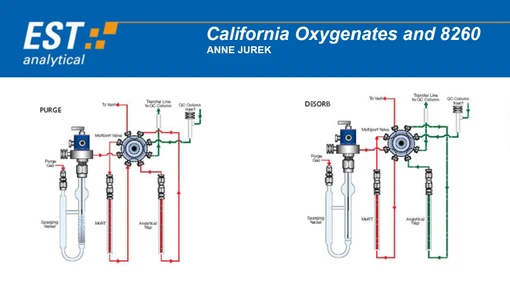
The United States Environmental Protection Agency’s (USEPA) Method 8260 has an extensive list of compounds of interest. In order to purge and trap these analytes, there needs to be an analytical trap able to trap these compounds and desorb them to the Gas Chromatograph/Mass Spectrometer (GC/MS) both accurately and efficiently. Due to the broad range of compounds on the Method 8260 list, there are many issues to take into account. Purge efficiency, molecular weight, volatility, and water are among the most problematic issues. The purge and trap concentrator and analytical trap must be able to account for all of these concerns.
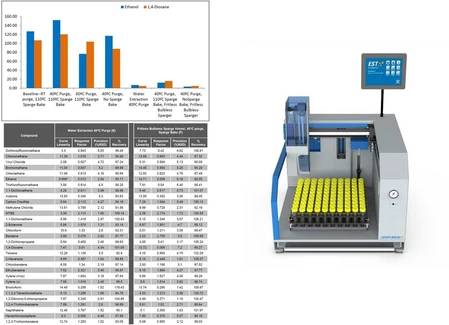
The most commonly used analytical trap is the Vocarb® 3000 due to its ability to trap and desorb the extensive analyte list both effectively and correctly. However, the Vocarb® 3000 trap is not without its drawbacks. One of which is Bromomethane degradation in the trap over time. This application will examine the Vocarb® 3000 and a custom trap along with the optimum trap temperature parameters for the stability of Bromomethane.
Experimental
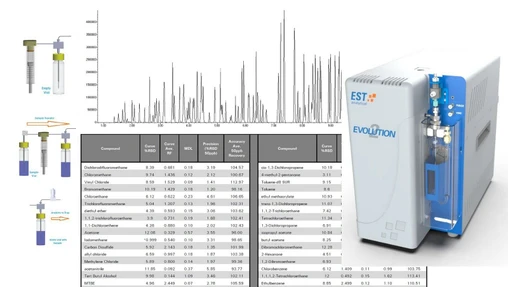
The purge and trap concentrator used for this study was the EST Analytical Evolution. The Centurion Water and Soil autosampler equipped with the syringe option was employed as the autosampler. Separation and analysis of the volatile compounds was performed by the Agilent 7890A Gas Chromatograph (GC) and 5977B Mass Spectrometer (MS). The GC was configured with a Restek Rxi624 Sil MS 30m x 0.25mm x 1.4µm column. The purge and trap parameters and analytical traps used for this study are listed in Tables 1 and 2 while Table 3 details the GC/MS parameters.
Conclusions
Initially, all of the traps and heating parameters used in the EST Analytical Evolution met USEPA method 8260 requirements and could be used in the laboratory. However, the custom trap and the higher temperature desorb and bake showed a lower response when compared to using a lower temperature desorb and bake. Furthermore, over time, the custom trap and higher temperature desorb and bake displayed lower recoveries of Bromomethane which could in turn affect the continuing calibration standards. The Vocarb® 3000 trap with the lower temperature desorb and bake proved to be the optimum method for sampling USEPA Method 8260 compounds. The technique met all of the method requirements and exhibited the best response and stability not only for Bromomethane but also for the rest of the extensive compound list.
3. Shimadzu: Quantitative Analysis of Furan and Alkylfurans in Processed Food Using Headspace GC-MS
- Application note
- Full PDF for download
Furan and alkylfurans are aromatic compounds with a fivemembered ring structure. Furan and some alkylfurans, such as 2-methylfuran, 3-methylfuran, and 2,5-methylfuran (furan with a hydrocarbon chain attached), are found in processed food. They are generated through a variety of pathways during heat treatment of the food. Some countries have studied these compounds and concluded they are a health concern. 1) At present, no country has set permissible levels for furan or alkylfurans in food. But since they are harmful substances that are generated unintentionally during the processing of food, analyzing them is becoming increasingly important. In this Application News, the levels of furan and alkylfurans in commercially available processed food were measured.
Equipment
The GCMS-QP2050 gas chromatograph mass spectrometer has a compact design for a smaller installation footprint. When combined with the HS-20 NX headspace sampler, the GCMSQP2050 can simply and accurately measure furan and alkylfuran levels in processed food. The DuraEase ion source, which is specifically designed for durability and ease of maintenance, also providesreduced maintenance requirements.
Conclusion
In this Application News, headspace GC-MS analysis was used to measure levels of furan and alkylfurans in processed food. Analysis of standard samples produced good results in terms of separation, calibration curve linearity, and repeatability. Analyzing food samples and comparing the results obtained by the external standard method and the standard addition method showed that the matrix effects differed depending on the sample.
4. Thermo Fisher Scientific: Everything You Need in a GC Detector: VGA-100 Gas Chromatography Detector for TRACE 1600 Series GC
- Brochure
- Full PDF for download
Performance synergy—the VGA-100 detector and the TRACE 1600 Series GC
VUV absorbance and gas chromatography offer a perfect match, joining insights on light absorption in the VUV range with each compound’s unique gas phase absorption features. The innovative VUV absorption technology of the VGA-100, combined with the robust and reliable performance of the Thermo Scientific™ TRACE™ 1600 Series gas chromatograph, offers a powerful analytical solution to support timecritical laboratory demands.
Harnessing breakthrough gas chromatography technology, VGA-100 provides unmatched precision and data quality with faster results and higher sample volume. Experience analytical insights with a system designed for ease of use that delivers accurate, reportable results across a diverse range of industries.
Explore the benefits of VUV technology
The unique capabilities of the VGA-100 detector for the TRACE 1600 Series GC help solve common challenges, such as correct isomer identification, poor selectivity, long method run times, analyte co-elution, burdensome data processing and analysis, and method scalability to production environments.
Expand detectable compounds.
Access to a wider range of analytes with enhanced sensitivity towards impurities as well as accurate sample profiling, thanks to the combined universal and selective response of the VGA-100 detector.
Unambiguous identification.
The VGA-100 universal mass-sensitive detector delivers comprehensive data for robust analysis. Data provided in 3D (time, wavelengths, and intensity) supports reliable identification through spectra that can be matched to a dedicated library, including isomers discrimination.
Ease of use and maintenance.
Robust and easy to set up and operate, the VGA‑100 requires minimal maintenance, with no vacuum pumps required. An intuitive design supports high demands for throughput and compliance, supporting the needs of both research and quality control laboratories.
Faster analysis.
Obtain rapid and accurate results with the advanced capabilities of VUV technology, complemented by the fast and efficient chromatographic separation of the TRACE 1600 Series GC.
VUV Analyze Software for push-button simplicity
The advanced post-acquisition processing capabilities of VUV Analyze™ Software (VUV Analytics, Inc.) allows laboratories to generate meaningful results with just the push of a button. This cutting-edge software platform swiftly analyzes complex chromatographic and spectral data, delivering method-specific results and reports. By automating the analysis process, VUV Analyze Software significantly streamlines and speeds up each run while minimizing errors, leading to greater confidence in results.