News from LabRulezGCMS Library - Week 40, 2025
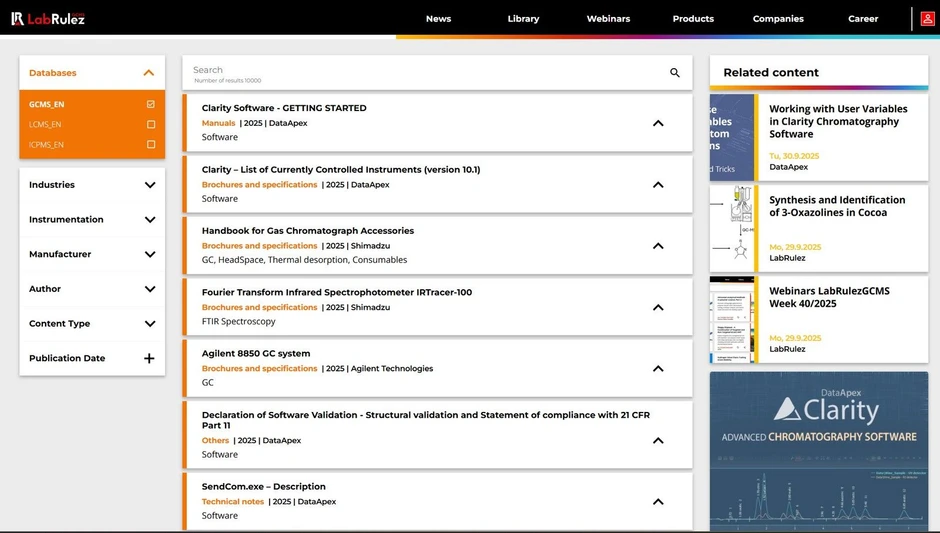
LabRulez: News from LabRulezGCMS Library - Week 40, 2025
Our Library never stops expanding. What are the most recent contributions to LabRulezGCMS Library in the week of 29th September 2025? Check out new documents from the field of the gas phase, especially GC and GC/MS techniques!
👉 SEARCH THE LARGEST REPOSITORY OF DOCUMENTS ABOUT GCMS AND RELATED TECHNIQUES
👉 Need info about different analytical techniques? Peek into LabRulezLCMS or LabRulezICPMS libraries.
This week we bring you application notes by Agilent Technologies and EST Analytical, poster by Shimadzu and smart note by Thermo Fisher Scientific!
1. Agilent Technologies: Equimolar Response to ASTM D5623 Relevant Sulfur Compounds
Using an Agilent 8890 gas chromatograph and 8355 sulfur chemiluminescence detector (GC/SCD)
- Application note
- Full PDF for download
For many years, the use of a sulfur-specific detector in the petroleum industry has been invaluable for accurately identifying low levels of sulfur-containing compounds in petroleum at various stages of production.1 Many environmental and health requirements limit the amount of sulfur allowed in the final petroleum product. The presence of sulfur also has the potential to poison the catalytic processes that take place during petroleum refining.
Along with the determination of low sulfur levels in a petroleum sample, a detector may also need to measure high sulfur levels and total sulfur content. A detector with a high linear range is essential in making both low-level and high‑level determinations of sulfur in a petroleum sample.
In this application note, an Agilent 8355 SCD was used to measure 19 sulfur-containing compounds within a standard sample. The 8355 SCD is ideal for the widely used ASTM D5623 method2 because of its ability to obtain linear and equimolar responses to sulfur compounds with minimal hydrocarbon interference. When comparing the equimolar response of analytes containing different numbers of sulfur atoms, the response should be double for the analytes containing two sulfur atoms compared to those with one sulfur atom.
Another advantage of the 8355 SCD is the ability to use it in tandem with an FID. This combination allows monitoring solvent elution through the GC system, assisting in the detection of the coelution of solvents with analyte peaks. These coelutions can cause peak distortion, which might be mistaken for activity issues within the GC system.
Methods
Instrumentation
Two Agilent 8890 GC systems were equipped with an 8355 SCD. Both GC/SCD systems were run in the same manner to confirm equimolar results. A third GC system was also configured with a tandem flame ionization detector sulfur chemiluminescence detector (FID/SCD) to allow the determination of the solvent peak elution from the system. This third system also served as another confirmation of the equimolar results that were obtained from the other two GC/SCD systems. Sample introduction for all systems was completed with an Agilent 7693A automatic liquid sampler with a 5 µL syringe. The sample volume for each injection was 1.0 µL. All analyses were performed with a split/splitless inlet in split mode.
The GC/SCD parameters are provided in Table 1. Note that an Agilent DB-Sulfur SCD GC column (part number G3903-63002) was used in this study because of the low column bleed and excellent inertness and performance for sulfur compound analysis. When using the SCD, be aware that stationary phase bleed from the GC column can lead to fouling of the ceramic tubes within the detector. This phenomenon can cause poor SCD performance, such as decreased sensitivity, and may require more frequent maintenance. Proper GC column selection (such as the DB-Sulfur column) is important to ensure lower column bleed into the detector and will reduce fouling of ceramic tubes, reducing instrument downtime.
Results and discussion
Use of GC/FID for solvent elution determination
Determination of the solvent peak elution can be a challenge when using a sulfur-selective detector such as the SCD. Many times, the large, fronting solvent peak may coelute with analytes of interest, causing distortion of the analyte peak shape (peak tailing, fronting, or broadening) and poor chromatographic separation. This poor peak shape, caused by column overloading, can be mistaken for activity issues in the system or hydrocarbon interferences, leading to unnecessary troubleshooting or inlet/column maintenance. Determination of the solvent peak elution time is recommended to ensure that coelution does not occur with any of the analytes of interest. To confirm the solvent elution time, a tandem GC/FID/SCD system was used. The GC/FID/SCD system puts the FID in-line before the SCD analysis, allowing the user to obtain both FID and SCD signals from a single injection, thus confirming the solvent retention time and determining any solvent/analyte coelutions.
Conclusion
The Agilent 8355 sulfur chemiluminescence detector, paired with an Agilent 8890 GC, was evaluated by analyzing 19 sulfur‑containing compounds relevant to ASTM D5623. The SCD met the specifications of the test method, including an equimolar response to the analyzed sulfur compounds and a wide range of linearity to a sulfur-containing standard. The 8355 SCD shows excellent area reproducibility, and when used in tandem with a flame ionization detector, the system can aid in the determination of solvent peak elution through the GC system.
2. EST Analytical: Reducing Carryover in Environmental Water Samples
- Application note
- Full PDF for download
In order to mitigate carryover, many environmental labs resort to running sample dilutions or adding blank samples after a highly contaminated sample. Both of these solutions are not ideal and can lead to a loss of analyte detection when diluting or a loss of profits when blank samples need to be run.
Since, the primary source of carryover for water samples is the sparge vessel, purge and trap manufactures have incorporated a rinsing step in which the sparge vessel is “washed” with hot water in order to clean up the volatile compounds that may still reside in the sparge vessel. Expanding on the idea of limiting volatile compounds in the sparge vessel, EST Analytical developed a patented process of heating the sparge vessel during the bake step of the purge and trap process (Patent Number: US 8,075,842 B1) . This engineering innovation essentially performs two bakes; as a result both the trap and the sparge vessel are “cleaned” at the same time. No other concentrator is or can be engineered to do this.
Experimental
The sampling system used for this study was the EST Analytical Evolution concentrator and the Centurion WS autosampler. The concentrator was affixed with a Vocarb 3000 trap and connected to an Agilent 7890A GC and 5975C inert XL MS. The GC was configured with a Restek Rxi-624 Sil MS 30m x 0.25mm x 1.4µm column. Refer to Table 1 for the sampling method parameters and Table 2 for GC/MS parameters.
Conclusions
The Evolution purge and trap concentrator with its patented technique of heating the sparge vessel during the bake process proved to reduce carryover by almost half when comparing with hot water rinses alone. The advantages of reduced carryover are many. Primary among them is the ability to run more samples during the twelve hour tune window. This increase in productivity translates to more laboratory profits and better use of instrument time.
3. Shimadzu / AOAC: Analysis of PFAS in juice using Head-Space Solid Phase Microextraction-Gas Chromatography/Mass Spectrometry (HS-SPME GCMS)
- Poster
- Full PDF for download
PFAS contaminate water and food through packaging that can leach volatile PFAS from plastics and inks or coatings. This work developed a headspace SPME GCMS method to analyze six volatile PFAS classes in juices. The United States Food and Drug Administration has tested for PFAS in a broad range of foods and beverages as part of its Total Diet Study. Juice matrices differ in flavor, sugar, as well as manufacturing practices, and packaging, with the latter two potentially introducing PFAS contamination. The former differences between products can impact PFAS detection.
Materials and Methods
The SPME method used in this study is based on a method published by Bach et.al. (2016). An HS-SPME method is used to improve method performance when analyzing complex aqueous samples over direct immersion. The optimized parameters of the instrument method for the targeted PFAS are listed in table 1.
Conclusion
The Shimadzu GCMS-TQ8040 NX triple quadrupole instrument, configured with an AOC-6000 Plus SPME unit, was used to measure PFAS in different juice samples. Without isotope dilution, matrix effects caused recoveries to fall outside of acceptable criteria. Method blanks showed no detectable PFAS, and calibration demonstrated excellent linearity (R² ≥ 0.993). This HS-SPME GCMS-TQ8040 NX method demonstrated quantitative capability for analyzing nanogram-per-liter PFAS compounds in complex juice matrices. This application highlights a simple, fast, robust, precise, and accurate workflow for measuring volatile PFAS in challenging matrices.
4. Thermo Fisher Scientific: Safe use of carrier hydrogen for air monitoring with Multi-Gas TD-GC-MS
- Other document (smart note)
- Full PDF for download
Monitoring volatile organic air compounds, also known as hazardous air pollutants (HAPs), is crucial for maintaining air quality in urban and industrial environments due to their significant health risks. The growing concerns about these potentially dangerous volatile organic compounds in ambient air, particularly in urban areas and from industrial emissions, have led to the development of numerous national and international regulations. The use of Thermal Desorption (TD) coupled with GC-MS is the analytical technique of choice to enrich volatile organic compounds from air and quantify them at trace levels.1 In gas chromatography, the choice of carrier gas is pivotal for the separation and detection of VOCs. Helium has traditionally been the preferred carrier gas for analyzing volatile organic air toxics due to its inertness and performance benefits. However, hydrogen is becoming increasingly popular due to economic and supply considerations. Each carrier gas has unique advantages and challenges, and the choice should be guided by specific analytical requirements, cost constraints, and safety protocols. As the demand for sustainable and cost-effective solutions grows, hydrogen is expected to play a more significant role in monitoring hazardous air pollutants in urban and industrial settings.
Thermal Desorption is an established way to analyze VOCs in a wide variety of sample types. This smart note highlights the use of the new Multi-Gas TD system (Markes International) that allows a safe use of carrier hydrogen for the analysis of VOCs in air, enhancing operational flexibility and supporting more sustainable laboratory practices.
Experimental
In this study, Markes TD100-xr™ Multi-Gas system, coupled with the Thermo Scientific™ TRACE™ 1610 gas chromatograph and Thermo Scientific™ ISQ™ 7610 single quadrupole mass spectrometer, was employed to accurately detect and quantify compounds for effective air monitoring. This combination leverages several technological advancements to optimize analytical performance and operational efficiency.
The comparison between helium and hydrogen carrier gas was carried out using the same analytical column. The method conditions for all analytes could be easily transferred. Flow rates were adjusted using the split ratio calculator available in the Thermo Scientific™ Chromeleon™ Chromatography Data System (CDS) Instrument Method Wizard (Figure 1) to maintain the same split level and therefore the same amount of transferred sample. A further factor facilitating rapid adoption of hydrogen carrier gas in laboratories is that existing columns and consumables can be used without restrictions.
Conclusion
The use of the Markes TD100-xr Multi-Gas system combined with the ISQ 7610 GC-MS for the analysis of VOC in air allows for a safe use of carrier hydrogen, making it a viable alternative to helium and offering an effective solution for laboratories facing the challenges of helium scarcity and rising costs, while maintaining the accuracy and reliability of VOC detection and quantification.
- The comparative analysis clearly confirmed that using hydrogen carrier gas in gas chromatography offers substantial benefits over helium. The significant reduction in retention time, as shown by the 60% decrease for 1,2,3-trichlorobenzene, leads to faster analysis without compromising the separation efficiency.
- Enabling shorter analysis time, hydrogen enhances laboratory productivity, reduces costs, and contributes to more sustainable practices.
- The results also indicate that both helium and hydrogen can be used effectively as carrier gases without impacting the response linearity for the VOC compounds under evaluation. Laboratories can confidently use hydrogen as an alternative to helium for quantitative analysis, ensuring accurate and reliable analytical results.
- When using multiple carrier gases, the ISQ 7610 NeverVent technology is key to easily switching from helium to hydrogen and back to helium with no venting required, making this operation very quick and safe.
In conclusion, coupling the Markes TD100-xr Multi-Gas system with the ISQ 7610 single quadrupole GC-MS offers a robust and flexible solution for air monitoring. This integration enhances operational efficiency, reduces costs, and maintains high data integrity, making it an invaluable tool for modern analytical laboratories.