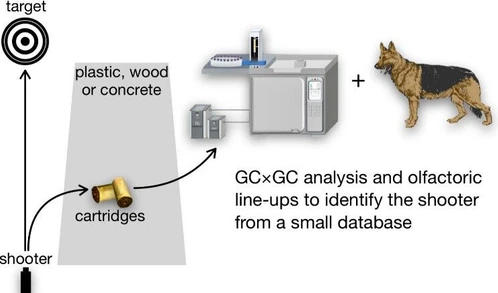
Analysis of the human scent on the cartridge cases using GC×GC-MS/TOF (Ulrika Malá, MDCW 2025)
- Photo: MDCW: Analysis of the human scent on the cartridge cases using GC×GC-MS/TOF (Ulrika Malá, MDCW 2025)
- Video: LabRulez: Ulrika Malá: Analysis of the human scent on the cartridge cases using GC×GC-MS/TOF (MDCW 2025)
🎤 Presenter: Ulrika Malá (University of Chemistry and Technology in Prague, Prague, Czech Republic)
💡 Book in your calendar: 17th Multidimensional Chromatography Workshop (MDCW) 13 - 15. January 2026
Abstract
Two-dimensional gas chromatography offers various applications due to its higher separation efficiency. This GC system could also be valuable for forensic purposes. This pilot study focuses on the human scent analysis on the crime scene, particularly on the cartridge cases. Although dactyloscopic fingerprints can sometimes be found on cartridges, they are often partial, lacking sufficient minutiae for successful database comparisons. However, the perpetrator also leaves behind its scent on the cartridges, which could be useful for both the individual as well as class identifications.
In this study, cartridge cases were collected from a simulated crime scene from four different surfaces. These cases were extracted using ethanol and the extract was analyzed with GC×GC-MS/TOF using liquid injection. Additionally, four different volunteers were sampled to be compared their scents with the samples from the simulated crime scene.
The results showed that the surface from where the traces were collected did not play significant role for the identification. While the ability to distinguish each volunteer´s scent was observed, it was not yet possible to link the fired cartridge cases to any of the volunteers. This issue could be resolved in the future by target analysis focused on genetically determined substances or by solving present problems with peak processing in the commercial software that accompanies the two-dimensional gas chromatograph.
This study is supported by Ministry of The Interior of The Czech Republic by the project No. VK01010240.
Video transcription
Background and Motivation
- Fingerprints on cartridge cases are often partial and unsuitable for individual identification.
- Human scent can survive extreme conditions – thermal stability up to 500 °C for one minute.
- This residual scent could remain on cartridge cases even after firing.
- Scent analysis may provide an alternative route to individual or class identification.
Experimental Setup
- Simulated crime scene with 4 volunteers (one designated as shooter).
- Each volunteer provided 3 scent samples on glass beads.
- 4 unknown scent samples were collected from cartridge cases fired at the scene.
- Surfaces: plastic sheet, wooden pallet, concrete floor.
- Cartridges extracted in ethanol and analyzed by GC×GC-MS/TOF with liquid injection.
Data Processing
- Data aligned using Kovats retention indices with internal standards.
- Focused on substances:
- Present in at least one unknown sample.
- Detected in ≥75% of known data.
- Statistical evaluation:
- Used peak areas and area ratios, not compound identity.
- Selected first 150 area ratios (stable in time).
- Cluster analysis applied.
Results
- Volunteers’ samples on glass beads: clearly distinguishable.
- Cartridge case samples: not yet linkable to specific volunteers.
- Possible limitation: imperfect data alignment (nonlinear shifts not accounted for).
- Surface effect: type of surface (plastic, wood, concrete) did not significantly impact identification.
Conclusions
- Human scent shows strong potential as a forensic identification tool.
- Volunteers distinguishable on glass beads, but not yet on fired cartridge cases with GC×GC-MS/TOF.
- Key findings:
- Scent persists across different surfaces.
- Dogs confirmed shooter identification, supporting feasibility.
Future Work
- Equalize sample conditions: heat glass bead samples to simulate firing temperature.
- Shorten scent transfer time: in this pilot, shooter rubbed cartridges for 10 minutes before firing; future studies will use natural handling time only.
- Combine scent analysis with fingerprint analysis on the same samples.
- Expand study to more volunteers, various firearms, and ammunition types.
- Improve GC×GC software processing for nonlinear retention shifts.
This text has been automatically transcribed from a video presentation using AI technology. It may contain inaccuracies and is not guaranteed to be 100% correct.
-Workshop-LOGO_s.webp)