

Radioactively labeled peptides from IOCB Prague in high demand worldwide
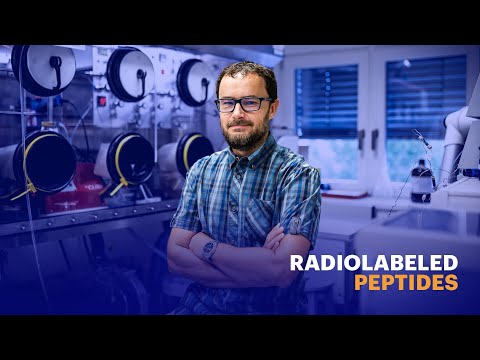
- Photo: IOCB Prague / Tomáš Belloň: Dr. Aleš Marek, head of the Synthesis of Radiolabeled Compounds group at IOCB Prague
- Video: IOCB Prague: Radioactively labeled peptides from IOCB Prague in high demand worldwide
Researchers in Aleš Marek’s laboratory at IOCB Prague prepare radioactively labeled peptides of such quality – and with such speed – that they are sought after by research institutions worldwide. The team has refined a procedure that enables simple, mild, and universal labeling of biologically active molecules, indispensable for the development of highly demanded peptide-based drugs, such as the well-known Ozempic. The group’s latest study, which provides a thorough overview of modern methods for peptide and protein labeling with the radioactive isotope iodine-125 (^125I), was published in the Journal of Pharmaceutical Analysis.
The article summarizes existing labeling techniques and, above all, describes in detail the group’s own unique method. The radioisotope is attached to peptides or proteins only at the very end of the process, once the biomolecules are fully synthesized. This approach protects them from damage and is suitable for a wide spectrum of substances – from short peptides to large proteins.
As the IOCB group leader Aleš Marek explains: “Our goal is to make it possible to monitor the activity of a chosen compound during experiments. Because our labeling method ensures that the molecule retains its biological properties even after iodine tagging, it’s enough to track the radioactivity in the sample – there’s no need to look for the molecule itself. That makes it much simpler.” Such labeled molecules can even be traced in vivo, i.e. in living organisms, providing a picture of how a compound moves through the body of an animal model.
 IOCB Prague / Tomáš Belloň: Dr. Aleš Marek, head of the Synthesis of Radiolabeled Compounds group at IOCB Prague
Radioisotope-labeled molecules are critical for one of today’s biggest trends in medicine: peptide therapeutics, a field drawing the focus of major pharmaceutical companies. These drugs are most commonly used in the treatment of diabetes and obesity, though their potential reaches further. Their effects are also being investigated in the fight against neurodegenerative diseases such as Alzheimer’s or Parkinson’s.
At IOCB Prague, promising peptides are being developed in the laboratory of Dr. Lenka Maletínská. She explains why radioactively labeled peptides are essential to her research: “The radioactively labeled peptide hormones we work with help us assess the potential of promising substances that could become drugs. We monitor how the compound binds to its receptor (the site of action), which tells us whether it has a chance to pass testing in mice, or whether it’s better to exclude it from further study.”
 IOCB Prague / Tomáš Belloň: Dr. Lenka Maletínská, Head of the Research Group on Pathophysiological Mechanisms of Food Intake Regulation, ÚOCHB AV ČR
Dr. Marek’s team works with simple, commercially available materials. No special reactor is needed – only standard laboratory equipment. Their method is reliable, highly economical, and, above all, reproducible. Because the process is gentle on the labeled peptide, they can produce the desired compounds in large quantities. Compared with other suppliers of radioactively labeled molecules on the market, they are therefore not only less expensive but also much faster. Their colleagues at IOCB Prague benefit from a service that is exceptional not only by Czech but also by international standards.
 IOCB Prague: Three-dimensional (3D) structure of a peptide selectively radioiodinated by I-125 out of the receptor-peptide binding site. The yellow sphere depicts labeling with 125I. (A) Cocaine- and amphetamine-regulated transcript peptide (CART)(61–102).
The original article
Late-stage labeling of diverse peptides and proteins with iodine-125
Aleš Marek, Břetislav Brož, Michal Kriegelstein, Gabriela Nováková, Jana Hojcsková, Miroslava Blechová, Lenka Žáková, Jiří Jiráček, Lenka Maletínská
J. Pharm. Anal. 2025, 101198
https://doi.org/10.1016/j.jpha.2025.101198
licensed under CC-BY 4.0
Abstract
The preparation of specifically iodine-125 (125I)-labeled peptides of high purity and specific activity represents a key tool for the detailed characterization of their binding properties in interaction with their binding partners. Early synthetic methods for the incorporation of iodine faced challenges such as harsh reaction conditions, the use of strong oxidants and low reproducibility. Herein, we review well-established radiolabeling strategies available to incorporate radionuclide into a protein of interest, and our long-term experience with a mild, simple and generally applicable technique of 125I late-stage-labeling of biomolecules using the Pierce iodination reagent for the direct solid-phase oxidation of radioactive iodide. General recommendations, tips, and details of optimized chromatographic conditions to isolate pure, specifically 125I-mono-labeled biomolecules are illustrated on a diverse series of (poly)peptides, ranging up to 7.6 kDa and 67 amino acids (aa). These series include peptides that contain at least one tyrosine or histidine residue, along with those featuring disulfide crosslinking or lipophilic derivatization. This mild and straightforward late-stage-labeling technique is easily applicable to longer and more sensitive proteins, as demonstrated in the cases of the insulin-like growth factor binding protein-3 (IGF-BP-3) (29 kDa and 264 aa) and the acid-labile subunit (ALS) (93 kDa and 578 aa).
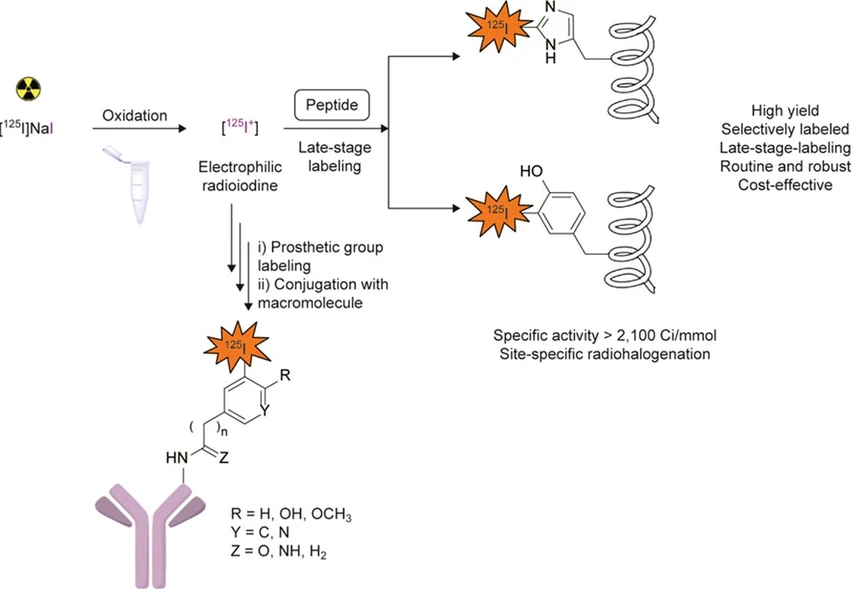 J. Pharm. Anal. 2025, 101198: Graphical abstract


_s.webp)


