Focus on endogenous parameters influencing body volatolome composition (Elsa Boudard, MDCW 2025)
- Photo: MDCW: TOWARDS A BETTER UNDERSTANDING OF THE BODY VOLATOLOME: FOCUS ON ENDOGENOUS PARAMETERS INFLUENCING BODY VOLATOLOME COMPOSITION (Elsa Boudard, MDCW 2025)
- Video: LabRulez: Elsa Boudard: Focus on endogenous parameters influencing body volatolome composition (MDCW 2025)
🎤 Presenter: Elsa Boudard (ESPCI, Paris, France / SenseBiotek Health-Care, Aigremont, France)
💡 Book in your calendar: 17th Multidimensional Chromatography Workshop (MDCW) 13 - 15. January 2026
Abstract
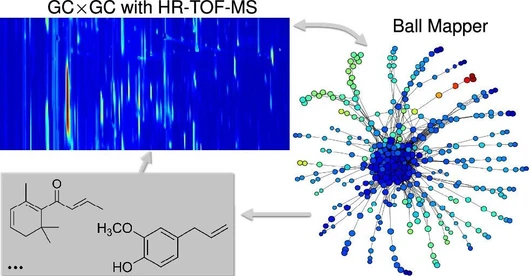
The body volatolome describes the numerous volatile organic compounds (VOCs) that are constantly emitted by the skin. These VOCs mainly result from the interaction of compounds produced by the sweat glands with microorganisms present on the skin surface. However, this production pathway can be affected by factors such as pathologies. This is why body volatolome analysis can be a smart and non-invasive way to perform large-scale health screening and monitoring. To do so, sampling body VOCs on a solid sorbent followed by thermodesorption into comprehensive two-dimensional chromatography coupled with time-of-flight mass spectrometry (TD-GC×GC/ToFMS) is among the most relevant solutions for the analysis of body odor because it provides both high sensitivity and resolution.
The first step of this study was the development of a user-friendly and reliable sampling system called SkinVOCs®. Then, SkinVOCs® was used to explore both endogenous and exogenous factors that influence the composition of the body volatolome, a needed knowledge to perform more accurate health monitoring. The specific study that will be presented here was carried out on 19 individuals, sampled on different body locations (armpits, forearms and upper-back) in order to understand the effect of age and gender over the body volatolome. Thanks to chemometric tools such as partial least square discriminant analysis (PLS-DA), 3 molecules specific to gender were identified while age groups were discriminated using a wider set of molecules. It also revealed a right/left symmetry in the body volatolome, as well as certain molecules specific to certain body areas.
Video transcription
Introduction
The body volatolome, commonly perceived as body odor, consists of volatile organic compounds (VOCs) emitted by the skin. These compounds originate from sweat gland secretions interacting with microorganisms on the skin surface. Understanding the volatolome is essential for biomarker discovery and disease monitoring.
This presentation focuses on endogenous factors—such as body area, gender, and age—that influence volatolome composition, ensuring biomarkers identified are truly disease-related rather than confounded by other variables.
Clinical Study Design
When identifying disease biomarkers, clinical study design is crucial. For example, in a skin cancer study:
- Inclusion criteria: confirmed skin cancer diagnosis (≥24 h old).
- Exclusion criteria: other skin diseases (e.g., eczema) to avoid confounding influences.
Additionally, exogenous factors such as cosmetic products significantly affect body VOC profiles. Thus, participants must refrain from using deodorants or perfumes for at least 24 hours before sampling.
Methodology
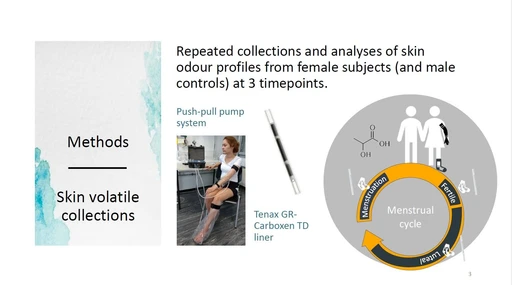
A patented sampling device (SkinVOCs®/SkinBox) was used to collect skin VOCs.
- Sample size: 19 individuals.
- Sampled body areas: armpits, forearms, upper back.
- Approach: combined targeted (literature-based molecules) and non-targeted analysis (novel compounds identified in this study).
- Data analysis: Principal Component Analysis (PCA) and Partial Least Squares Discriminant Analysis (PLS-DA).
Key Results
1. Body Area Specificity
- VOC profiles varied significantly across body regions.
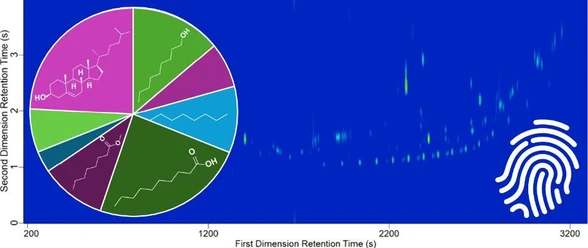
- Example: benzene methyl gel was specific to armpits, while benzyl alcohol appeared across multiple areas.
2. Left–Right Symmetry
- Sampling both sides of the body revealed strong left-right similarity within individuals.
- Hierarchical clustering showed 15 of 18 sample pairs clustered together, suggesting left/right samples can serve as replicates.
3. Age Influence
- VOCs could distinguish age groups (<40 vs. >40 years).
- Steroid molecules, produced by apocrine glands, were more abundant in younger individuals.
- PLS-DA provided clearer group separation, confirming PCA observations.
4. Gender Differences
- Distinct molecules differentiated male and female samples.
- Indicates gender must be considered as a confounding factor in biomarker studies.
Conclusion
- The body volatolome varies by sampling site, age, and gender, but shows left-right symmetry.
- Endogenous factors strongly influence VOC composition.
- Future clinical studies (e.g., in skin cancer) should ensure age- and gender-matched cohorts for reliable biomarker identification.
This text has been automatically transcribed from a video presentation using AI technology. It may contain inaccuracies and is not guaranteed to be 100% correct.
-Workshop-LOGO_s.webp)