MW extraction and derivatization & GCxGC-FID for FAMEs in food (Donatella Ferrara, MDCW 2025)
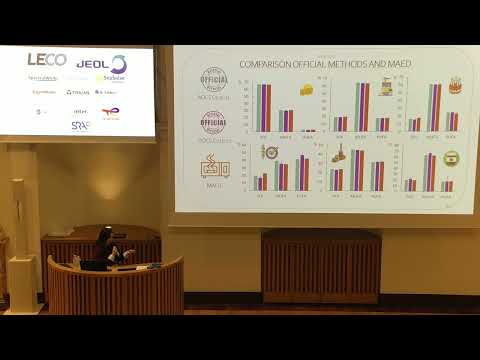
- Photo: MDCW: MW extraction and derivatization & GCxGC-FID for FAMEs in food (Donatella Ferrara, MDCW 2025)
- Video: LabRulez: Donatella Ferrara: MW extraction and derivatization & GCxGC-FID for FAMEs in food (MDCW 2025)
🎤 Presenter: Donatella Ferrara (University of Liege, Gembloux Agro-Bio Tech, Belgium / University of Turin, Dipartimento di Scienza e Tecnologia del Farmaco, Turin, Italy)
💡 Book in your calendar: 17th Multidimensional Chromatography Workshop (MDCW) 13 - 15. January 2026
Abstract
The analysis of fatty acids (FAs) is crucial from different viewpoints, as it can provide valuable insights into the composition of fats for instance for industrial processes or their impact on nutrition and health. Typically, the analysis of FAs involves extracting lipids from the matrix and subsequently undergoing a derivatization process to convert them into FAMEs before gas chromatography (GC) analysis.
This work aims to characterize the FAs profile of complex matrices using a one-step microwave-assisted extraction and derivatization (MAED) method used to simultaneously extract and derivatize the lipid fractions in FAMEs, followed by a flow-modulated (FM) two-dimensional comprehensive gas chromatography – flame ionization detector (GC×GC-FID) analysis. The use of FM-GC×GC enhances interpretation capabilities, and the structured chemical patterns generated in the 2D plot allow for precise characterization of the FAMEs profile based on specific chromatogram positions, ensuring reliable identification without the need for MS. Moreover, the use of FM allowed to obtain the same profile as a cryogenic modulator.
FAMEs were tentatively identified through standards, literature data, and the 2D-GC plot position. The MAED method proved to be a robust, greener, and rapid alternative to the more time-consuming routine methods normally in use.
Video transcription
Introduction
The presentation addresses the analysis of fatty acids (FAs) in complex food matrices using a combined approach of microwave-assisted extraction and derivatization (MAED), followed by flow-modulated comprehensive two-dimensional gas chromatography with flame ionization detection (GC×GC-FID). Fatty acid profiling is essential for nutritional labeling, industrial applications, and health-related studies. Conventional methods involve separate extraction and derivatization steps, which are time-consuming and often require toxic reagents.
Background on Microwave-Assisted Extraction
Microwave heating provides rapid, efficient, and uniform heating of samples compared with conventional methods. Energy transfer occurs through ion conduction and dipole rotation, directly heating the sample solution. This approach reduces processing times, improves energy efficiency, and minimizes solvent use, offering a greener alternative to conventional extraction.
Methodology – One-Step MAED and GC×GC-FID
A one-step MAED protocol was developed to simultaneously extract lipid fractions and convert them into fatty acid methyl esters (FAMEs). Within 15 minutes, the organic phase is ready for injection into the GC system. The chromatographic analysis was optimized using flow-modulated GC×GC-FID, enabling high-resolution separation of FAMEs. Flow modulation provides advantages over cryogenic modulation, including lower operating costs, consumable-free operation, and efficient handling of both volatile and semi-volatile compounds.
Results
- Comparison with Official Methods: The MAED procedure was benchmarked against two official reference methods. The resulting FA profiles, including saturated, monounsaturated, and polyunsaturated fractions, showed complete agreement. Furthermore, MAED employed a less hazardous acidic methanol solution instead of boron trifluoride, confirming it as a robust, greener, and reliable alternative.
- Chromatographic Performance: Analysis of complex matrices (e.g., mussel tissue) demonstrated the limitations of one-dimensional GC, where long run times and peak coelutions hindered accurate identification. GC×GC-FID provided structured chromatograms with clear separation, enabling the detection of over 80 FAMEs compared to fewer than 20 under equivalent 1D conditions. Nutritional indices based on FA distribution (saturated, monounsaturated, polyunsaturated) were also more accurately determined with GC×GC.
- Greenness and Practicality: Sustainability assessments confirmed that MAED achieved the highest scores in terms of environmental impact and practicality, while also supporting high-throughput analysis (up to 48 samples per hour).
Conclusion
The study demonstrates that MAED is a reliable, sustainable, and practical alternative to conventional methods for FAMEs sample preparation. Coupling MAED with GC×GC-FID provides reliable quantification, enhanced separation, and accurate profiling of fatty acids in complex food matrices. This combined workflow improves throughput, reduces costs, minimizes solvent use, and supports accurate nutritional assessment.
This text has been automatically transcribed from a video presentation using AI technology. It may contain inaccuracies and is not guaranteed to be 100% correct.
-Workshop-LOGO_s.webp)


_s.webp)