Vac-HS-SPME & GC×GC-qMS for 5-HMF quant. & volatile profiling in honey (Damien Eggermont, MDCW 2025)
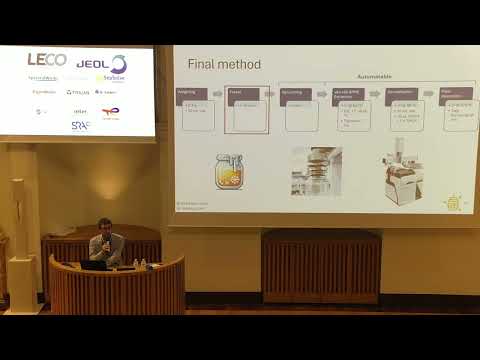
- Photo: MDCW: Coupling of Vac-HS-SPME and GC×GC-qMS for simultaneous 5-HMF quantification and volatile profiling in honey (Damien Eggermont, MDCW 2025)
- Video: LabRulez: Damien Eggermont: Vac-HS-SPME & GC×GC-qMS for 5-HMF quant. & volatile profiling in honey (MDCW 2025)
🎤 Presenter: Damien Eggermont (Gembloux Agro-Bio Tech, University of Liège, Gembloux, Belgium)
💡 Book in your calendar: 17th Multidimensional Chromatography Workshop (MDCW) 13 - 15. January 2026
Abstract
Faced with the growing complexity of the food industry's demands, analytical techniques are evolving towards increasingly sophisticated and multi-response analyses. In this respect, multidimensional techniques such as GC-MS and GC×GC-MS are ideally suited.
Regarding sample preparation, headspace-solid-phase microextraction (HS-SPME) is one of the most favoured techniques for food volatile analysis thanks to its simplicity and ability to concentrate a wide range of compounds without needing solvents. However, the extraction of low-volatile compounds can be limited. Among different available strategies to increase their extraction, vacuum-assisted (Vac)-HS-SPME is highly promising. The use of vacuum facilitates the volatilisation of less-volatile compounds by lowering the gas-phase resistance to the mass transfer while maintaining the same extraction efficiency for the more volatile compounds.
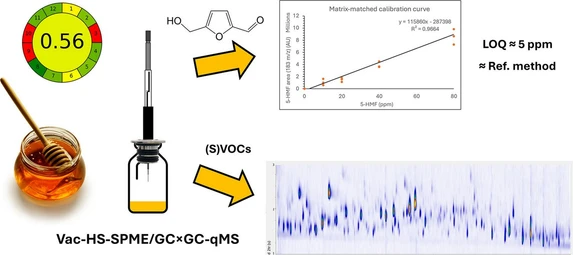
In this project, Vac-HS-SPME has been coupled with GC×GC-qMS to quantify the 5-HMF (storage and heat processing marker) and analyse the volatile profile of honey. 5-HMF is regulated by the EU (2001/110/EC) fixing the maximum limit level to 40 mg/kg in most cases. Validation of the proposed method has been realized using a matrix-matched calibration, reaching LOD and LOQ of 1.6 and 4.7 mg/kg, respectively; while a recovery of 98% and a RDS of 21% were achieved. The method was trailed with eight real-world samples against the official HPLC method showing, an average bias of 6%. In terms of greenness the proposed method gave better results using the AGREE metrics, while the practicality was similar, as calculated with the BAGI.
Video transcription
Introduction
The presentation focuses on the analysis of 5-hydroxymethylfurfural (5-HMF) and volatile organic compounds in honey, using vacuum-assisted headspace solid-phase microextraction (Vac-HS-SPME) coupled with comprehensive two-dimensional gas chromatography quadrupole mass spectrometry (GC×GC-qMS).
5-HMF is a compound formed during heat processing and storage, serving as a general freshness indicator for honey. Its maximum content is regulated by the European Union and other authorities (e.g., 40 mg/kg in most cases, 15 mg/kg for low enzyme activity honeys such as thyme honey). Analytical methods must therefore be sensitive enough to detect concentrations well below these limits.
Objective
To develop a targeted method for 5-HMF quantification that also provides a complete volatile profile of honey, enabling additional untargeted analyses for authenticity, botanical origin, contaminants, and more.
Method Overview
- Sample preparation: Vac-HS-SPME, where the vial is placed under vacuum to reduce gas-phase mass transfer resistance, enhancing extraction of semi-volatile compounds like 5-HMF.
- Instrumentation: GC×GC-qMS using an apolar × polar column configuration.
- Derivatization: Required for accurate 5-HMF quantification due to peak tailing; optimized (80 °C for 5 min) using central composite design.
- Extraction optimization: 17 min at 60 °C, determined via experimental design.
- Workflow: Weighing → freezing (to reduce volatility losses) → vacuuming → extraction & derivatization → fiber desorption. Most steps can be automated.
Validation
- Calibration: Matrix-matched, 5 levels.
- LOD/LOQ: 1.6 mg/kg and 4.7 mg/kg — three times lower than the EU limit.
- Recovery: 98%, RSD 21%.
- Comparison to official HPLC method: Good agreement, with minor differences in low-concentration samples far below legal limits.
- Greenness (AGREE metrics): Better than HPLC; practicality similar (BAGI).
Results
- Vacuum vs. atmospheric SPME:
- Vacuum significantly improves extraction of late-eluting (less volatile) compounds.
- For highly volatile compounds, no major difference observed.
- Greater compound diversity and intensity with vacuum in shorter times.
- Coupling with GC×GC: The increased compound load benefits from the high separation capacity of 2D GC.
Conclusion
- The Vac-HS-SPME/GC×GC-qMS method achieves sensitive, reliable 5-HMF quantification and comprehensive volatile profiling in honey.
- It outperforms the official HPLC method in certain aspects, especially in green metrics and the breadth of information obtained.
- Recently published in Green Analytical Chemistry.
This text has been automatically transcribed from a video presentation using AI technology. It may contain inaccuracies and is not guaranteed to be 100% correct.
-Workshop-LOGO_s.webp)


_s.webp)