Potential of FT-MIR/GC-MS Multivariate Hyphenation for the Fast Characterization of Agavins Metabolism
10.1021/acs.analchem.5c01074: Graphical abstract
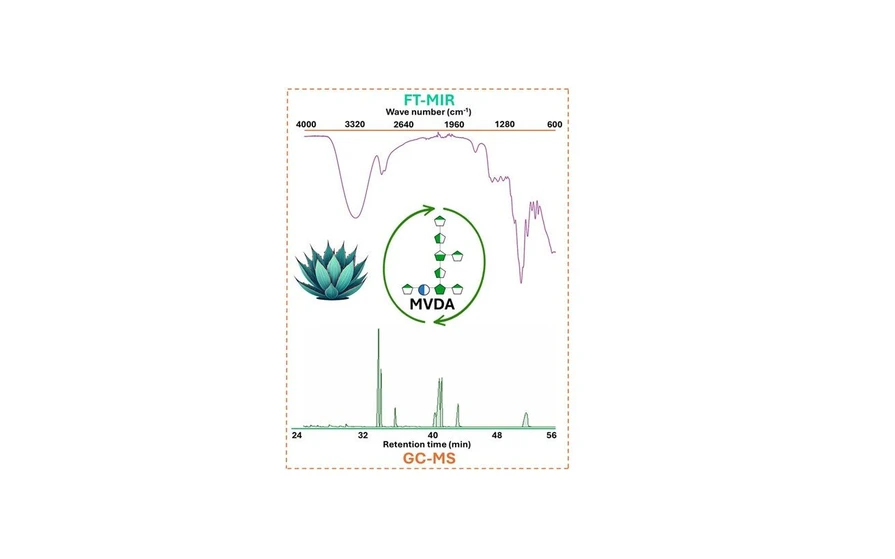
Agavins, recently characterized fructans, can be rapidly detected using FT-MIR, while GC-MS offers valuable structural information. This study integrated data from both techniques to characterize agavins metabolism in Agave angustifolia and Agave potatorum. FT-MIR efficiently revealed species and age differences, while GC-MS glycosidic linkage analysis proved highly effective for multivariate data analysis.
Correlation of specific MIR spectral regions with GC-MS structural features enhanced the structural detail obtainable from IR data. This integrated approach offers a faster, more comprehensive method for studying agavins metabolism and could accelerate research on these unique fructans.
The original article
Potential of FT-MIR/GC-MS Multivariate Hyphenation for the Fast Characterization of Agavins Metabolism
Luis F. Salomé-Abarca, Ruth E. Márquez-López, Patricia A. Santiago-García, Mercedes G. López*
Anal. Chem. 2025, XXXX, XXX, XXX-XXX
https://doi.org/10.1021/acs.analchem.5c01074
licensed under CC-BY 4.0
Selected sections from the article follow. Formats and hyperlinks were adapted from the original.
Fructans are polymers made of fructose, if any, with one glucose in their structures. (1) Fructans are classified as linear inulins (β2→1) and levan (β2→6) with terminal glucose; neo-series of inulins and levan with internal glucose; moderate branched graminans (β2→1/β2→6); and agavins, highly branched neo-fructans. (2,3) Agavins are of great interest because of their metabolic effects and correlation with tequila production. (4−6) Thus, several studies have been conducted on the metabolism of agavins including their biosynthesis, accumulation, applications, and content in agave derived-products. (7−10) To perform such characterizations, several analytical platforms have been employed, for instance, thin layer chromatography (TLC), high performance thin layer chromatography (HPTLC), high performance liquid chromatography (HPLC), matrix assisted laser desorption ionization mass spectrometry (MALDI-MS), Fourier transform mid infrared spectrometry (FT-MIR), gas chromatography coupled to mass spectrometry (GC-MS), high performance anion exchange chromatography coupled to pulsed amperometric detection (HPAEC-PAD), and nuclear magnetic resonance (NMR). (9−15)
Each of these techniques possesses advantages and drawbacks. Some examples include the parallel analysis of samples by TLC, but low reproducibility when manually performed. Even the implementation of HPTLC cannot properly separate agavins with a degree of polymerization (DP) higher than 12. (16) HPLC provides total inulin content data, but it cannot separate agavins with DP higher than four. (13) Conversely, HPAEC-PAD separates fructans with DP up to 40 units, but it does not provide specific structural data, is time-consuming, and needs standard compounds for identification and quantitation. (10) Proton NMR (1H NMR) is limited to overlapped fructose signals and general DP information obtained by integrating all fructose signals in respect to the glucose anomeric proton. (2,9,15) On the other hand, carbon and bidimensional experiments provide more valuable structural information, but they are time-consuming. (2,9,15) GC-MS yields structural and molar contribution data; however, samples need complex and time-consuming derivatization, and the resulting structures depend on the predominant type of fructan in the extracts. (2,14) Finally, FT-MIR possesses the fastest time of analysis, but its structural information is limited to functional groups. (17)
Each analytical platform offers a specific time and space view of these molecules. Nonetheless, the study of metabolites and biomolecules tends to become more efficient and more informative. This has been achieved by the creation of new technology or the on- and offline hyphenation of multiple analytical platforms. (16) In this regard, FT-MIR gathers the fast analysis character of a high throughput approach, and GC-MS provides specific structural data based on glycosidic linkage analysis. (2) Therefore, this research aimed to evaluate the efficiency of FT-MIR and GC-MS data for the characterization of agavin metabolism and assess the feasibility of their offline hyphenation through multivariate data analysis (MVDA). Finally, we characterize the effect of the type of agavins present in the extracts on the molecular structure prediction and MVDA output. To carry out such a task, we used a previously characterized sample set of fructans extracted from the emblematic Agave potatorum Zucc. and Agave angustifolia Haw. as the model. (18)
Materials and Methods
Fourier-Transformed Infrared (FT-IR) Spectroscopy
Infrared analysis was performed on a Nicolet 6700 FTIR spectrometer (Thermo Scientific) with a single bounce Smart ITR diamond ATR-accessory and a DTGS KBr detector. The IR measurements were recorded by placing 50 mg of each sample on an ATR crystal plate. For all samples (n = 108), 32 scans were performed between 4000 and 650 cm–1 with nominal resolution of 4 cm–1 in transmittance mode (%T). The MIR spectra were analyzed with OMNIC software V. 8.3.103 (Thermo Fisher Scientific Inc.). Data were used for spectra interpretation and MVDA. The spectral analysis lasted 4 h and MDVA around 2 days.
Glycosidic Linkage Analysis by GC-MS
The analysis was performed in a gas chromatograph 7890B (Agilent Technologies) equipped with an automatic liquid sampler 7386B and a selective mass detector 5779A (Agilent Technologies). The separation occurred in an HP5-MS capillary column (30 m × 0.250 mm × 0.25 μm). All conditions were programed as previously described for analysis of fructan samples. (10)
Results and Discussion
The GC-MS data were further scrutinized by OPLS modeling for the correlation between structural variation, age, Tfru, and °Bx. The best models for age correlation were produced by aFOS in both agave species (Figure S8A,B). The models’ Q2 values were 0.97 and 0.98, and p-values of 0.02 and 0.001, respectively for A. potatorum and A. angustifolia. For Tfru correlations, the best models were also produced by aFOS (Figure S8C,D) with Q2 values of 0.97 and 0.99, and p-values of 0.02 and 0.0006, respectively for A. potatorum and A. angustifolia. Among the °Bx models, the CF data produced the best one for A. potatorum (Q2 = 0.96, p = 0.00004) (Figure S8E). For A. angustifolia, the best model was produced by aFOS (Q2 = 0.91, p = 0.02) (Figure S8F).
Additionally, the VIP-pred-plot determined that the length of inulin chain, branching degree, number of terminal fructose, and levan ramifications are the most correlated structural features of agavins with age increase in A. potatorum (Figure S9A). This represented an increase in the agavin DP and their complexity. In the case of A. angustifolia, all previous features, except for inulin chain length, were the most correlated structural features with age. Furthermore, A. angustifolia showed a correlation between age and the content of terminal glucose (Figure S9B). This indicated that agavins in this species could possess shorter inulin chains than those of A. potatorum but higher branching frequency and longer levan branches along with a higher activity of sucrose:fructan 6-fructosyltransferase (6-SFT; EC 2.4.1.10). The correlation between terminal glucose and age indicated an important variation in the graminan:agavin ratio, favoring agavins, as the age of A. angustifolia increases. This implied an increase in the activity of fructan:fructan 6G-fructosyltransferase (6G-FFT; EC 2.4.1.243), responsible for synthetizing neo-series. (36) Differently, larger inulin chains in A. potatorum suggested a higher activity of fructan:fructan 1-fructosyltransferase (1-FFT). This demonstrated the power of GC-MS analysis to discriminate metabolic features between agave species. Therefore, the structural classification obtained by GC-MS can serve as an alternative tool to assign different agave materials for specific industrial purposes, for instance, aFOS-rich agaves for prebiotic production and high-DP-rich agaves as food additives or encapsulant agents. (33)
As expected, the same variables were correlated in the same magnitude for the correlation of agavin structural variation through age and Tfru (Figure S9C,D). Contrastingly, the VIP-pred-plot determined a different correlation order in the °Brix OPLS models. In the case of A. potatorum, internal and terminal glucose were the only two features not correlated to °Bx (Figure S9E). This meant that carbohydrates other than graminans or agavins dictate the °Bx variation in A. potatorum through age. In A. angustifolia, levan moieties and internal glucose were not correlated with the increase of °Brix through agave age (Figure S9F). This suggested that carbohydrates determining °Brix differences through age possess similar levan branch lengths, and the ratio between graminans and agavins might affect the increase of °Brix in this species. Thus, considering FT-MIR and GC-MS data, we can state that °Bx might be a good Tfru content predictor, however, with limited potential to differentiate fructan structural variation.
For the first time, PMAAs data have been demonstrated as a tool not only for generating fructan structures but as a valuable chemometric data set. Nonetheless, this approach is time-consuming and needs specialized technical training. Therefore, establishing correlations between GC-MS and FT-MIR data could provide more structural meaning to specific wave numbers or regions, which could be later used for IR data interpretation. To assess the potential correlation between FT-MIR and GC-MS data, OPLS models were constructed setting GC-MS data (peak areas) as “Y” variables, and FT-MIR data (wave numbers) as “X” variables. For A. potatorum, only aFOS data produced validated results. The models for correlating inulin chains, levan chains, and branching degree produced Q2 = 0.98, 0.96, and 0.95, respectively and p ≤ 0.01 (Figure 2A–C). Interestingly, most of the MIR ranges correlated with those features were overlapped. The ranges included 949–950, 954–956, 995, 1024–1028, 1037–1039, 1077–1078, 1091–1095, and 1106–1107 cm–1 (Tables S8–S10). Bands around 950 cm–1 have been pointed as characteristic α- and β-anomers signals of cyclic carbohydrates. (22) Transmission at 995 cm–1 was attributed to coupled vibrations of a −O–C–O–C–O– system. The overlapping ranges might be explained by intrinsic correlations between those structural features. For instance, increasing of the branching points indicates a parallel increase of the inulin chain length. In addition, there will be new levan moieties at each branching point. (2,10) However, an increase in levan moieties must be interpreted, along with the number of branching points. That is, an equal increase in both features might indicate more branches with short levan chains. Conversely, a small number of branching points and a high amount of levan moieties suggest less ramifications with larger levan chains.
 10.1021/acs.analchem.5c01074: Figure 2. Correlation analysis between FT-MIR and GC-MS data through OPLS analysis. (A) OPLS analysis for the correlation between inulin moieties and FT-MIR data from aFOS of Agave potatorum. (B) OPLS analysis for the correlation between levan moieties and FT-MIR data from the aFOS of A. potatorum. (C) OPLS analysis for the correlation between the branching degree and FT-MIR data from aFOS of A. potatorum. (D) OPLS analysis for the correlation between branching degree and FT-MIR data from aFOS of Agave angustifolia. (E) OPLS analysis for the correlation between terminal glucose and FT-MIR data from aFOS of A. angustifolia.
Conclusions
FT-MIR and GC-MS are robust fingerprinting platforms for the characterization of the agave fructan metabolism. FT-MIR determined that agave species are mainly differentiated by their DP-range, especially by HDP-agavins. The lower infraspecific variability of HDP-fructans conferred on them good species-biomarker character. Differently, aFOS represents a better age differentiator in agaves. GC-MS approached by MDVA provided specific linkage variation correlated to age increase, Tfru, °Bx, agave species, and age. Such correlations dilucidated an activity increase of 6G-FFT and 6-SFT in A. angustifolia, and 1-FFT in A. potatorum. Furthermore, correlations established between FT-MIR and GC-MS data corroborated the value of combining these analytical platforms by providing a more structural meaning to MIR signals. This positioned FT-MIR a step further from a common fingerprinting tool. Nonetheless, studies including a larger number of samples must be carried out to produce more robust models. FT-MIR/GC-MS correlations are species-dependent; thus, such correlations must be created for individual agave species. Finally, these correlations proved that most of the agavin structural variation in agave species through age can be profiled by aFOS. This highlights aFOS as the most informative block for the fast fingerprinting of agavins’ metabolism.