Investigating the impact of packaging on oat volatiles using GC×GC–TOF MS (Steve Smith, MDCW 2025)
- Photo: MDCW: Investigating the impact of packaging on oat volatiles using GC×GC–TOF MS (Steve Smith, MDCW 2025)
- Video: LabRulez: Steve Smith: Investigating the impact of packaging on oat volatiles using GC×GC–TOF MS (MDCW 2025)
🎤 Presenter: Steve Smith (SepSolve Analytical, Peterborough, United Kingdom)
💡 Book in your calendar: 17th Multidimensional Chromatography Workshop (MDCW) 13 - 15. January 2026
Abstract
Investigating the migration of volatiles from food packaging is essential for ensuring the safety, quality, and sensory integrity of food products.. Packaging materials can release volatiles that may migrate into the food over time, significantly affecting the sensory characteristics of food, altering its taste, aroma, and overall consumer appeal. Understanding the extent and mechanisms of this migration is vital not only for meeting stringent food safety regulations but also for developing packaging solutions that minimise these interactions.
However, the study of volatiles in complex food matrices requires advanced analytical techniques due to the low concentrations and diverse nature of the compounds. Traditional methods, such as SPME–GC–MS, often lack the sensitivity and resolution needed to fully characterise the volatile composition.
Here, we employ headspace sorptive extraction and GC×GC-TOF MS to investigate the volatile profiles of oats. The high-capacity probes enable efficient extraction and pre-concentration of a wide range of trace-level volatiles, while GC×GC-TOF MS provides exceptional separation and identification capabilities. This powerful combination allows for a detailed investigation of the volatile profile of foods and the potential impact of packaging materials on these profiles.
We apply this approach to analyse volatiles from six brands of packaged oats. Using sophisticated chemometrics workflows, we identify key differentiators among the packaging materials—cardboard, paper, and plastic—and analyse the volatiles emitted from these sources to confirm and understand migration patterns.
Video transcription
With the global push for a circular economy, recycled packaging materials are increasingly used for food products. However, concerns remain about chemical interactions between packaging materials and food, which can alter flavor, aroma, and safety. Volatile organic compounds (VOCs) from inks, adhesives, and plastics can migrate into food during storage.
This study aimed to investigate how different types of packaging—plastic, paper, and cardboard—affect the volatile profiles of packaged oats.
Methods: Advanced Extraction and Separation
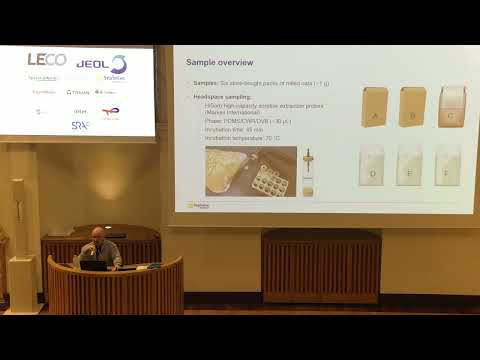
- Sample Set: Six brands of store-bought rolled oats in different packaging types.
- Extraction: High-capacity headspace sorptive extraction (HiSorb probes).
- Analysis: GC×GC–TOF MS with INSIGHT-Flow modulation.
- Data Processing: Tile-based chemometric workflows using ChromCompare+.
This method enabled detection of over 100,000 unique features across triplicate runs of each sample, offering an in-depth look at trace-level volatiles.
Key Findings
Packaging Influences Volatile Profiles
- Principal Component Analysis (PCA) showed clustering based on packaging type.
- Notable compounds linked to packaging materials:
- 2-Ethyl hexanol – elevated in cardboard-packaged oats.
- Triacetin – dominant in one plastic-packaged sample.
- Styrene, α-methylstyrene – linked to cardboard.
- 1-Ethoxy-2-propanol – elevated in plastic packaging.
Confirmed by Direct Packaging Analysis
- 33 differentiator compounds were identified in oats.
- 25 of these were also found in the packaging, confirming migration.
- Volatile contamination likely originated from coatings, adhesives, or printing materials.
New Tool: Smart Subtract® for Rapid Comparison
To address the need for faster industrial troubleshooting, SepSolve introduced Smart Subtract®, a spectral subtraction tool that:
- Removes background noise and minor peak differences.
- Highlights only the key discriminating compounds.
- Supports direct library searching and faster decision-making in quality control.
When comparing two plastic-packaged brands, Smart Subtract isolated chlorinated solvents and other volatiles responsible for aroma taints—dramatically reducing analysis time.
Conclusion
This study demonstrates how headspace sorptive extraction and GC×GC–TOF MS enable:
- Detailed profiling of food volatiles.
- Effective identification of migration from packaging materials.
- Improved understanding for safer and more sustainable packaging design.
Combined with tile-based chemometrics and Smart Subtract®, this approach is suitable for both research and fast industrial diagnostics.
This text has been automatically transcribed from a video presentation using AI technology. It may contain inaccuracies and is not guaranteed to be 100% correct.
-Workshop-LOGO_s.webp)