

Sample preparation & GC×GC-MS for new energy materials wastes analysis (Giulia Giacoppo, MDCW 2025)
- Photo: MDCW: ONE-STEP MICROWAVE-ASSISTED EXTRACTION AND DERIVATIZATION FOLLOWED BY COMPREHENSIVE TWO-DIMENSIONAL CHROMATOGRAPHY COUPLED WITH FLAME IONIZATION DETECTOR TO FAMEs ANALYSIS IN COMPLEX FOOD MATRICES (Giulia Giacoppo, MDCW 2025)
- Video: LabRulez: Giulia Giacoppo: Sample preparation & GC×GC-MS for new energy materials wastes analysis (MDCW 2025)
🎤 Presenter: Giulia Giacoppo (University of Ferrara, Ferrara, Italy / International Joint Laboratory – iC2MC, Harfleur, France)
💡 Book in your calendar: 17th Multidimensional Chromatography Workshop (MDCW) 13 - 15. January 2026
Abstract
The goal of this project was to develop analytical solutions to understand better the recycling of chemicals and valuable materials from wind turbine blades, addressing the need for sustainable end-of-life solutions for renewable energy infrastructure.
Wind turbine blades underwent solvolysis treatments for 8 and 13 hours. The resulting solvolysis mixtures, referred to as solvolysis soups, with highly basic pH levels, were neutralized. Afterwards, while the solid phases were directly processed after neutralization, the liquid phases needed an additional filtration step to remove solid residues from them.
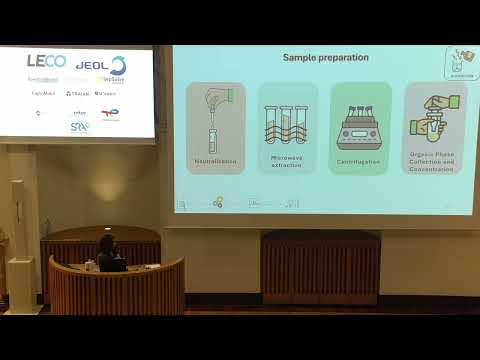
Microwave-assisted extraction (MAE) was performed on the products of these procedures using a hexane-methanol solvent mixture (10:3 ratio), followed by water addition (2.5 ratio) and centrifugation. Subsequently, the organic phase was collected, concentrated, and analyzed using comprehensive two-dimensional gas chromatography coupled with time-of-flight mass spectrometry (GC×GC-TOFMS). The system was equipped with a non-polar column in the first dimension and a medium-polar column in the second dimension, connected with a cryogenic modulator.
Identification was achieved through mass spectral electron ionization (EI) database matching at 70 eV (≥800/1000) and the Linear Retention Index (LRI) window within ±20, based on non-polar 1D-GC LRI data from the NIST database and literature. The location of the investigated molecules on the 2D-GC plane was also considered.
Due to this MAE-GC×GC-MS technique, it was possible to identify approximately 60 molecules from various chemical classes, including aromatic compounds, and nitrogen- and oxygen-containing compounds.
Video transcription
🌍 Context & Importance
- Climate change and environmental degradation drive Europe’s Green Deal, which emphasizes circularity and sustainability.
- Wind energy plays a key role in the energy transition, but its waste output is expected to grow rapidly in coming years.
- Wind turbine blades—made from complex composite materials—pose a recycling challenge, especially due to variation in materials across manufacturers.
♻️ Recycling Challenges
- Up to 90% of a wind turbine is recyclable; however, blades remain problematic due to their composition (glass/carbon fibers, resins).
- Currently, most end-of-life blades go to landfills, though methods like mechanical, thermal, and chemical recycling are under evaluation.
- A key obstacle: lack of analytical characterization of by-products from recycling processes.
🔬 Research Aim
- Evaluate chemical composition of recycled blade materials using GC×GC‑TOF-MS.
- Compare two processes:
- Solvolysis
- Pyrolysis
🧪 Solvolysis Study
- Blades from TotalEnergies were subjected to solvolysis, producing liquid and solid fractions.
- Samples were complex, requiring:
- Microwave-assisted extraction with solvent mixtures.
- Centrifugation and concentration, followed by GC×GC-TOF-MS analysis.
- Identified ~120 analytes, including:
- Aromatic compounds (potentially valuable)
- O/N-containing compounds (problematic: corrosive, catalyst poisoning)
- Method was statistically robust (CV <15% in most cases).
- Most analyte concentrations were not significantly different between liquid and solid phases.
🔥 Pyrolysis Study
- Pyrolysis oil was chemically complex and unstable (acidic, reactive).
- Developed fractionation protocol using various SPE cartridges (e.g., silica).
- Elemental analysis showed:
- One fraction rich in aromatics and hydrocarbons.
- Another fraction concentrated oxygen and nitrogen species, which are undesirable in recycling.
- GC×GC analysis with normal and reverse phase columns allowed detailed chemical profiling.
🎯 Conclusions
- Sample preparation is critical for analyzing and valorizing recycled materials.
- These methods support:
- More efficient recycling strategies
- Alignment with European Green Deal goals
- Enhanced understanding of chemical risks and opportunities in wind blade recycling.
This text has been automatically transcribed from a video presentation using AI technology. It may contain inaccuracies and is not guaranteed to be 100% correct.
-Workshop-LOGO_s.webp)


