News from LabRulezGCMS Library - Week 15, 2025
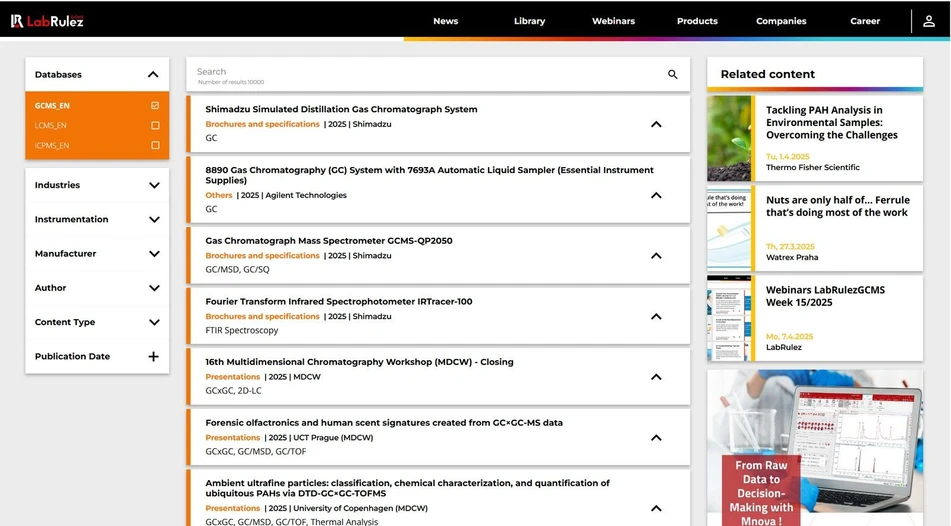
LabRulez: News from LabRulezGCMS Library - Week 15, 2025
Our Library never stops expanding. What are the most recent contributions to LabRulezGCMS Library in the week of 7th April 2025? Check out new documents from the field of the gas phase, especially GC and GC/MS techniques!
👉 SEARCH THE LARGEST REPOSITORY OF DOCUMENTS ABOUT GCMS AND RELATED TECHNIQUES
👉 Need info about different analytical techniques? Peek into LabRulezLCMS or LabRulezICPMS libraries.
This week we bring you brochures by Agilent Technologies, Shimadzu, application note by Thermo Fisher Scientific and poster by University of Liège / MDCW!
1. Agilent Technologies: Ensure Composition, Purity, and Calorific Value
Agilent natural gas analyzers
- Brochure
- Full PDF for download
Produce Accurate, Reliable Data and Maximize Product Quality
Before it can be sold, natural gas must meet specifications for calorific value and purity. Accordingly, collection, processing, transmitting, and distribution require an array of analytical capabilities.
Confidently measure permanent gases and hydrocarbon content with Agilent natural gas analyzers
Agilent natural gas analyzers (NGAs) are based on Agilent 8890 GC or 990 Micro GC systems. Each is factory configured and chemically tested to deliver the results you need, fast, while saving you precious startup time.
Choose from standard or extended configurations, or for a solution for sour natural gas. Our ability to create custom analyzers, along with specialty hardware and modifications, allows you to customize a natural gas analyzer for your specific needs.
Agilent 8890 fast GC
Precisely analyze natural gas
Separating complex mixtures of hydrocarbons and permanent gases (oxygen, nitrogen, and carbon dioxide) can be difficult on a single-channel GC. The Agilent 8890 natural gas analyzer is configured for one or two channels and conforms to ASTM D1945, GPA 2261, and GPA 2286 methods.
- A second thermal conductivity detector (TCD) channel improves hydrogen detection and linearity.
- Optional flame ionization detector (FID) enables low-level hydrocarbon analysis.
- Customized reporting simplifies data review and processing. OpenLab CDS reporting provides calculations in mole, weight, or volume percentages, and calculated heat content. It also offers the calorific value add-on.
Agilent 990 Micro GC
Precision results in seconds
Agilent 990 Micro GC natural gas analyzers cover key GPA, ISO, and GB/T methods, and they provide accurate compositional data and calculated physical properties. Their small size and mobility make them ideal for labs, pilot plants, and field work—delivering the information you need anytime, anywhere.
- Ready-to-go configuration and methods include proven hardware and software.
- Reporting is based on standardized GPA, ISO, and GB/T calculation methods.
- Options include sample pressure reduction, filtering, and automated stream selection valves.
- Natural gas odorant monitoring is available in an optional extra channel.
Additionally, the Agilent 990 Micro GC PRO is designed for online process environments and features onboard data collection, integration, and result generation.
- Control processes by directing automatic user-defined information to an external system.
- Eliminate the need for an external computer by using our onboard setup feature.
- Meet industry standards with confidence through various communication protocols, such as Modbus, FTP, and 4-20 mA.
- Enable online monitoring of calorific value and odorants (such as THT or DMS).
- Deliver quick analysis of dissolved gases in mud-logging during drilling operations that need to be constantly monitored.
Agilent GC gasifier
Reliably introduce liquefied gas into your GC
The Agilent GC gasifier accessory safely controls the transition of liquefied gas to a gaseous state without discrimination or adsorption due to its inert flow path. So you can feel confident that the sample in the line is the sample being analyzed.
- Samples are delivered to the GC system under constant flow and pressure.
- Control and monitor the gasifier with ease through the GC user interface.
- Seamlessly switch between two samples—or one sample plus a calibration standard or purge gas.
- Purge N2 gas without the need to disconnect samples
Capture, analyze, and share data: OpenLab CDS works the way you do
OpenLab CDS is a chromatography data system that combines productivity, usability, and the highest level of data integrity. With a single user interface, you can control your Agilent LC, GC, Micro GC, single quadrupole LC/MS, and GC/MS, as well as other vendors’ instruments in the lab, to streamline training and support. Built-in tools provide time-saving steps in analysis, interpretation, and reporting workflows while technical controls ensure work quality, effective records management, and enhanced data security.
Reporting for natural gas analyzers (as with refinery gas analyzers) can be done through OpenLab CDS with the built-in NGA/RGA reporting tool or through Diablo Analytical, which can take data from OpenLab CDS, ChemStation or EZChrom.
The OpenLab reporting feature for NGA lets you generate a custom calculation file, a constants file, and a report template for conditions defined in GPA, ASTM, or ISO standards. FPS (foot-pound-second)- based calculations (Btu) are used by GPA, ASTM, and other organizations in the United States. Metric-based calculations (meter-kilogram-second) are used for reporting natural gas composition and physical property calculations according to ISO 6976 for EU and GB/T 11062 for China.
Note: Optionally the 990 Micro GC can be equipped with a PRO license. In this process-mode, which is usually highly automated and unattended, the instrument communicates compositional analysis results and calculated physical property data directly to a remote process computer. All data is handled on board (via browser-based access), and this does not require OpenLab CDS.
2. University of Liège / MDCW: Identification of Antifungal Volatile Organic Compounds (Vocs) from Streptomyces Scabiei 87-22 Using GC×GC-TOF-MS
- Poster
- Full PDF for download
Plant pathogens harm food production and the economy, while synthetic fungicides pose health and environmental risks, emphasizing the need for new alternatives.1 Streptomyces scabiei 87-22 shows promises by producing antifungal volatile organic compounds (VOCs). This study seeks to identify the VOCs responsible for their antifungal effects, with the aim to open the door to developing environmentally friendly biofungicides.2
Study inception
- In vitro experiments were conducted on Alternaria solani, Gibberella zeae, and Penicillium sp. NS1 to assess antifungal activity
- Different growth conditions of Streptomyces scabiei 87-22 were evaluated
- using five culture media: MHB, LB, TSB, ISP2, and ISP6
Results and discussion
- 20 Antifungal VOCs were identified in the different samples
- VOCs production depend on the culture media
- Some VOCs are inherent to the culture media
- Non targeted approach is needed
Conclusion and perspectives
Out of 25 identified VOCs, 4 demonstrated antifungal activity in vitro, highlighting their potential as antifungal agents. Conduct antifungal tests on the remaining 19 VOCs to fully evaluate their potential. Extend the study to a broader range of bacterial strains to assess their antimicrobial spectrum.
3. Shimadzu: Gas Chromatography Detector VGA-100 / VGA-101
- Brochure
- Full PDF for download
Meet the alternative with a vacuum ultraviolet (VUV) detector for Gas Chromatography
The VUV (Vacuum Ultraviolet) detector is designed to collect absorption spectrum of compounds eluted from GC in the wavelength range of 120 nm to 240 nm (vacuum ultraviolet region). It consists of a deuterium lamp, ¬ow cell, grating device and detection device. Hydrocarbons, such as fuels, have strong absorption in the range of 115 nm to 185 nm (due to σ→σ* and π→→π* transitions), making the VUV detector an ideal choice for fuel analysis.
The VUV wavelength region is typically characterized by signi cant background absorption. Traditionally, very high-energy photons generated by a synchrotron facilities were used to obtain VUV spectrum. The VGA-100/101 VUV detector minimizes background absorption to an exceptional degree, enabling easy acquisition of VUV spectrum.
Gas Chromatography detection in a whole new light
VUV analysis system offers…
- Identification performance specialized for fuel analysis
- Full spectrum detection in the vacuum ultraviolet (VUV) wavelength region enhances identi cation performance of various hydrocarbon compounds.
- Excellent oven performance of the Nexis GC-2030 improves identi cation performance with retention index.
- Full compliance with ASTM official standards
- A multi-method architecture that allows testing of different fuels and methods on the same analyzer without changing hardware.
- Dedicated spectral libraries for various ASTM of cial methods
- Enhanced analysis support functions
- Time Interval Deconvolution™ (TID™) to easily deconvolve co-eluting analytes.
- Push-button, automated data analysis and reporting using VUV Analyze™ Software.
4. Thermo Fisher Scientific: Thermo Scientific Orbitrap GC-MS HRAM Flavor and Fragrances Library
- Application note
- Full PDF for download
Flavors and fragrances analysis aims to give a comprehensive characterization of samples to determine their origin (natural or synthetic), assess their quality, ensure product consistency, and comply with regulatory standards. This analysis is crucial for industries such as food, beverages, cosmetics, and perfumery to develop and maintain consistent product formulations and control. With such a high number of possible compounds, a library is an essential tool to support compound identification within a fast time frame. The Thermo Scientific™ Orbitrap™ GC-MS Flavor and Fragrances Library is a high-resolution, accuratemass (HRAM) spectral library for electron ionization (EI) GC-MS. It contains 411 compounds, which cover over eleven different chemical classes.
When used in combination with powerful Orbitrap technology and data processing tools such as Thermo Scientific™ Compound Discoverer™ software, accurate flavor and fragrance identification can be quickly achieved. The Thermo Scientific™ Orbitrap Exploris™ GC mass spectrometers provide unique advantages for flavor and flagrance analysis over alternative instrumental techniques. Orbitrap technology allows analytical chemists to gain data certainty and achieve unprecedented selectivity using a full-scan acquisition, enabling:
- The targeting of an unlimited number of analytes down to triple quadrupole level detection limits
- Identification of unknowns driven by spectral matching and sub-ppm mass accuracies
- Retrospective screening of compounds not known to be of interest at time of acquisition
Furthermore, the consistent sub-ppm mass accuracy delivered by the system, regardless of peak intensity, allows for confident targeting of compounds within narrow mass accuracy windows. The Thermo Scientific Orbitrap GC-MS Flavor and Fragrances Library enables a rapid and customizable set-up of a screening method, which allows users to quickly implement this powerful technology. Included in this Library are:
- High-resolution, accurate-mass spectral library acquired at 60,000 mass resolving power (FWHM m/z 200)
- Spectra for 411 flavor compounds across eleven categories refined and curated with elemental composition of each EI fragment verified (Figure 1)
- Compound information list showing chemical categories, odors, rendition index values, and GC column types used
- Kovats retention index entries
- Can be used in combination with existing unit mass libraries.
The Orbitrap GC-MS Flavor and Fragrances Library can be used to quickly apply the theoretical masses for each analyte into a Thermo Scientific™ TraceFinder™ software fullscan screening or quantitation processing method. Also included for each compound is an accurate mass reference spectrum acquired on an Orbitrap GC-MS system at 60,000 resolving power.
This spectral library can be used as a standalone reference or in conjunction with the unknowns screening functionality of Compound Discoverer software (Figures 2 and 3) or TraceFinder software. Each software utilizes chromatographic deconvolution followed by accurate mass spectral library search to identify untargeted compounds.