GCMS
More information
WebinarsAbout usContact usTerms of use
LabRulez s.r.o. All rights reserved. Content available under a CC BY-SA 4.0 Attribution-ShareAlike
Author
LabRulez
LabRulez
Everything from the world of analytical chemistry in one place. We connect people in solving their problems. At Labrulez you will find all the necessary information easily, quickly and clearly. Stop searching and start finding.
Tags
Article
Application
Poster
LinkedIn Logo

News from LabRulezGCMS Library - Week 14, 2025
We, 2.4.2025
| Original article from: LabRulezGCMS Library
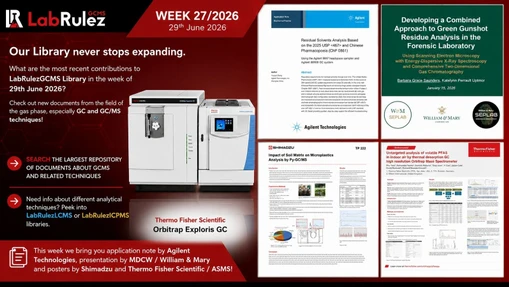
This week we bring you application notes by Agilent Technologies and Shimadzu and poster by GC Image / MDCW!
<p><strong>LabRulez:</strong> News from LabRulezGCMS Library - Week 14, 2025</p>

LabRulez: News from LabRulezGCMS Library - Week 14, 2025

Our Library never stops expanding. What are the most recent contributions to LabRulezGCMS Library in the week of 31th March 2025? Check out new documents from the field of the gas phase, especially GC and GC/MS techniques!

👉 SEARCH THE LARGEST REPOSITORY OF DOCUMENTS ABOUT GCMS AND RELATED TECHNIQUES

👉 Need info about different analytical techniques? Peek into LabRulezLCMS or LabRulezICPMS libraries.

This week we bring you application notes by Agilent Technologies and Shimadzu and poster by GC Image / MDCW!

1. Agilent Technologies: Navigating Global Microplastics Regulations in Drinking Water with Vibrational Spectroscopy

Ensuring accurate and reliable microplastics characterization with the 8700 LDIR

Access to clean and safe drinking water is a fundamental human right and a critical public health priority. With growing concerns about environmental pollution, emerging contaminants such as microplastics have become a major focus for regulatory bodies worldwide. Microplastic particles, originating from sources such as industrial waste, packaging, and everyday consumer products, have been detected in diverse water sources, raising concerns about both their potential health risks and environmental impact.

The accurate and reliable characterization of microplastics presents significant analytical challenges due to the diversity in size, shape, and composition of these materials. Particles range from less than 20 µm to visible fragments and can exist in various forms including spheres, fibers, and irregular shapes. Microplastics are typically composed of various types of polymer, each with distinct physical and chemical properties and unique degradation histories. Because of this complexity, analyzing microplastics requires advanced analytical techniques. 

To address these challenges, regulatory bodies and standardization organizations have actively been developing guidelines and testing methods to monitor and control microplastics contamination in drinking water. The analytical techniques used to characterize microplastics are critical in achieving accurate and reliable outcomes when studying the impact of this emerging class of contaminant. The primary techniques used to analyze microplastics fall into two categories: 

  • Thermo-analytical methods such as thermal extraction desorption gas chromatography-mass spectrometry (TED-GC/MS) and pyrolysis-GC/MS, which provide information about polymer type and mass1 
  • Vibrational spectroscopy methods including Fourier transform infrared (FTIR) spectroscopy and Raman spectroscopy, which provide information about polymer type, number of particles, and size

There has been an ongoing effort for several years to standardize methods for microplastic analysis using vibrational spectroscopy. These standard methods provide structured approaches that help to ensure consistent, accurate, and reproducible microplastics analysis across different laboratories and regulatory environments. 

Three such regulatory frameworks have been established by the following bodies: 

  • Commission Delegated Decision (EU) 2024/1441: Supplementing Directive (EU) 2020/2184 of the European Parliament and of the Council by laying down a methodology to measure microplastics in water intended for human consumption.2
  • California Water Boards: Policy handbook establishing a standard method of testing and reporting of microplastics in drinking water, August 9, 2022.3 The policy handbook was developed in response to State of California legislation (SB1422) requiring monitoring for microplastics. As noted in the introductory text, the method is designed to "[set] forth the requirements for conducting monitoring and reporting of microplastics in drinking water." Attachment C to that document (SWB-MP1-rev1) is a Standard Operating Procedure that describes the method as relevant to IR techniques.4 
  • ISO/DIS 16094-2: Water Quality — Analysis of Microplastic in Water, Part 2: Vibrational spectroscopy methods for waters with low content of suspended solids including drinking water (under development).5 

ASTM WK87463 (New Test Method for Spectroscopic Identification and Quantification of Microplastic Particles in Water Using Infrared (IR) Spectroscopy) is also under development. As this method has not yet been published, it is not covered by this white paper.6

Requirements of regulatory methods

Minimum and maximum particle size 

It is necessary to check the accuracy of any particle-sizing data generated by the analytical method used for the analysis of microplastics. The three regulatory frameworks summarized in Table 1 specify a minimum detectable particle size of 10 to 20 µm using IR spectroscopy. 

To demonstrate the performance of the 8700 LDIR, 10, 20, and 50 µm NIST-traceable polystyrene latex beads were measured on a low-e slide. As shown in Figure 5, particles were detected using the automated Particle Analysis workflow within the Clarity software. The method also correctly identified the type of particles, with a hit quality index (HQI) of > 0.95, demonstrating the characterization capabilities of LDIR for particles as small as 10 µm. Additional details on particle sizing using gold- and aluminum-coated filters are available in other publications.8,9

As stated in Table 1, the maximum required measurement size across the three regulatory frameworks is 5 mm for particles and 15 mm for fibers per EU 2024/1441. While LDIR analyzes particles up to 500 µm, larger particles can be detected visually and measured using an Agilent Cary 630 FTIR spectrometer fitted with a diamond attenuated total reflectance (ATR) module (Figure 6). A fast and simple method for identifying plastic debris in this size range is reported elsewhere.10

Conclusion 

Microplastics are widespread in the environment, exhibiting significant variation in size, shape, color, and composition, which complicates their analysis. To address these challenges, current regulatory frameworks and emerging analytical methods offer flexibility in sampling equipment, instrumentation, and data analysis techniques, provided they meet the required analytical standards. The aim of the standardized methods is to improve the accuracy and comparability of microplastic assessments. In addition to thermo-analytical methods and vibrational spectroscopy techniques such as μ-FTIR and μ-Raman, quantum cascade laser-based IR technology has proven to be a suitable technique for microplastic analysis. This white paper demonstrates how an Agilent 8700 LDIR chemical imaging system combined with Agilent Clarity software meets the requirements of the three global regulatory frameworks, enabling accurate microplastics characterization. The laser-based system offers a fully automated workflow for the direct filter-based analysis of microplastics, resulting in significant time savings and higher sample throughput compared to conventional vibrational spectroscopy techniques.

2. Shimadzu: Analysis of Neutral PFAS in Ambient Air Using Thermal Desorption GC-MS

User Benefits:

  • A thermal desorptionGC-MS system can accurately measure quantities of volatile and semivolatile per- and polyfluoroalkyl
    substances (PFAS) in ambient air.
  • The TD-30R thermal desorption system can perform high-throughput analysis as it does not require solvent extraction

Because of the excellent heat-resistance and water-repelling properties of per- and polyfluoroalkyl substances (PFAS), they are used in many consumable products and industrial applications. However, their resistance to degradation and concerns over their persistence in the environment and toxicity to organisms mean they are increasingly regulated throughout the world. As one of the pollution routes of PFAS, the atmospheric dispersion of PFAS exhaust gas emitted from factories using PFAS is a concern. Therefore, monitoring studies have been conducted considering the risk of long-term exposure of PFAS to the respiratory system and the spread of PFAS pollution from atmosphericdispersion of PFAS. 

Because of the tightening of PFAS regulations, analytical methods are being developed for a variety of matrices, including water, soil, and food. While most of these methods target non-volatile (ionic) PFAS and use a liquid chromatograph-mass spectrometer (LC-MS/MS), volatile or semivolatile neutral PFAS are not easily measured by these methods, so a gas chromatograph-mass spectrometer (GC-MS) is suitable forthose compounds. 

In this Application News, the TD-30R thermal desorption system coupled to a GC-MS system (GCMS-QP2020 NX) measured the quantities of nine volatile and semivolatile neutral PFAS (Table 1) in ambient air.

Spike-and-Recovery Test with Ambient Air 

Standard solutions were prepared containing 10 ng of four FTOHs and 1 ng of three FTACs and two FOSAs and these standard solutions were added to the Tenax TA/Carboxen 1000 sample tubes. 20 L of ambient air was also collected at 100 mL/min. Spike-and-recovery test and repeatability results are shown in Table 5 and SIM chromatograms are shown in Fig. 3. The recovery rates were between 77 and 106 % and all concentration %RSD (n = 3) were below 8, showing generally good performance.

Conclusion 

The TD-30R and GCMS-QP2020 NX were used to measure quantities of nine neutral PFAS in ambient air. The measurements of standards demonstrated favorable results for sensitivity, calibration curve linearity, and repeatability for all the targeted compounds. A spike-and-recovery test with ambient air also demonstrated favorable results for recovery and repeatability. Using the TD-30R during sample pretreatment allows the sampling tube to be analyzed directly without a solvent extraction, enabling high-throughput analysis.

3. GC Image / MDCW: Interactive Ion Peak Analysis and Differencing for Comparing Multidimensional Chromatography Data

Comprehensive two-dimensional chromatography offers superior separation capabilities for complex mixtures, but the resulting data complexity necessitates advanced comparative analysis methods. A common scenario involves comparing two samples to identify similarities and differences. We demonstrate our methods through two applications including performing new peak detection (NPD) [1] for LC-MS data of peptide samples, and identifying and comparing common and unique compounds from pairs of GCxGC-MS chromatograms.

Approach 2: Ion Peak Matching 

  • Find bidirectional matching between detections in both chromatograms 
  • Matching criteria: matched apex within RT tolerance, matching detection ion m/z or spectral match of >750 
Data Set 
  • GCxGC-TOFMS public data set of different dark chocolates [5]. Mint-Lime and Orange flavors are used for this demonstration. The figures presented all have MintLime on the left and Orange on the right. 
  • JEOL AccuTof GC+ mass spectrometer with an Agilent 7890 GC
Unique Peaks Filter

Significant unique ion peaks are shown using filters:

  • ‘Unmatched’ status
  • SNR > 150
Common Peaks Filter 

Common ion peaks are shown are shown with the ‘In Both’ filter. The figure to the left shows common peaks that have a significant response difference. Filtering was done using > +200% change and < -50% change. 

Peak Comparison 

Common compounds are matched and allow comparison between the images. The compound response values, properties, and spectra can be viewed for both samples. Unique compounds are viewed and identified, with the SIC view used to analyze the alternate chromatogram at the RT location and ion ranges.
 

LabRulez
LinkedIn Logo
 

Related content

Analysis of Aroma Components in Apples Using the Smart Aroma Database

Applications
| 2026 | Shimadzu
Instrumentation
GC/MSD, GC/SQ, HeadSpace
Manufacturer
Shimadzu
Industries
Food & Agriculture

Analysis of Acetaldehyde and Limonene in Recycled PET Using an HS-GCMS System (Carrier Gas: H2)

Applications
| 2026 | Shimadzu
Instrumentation
GC/MSD, GC/SQ, HeadSpace
Manufacturer
Shimadzu
Industries
Energy & Chemicals

What Causes GC Capillary Column Performance Degradation, and How Can I Prevent It?

Technical notes
| 2026 | Agilent Technologies
Instrumentation
Consumables, GC columns
Manufacturer
Agilent Technologies
Industries
Other

Aromatic Component Analysis of Gasoline According to ASTM D5580 Using the Brevis GC- 2050 Gas Chromatograph

Applications
| 2025 | Shimadzu
Instrumentation
GC
Manufacturer
Shimadzu
Industries
Energy & Chemicals

Micro GC Analysis of Permanent Gas Impurities in PEM Fuel Cell-Grade Hydrogen

Applications
| 2025 | Agilent Technologies
Instrumentation
GC
Manufacturer
Agilent Technologies
Industries
Energy & Chemicals
 

Related articles

Webinars LabRulezGCMS Week 07/2026
Article | Webinars

Webinars LabRulezGCMS Week 07/2026

3 webinars: AI in manufacturing, fermentation, functional food, mAb production, metabolite monitoring, process Raman, process analytics
LabRulez
tag
share
more
QuEChERS Combined with Low-Temperature Partitioning and GC–MS as an Analytical Strategy for the Determination of Multiclass Pesticide Residues in Cocoa Beans
Scientific article | Science and research

QuEChERS Combined with Low-Temperature Partitioning and GC–MS as an Analytical Strategy for the Determination of Multiclass Pesticide Residues in Cocoa Beans

This study combines QuEChERS and low-temperature partitioning with GC–MS to determine multiclass pesticide residues in cocoa beans with good sensitivity and recoveries.
LabRulez
tag
share
more
ISC 2026 Short Course 3 - Interpretation of Mass Spectra: Basic Introduction for Chromatographers
Article | Events

ISC 2026 Short Course 3 - Interpretation of Mass Spectra: Basic Introduction for Chromatographers

Short Course 3 at ISC 2026 offers a practical introduction to LC–MS spectral interpretation for chromatographers, covering ESI, APCI, APPI, adducts, isotope patterns, and MS/MS fundamentals.
International Symposium on Chromatography - (ISC)
tag
share
more
Eurachem/CITAC Workshop on Quality in Analytical Measurements 2026
Article | Events

Eurachem/CITAC Workshop on Quality in Analytical Measurements 2026

Eurachem Week 2026 brings training and workshops on measurement uncertainty, quality in analytical measurements, and results interpretation, combining theory, practical cases, and expert-led discussions.
Eurachem
tag
share
more
 

Related content

Analysis of Aroma Components in Apples Using the Smart Aroma Database

Applications
| 2026 | Shimadzu
Instrumentation
GC/MSD, GC/SQ, HeadSpace
Manufacturer
Shimadzu
Industries
Food & Agriculture

Analysis of Acetaldehyde and Limonene in Recycled PET Using an HS-GCMS System (Carrier Gas: H2)

Applications
| 2026 | Shimadzu
Instrumentation
GC/MSD, GC/SQ, HeadSpace
Manufacturer
Shimadzu
Industries
Energy & Chemicals

What Causes GC Capillary Column Performance Degradation, and How Can I Prevent It?

Technical notes
| 2026 | Agilent Technologies
Instrumentation
Consumables, GC columns
Manufacturer
Agilent Technologies
Industries
Other

Aromatic Component Analysis of Gasoline According to ASTM D5580 Using the Brevis GC- 2050 Gas Chromatograph

Applications
| 2025 | Shimadzu
Instrumentation
GC
Manufacturer
Shimadzu
Industries
Energy & Chemicals

Micro GC Analysis of Permanent Gas Impurities in PEM Fuel Cell-Grade Hydrogen

Applications
| 2025 | Agilent Technologies
Instrumentation
GC
Manufacturer
Agilent Technologies
Industries
Energy & Chemicals
 

Related articles

Webinars LabRulezGCMS Week 07/2026
Article | Webinars

Webinars LabRulezGCMS Week 07/2026

3 webinars: AI in manufacturing, fermentation, functional food, mAb production, metabolite monitoring, process Raman, process analytics
LabRulez
tag
share
more
QuEChERS Combined with Low-Temperature Partitioning and GC–MS as an Analytical Strategy for the Determination of Multiclass Pesticide Residues in Cocoa Beans
Scientific article | Science and research

QuEChERS Combined with Low-Temperature Partitioning and GC–MS as an Analytical Strategy for the Determination of Multiclass Pesticide Residues in Cocoa Beans

This study combines QuEChERS and low-temperature partitioning with GC–MS to determine multiclass pesticide residues in cocoa beans with good sensitivity and recoveries.
LabRulez
tag
share
more
ISC 2026 Short Course 3 - Interpretation of Mass Spectra: Basic Introduction for Chromatographers
Article | Events

ISC 2026 Short Course 3 - Interpretation of Mass Spectra: Basic Introduction for Chromatographers

Short Course 3 at ISC 2026 offers a practical introduction to LC–MS spectral interpretation for chromatographers, covering ESI, APCI, APPI, adducts, isotope patterns, and MS/MS fundamentals.
International Symposium on Chromatography - (ISC)
tag
share
more
Eurachem/CITAC Workshop on Quality in Analytical Measurements 2026
Article | Events

Eurachem/CITAC Workshop on Quality in Analytical Measurements 2026

Eurachem Week 2026 brings training and workshops on measurement uncertainty, quality in analytical measurements, and results interpretation, combining theory, practical cases, and expert-led discussions.
Eurachem
tag
share
more
 

Related content

Analysis of Aroma Components in Apples Using the Smart Aroma Database

Applications
| 2026 | Shimadzu
Instrumentation
GC/MSD, GC/SQ, HeadSpace
Manufacturer
Shimadzu
Industries
Food & Agriculture

Analysis of Acetaldehyde and Limonene in Recycled PET Using an HS-GCMS System (Carrier Gas: H2)

Applications
| 2026 | Shimadzu
Instrumentation
GC/MSD, GC/SQ, HeadSpace
Manufacturer
Shimadzu
Industries
Energy & Chemicals

What Causes GC Capillary Column Performance Degradation, and How Can I Prevent It?

Technical notes
| 2026 | Agilent Technologies
Instrumentation
Consumables, GC columns
Manufacturer
Agilent Technologies
Industries
Other

Aromatic Component Analysis of Gasoline According to ASTM D5580 Using the Brevis GC- 2050 Gas Chromatograph

Applications
| 2025 | Shimadzu
Instrumentation
GC
Manufacturer
Shimadzu
Industries
Energy & Chemicals

Micro GC Analysis of Permanent Gas Impurities in PEM Fuel Cell-Grade Hydrogen

Applications
| 2025 | Agilent Technologies
Instrumentation
GC
Manufacturer
Agilent Technologies
Industries
Energy & Chemicals
 

Related articles

Webinars LabRulezGCMS Week 07/2026
Article | Webinars

Webinars LabRulezGCMS Week 07/2026

3 webinars: AI in manufacturing, fermentation, functional food, mAb production, metabolite monitoring, process Raman, process analytics
LabRulez
tag
share
more
QuEChERS Combined with Low-Temperature Partitioning and GC–MS as an Analytical Strategy for the Determination of Multiclass Pesticide Residues in Cocoa Beans
Scientific article | Science and research

QuEChERS Combined with Low-Temperature Partitioning and GC–MS as an Analytical Strategy for the Determination of Multiclass Pesticide Residues in Cocoa Beans

This study combines QuEChERS and low-temperature partitioning with GC–MS to determine multiclass pesticide residues in cocoa beans with good sensitivity and recoveries.
LabRulez
tag
share
more
ISC 2026 Short Course 3 - Interpretation of Mass Spectra: Basic Introduction for Chromatographers
Article | Events

ISC 2026 Short Course 3 - Interpretation of Mass Spectra: Basic Introduction for Chromatographers

Short Course 3 at ISC 2026 offers a practical introduction to LC–MS spectral interpretation for chromatographers, covering ESI, APCI, APPI, adducts, isotope patterns, and MS/MS fundamentals.
International Symposium on Chromatography - (ISC)
tag
share
more
Eurachem/CITAC Workshop on Quality in Analytical Measurements 2026
Article | Events

Eurachem/CITAC Workshop on Quality in Analytical Measurements 2026

Eurachem Week 2026 brings training and workshops on measurement uncertainty, quality in analytical measurements, and results interpretation, combining theory, practical cases, and expert-led discussions.
Eurachem
tag
share
more
 

Related content

Analysis of Aroma Components in Apples Using the Smart Aroma Database

Applications
| 2026 | Shimadzu
Instrumentation
GC/MSD, GC/SQ, HeadSpace
Manufacturer
Shimadzu
Industries
Food & Agriculture

Analysis of Acetaldehyde and Limonene in Recycled PET Using an HS-GCMS System (Carrier Gas: H2)

Applications
| 2026 | Shimadzu
Instrumentation
GC/MSD, GC/SQ, HeadSpace
Manufacturer
Shimadzu
Industries
Energy & Chemicals

What Causes GC Capillary Column Performance Degradation, and How Can I Prevent It?

Technical notes
| 2026 | Agilent Technologies
Instrumentation
Consumables, GC columns
Manufacturer
Agilent Technologies
Industries
Other

Aromatic Component Analysis of Gasoline According to ASTM D5580 Using the Brevis GC- 2050 Gas Chromatograph

Applications
| 2025 | Shimadzu
Instrumentation
GC
Manufacturer
Shimadzu
Industries
Energy & Chemicals

Micro GC Analysis of Permanent Gas Impurities in PEM Fuel Cell-Grade Hydrogen

Applications
| 2025 | Agilent Technologies
Instrumentation
GC
Manufacturer
Agilent Technologies
Industries
Energy & Chemicals
 

Related articles

Webinars LabRulezGCMS Week 07/2026
Article | Webinars

Webinars LabRulezGCMS Week 07/2026

3 webinars: AI in manufacturing, fermentation, functional food, mAb production, metabolite monitoring, process Raman, process analytics
LabRulez
tag
share
more
QuEChERS Combined with Low-Temperature Partitioning and GC–MS as an Analytical Strategy for the Determination of Multiclass Pesticide Residues in Cocoa Beans
Scientific article | Science and research

QuEChERS Combined with Low-Temperature Partitioning and GC–MS as an Analytical Strategy for the Determination of Multiclass Pesticide Residues in Cocoa Beans

This study combines QuEChERS and low-temperature partitioning with GC–MS to determine multiclass pesticide residues in cocoa beans with good sensitivity and recoveries.
LabRulez
tag
share
more
ISC 2026 Short Course 3 - Interpretation of Mass Spectra: Basic Introduction for Chromatographers
Article | Events

ISC 2026 Short Course 3 - Interpretation of Mass Spectra: Basic Introduction for Chromatographers

Short Course 3 at ISC 2026 offers a practical introduction to LC–MS spectral interpretation for chromatographers, covering ESI, APCI, APPI, adducts, isotope patterns, and MS/MS fundamentals.
International Symposium on Chromatography - (ISC)
tag
share
more
Eurachem/CITAC Workshop on Quality in Analytical Measurements 2026
Article | Events

Eurachem/CITAC Workshop on Quality in Analytical Measurements 2026

Eurachem Week 2026 brings training and workshops on measurement uncertainty, quality in analytical measurements, and results interpretation, combining theory, practical cases, and expert-led discussions.
Eurachem
tag
share
more
Other projects
LCMS
ICPMS
Follow us
More information
WebinarsAbout usContact usTerms of use
LabRulez s.r.o. All rights reserved. Content available under a CC BY-SA 4.0 Attribution-ShareAlike