News from LabRulezGCMS Library - Week 9, 2025
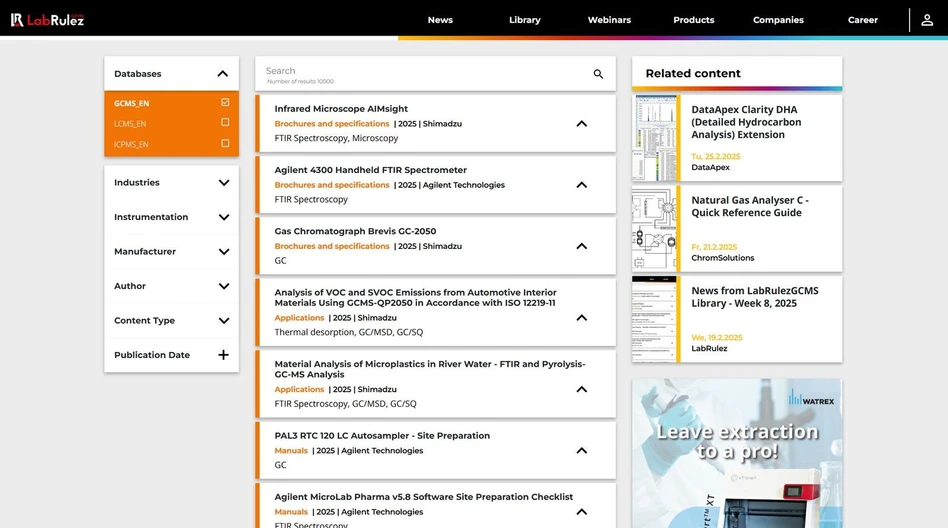
LabRulez: News from LabRulezGCMS Library - Week 9, 2025
Our Library never stops expanding. What are the most recent contributions to LabRulezGCMS Library in the week of 24th February 2025? Check out new documents from the field of the gas phase, especially GC and GC/MS techniques!
👉 SEARCH THE LARGEST REPOSITORY OF DOCUMENTS ABOUT GCMS AND RELATED TECHNIQUES
👉 Need info about different analytical techniques? Peek into LabRulezLCMS or LabRulezICPMS libraries.
This week we bring you application notes by Agilent Technologies, Knauer and Shimadzu!
1. Agilent Technologies: Analysis of 65 Volatile Organic Compounds in Ambient Air by Canister Sampling Using an Agilent 8890/5977 GC/MSD
A method using both scan and SIM mode that fully meets the requirements in the HJ 759-2023 standard
- Application note
- Full PDF for download
This application note introduces the use of a canister for gas sampling. Samples were introduced into an Agilent 8890 gas chromatograph (GC) with an Agilent 5977 single quadrupole mass selective detector (MSD) and the Markes Multi-Gas thermal desorption (TD), to analyze volatile organic compounds (VOCs) in the atmosphere or in semiconductor cleanrooms. The results of linearity, reproducibility, and detection limit fully met the requirements of the China method HJ759-2023. This method is widely used as a reference both in environmental laboratories and semiconductor cleanrooms. The linear correlation coefficient for all 65 compounds was greater than 0.991, with 86% of compounds having a value greater than 0.999. The results of reproducibility in scan mode varied between 0.3 to 6.8%, while results in SIM mode varied between 1.1 to 6.7%. The sampling volume was 300 mL, which resulted in detection limits of 0.013 to 0.113 nmol/mol for scan mode and 0.002 to 0.013 nmol/mol for SIM mode.
Experimental
This study was performed on an 8890 GC coupled to a 5977 single quadrupole GC/MSD with an electron ionization (EI) source. A Markes Multi-Gas thermal desorption sample introduction and preconcentration system was used and included three modules:
- CIA Advantage-xr (CIA): canister autosampler
- Kori-xr: water removal module
- Unity-xr: thermal desorption instrument
First, three internal standards (ISTDs) were introduced into the Unity trap by CIA. Then, the sample was passed through a heated transfer line through the CIA Advantage
into the Kori for water removal. Finally, the sample flowed into the focusing cold trap of the Unity for preconcentration. Eventually, the Unity trap was desorbed at high temperature, and the 65 VOCs and three ISTDs all entered the GC/MSD for analysis. Figure 1 shows the flow path of the combined system.
Conclusion
An Agilent 8890/5977 GC/MSD system, equipped with a Multi-Gas CIA Advantage-xr TD provides a robust analytical procedure for the analysis of 65 VOCs in ambient air. This system offers a highly efficient and highly sensitive solution for the simultaneous analysis of multiple VOCs in both atmospheric quality monitoring laboratories and semiconductor cleanrooms. Based on different application requirements, users can choose to collect data in scan or SIM mode, demonstrating the flexibility of Agilent instruments. Excellent analytical performance has been achieved based on this system both in scan and SIM mode, which fully meets the requirements detailed in method HJ 759-2023.
2. Knauer: GPC vs. SPE and subsequent determination of polycyclic aromatic hydrocarbons using GC/MS
- Application note
- Full PDF for download
Polycyclic aromatic hydrocarbons (PAHs) are ubiquitous environmental pollutants generated primarily during the incomplete combustion of organic materials. The removal of PAHs from the atmosphere by dry and wet deposition processes are strongly influenced by their gas/particle partitioning. Atmospheric deposition is a major source for PAHs in soil [1] which can be determined by various extraction and purification processes, subsequently detected by a GC/MS using the reference method UNI EN 15527. Our main purpose is to demonstrate that the purification of environmental matrix with high organic component using the gel permeation chromatography purification (AZURA GPC Cleanup, FS conditioned resins CHEX/DCM), compared to a SPE purification, allows are well-defined separation time of the analytes and it can provide narrow bands without their physical chemical interaction with the column, resulting in less chance of loss of analytes [2]. This differs from other separation techniques which depend upon chemical or physical interactions to separate analytes [3].
Conclusion
The GPC cleanup procedure of mud sludge samples prior analysis of PAHs with GC/MS technique is a good alternative to SPE purification steps. Advantages like better S/N ratios and third mass identification are obvious. The automatization of the GPC Cleanup using AZURA GPC Cleanup system yields high efficiency of the application.
3. Shimadzu: Material Analysis of Microplastics in River Water - FTIR and Pyrolysis-GC-MS Analysis
- Application note
- Full PDF for download
User Benefits
- Automated pretreatment of microplastics (MPs) reduces workload and enables highly reproducible pretreatment.
- Material analysis of MPs processed by the MAP-100 device can be easily performed by FTIR+ATR.
- Highly reproducible GC-MS analysis of MPs is possible by homogeneously pulverizing samples with Cryogenic Mill (IQ MILL-2070).
- Pyrolysis-GC-MS can measure the weight of multiple types of plastics even when they are mixed.
Microplastics (MPs) are microscopic plastic particles measuring a few µm to 5 mm in size. They are feared to have an impact on ocean pollution and ecosystems. Against this backdrop, surveys and studies on MPs in surface waters such as oceans, rivers, lakes and marshes are being conducted worldwide. Fourier Transform Infrared Spectrophotometer (FTIR) is often used for material analysis of MPs. ASTM recently published the D8401-24 standard test method for the qualitative and quantitative determination of MPs in water that uses a pyrolysis gas chromatograph mass spectrometer (Py-GC-MS). In this application news, a sample taken from a river was pretreated and analyzed for MPs using FTIR and Py-GC-MS.
Conclusion
Samples collected from river water were automatically pretreated using MAP-100, and the MPs materials were then analyzed by FTIR and Py-GC-MS. PP, PE and EVA were detected in both instruments, indicating that PP and PE are the main components (Fig. 8). Using an FTIR, individual qualitative results can be obtained easily, and the number ratios and densities can be calculated. Py-GC-MS also provides a more accurate massto material ratio (%). The system supports screening methods that take advantage of the features of each instrument, from preparation to analysis of MPs.