
LabRulez
Stop looking and start finding. We are your source for news, applications, articles, theory, job postings, e-shop or bazaar in the world of chromatography and mass spectrometry.


At LabRulez, we deliver high-resolution quantification of hydrocarbon group types in complex fuel matrices using GC×GC-FID with thermal modulation, fully compliant with ASTM D8396. This method is ideal for samples with boiling points between 36 °C and 451 °C, such as jet fuels, diesel, and synthetic blends.
✔️ Detailed profiling of n-paraffins, iso-paraffins, naphthenes, and aromatics (one-ring, two+ rings)
✔️ Custom analysis options available—targeted compounds or stream-specific reporting upon request.
This method provides precise and high-resolution profiling of hydrocarbon group types across a broad boiling range (36 °C to 451 °C). Using orthogonal GC×GC separation with polar and non-polar column chemistries, it offers unparalleled resolution of complex fuel matrices. Its performance has been validated through interlaboratory studies, making it ideally suited for quality assurance, process optimization, and regulatory compliance.
ASTM D8396 quantifies key hydrocarbon classes—n-paraffins (up to C30), iso-paraffins, naphthenes, one-ring aromatics, and two-ring plus aromatics—with excellent repeatability across diverse fuel types. Results are generated using template-based quantification, ensuring consistency and reproducibility between samples and over time.
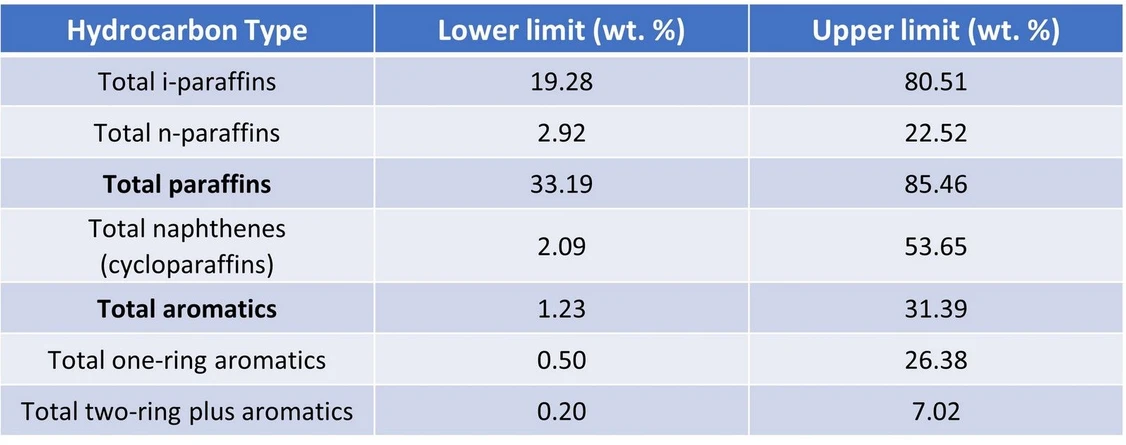 Table 1: Precision Range (wt. %)
This method may also be applied to other hydrocarbon types—such as benzene, toluene, and individual n-paraffins by carbon number—as well as alternative hydrocarbon streams. However, validated precision data is currently limited to the groups above.
Targeted component analysis (e.g., BTEX, PAHs, or carbon-specific paraffins) and customized reporting are available upon request.
 Comprehensive Hydrocarbon Group-Type Analysis by ASTM D8396 (GC×GC-FID)


