

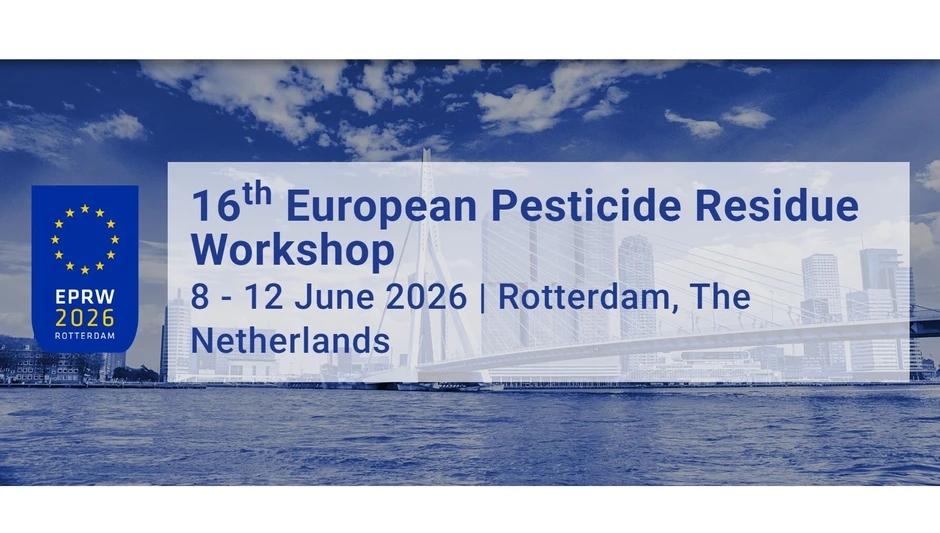
16th European Pesticide Residue Workshop (EPRW 2026)
Dear Colleagues and Friends,
On behalf of the EPRW Scientific and Organising Committee, we would like to welcome you to the 16th edition of the European Pesticide Residue Workshop (EPRW), which will take place from 8 – 12 June 2026, at the Postillion Hotel & Convention Centre WTC in the centre of Rotterdam. We are happy to celebrate the 30th anniversary of the EPRW in The Netherlands, where it all started in 1996, with the 1st EPRW, in Alkmaar.
We invite you to this key event dedicated to the latest developments in pesticide residue analysis in food, monitoring and control. Join this unique opportunity to network with 400+ renowned residue experts from around the world, specialists and authorities from governmental and private laboratories, public organisations, regulatory bodies, research institutes, food producers and distributors, pesticide manufactures and all major vendors of analytical equipment and consumables.
The main program will be preceded by a pre-workshop on Monday afternoon. Late afternoon, you are all invited to the welcome reception. The scientific program on Tuesday – Friday will consist of keynote, invited, regular, and young scientists’ oral presentations (all plenary) and poster presentations displayed throughout the conference. Vendor sessions and exhibitions are an integral part of the meeting. The exhibition, poster presentations and catering will all be ideally located on the same floor, next to the lecture hall and vendor session rooms, for an optimal interaction between the participants.
Looking forward to meeting you in the vibrant and innovating city of Rotterdam for an inspiring and exiting conference in a friendly and open atmosphere.
Hans Mol (Wageningen Food Safety Research)
EPRW 2026 Chair
André de Kok (Founder of EPRW)
EPRW 2026 Co-Chair
Registration
Registration Fees
Early Bird until 15 April 2026
- Regular Registration: 850,00€
- Student Registration*: 425,00€
- only available until 15 May 2026
- Pre-Workshop Courses**: 275,00€
- only available until 15 May 2026
- Gala Dinner**: 125,00€
- only available until 15 May 2026
Regular until 15 May 2026
- Regular Registration: 950.00€
- Student Registration*: 500.00€
- only available until 15 May 2026
- Pre-Workshop Courses**: 275.00€
- only available until 15 May 2026
- Gala Dinner**: 125.00€
- only available until 15 May 2026
Late from 16 May 2026
- Regular Registration: 1,050.00€
- Student Registration*: only available until 15 May 2026
- Pre-Workshop Courses**: only available until 15 May 2026
- Gala Dinner**: only available until 15 May 2026
The registration fees will be charged in € for all attendees and are inclusive of 21% Dutch VAT.
*Copy of student ID is required during registration process.
**The number of attendees for these events is limited. Tickets will be distributed on a first-come first-served basis.
The registration fee includes:
- Admission to all scientific sessions
- Access to the exhibition area
- Invitation to the Welcome Reception on 8 June 2026
- Refreshments and snack lunches during breaks according to the programme
- Possibility of presenting accepted oral/poster presentation
- Inclusion of the accepted oral/poster abstract in the Book of Abstracts
- EPRW 2026 Book of Abstracts
- Access to the PDF file of the “EPRW 2026 Book of Abstracts”
- Certificate of Participation
Abstract Submission
Key Dates
- 15 January– Oral abstract submission deadline
- 16 February – Oral abstract acceptance deadline
- 15 February – Poster abstract submission deadline
- 2 March – Poster abstract acceptance deadline
Poster Awards
The Poster Award Committee will prize the best posters presented on the basis of the following selection criteria:
- Scientific Content/Quality
- Originality
- Design / Layout / Clarity / Self-Explanatory
- Relevance for Routine Application
- Personal Presentation (Answering Questions)
The author of each selected poster will receive a free registration at the next EPRW 2028 and will have the opportunity for a short presentation of their work during the poster awards session on 12 June.
Presentation Types
You will be asked to select one of the following presentation types during the submission process.
- Oral
- Oral Young Scientist (authors under 30 years old) ➔ Presenting authors for Oral Young Scientist abstracts, must upload a short CV during the submission process
- Oral Vendor Session (only for companies who have booked a vendor session)
- Oral Invited Speaker (only for invited speakers)
- Poster presentation
The number of slots available for oral presentation is limited. Top abstracts submitted will be selected for oral presentation. Abstracts that are accepted, but not selected for oral presentation will be placed in the poster category.
Poster Topics
- PD – Development and Application of Analytical Methods
- PM – Regulatory Issues and Monitoring
- PT – Toxicology and Intake Assessment
- PO – Other Topics
- PV – Vendor Posters
Oral Presentations
A number of abstracts dealing with the specific topic of “Challenging pesticides and matrices” will be selected to be presented as a lecture on Wednesday, 10 June 2026.
- Oral Presentation: Each presentation will be 20 minutes long.
- Oral Young Scientist: Each presentation will be 10 minutes long.
Abstract Guidelines
- Please read the following guidelines for abstract submission carefully before you submit your work.
- Abstracts must be submitted through the Online Submission Form published on this website. Submissions via email cannot be accepted.
- Abstracts must be submitted in English, which is the official language of the Workshop
- Submitted abstracts must be original. Abstracts previously published or presented at another international scientific meeting should not be submitted.
- Once your abstract has been successfully submitted, the contact person (author who submits the abstract) will receive an automatic confirmation of receipt via email. If you do not receive this confirmation within 24 hours (make sure you check your spam folder), please contact [email protected](öffnet in neuem Tab)
- Authors will have access to their abstracts to review or edit the text via the abstract submission tool and their login until submission deadline ends.
- Authors can submit a maximum of 2 abstracts for the Oral presentation proposals, while there is no limit for poster presentations.
- Please do not submit multiple copies of the same abstract
- All correspondence concerning abstracts will be sent to the Presenting Author email address.
Abstract Content
The length of the abstracts should be 400 words maximum, including references, if quoted. Please do not include tables and/or images.
You can create your abstract text with any text editor, have it ready in advance and paste it in the abstract form.
Abstract Title
Make the title of the abstract brief, clearly indicating the nature of the investigation. 25 words maximum
Limitations and Rules
- The same Author may act as presenting author on up to 2 oral presentations.
- Authors must be registered participants. Only abstracts of authors who have paid their registration fees by 15 April 2026 (early bird registration deadline) will be scheduled for presentation and included for publication.
- Submission of an abstract acknowledges your acceptance for the abstract to be published in the official conference publications.
- The Author is required to ensure that all co-authors are aware of the content of the abstract and agree to its submission, before submitting the abstract.
- Disclosure of Conflicts of Interest: Authors will be required to disclose any conflict of interest in the Abstract submission form.
- Abstract Author declaration: Authors will be required to approve declaration in the Abstract submission form
Main Topics
EPRW 2026 will focus on the following main topics:
- Advanced analytical techniques and methods
- Qualitative/quantitative methods using High Resolution Mass Spectrometry
- Single residue methods
- Quality assurance and requirements for laboratory accreditation
- Toxicology and risk assessment
- Trends in pesticide registration and use
- Monitoring programmes
- Regulatory issues
- Green analytical chemistry
- Analysis of “new food”
- Artificial Intelligence
- Analytical Quality Control (AQC)
Pre-Workshop Courses
Dietary exposure assessment of pesticide residues at EFSA
- Monday, 8 June 2026
- 14:00-17:00
- 275,00€
Methodologies used for dietary exposure assessment of pesticide residues are different depending on the scope and context of the assessment. Participants will acquire a better understanding of the different methods used by EFSA, their interconnection and the use of available web-tools.
Highlights
EFSA’s overarching strategy for dietary exposure assessment of pesticide residues
Underlying data on food consumption and occurrence of residues
Pesticide Residue Intake Model (PRIMo) for prospective exposure assessment
Probabilistic methods for retrospective and cumulative exposure assessment
Speakers
- Luis CARRASCO CABRERA, Pesticides Peer Review Unit (EFSA)
- Giulio DI PIAZZA, Methodology & Scientific Support Unit (EFSA)
AQC in Pesticide Residue Analysis: Key points in the SANTE Guidelines
- Monday, 8 June 2026
- 14:00-17:00
- 275,00€
This course is based on the SANTE/11312/2021 v2026 Guidelines for Analytical Quality Control (AQC) and Method Validation Procedures for Pesticide Residues Analysis in Food and Feed. Participants will acquire a thorough understanding of the technical and regulatory requirements necessary for generating reliable results in the context of official control, focusing on accuracy, precision, and compliance with ISO/IEC 17025 standards.
Highlights:
- Pesticide Standards and Calibration Solutions.
- Initial and on-going Method Validation.
- Calibration for quantification.
- Reporting Results, Correction for Method Bias, Uncertainty
Speakers
- Michelangelo ANASTASSIADES, EURL SRM – European Union, Reference Laboratory for Pesticide
Residues in Food with Single, Residue Methods, CVUA-Stuttgart, Fellbach, Germany - Tuija PIHLSTRÖM
- Mette E. POULSEN
- Björn HARDEBUSCH
- Carmen FERRER AMATE
Invited Speakers
News from EFSA on prospective cumulative risk assessment
- Mónica del Águila (European Food Safety Authority (EFSA), Parma, Italy)
Two Decades of HRMS in Pesticide Residue Analysis: From Milestones to Future Directions
- Amadeo Fernandez Alba (University of Almería, Almeria, Spain)
TBA...
- Michelangelo Anastassiades (EURL SRM – European Union Reference Laboratory for Pesticide Residues in Food with Single Residue Methods, CVUA-Stuttgart, Fellbach, Germany)
Effective Sample Preparation for LC/GC-MS MRM Botanicals Essential Oils (tentative)
- Jonathan DeCenzi (NOW Foods, Bloomingdale, USA)
EA Guidelines on Accreditation of Pesticide Residues Analysis in Food and Feed
- Elisa Gredilla (European Accreditation Laboratory Committee (TN Food and Feed), Madrid, Spain)
Making more of pesticide LC/HRMS Data: machine learning for standard-free quantification and risk-based prioritisation
- Henrik Hupatz (Stockholm University and Stockholm University Center for Circular and Sustainable Systems (SUCCeSS), Stockholm, Sweden)
Why the QECh*All mega-method should replace the QuEChERS method
- Steven Lehotay (USDA Agricultural Research Service, Wyndmoor, USA)
The 2024 EU report on pesticide residues in food, latest updates
- Paula Medina (European Food Safety Authority (EFSA), Parma, Italy)
AI & Machine learning: Driving Innovation in Regulatory Science
- Leah Riter (Bayer Crop Science, Chesterfield, USA)
Progress in analytical-separation methodologyy for pesticide analysis
- Peter Schoenmakers (Van ’t Hoff Institute for Molecular Science (HIMS), University of Amsterdam, and Centre for Analytical Sciences, Amsterdam, The Netherlands)
AI in food safety
- Bas van der Velden (Wageningen Food Safety Research, The Netherlands)
Call for Sponsors
EPRW 2026 invites companies and organisations to participate in this important event as sponsors and exhibitors. A variety of sponsorship opportunities are available for companies who wish to participate at EPRW 2026.
The sponsoring and exhibition sale will start in the summer of 2025. If you are interested in participating, please contact [email protected] so we can add you to our mailing list. This way, you will be informed as soon as our web shop opens.


