Use of surplus proficiency test items

Eurachem: Use of surplus proficiency test items
Test items are sometimes available from proficiency testing (PT) providers after the completion of a PT round. The purpose of this information leaflet is to advise laboratories on benefits and limitations of surplus PT items.
Potential uses
Surplus PT items have a number of potential uses including:
- Assessing new measurement procedures and verifying their correct implementation;
- Training of new analysts;
- Assessing the likely performance in a PT scheme;
- Troubleshooting of measurement procedures and reassessing analytical performance following questionable or unacceptable results reported in a PT round;
- As internal quality control (IQC) samples [1].
General considerations
The following factors should be considered prior to use of surplus PT items:
- Check whether any relevant accompanying information is available and meets the end-user requirements, e.g. the assigned value and associated uncertainty of the measurand(s) of interest.
- Assess their physical suitability and ensure that the matrix is appropriate. Some PT items have compositions close to that of routine samples, while others are synthetic or fortified (spiked). This may influence the suitability of the PT item for assessing different stages of the measurement procedure.
- Check their availability. Surplus PT items may only be available in small numbers which will limit their usefulness for repeated testing over time, for example, as IQC samples.
- Assess the stability information provided. PT items must be stable during the conduct of a round but there is no requirement for PT items to be assessed for stability following the completion of the round. The PT provider may be able to provide additional stability data or storage requirements, otherwise further evaluations by the end-user will be necessary.
Usefulness of accompanying PT data
At the end of a PT round an assigned value is provided for each parameter, and participants’ performances are judged against a predefined performance acceptability criterion, for example, using a z score [2]. This information can support the use of surplus test items provided the following points are considered:
- If the assigned value is a consensus value end-users may need to reflect on the measurement procedure used to derive it;
- Whether the metrological traceability of the assigned values makes them suitable for assessing measurement bias, for example if derived from a known spike value or a measurement made with a primary measurement procedure;
- Whether the PT provider’s performance evaluation criteria agree with the fitness-for-purpose criteria required by the end-user. If so they could be used to set control limits in IQC charts. Otherwise own criteria have to be set [3].
Case study - Use of surplus PT items when implementing a standard method
A laboratory wishes to adopt the standard method EN 15763 for the determination of the mass fraction of cadmium in foodstuffs by ICP-MS after microwave digestion. To this purpose, five PT items with different matrices and levels (mass fraction) were obtained from a PT provider and analysed in duplicate.
The laboratory (i) verifies that the average of the replicates falls within the satisfactory performance range for the respective PT rounds (| z score | ≤ 2) and (ii) checks that the observed difference of the replicates does not exceed the repeatability limit (r) of the standard method.
The data below confirms that the laboratory can operate the method correctly.
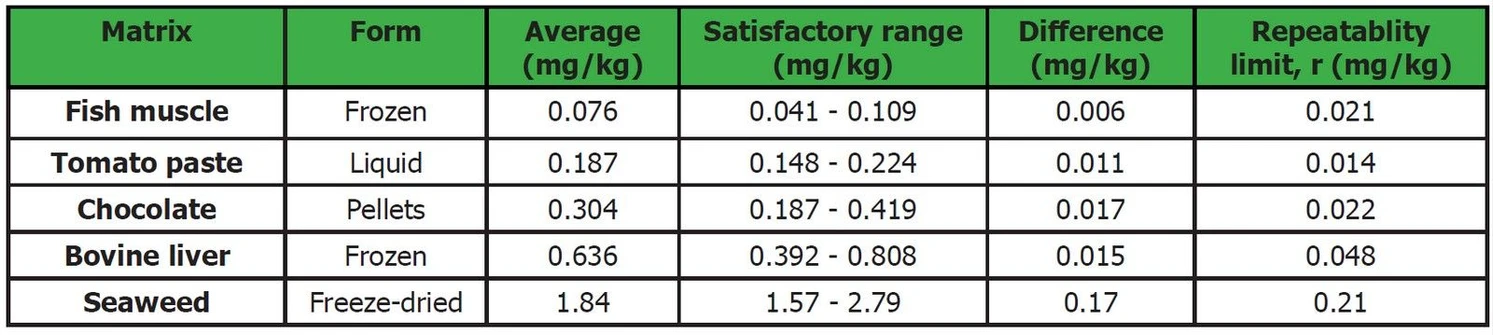 Eurachem: Case study - Use of surplus PT items when implementing a standard method
[1] B. Brookman and I. Mann (eds.) Eurachem Guide: Selection, Use and Interpretation of Proficiency Testing (PT) Schemes (3rd ed. 2021).
[2] Eurachem Information Leaflet: How can proficiency testing help my laboratory? (2022).
[3] B. Magnusson and U. Örnemark (eds.) Eurachem Guide: The Fitness for Purpose of Analytical Methods – A Laboratory Guide to Method Validation and Related Topics, (2nd ed. 2014). ISBN 978-91-87461-59-0