Author
LabRulez
LabRulez
Everything from the world of analytical chemistry in one place. We connect people in solving their problems. At Labrulez you will find all the necessary information easily, quickly and clearly. Stop searching and start finding.
Tags
Scientific article
Science and research
LinkedIn Logo

Gas Chromatography-Atmospheric Pressure Chemical Ionization (GC-APCI) Expands the Analytical Window for Detection of Large PAHs (≥24 Ringed-Carbons) in Pyroplastics and Other Environmental Matrices
Mo, 11.5.2026
| Original article from: ACS Omega 2026, 11, 7, 12321–12329
This study develops a GC-APCI-MS/MS method for detecting large PAHs in pyroplastics, identifying potential markers of burned plastic pollution.
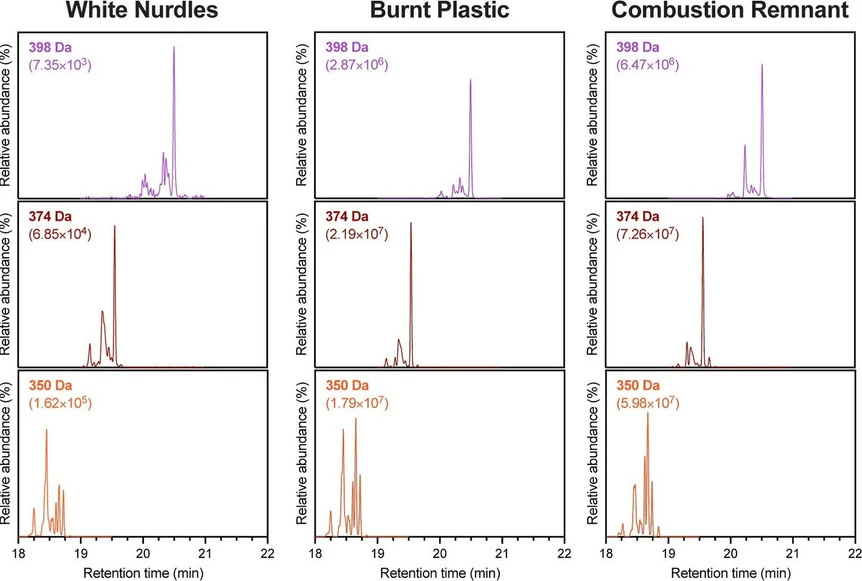
<p>ACS Omega 2026, 11, 7, 12321–12329: Figure 3. Comparison of the resolved isomers for 398, 374, and 350 Da of the white nurdles, burnt plastic, and combustion remnant pieces collected from Pamunugama Beach, Sri Lanka, following the 2021 M/V X-Press Pearl ship fire and plastic spill.</p>

ACS Omega 2026, 11, 7, 12321–12329: Figure 3. Comparison of the resolved isomers for 398, 374, and 350 Da of the white nurdles, burnt plastic, and combustion remnant pieces collected from Pamunugama Beach, Sri Lanka, following the 2021 M/V X-Press Pearl ship fire and plastic spill.

This study presents a high-temperature GC-APCI-MS/MS method for detecting large polycyclic aromatic hydrocarbons in pyroplastics and environmental samples. The approach enables sensitive analysis of PAHs with molecular weights from 314–424 Da without extensive cleanup or fractionation.

Application to pyroplastics from the M/V X-Press Pearl fire revealed substantially elevated levels of large PAHs compared to unburnt plastics. Several compounds, including 1,3,5-triphenylbenzene, emerged as promising markers for identifying pyroplastic contamination, supporting future monitoring of plastic burning, fires, and microplastic pollution.

The original article

Gas Chromatography-Atmospheric Pressure Chemical Ionization (GC-APCI) Expands the Analytical Window for Detection of Large PAHs (≥24 Ringed-Carbons) in Pyroplastics and Other Environmental Matrices

Cara Megill, Douglas M. Stevens*, Christopher M. Reddy, Bryan D. James*, Robert K. Nelson, and Frank L. Dorman

ACS Omega 2026, 11, 7, 12321–12329

https://doi.org/10.1021/acsomega.5c11703

licensed under CC-BY 4.0

Selected sections from the article follow. Formats and hyperlinks were adapted from the original.

The measurement and reporting of polycyclic aromatic hydrocarbons (PAHs) are routine practices in environmental monitoring and risk assessment. (1−3) However, of the thousands of PAHs, only the 16 designated as Priority Pollutants by the U.S. Environmental Protection Agency (EPA16) are typically reported. (4,5) These span two to six ringed parent PAHs, ranging in molecular weight from 128 to 278 Da. It is well recognized that this limited analyte list drastically simplifies and misses a significant fraction of PAHs. (4) For example, the concentration of C1–C4 alkylated PAHs can be greater than or equal to the concentration of the EPA16 in crude oils and fuels. (6) Expanding the analytical window of PAHs has proven valuable for forensic analysis of oil spills (e.g., alkylated and heterocycle-containing PAHs) and relevant for toxicological evaluation(e.g., oxygen-, nitrogen-, and sulfur-containing PAHs). (3,7) Moreover, the sources of PAHs have distinct compositions of PAHs, (1,8) which enables the use of PAHs for source apportionment. (2,7) Including alkylated and sulfur-containing PAHs (those beyond the EPA16) in the investigation of environmental samples and other matrices provides greater discriminating power between potential sources (using extracted ion chromatograms). (3,7,9) Additionally, monitoring the compositional changes of PAHs in the environment can inform about the fate and environmental processing of the matrix (e.g., oil weathering). (2) While these efforts have made strides in considering other PAHs, an environmentally relevant fraction of PAHs remains underutilized.

PAHs with more than six rings have been reported in diverse environmental matrices. (10,11) These large PAHs (≥24 ringed-carbons (10)) have been found in combustion-derived particulate matter, (12−19) urban dust, (20−23) refinery deposits, (11) coal tars and pitches, (24−27) cokes, (28) soils, (20,22) sediments, (20−23) and deep-sea hydrothermal vent bitumen. (29) Most reports of large PAHs in environmental matrices have been from analyses of U.S. National Institute of Standards and Technology (NIST) standard reference materials (SRMs); (18,21−23,25,26,30) a few 302 Da isomers have been certified in three SRM. (31) Nonetheless, isomers ranging from 326 to 374 Da have been reported in SRMs for urban dust (1649a/b), diesel particulate (1650b and 2975), coal tar (1597a), and marine sediment (1941b), displaying qualitative differences between the sources in their large PAH compositions; (18,20,22,23,27) thus, large PAHs should offer forensic utility.

Recent advances in soft ionization within an atmospheric pressure chemical ionization source for gas chromatography–mass spectrometry (GC-APCI) are well-suited for the analysis of large PAHs. Two contributing factors for this are the tolerance for high carrier gas flow rates by GC-APCI and the sensitivity of charge exchange APCI for aromatic species. (48) Increasing the carrier gas flow rate reduces the elution temperature of analytes, making many higher mass analytes accessible using a conventional GC and column, although poor thermal stability may still pose challenges for some analytes. (49) Classic vacuum-source GC/MS systems using electron ionization (EI) restrict the upper carrier gas flow allowed from the GC, and therefore, cannot fully utilize high GC carrier gas flows. The sensitivity of GC-APCI for components of petroleum, such as PAHs, has been previously reported. (48) Furthermore, unlike LC-APCI, which commonly exhibits protonation of analytes in positive ion mode, (50) GC-APCI+ can operate with dry source conditions. These conditions result in nitrogen-mediated charge exchange ionization and ions of the form M+, the same form of molecular ion created using EI. As a result, because the charge site location on an ion dictates which product ions will be stable, the same multiple reaction monitoring (MRM) transitions can be used for both GC-APCI MS/MS and EI MS/MS. (51)

Herein, a GC-APCI method was developed for the detection of large PAHs. Due to the limited availability of pure standards, previously characterized NIST SRMs were used in method development as sources of large PAHs. The values of the method and detection of large PAHs were demonstrated by analyzing environmental plastic samples collected after the M/V X-Press Pearl ship fire and plastic spill.

Materials and Methods

GC-APCI

The solvent extracts and dilutions were analyzed by GC-APCI on a Xevo TQ Absolute (Waters Corporation) tandem quadrupole mass spectrometer (TQ-MS/MS). The atmospheric pressure gas chromatography (APGC) ionization source was operated in charge transfer mode using dry N2 as the reagent gas. Dry N2 reagent gas creates molecular ions of the form M+ with no significant adduct formation for large PAHs. The high reagent gas flow rate of 350 mL/min into the ionization chamber, combined with low energies applied to the transfer optics from the atmospheric pressure region to the first quadrupole, leads to a high molecular ion survival rate. Furthermore, the use of MS/MS with quadrupoles operating at unit mass resolution prevents potential effects on response caused by adduct formation. Acquisitions were performed in positive ion, MRM mode. Two MRM transitions were used for each of the 16 precursor masses, ranging from 314 to 424 Da (Table S1). No optimization of source conditions specific to the analysis of large PAHs was required. The list of 16 specific precursor masses targeted in this range was developed using multiple sources reporting large PAHs in NIST SRMs and samples from deep-sea hydrothermal vents. (18,29,30) The two transitions represented constant neutral losses of 2 and 4 Da at high collision energies of 60–100 eV, using N2 as the collision gas.

For 1,3,5-TPB analysis, the APGC ionization source was operated in charge transfer mode using N2 as the collision gas. Acquisitions were performed in positive ion, MRM mode, yielding six MRM transitions for analysis (Table S2). Similar to the large PAHs, this analyte also shows neutral losses of 2 and 4 Da, reflecting behavior like that of the more condensed structures.

The 8890 GC (Agilent Technologies) was configured with N2 as the carrier gas and an Rxi-5HT column (Restek) of 15 m in length, 0.25 mm inner diameter, and 0.10 μm film thickness. The split/splitless (SSL) injection port was operated at a 10:1 split ratio with a temperature of 380 °C. A 1 μL injection volume was used for all analyses. The temperature program was 30.8 min; it started by holding at 40 °C for 0.5 min, then ramped to 160 °C at 14 °C/min, followed by a ramp to 395 °C at 22 °C/min and a hold at the temperature for 11 min. The flow rate of the N2 carrier gas was initially 0.60 mL/min, then ramped at 0.015 mL/min2 to 0.90 mL/min, followed by a ramp at 0.150 mL/min2 to 3.0 mL/min. To adapt the system for high-temperature work, the SSL was configured with a high-temperature septum (400 °C maximum), a 100% graphite liner O-ring, and a straight 4 mm inner diameter, wool-packed liner (450 °C maximum). Additional instrument and method details are included in the Supporting Information.

Results

Analysis of Large PAHs in Pyroplastic Samples by GC-APCI

Macroplastic and microplastic debris from the M/V X-Press Pearl ship fire and plastic spill were investigated for the presence and distribution of large PAHs. The field samples included white, unburnt polyethylene nurdles and two types of pyroplastic, termed burnt plastic and combustion remnant (Figure 1), both of which were polyethylene. (43) The types of pyroplastics were previously operationally defined based on the size and shape of the pieces. (43)

Investigation of the 302 Da isomers revealed profiles similar to those of the SRMs; however, unique differences were observed (Figure S2). Eighteen to twenty-one peaks were detected across the plastic samples. Compared with the SRMs, the pyroplastics showed decreases in the relative abundance of dibenzo[a,e]fluoranthene and increases in dibenzo[a,h]pyrene (Figure S2). This trend was not the case for the white nurdle sample. Starting at a retention time of 16.80 min, two peaks were unique to the pyroplastic samples (not present in the SRMs and especially minor in the white nurdles). These peaks followed that for dibenzo[a,h]pyrene, which had previously been reported as the last detected 302 Da isomer compound in the SRMs, (21) supporting their novelty as marker compounds of pyroplastics.

The plastic samples displayed similarities and differences in the presence and distribution of large PAHs (Figure 3). The white nurdles, burnt plastic, and combustion remnant all contained high-intensity peaks at 20.50 min for 398 Da and 19.55 min for 374 Da. Peaks between 20.00 and 20.25 min of 398 Da and the 19.35 min peak of 374 Da were reduced in intensity for the pyroplastics compared to the white nurdles (Figure S3). Conversely, the peaks between 18.50 and 18.75 min of 350 Da were more intense in the pyroplastics compared to the white nurdles.

ACS Omega 2026, 11, 7, 12321–12329: Figure 3. Comparison of the resolved isomers for 398, 374, and 350 Da of the white nurdles, burnt plastic, and combustion remnant pieces collected from Pamunugama Beach, Sri Lanka, following the 2021 M/V X-Press Pearl ship fire and plastic spill.ACS Omega 2026, 11, 7, 12321–12329: Figure 3. Comparison of the resolved isomers for 398, 374, and 350 Da of the white nurdles, burnt plastic, and combustion remnant pieces collected from Pamunugama Beach, Sri Lanka, following the 2021 M/V X-Press Pearl ship fire and plastic spill.

The levels of all the targeted large PAHs were at least 2 orders of magnitude higher in the pyroplastics than in the white nurdles. These levels included the individual PAHs that were common to the pyroplastics. This trend mirrored that observed for smaller PAHs and the solvent-extractable content of the sample types. (39,43,46) There were also slight differences in the signatures of the large PAHs found in the pyroplastics. The 398 Da peak at 20.24 min, along with the 374 Da peak at 19.31 min and the 350 Da peak at 18.61 min, were more prominent in the combustion remnant compared to the burnt plastic (Figure S3).

Similar to the differences in large PAH signatures between the SRMs, the plastic samples had different signatures. Such qualitative interpretation of extracted ion chromatograms is forensically accepted for distinguishing sources. (3) This feature can potentially be utilized to differentiate between plastic types (e.g., virgin, weathered, and partially combusted) as well as to identify sources of the large PAHs and the combustion temperature.

Conclusions

GC-APCI-MS/MS proved a useful technique for detecting large PAHs in diverse environmental matrices, including extracts from pyroplastic field samples. Despite a lack of widely available analytical standards for large PAHs, NIST SRMs provided ample material for method development for their detection. Nonetheless, with the increasing research on microplastics in the environment and their relevance to human health, an environmental SRM with certified values for large PAHs is needed, and pyroplastics may provide such a source of material. Large PAHs and 1,3,5-TPB were detected in pyroplastic field samples and hold promise as chemical markers for pyroplastics, complementing other means for their detection in environmental samples (e.g., appearance and physical properties). Due to the accessibility of GC-APCI, the detection of large PAHs can be integrated into workflows for evaluating environmental samples, including those for microplastics.

LabRulez
LinkedIn Logo
 

Related content

Alcohol Determination of Sanitizer Gel Using Nexis GC-2060

Applications
| 2026 | Shimadzu
Instrumentation
GC
Manufacturer
Shimadzu
Industries
Pharma & Biopharma

Sensitive and Reproducible Determination of Nitrosamines by GC/MSD

Applications
| 2026 | Agilent Technologies
Instrumentation
GC/MSD, GC/SQ
Manufacturer
Agilent Technologies
Industries
Environmental

High-Throughput BTEX Analysis in Nail Products by SPME and GC/TQ

Applications
| 2026 | Agilent Technologies
Instrumentation
GC/MSD, GC/MS/MS, GC/QQQ, SPME
Manufacturer
Agilent Technologies
Industries
Materials Testing

Accurate multi-component blast furnace gas analysis maximizes iron production and minimizes coke consumption

Applications
| 2026 | Thermo Fisher Scientific
Instrumentation
GC/MSD
Manufacturer
Thermo Fisher Scientific
Industries
Energy & Chemicals

Gas Chromatograph Nexis GC-2060

Brochures and specifications
| 2026 | Shimadzu
Instrumentation
GC
Manufacturer
Shimadzu
Industries
Other
 

Related articles

Analysis of Fentanyl and Fentanyl Analogs Using Atmospheric Pressure Chemical Ionization Gas Chromatography–Mass Spectrometry (APCI-GC-MS)
Scientific article | Toxicology

Analysis of Fentanyl and Fentanyl Analogs Using Atmospheric Pressure Chemical Ionization Gas Chromatography–Mass Spectrometry (APCI-GC-MS)

This study aims to characterize 74 fentanyl analogs using APCI-GC-MS, providing retention times, precursor, and product ion data to improve analog differentiation and identification.
LabRulez
tag
share
more
PAH Induction upon Pyrolysis of Hydroxyl-Terminated Polybutadiene-Based Solid Rocket Fuels
Scientific article | Science and research

PAH Induction upon Pyrolysis of Hydroxyl-Terminated Polybutadiene-Based Solid Rocket Fuels

Pyrolysis of HTPB/AP mixtures produces PAHs and aromatic C6 species absent in pure HTPB. Mass spectrometry confirms rapid PAH growth on μs time scales with pathways revealed by Pyr-GC-MS.
LabRulez
tag
share
more
Flavor Characteristics of Different Varieties of Flue-Cured Tobacco Based on Headspace Gas Chromatography–Ion Mobility Spectrometry and Headspace Solid-Phase Microextraction–Gas Chromatography–Mass Spectrometry
Scientific article | Science and research

Flavor Characteristics of Different Varieties of Flue-Cured Tobacco Based on Headspace Gas Chromatography–Ion Mobility Spectrometry and Headspace Solid-Phase Microextraction–Gas Chromatography–Mass Spectrometry

Six flue-cured tobacco varieties were analyzed by HS-GC-IMS and HS-SPME-GC-MS. Ninety-plus volatiles were identified, and 19 key compounds distinguished flavor differences.
LabRulez
tag
share
more
News from LabRulezGCMS Library - Week 09, 2026
Article | Application

News from LabRulezGCMS Library - Week 09, 2026

This week we bring you application notes by Agilent Technologies, Shimadzu and Waters Corporation and presentation by MDCW / William & Mary!
LabRulez
tag
share
more
 

Related content

Alcohol Determination of Sanitizer Gel Using Nexis GC-2060

Applications
| 2026 | Shimadzu
Instrumentation
GC
Manufacturer
Shimadzu
Industries
Pharma & Biopharma

Sensitive and Reproducible Determination of Nitrosamines by GC/MSD

Applications
| 2026 | Agilent Technologies
Instrumentation
GC/MSD, GC/SQ
Manufacturer
Agilent Technologies
Industries
Environmental

High-Throughput BTEX Analysis in Nail Products by SPME and GC/TQ

Applications
| 2026 | Agilent Technologies
Instrumentation
GC/MSD, GC/MS/MS, GC/QQQ, SPME
Manufacturer
Agilent Technologies
Industries
Materials Testing

Accurate multi-component blast furnace gas analysis maximizes iron production and minimizes coke consumption

Applications
| 2026 | Thermo Fisher Scientific
Instrumentation
GC/MSD
Manufacturer
Thermo Fisher Scientific
Industries
Energy & Chemicals

Gas Chromatograph Nexis GC-2060

Brochures and specifications
| 2026 | Shimadzu
Instrumentation
GC
Manufacturer
Shimadzu
Industries
Other
 

Related articles

Analysis of Fentanyl and Fentanyl Analogs Using Atmospheric Pressure Chemical Ionization Gas Chromatography–Mass Spectrometry (APCI-GC-MS)
Scientific article | Toxicology

Analysis of Fentanyl and Fentanyl Analogs Using Atmospheric Pressure Chemical Ionization Gas Chromatography–Mass Spectrometry (APCI-GC-MS)

This study aims to characterize 74 fentanyl analogs using APCI-GC-MS, providing retention times, precursor, and product ion data to improve analog differentiation and identification.
LabRulez
tag
share
more
PAH Induction upon Pyrolysis of Hydroxyl-Terminated Polybutadiene-Based Solid Rocket Fuels
Scientific article | Science and research

PAH Induction upon Pyrolysis of Hydroxyl-Terminated Polybutadiene-Based Solid Rocket Fuels

Pyrolysis of HTPB/AP mixtures produces PAHs and aromatic C6 species absent in pure HTPB. Mass spectrometry confirms rapid PAH growth on μs time scales with pathways revealed by Pyr-GC-MS.
LabRulez
tag
share
more
Flavor Characteristics of Different Varieties of Flue-Cured Tobacco Based on Headspace Gas Chromatography–Ion Mobility Spectrometry and Headspace Solid-Phase Microextraction–Gas Chromatography–Mass Spectrometry
Scientific article | Science and research

Flavor Characteristics of Different Varieties of Flue-Cured Tobacco Based on Headspace Gas Chromatography–Ion Mobility Spectrometry and Headspace Solid-Phase Microextraction–Gas Chromatography–Mass Spectrometry

Six flue-cured tobacco varieties were analyzed by HS-GC-IMS and HS-SPME-GC-MS. Ninety-plus volatiles were identified, and 19 key compounds distinguished flavor differences.
LabRulez
tag
share
more
News from LabRulezGCMS Library - Week 09, 2026
Article | Application

News from LabRulezGCMS Library - Week 09, 2026

This week we bring you application notes by Agilent Technologies, Shimadzu and Waters Corporation and presentation by MDCW / William & Mary!
LabRulez
tag
share
more
 

Related content

Alcohol Determination of Sanitizer Gel Using Nexis GC-2060

Applications
| 2026 | Shimadzu
Instrumentation
GC
Manufacturer
Shimadzu
Industries
Pharma & Biopharma

Sensitive and Reproducible Determination of Nitrosamines by GC/MSD

Applications
| 2026 | Agilent Technologies
Instrumentation
GC/MSD, GC/SQ
Manufacturer
Agilent Technologies
Industries
Environmental

High-Throughput BTEX Analysis in Nail Products by SPME and GC/TQ

Applications
| 2026 | Agilent Technologies
Instrumentation
GC/MSD, GC/MS/MS, GC/QQQ, SPME
Manufacturer
Agilent Technologies
Industries
Materials Testing

Accurate multi-component blast furnace gas analysis maximizes iron production and minimizes coke consumption

Applications
| 2026 | Thermo Fisher Scientific
Instrumentation
GC/MSD
Manufacturer
Thermo Fisher Scientific
Industries
Energy & Chemicals

Gas Chromatograph Nexis GC-2060

Brochures and specifications
| 2026 | Shimadzu
Instrumentation
GC
Manufacturer
Shimadzu
Industries
Other
 

Related articles

Analysis of Fentanyl and Fentanyl Analogs Using Atmospheric Pressure Chemical Ionization Gas Chromatography–Mass Spectrometry (APCI-GC-MS)
Scientific article | Toxicology

Analysis of Fentanyl and Fentanyl Analogs Using Atmospheric Pressure Chemical Ionization Gas Chromatography–Mass Spectrometry (APCI-GC-MS)

This study aims to characterize 74 fentanyl analogs using APCI-GC-MS, providing retention times, precursor, and product ion data to improve analog differentiation and identification.
LabRulez
tag
share
more
PAH Induction upon Pyrolysis of Hydroxyl-Terminated Polybutadiene-Based Solid Rocket Fuels
Scientific article | Science and research

PAH Induction upon Pyrolysis of Hydroxyl-Terminated Polybutadiene-Based Solid Rocket Fuels

Pyrolysis of HTPB/AP mixtures produces PAHs and aromatic C6 species absent in pure HTPB. Mass spectrometry confirms rapid PAH growth on μs time scales with pathways revealed by Pyr-GC-MS.
LabRulez
tag
share
more
Flavor Characteristics of Different Varieties of Flue-Cured Tobacco Based on Headspace Gas Chromatography–Ion Mobility Spectrometry and Headspace Solid-Phase Microextraction–Gas Chromatography–Mass Spectrometry
Scientific article | Science and research

Flavor Characteristics of Different Varieties of Flue-Cured Tobacco Based on Headspace Gas Chromatography–Ion Mobility Spectrometry and Headspace Solid-Phase Microextraction–Gas Chromatography–Mass Spectrometry

Six flue-cured tobacco varieties were analyzed by HS-GC-IMS and HS-SPME-GC-MS. Ninety-plus volatiles were identified, and 19 key compounds distinguished flavor differences.
LabRulez
tag
share
more
News from LabRulezGCMS Library - Week 09, 2026
Article | Application

News from LabRulezGCMS Library - Week 09, 2026

This week we bring you application notes by Agilent Technologies, Shimadzu and Waters Corporation and presentation by MDCW / William & Mary!
LabRulez
tag
share
more
 

Related content

Alcohol Determination of Sanitizer Gel Using Nexis GC-2060

Applications
| 2026 | Shimadzu
Instrumentation
GC
Manufacturer
Shimadzu
Industries
Pharma & Biopharma

Sensitive and Reproducible Determination of Nitrosamines by GC/MSD

Applications
| 2026 | Agilent Technologies
Instrumentation
GC/MSD, GC/SQ
Manufacturer
Agilent Technologies
Industries
Environmental

High-Throughput BTEX Analysis in Nail Products by SPME and GC/TQ

Applications
| 2026 | Agilent Technologies
Instrumentation
GC/MSD, GC/MS/MS, GC/QQQ, SPME
Manufacturer
Agilent Technologies
Industries
Materials Testing

Accurate multi-component blast furnace gas analysis maximizes iron production and minimizes coke consumption

Applications
| 2026 | Thermo Fisher Scientific
Instrumentation
GC/MSD
Manufacturer
Thermo Fisher Scientific
Industries
Energy & Chemicals

Gas Chromatograph Nexis GC-2060

Brochures and specifications
| 2026 | Shimadzu
Instrumentation
GC
Manufacturer
Shimadzu
Industries
Other
 

Related articles

Analysis of Fentanyl and Fentanyl Analogs Using Atmospheric Pressure Chemical Ionization Gas Chromatography–Mass Spectrometry (APCI-GC-MS)
Scientific article | Toxicology

Analysis of Fentanyl and Fentanyl Analogs Using Atmospheric Pressure Chemical Ionization Gas Chromatography–Mass Spectrometry (APCI-GC-MS)

This study aims to characterize 74 fentanyl analogs using APCI-GC-MS, providing retention times, precursor, and product ion data to improve analog differentiation and identification.
LabRulez
tag
share
more
PAH Induction upon Pyrolysis of Hydroxyl-Terminated Polybutadiene-Based Solid Rocket Fuels
Scientific article | Science and research

PAH Induction upon Pyrolysis of Hydroxyl-Terminated Polybutadiene-Based Solid Rocket Fuels

Pyrolysis of HTPB/AP mixtures produces PAHs and aromatic C6 species absent in pure HTPB. Mass spectrometry confirms rapid PAH growth on μs time scales with pathways revealed by Pyr-GC-MS.
LabRulez
tag
share
more
Flavor Characteristics of Different Varieties of Flue-Cured Tobacco Based on Headspace Gas Chromatography–Ion Mobility Spectrometry and Headspace Solid-Phase Microextraction–Gas Chromatography–Mass Spectrometry
Scientific article | Science and research

Flavor Characteristics of Different Varieties of Flue-Cured Tobacco Based on Headspace Gas Chromatography–Ion Mobility Spectrometry and Headspace Solid-Phase Microextraction–Gas Chromatography–Mass Spectrometry

Six flue-cured tobacco varieties were analyzed by HS-GC-IMS and HS-SPME-GC-MS. Ninety-plus volatiles were identified, and 19 key compounds distinguished flavor differences.
LabRulez
tag
share
more
News from LabRulezGCMS Library - Week 09, 2026
Article | Application

News from LabRulezGCMS Library - Week 09, 2026

This week we bring you application notes by Agilent Technologies, Shimadzu and Waters Corporation and presentation by MDCW / William & Mary!
LabRulez
tag
share
more
Other projects
LCMS
ICPMS
Follow us
FacebookX (Twitter)LinkedInYouTube
More information
WebinarsAbout usContact usTerms of use
LabRulez s.r.o. All rights reserved. Content available under a CC BY-SA 4.0 Attribution-ShareAlike