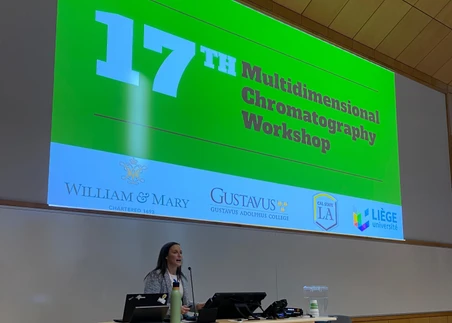
Sniff smarter: Empowering GC–O with trap-based enrichment and GC×GC for advanced aroma profiling (Lina Mikaliunaite, MDCW 2026)

- Photo: MDCW: Sniff smarter: Empowering GC–O with trap-based enrichment and GC×GC for advanced aroma profiling (Lina Mikaliunaite, MDCW 2026)
- Video: LabRulez: Lina Mikaliunaite: Sniff smarter: GC–O with trap enrichment & GC×GC for aroma profiling (MDCW 2026)
🎤 Presenter: Lina Mikaliunaite (Markes International)
Abstract
Gas chromatography–olfactometry (GC–O) integrates human sensory perception into analytical workflows by combining the nose with chromatographic instrumentation. While mass spectrometry provides molecular information, it cannot describe odour attributes, making GC–O essential for linking chemical composition to sensory perception.
Analysis is complicated by several factors. Many odorants occur at trace levels, with detection thresholds below the sensitivity of common detectors, creating a gap between measurable compounds and those perceived by the human nose. Additionally, co-elution in complex matrices, such as citrus fruits, can obscure identification of the compounds responsible for specific aromas.
Trap-based enrichment addresses these challenges by combining several sampling stages into a single run, focusing analytes on an electrically-cooled trap. This enhances sensitivity, allowing previously undetectable odorants to be confidently identified by mass spectrometry.
Comprehensive two-dimensional gas chromatography (GC×GC) further improves separation by resolving co-eluting compounds, producing cleaner spectra and enabling distinct assignment of compounds to sensory events.
This integrated workflow provides high-resolution aroma profiling, bridging analytical chemistry and sensory science, and is broadly applicable to flavour research, quality control, and product development in the food and beverage sector.
Video Transcription
I attended the Multidimensional Chromatography Workshop previously during my PhD, and it’s nice to return now representing SepSolve Analytical. In this presentation, I will discuss integrating gas chromatography–olfactometry (GC-O) with comprehensive two-dimensional gas chromatography (GC×GC) and how these technologies can be leveraged together.
SepSolve Analytical and Markes International
SepSolve focuses primarily on GC×GC modulation technologies and chemometric data analysis, while our sister company Markes International specializes in sample introduction, thermal desorption, and sample enrichment technologies.
As of last week, both companies became part of the Valaris Group. Our global presence includes offices in:
- Sacramento, USA
- Waterloo, Canada
- Germany
- China
- Headquarters in the United Kingdom
SepSolve has been part of the development of advanced separation technologies since the first benchtop GC×GC systems were introduced in 2008. Since then, multiple improvements have been made, including:
- New ion source designs
- Updated transfer lines
- Flow and cryogen-free thermal modulators
Recently, SepSolve also acquired HyperChrom, a fast-GC technology developed by Peter Becker in Germany. In addition, we introduced Smart Subtract, a chemometrics tool integrated into the ChromCompare software suite.
Why GC×GC Is Important for Aroma Analysis
GC×GC is particularly powerful for aroma profiling, where samples can contain hundreds of compounds. When analyzing complex mixtures, a traditional one-dimensional GC separation often results in overlapping peaks.
In contrast, GC×GC provides enhanced separation, allowing analysts to resolve compounds that would otherwise co-elute. This is especially important when analyzing aromas, where low-concentration compounds may significantly influence perceived smell but remain hidden behind dominant signals.
For example, strong fruity or vegetal aromas can mask more subtle odor compounds such as nutty or onion-like notes. This raises an important question:
How do we correlate chemical data with sensory perception?
Challenges in Traditional GC-Olfactometry
Gas chromatography–olfactometry (GC-O) allows analysts to smell compounds as they elute from the chromatograph. However, several challenges remain.
First, human noses are extremely sensitive detectors. In some cases, analysts can detect odors that are present at concentrations below the detection limits of mass spectrometers.
Second, co-eluting compounds may produce a combined odor perception. When smelling a chromatographic peak, the analyst may actually be detecting multiple compounds simultaneously.
Integrating GC-O with GC×GC
To address these challenges, our approach integrates GC-O with GC×GC. In a typical GC-O configuration, the sample is injected into the GC column and the effluent is split between:
- an olfactory detection port (ODP)
- an instrumental detector
As compounds elute, an analyst at the ODP records the odors detected, which can then be correlated with chromatographic data.
However, a common problem occurs when an analyst detects an odor but no corresponding peak appears in the chromatogram. This typically indicates that the compound concentration is below the instrumental detection limit.
Improving Sensitivity with Sample Enrichment
To overcome this limitation, we incorporate sample enrichment using the Markes Sentry system before the GC or GC×GC analysis.
The Sentry system supports several sampling techniques, including:
- Headspace sampling
- SPME Arrow
- HiSorb probes
- Tube-based sampling
Analytes are thermally desorbed onto an electronically cooled trap, eliminating the need for cryogens. Multiple injections can be accumulated on the trap, effectively preconcentrating the sample and significantly improving detection limits.
The trap uses multiple sorbents with different strengths:
- Weak sorbents capture heavier compounds
- Medium sorbents retain intermediate analytes
- Strong sorbents trap lighter compounds
During desorption, the trap is heated ballistically at approximately 100 °C per second, releasing analytes as a narrow band into the GC column. This produces sharper chromatographic peaks and improved separation.
Additionally, the system allows automated recollection of samples before GC analysis. This can be useful when dealing with limited or perishable samples, such as food products.
Resolving Co-Eluting Odor Compounds
Even with improved sensitivity, analysts may still encounter situations where multiple compounds contribute to a single perceived odor.
To address this, we introduce a flow modulator and a second GC column, effectively converting the system into GC×GC after the GC-O split. This allows compounds contributing to a single odor perception to be separated in the second dimension.
For example, what initially appears to be a single “sweet” odor may actually consist of three different compounds that can be resolved through two-dimensional separation.
Example Applications
Citrus Rind Analysis
In preliminary experiments, citrus rind samples were analyzed using thermal desorption tubes followed by GC×GC analysis. These samples produced highly complex chromatograms.
Using the integrated GC-O system, analysts identified a woody aroma that was actually composed of multiple compounds. One of these compounds contributed a subtle caramel-like note that would otherwise have gone unnoticed.
Orange Juice with and without Pulp
Another study compared orange juice samples with and without pulp using headspace extraction.
In traditional one-dimensional GC analysis, the chromatograms appear very similar. However, GC×GC separation reveals detailed chemical differences between the samples.
Using GC-O, analysts identified a woody aroma compound present only in the pulp-containing sample, demonstrating how subtle sensory differences can be linked to specific chemical components.
Chemometrics and Smart Subtract
When comparing chromatograms from complex samples, visual inspection alone often fails to reveal meaningful differences.
Traditional chromatogram subtraction highlights all differences, including minor variations that may not be significant. To improve this process, SepSolve developed Smart Subtract, a chemometrics-based approach introduced last year.
Smart Subtract identifies only meaningful changes between datasets, allowing analysts to quickly locate compounds responsible for differences between samples.
For example, when comparing orange juice samples, Smart Subtract highlighted compounds contributing to flavor differences, including:
- Furfural, associated with nutty or almond aromas
- Dimethylfuran, producing coffee-like notes
- Linalool, contributing floral aromas
Conclusion
Gas chromatography–olfactometry remains an indispensable tool in food, flavor, and fragrance research. By integrating trap-based sample enrichment and GC×GC separation, analysts can significantly improve detection limits and resolve complex mixtures.
This combined approach allows researchers to better understand which specific compounds contribute to the odors perceived by human analysts, bridging the gap between chemical analysis and sensory perception.
Finally, I would like to mention that our Waterloo laboratory will soon relocate to a larger facility, approximately 10 kilometers from its current location. The new facility will house both Markes and SepSolve instrumentation, and we look forward to welcoming visitors at the grand opening in May.
This text has been automatically transcribed from a video presentation using AI technology. It may contain inaccuracies and is not guaranteed to be 100% correct.
-Workshop-LOGO_s.webp)