News from LabRulezGCMS Library - Week 18, 2025
LabRulez: News from LabRulezGCMS Library - Week 18, 2025
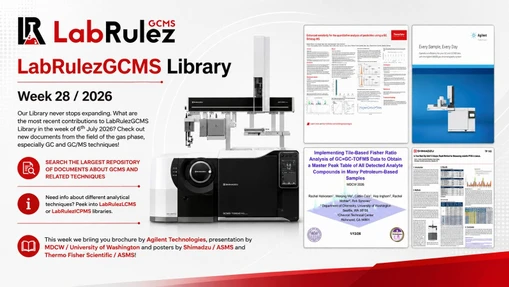
Our Library never stops expanding. What are the most recent contributions to LabRulezGCMS Library in the week of 28th April 2025? Check out new documents from the field of the gas phase, especially GC and GC/MS techniques!
👉 SEARCH THE LARGEST REPOSITORY OF DOCUMENTS ABOUT GCMS AND RELATED TECHNIQUES
👉 Need info about different analytical techniques? Peek into LabRulezLCMS or LabRulezICPMS libraries.
This week we bring you application note by Agilent Technologies, poster by MDCW / UCT Prague and technical note by Thermo Fisher Scientific!
1. Agilent Technologies: Group-Type Analysis of Jet Fuel Using the Agilent Flow-Modulated GC×GC-FID
- Application note
- Full PDF for download
Jet fuel, also known as aviation kerosene and aviation turbine fuel, is a petroleum product primarily used as fuel for aircraft turbine engines. Characterizing the composition of jet fuel is essential for ensuring safe and efficient aircraft operation and for maintaining the high performance and reliability standards the aviation industry requires. This type of analysis also has significant practical importance for understanding the fuel production process and evaluating catalyst performance and lifetime. The aromatic hydrocarbon content of jet fuel is a crucial quality indicator and is subject to global regulations.
However, the number of unique hydrocarbon structural isomers in jet fuel exceeds the selectivity of conventional one-dimensional chromatographic and spectroscopic methods, which cannot provide the necessary hydrocarbon composition and carbon number distribution information. Comprehensive GC×GC has a number of advantages over conventional chromatographic techniques, such as enhanced resolution, peak capacity, sensitivity, and a highly ordered and structured separation pattern. The analysis procedure of such petroleum products can be significantly simplified, since GC×GC allows direct injection without the need for sample pretreatment. Additionally, the analysis of such petroleum products by GC×GC does not require any sample preparation or pretreatment, making it an attractive method for quality control laboratories.
This application note establishes a group-type quantification method for jet fuel according to China's NB/SH/T 6078-2023 standard1 using the Agilent 8890 reverse fill/flush flow-modulated GC×GC-FID system.2–4 The Agilent reverse flow modulator (RFM) is a differential flow modulator. It is based on the Agilent Capillary Flow Technology (CFT) and fractionates the carrier gas by simply directing the carrier gas flow. The system requires no additional footprint (since the modulator is installed within the GC oven), has no moving parts, is cost-effective, robust, and yields highly reproducible results. The system is particularly suited to analyzing middle petroleum distillates like jet fuel, because these mixtures typically have a well-defined beginning and end of elution in GC separations. This application note determined the relative abundance of 1-ring aromatics, 2-ring aromatics, and homologous aromatic series by carbon number in real jet fuel samples. The repeatability, linearity, and quantitative precision of the system was also evaluated.
Experimental
Instrumentation
An 8890 GC×GC-FID system with a split/splitless inlet and a reverse fill/flush RFM were used with the configurations listed in Table 1. Three different column sets were evaluated.
Results and discussion
Repeatability
RT stability is a critical characteristic for GC×GC-FID analysis, as peak identification relies on their position in the 2D chromatogram. The flow modulator, which does not involve any moving parts or cold/hot jets, achieves modulation by controlling the flow direction through a collection channel using an electronic pressure control module. By controlling the modulation process using the Agilent sixth-generation electronic pneumatics control technology, exceptionally stable RTs were achieved. Table 2 presents the primary retention time (1 RT) and secondary retention time (2 RT) data of various common aromatic species identified in jet fuel (n = 10). The 1 RT remains almost constant. The %RSD of 2 RT is less than 0.27% for all compounds, and near 0.0000% for most. The exceptional RT stability allows the user to generate a data template and use it for peak identification routinely without much concern about mismatch. The FID response in a GC×GC-FID system is also highly repeatable; the absolute area %RSD of each identified blob was typically below 2%, except in cases of very low concentrations such as benzene at 0.0033% mass, where it reached 2.95%. The normalized area %RSD is mostly below 1%, with a few exceptions falling between 1 and 3%.
Conclusion
The Agilent RFM flow-modulated GC×GC-FID system has been successfully applied to the group-type analysis of jet fuel. This system has proven it can provide high repeatability (both retention time and response), sensitivity, robustness, and quantitative precision. The exceptional retention time stability and precision in quantitation facilitate the ease of using the RFM for routine peak identification and quantitation. GC×GC-FID is a powerful tool that provides routine compositional analysis to further standardize jet fuel product quality.
2. MDCW / UCT Prague: Challenges in data processing and evaluation of scent samples analysed by GCxGC-TOF
- Poster
- Full PDF for download
The aim of this contribution is to summarize the methods and procedures used in processing data obtained from the analyses of scent samples. The poster also demonstrates problems with the ChromaTOF software in processing raw data (version 5.51.06.0 and 5.55.41_BT by Leco).
Data evaluation
Three types of approaches:
1) DA_2DCHROM [3] - automatic data alignment, anchor points not successful on such dense data
2) Kovats indexes – 15 manually selected peaks as references in each chromatogram, retention indexes calculation for all other peaks
- semi-automatic, not always successful, slightly subjective according to the person
- OUR CHOICE FOR MOST EXPERIMENTS
3) Target peaks – manually selected peaks (up to 300 per chromatogram)
- successful, but very time-consuming, subjective
- USEFUL FOR CERTAIN EXPERIMENTS
Material and methods
According to the methodology [1], samples were collected from a volunteer palms using glass beads (3.6 mm; cleaned before sampling). Samples were then extracted into ethanol and evaporated. The extracts were dissolved in 70 µl of ethanol and analysed by comprehensive gas chromatography (GC×GC-MS, BT-4D, Leco). [2]
Conclusions
Data evaluation types 2 and 3 are unsuccessful for data acquired from the BT-4D GC×GC-MS. Evaluating repeatability when using a mixture of standards is not possible even when using the target approach (this could be done on a version for 4D-C type).
3. Thermo Fisher Scientific: Grant application resource: Using the Orbitrap Exploris GC 240 mass spectrometer to accelerate research
- Technical note
- Full PDF for download
Scientific research laboratories need to obtain confident results while maintaining the highest levels of accuracy and confidence. For many researchers, it is critical to have the flexibility and analytical power to tackle a diverse range of analytical challenges to gain a comprehensive understanding of their samples. Most of these laboratories rely on both targeted and untargeted analytical approaches, using both gas chromatography and liquid chromatography coupled to single quadrupole or triple quadrupole mass spectrometry (MS) instrumentation. These systems cover the wide range of chemical classes to be detected but provide only limited information for discovery workflows. For targeted applications, they are limited to detect only those compounds in the target list, and they require careful optimization of acquisition parameters for each compound.
High-resolution, full scan mass spectrometry using Orbitrap technology provides a solution to:
- Detection and quantification of an increasing number of compounds
- Identification and elucidation of the chemical composition and structure of unknown compounds
- Retrospective analysis of samples long after data acquisition
High-resolution Orbitrap mass spectrometry has been available with both liquid and gas chromatography for many years and has proven to be a highly valuable analytical technique. More recently, the technology in gas chromatography moved to join the Thermo Scientific Orbitrap Exploris Mass Spectrometer series. This new platform of a benchtop hybrid quadrupole-Orbitrap mass spectrometer opens up new research opportunities in a system with significantly reduced footprint, saving both energy and raw materials in their manufacture.
High-resolution Orbitrap mass spectrometry has proven to be a highly valuable analytical technique for both analytical science and scientific research applications. 1-3 Orbitrap mass spectrometry technology coupled to gas chromatography (GC) has evolved with the Orbitrap Exploris GC 240 mass spectrometer system (Figure 1), which delivers a maximum resolving power of 240,000 (FWHM at m/z 200), in a compact design and with intelligent informatic solutions. Researchers gain the ability to have the right answers the first time and the flexibility to adapt to ever changing needs from superior mass accuracy, dynamic range, and robustness.
This quadrupole Orbitrap mass spectrometer opens new possibilities for increased mass accuracy, sensitivity, and selectivity for GC-amenable compounds. The detailed examples described in this white paper highlight the benefits of highresolution MS coupled to GC for the confident detection of both known and unknown compounds in targeted and untargeted workflows. Figure 2 shows the different analytical approaches to increase scope of analysis through full scan high-resolution, accurate-mass data from a targeted list of analytes to screening and unknowns compound identification.
Here, we highlight how next generation technologies in mass spectrometry hardware and software innovations detailed in Figure 3 and Table 1 achieve increased sensitivity and selectivity on the Orbitrap Exploris GC 240 system.
Additional features for research applications:
- Thermo Scientific™ ExtractaBrite™ Electron Ionization (EI) source
- Ion source includes ion volume, repeller, source lenses, RF lens, and dual filaments in all ionization modes, programmable from 50 ˚C to 350 ˚C
- VeV tuning allows optimized low electron energy acquisition down to 8 eV
- Chemical ionization (CI) source for acquisition with positive ion chemical ionization (PCI) and negative ion chemical ionization (NCI)
- Entire ion source can be removed or changed to a CI source in under 2 minutes without venting
- Vent-free column exchange with patented source plug combination EI/PCI/NCI ion volume can be used without the need for source interchange
Conclusions
- With unprecedented resolving power of 240,000 and consistent sub-ppm mass accuracy, the Orbitrap Exploris GC 240 mass spectrometer is a unique laboratory tool for targeted and discovery workflows, where screening, quantitation, compound identification, and structural elucidation applications are required.
- The Orbitrap Exploris GC 240 mass spectrometer provides selectivity to resolve target compounds from other interfering compounds and/or from matrix ions of similar mass, which is essential for the compound confirmation in targeted or untargeted experiments. As an example, a mass resolving power of 240,000 (corresponding to a mass resolution of 230,000 at m/z 167.08113) is needed to separate bifenthrin from the background interfering ions in a soil sample extract.
- High sensitivity is maintained across all resolving power settings, ensuring unmatched analytical performance irrespective of matrix complexity and providing limits of detection of ppt levels.
- Excellent sub-ppm mass accuracy accelerates the identification of elemental composition and compound identification in unknown workflows by allowing the use of narrow mass tolerances.
- Availability of soft chemical ionization, such as PCI coupled with MS/MS, allows for structural elucidation and confirmation of parent molecules using accurate mass information.