GCMS
More information
WebinarsAbout usContact usTerms of use
LabRulez s.r.o. All rights reserved. Content available under a CC BY-SA 4.0 Attribution-ShareAlike
Author
CATRIN
CATRIN
The Czech Advanced Technology and Research Institute (CATRIN) at Palacký University is a cutting-edge scientific hub dedicated to advancing research in the fields of nanotechnology, biotechnology, and biomedicine. At its core, CATRIN boasts outstanding scientific teams, featuring international researchers. We emphasize interdisciplinarity, foster global collaborations, and work to translate our research findings into practical applications.
Tags
Article
Popularization
Science and research
Video
LinkedIn Logo

Veronika Šedajová: The Falling Walls finale broadened my horizons

Mo, 8.12.2025
| Original article from: CATRIN / Martina Šaradínová
Veronika Šedajová represented CATRIN in the Falling Walls Lab finale, showcasing nitrogen-doped graphene for supercapacitors and gaining global insight and networking opportunities.
Video placeholder
  • Photo: CATRIN: Veronika Šedajová: The Falling Walls finale broadened my horizons
  • Video: Katedra fyzikální chemie UPOL: Veronika Šedajová (Atomiver) - Cesta grafenu z laboratoře do praxe

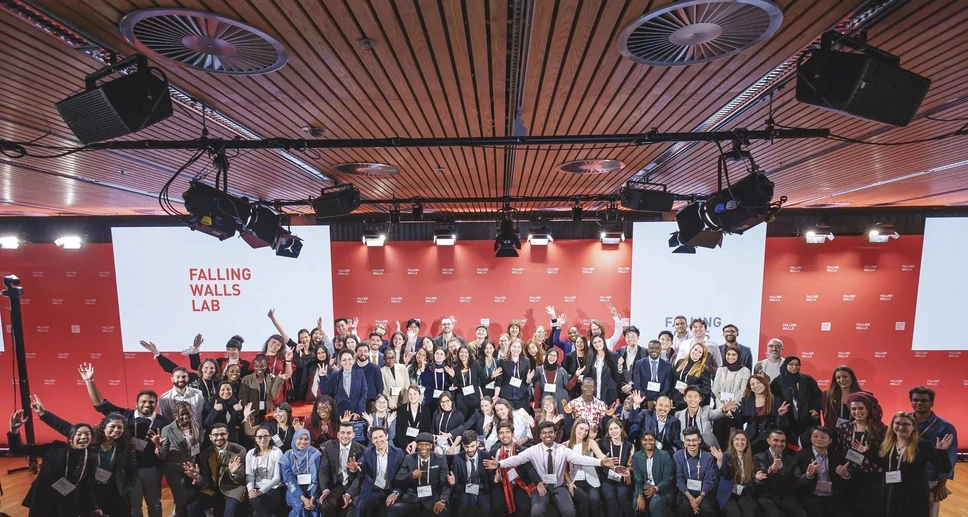
Thanks to her victory in the national round of the Falling Walls Lab science communication competition, the physical chemist Veronika Šedajová from CATRIN took part in the global finale in Berlin in early November. A total of one hundred finalists competed for the title Science Breakthrough of the Year in the Emerging Talents category. This global, interdisciplinary contest gives students and early-career researchers the opportunity to present their innovative ideas in just three minutes. Participants presented their research and proposed solutions to an expert jury made up of representatives from academia, industry and the public sector.
CATRIN: Falling Walls LabCATRIN: Falling Walls Lab

Veronika, what did you present in Berlin?

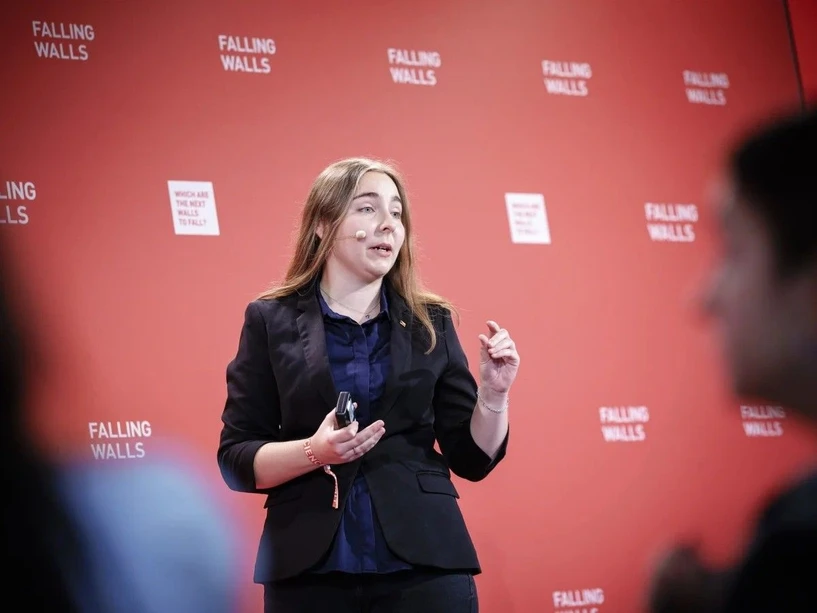
I presented our material—nitrogen-doped graphene for use in supercapacitors. I focused on the potential use of a supercapacitor containing our material in next-generation pacemakers and explained the benefits it could bring. I also mentioned that our research has already progressed from the lab towards practical application within the Trans2DChem project, and that we have founded the spin-out company Atomiver, where we are already able to produce the material in larger quantities.

As an experienced science communicator, what was different about this competition for you?

The format was very specific because of the extremely limited time. We were allowed only two slides and three minutes, which couldn’t be exceeded. So we were all under a lot of pressure to fit everything in. We presented before a jury made up of representatives of various scientific disciplines, so I had to make sure the information was understandable to everyone, not just colleagues from my field. It was important to show that the research is groundbreaking and to highlight its benefits for society.
CATRIN: Veronika Šedajová: The Falling Walls finale broadened my horizonsCATRIN: Veronika Šedajová: The Falling Walls finale broadened my horizons

Were you nervous? After all, it was the global finale with a hundred young scientists competing.

Given the significance and scale of the event, I was nervous—but I have to say I prepared for this competition more than for any other. I learned my script word for word to stay within the time limit. My colleague Martin Pykal helped me enormously by creating visualisations of what I wanted to present. I was also supported by the science communicator Vendula Lužná from Palacký University, as well as the community around the Žárovky endowment fund. It was extremely helpful to talk to Czech finalists from previous years, who gave me many useful recommendations. And I am very grateful to Barbora Boušová from the Czech office of DAAD: German Academic Exchange Service, who travelled with me to Berlin, for her support and encouragement.

How did you enjoy the presentations given by the other finalists?

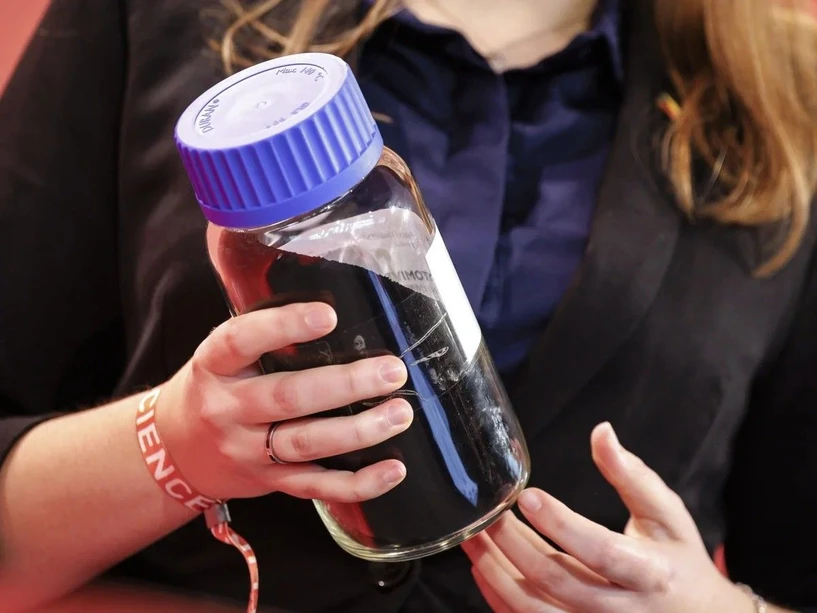
It was very enriching to see what problems researchers from different countries around the world are tackling. From the follow-up discussions I also learned what kind of resources colleagues—for example in Africa or South America—do or do not have, and how they collaborate internationally. It really opens your eyes and gives you a new perspective. The event definitely broadened my horizons, and I plan to listen to the presentations again because I wasn’t able to fully concentrate on all of them. As I learnt later from conversations with the other finalists, I was actually quite easy to recognise thanks to my props—I had the supercapacitor that I carry with me everywhere and a large bottle of graphene.
CATRIN: Veronika Šedajová: The Falling Walls finale broadened my horizonsCATRIN: Veronika Šedajová: The Falling Walls finale broadened my horizons

The presentations took place over a single day, but together with the other finalists you could attend the whole Science Summit. What did that bring you?

We had a very demanding programme, during which we visited university departments and the laboratories of the Max Planck Institute. The weekend was dedicated to networking. We could attend any lectures we wanted, and there were dedicated networking sessions with representatives of major industrial players. You could talk to people from different sectors and possibly even find someone to collaborate with in the future. Many people were approaching us, so it was certainly very useful. I also met representatives of the Czech Embassy in Berlin and described our research to the ambassador.

Will science communication remain something you want to pursue alongside your research and company work? Was the competition a new impulse?

I’ve always enjoyed science communication, and to some extent it helps me push my own boundaries. I’m rather prone to stress, and events like this teach me to calm down and present science to people who are not experts. The advice we received in Berlin will definitely be useful in the future—whether when presenting scientific results or within a company. I still consider science popularization important, but I don’t have any special plans. I’m letting things flow—we’ll see.

CATRIN
LinkedIn Logo
 

Related content

Analysis of Aroma Components in Apples Using the Smart Aroma Database

Applications
| 2026 | Shimadzu
Instrumentation
GC/MSD, GC/SQ, HeadSpace
Manufacturer
Shimadzu
Industries
Food & Agriculture

Analysis of Acetaldehyde and Limonene in Recycled PET Using an HS-GCMS System (Carrier Gas: H2)

Applications
| 2026 | Shimadzu
Instrumentation
GC/MSD, GC/SQ, HeadSpace
Manufacturer
Shimadzu
Industries
Energy & Chemicals

What Causes GC Capillary Column Performance Degradation, and How Can I Prevent It?

Technical notes
| 2026 | Agilent Technologies
Instrumentation
Consumables, GC columns
Manufacturer
Agilent Technologies
Industries
Other

Aromatic Component Analysis of Gasoline According to ASTM D5580 Using the Brevis GC- 2050 Gas Chromatograph

Applications
| 2025 | Shimadzu
Instrumentation
GC
Manufacturer
Shimadzu
Industries
Energy & Chemicals

Micro GC Analysis of Permanent Gas Impurities in PEM Fuel Cell-Grade Hydrogen

Applications
| 2025 | Agilent Technologies
Instrumentation
GC
Manufacturer
Agilent Technologies
Industries
Energy & Chemicals
 

Related articles

Webinars LabRulezGCMS Week 07/2026
Article | Webinars

Webinars LabRulezGCMS Week 07/2026

3 webinars: AI in manufacturing, fermentation, functional food, mAb production, metabolite monitoring, process Raman, process analytics
LabRulez
tag
share
more
QuEChERS Combined with Low-Temperature Partitioning and GC–MS as an Analytical Strategy for the Determination of Multiclass Pesticide Residues in Cocoa Beans
Scientific article | Science and research

QuEChERS Combined with Low-Temperature Partitioning and GC–MS as an Analytical Strategy for the Determination of Multiclass Pesticide Residues in Cocoa Beans

This study combines QuEChERS and low-temperature partitioning with GC–MS to determine multiclass pesticide residues in cocoa beans with good sensitivity and recoveries.
LabRulez
tag
share
more
ISC 2026 Short Course 3 - Interpretation of Mass Spectra: Basic Introduction for Chromatographers
Article | Events

ISC 2026 Short Course 3 - Interpretation of Mass Spectra: Basic Introduction for Chromatographers

Short Course 3 at ISC 2026 offers a practical introduction to LC–MS spectral interpretation for chromatographers, covering ESI, APCI, APPI, adducts, isotope patterns, and MS/MS fundamentals.
International Symposium on Chromatography - (ISC)
tag
share
more
Eurachem/CITAC Workshop on Quality in Analytical Measurements 2026
Article | Events

Eurachem/CITAC Workshop on Quality in Analytical Measurements 2026

Eurachem Week 2026 brings training and workshops on measurement uncertainty, quality in analytical measurements, and results interpretation, combining theory, practical cases, and expert-led discussions.
Eurachem
tag
share
more
 

Related content

Analysis of Aroma Components in Apples Using the Smart Aroma Database

Applications
| 2026 | Shimadzu
Instrumentation
GC/MSD, GC/SQ, HeadSpace
Manufacturer
Shimadzu
Industries
Food & Agriculture

Analysis of Acetaldehyde and Limonene in Recycled PET Using an HS-GCMS System (Carrier Gas: H2)

Applications
| 2026 | Shimadzu
Instrumentation
GC/MSD, GC/SQ, HeadSpace
Manufacturer
Shimadzu
Industries
Energy & Chemicals

What Causes GC Capillary Column Performance Degradation, and How Can I Prevent It?

Technical notes
| 2026 | Agilent Technologies
Instrumentation
Consumables, GC columns
Manufacturer
Agilent Technologies
Industries
Other

Aromatic Component Analysis of Gasoline According to ASTM D5580 Using the Brevis GC- 2050 Gas Chromatograph

Applications
| 2025 | Shimadzu
Instrumentation
GC
Manufacturer
Shimadzu
Industries
Energy & Chemicals

Micro GC Analysis of Permanent Gas Impurities in PEM Fuel Cell-Grade Hydrogen

Applications
| 2025 | Agilent Technologies
Instrumentation
GC
Manufacturer
Agilent Technologies
Industries
Energy & Chemicals
 

Related articles

Webinars LabRulezGCMS Week 07/2026
Article | Webinars

Webinars LabRulezGCMS Week 07/2026

3 webinars: AI in manufacturing, fermentation, functional food, mAb production, metabolite monitoring, process Raman, process analytics
LabRulez
tag
share
more
QuEChERS Combined with Low-Temperature Partitioning and GC–MS as an Analytical Strategy for the Determination of Multiclass Pesticide Residues in Cocoa Beans
Scientific article | Science and research

QuEChERS Combined with Low-Temperature Partitioning and GC–MS as an Analytical Strategy for the Determination of Multiclass Pesticide Residues in Cocoa Beans

This study combines QuEChERS and low-temperature partitioning with GC–MS to determine multiclass pesticide residues in cocoa beans with good sensitivity and recoveries.
LabRulez
tag
share
more
ISC 2026 Short Course 3 - Interpretation of Mass Spectra: Basic Introduction for Chromatographers
Article | Events

ISC 2026 Short Course 3 - Interpretation of Mass Spectra: Basic Introduction for Chromatographers

Short Course 3 at ISC 2026 offers a practical introduction to LC–MS spectral interpretation for chromatographers, covering ESI, APCI, APPI, adducts, isotope patterns, and MS/MS fundamentals.
International Symposium on Chromatography - (ISC)
tag
share
more
Eurachem/CITAC Workshop on Quality in Analytical Measurements 2026
Article | Events

Eurachem/CITAC Workshop on Quality in Analytical Measurements 2026

Eurachem Week 2026 brings training and workshops on measurement uncertainty, quality in analytical measurements, and results interpretation, combining theory, practical cases, and expert-led discussions.
Eurachem
tag
share
more
 

Related content

Analysis of Aroma Components in Apples Using the Smart Aroma Database

Applications
| 2026 | Shimadzu
Instrumentation
GC/MSD, GC/SQ, HeadSpace
Manufacturer
Shimadzu
Industries
Food & Agriculture

Analysis of Acetaldehyde and Limonene in Recycled PET Using an HS-GCMS System (Carrier Gas: H2)

Applications
| 2026 | Shimadzu
Instrumentation
GC/MSD, GC/SQ, HeadSpace
Manufacturer
Shimadzu
Industries
Energy & Chemicals

What Causes GC Capillary Column Performance Degradation, and How Can I Prevent It?

Technical notes
| 2026 | Agilent Technologies
Instrumentation
Consumables, GC columns
Manufacturer
Agilent Technologies
Industries
Other

Aromatic Component Analysis of Gasoline According to ASTM D5580 Using the Brevis GC- 2050 Gas Chromatograph

Applications
| 2025 | Shimadzu
Instrumentation
GC
Manufacturer
Shimadzu
Industries
Energy & Chemicals

Micro GC Analysis of Permanent Gas Impurities in PEM Fuel Cell-Grade Hydrogen

Applications
| 2025 | Agilent Technologies
Instrumentation
GC
Manufacturer
Agilent Technologies
Industries
Energy & Chemicals
 

Related articles

Webinars LabRulezGCMS Week 07/2026
Article | Webinars

Webinars LabRulezGCMS Week 07/2026

3 webinars: AI in manufacturing, fermentation, functional food, mAb production, metabolite monitoring, process Raman, process analytics
LabRulez
tag
share
more
QuEChERS Combined with Low-Temperature Partitioning and GC–MS as an Analytical Strategy for the Determination of Multiclass Pesticide Residues in Cocoa Beans
Scientific article | Science and research

QuEChERS Combined with Low-Temperature Partitioning and GC–MS as an Analytical Strategy for the Determination of Multiclass Pesticide Residues in Cocoa Beans

This study combines QuEChERS and low-temperature partitioning with GC–MS to determine multiclass pesticide residues in cocoa beans with good sensitivity and recoveries.
LabRulez
tag
share
more
ISC 2026 Short Course 3 - Interpretation of Mass Spectra: Basic Introduction for Chromatographers
Article | Events

ISC 2026 Short Course 3 - Interpretation of Mass Spectra: Basic Introduction for Chromatographers

Short Course 3 at ISC 2026 offers a practical introduction to LC–MS spectral interpretation for chromatographers, covering ESI, APCI, APPI, adducts, isotope patterns, and MS/MS fundamentals.
International Symposium on Chromatography - (ISC)
tag
share
more
Eurachem/CITAC Workshop on Quality in Analytical Measurements 2026
Article | Events

Eurachem/CITAC Workshop on Quality in Analytical Measurements 2026

Eurachem Week 2026 brings training and workshops on measurement uncertainty, quality in analytical measurements, and results interpretation, combining theory, practical cases, and expert-led discussions.
Eurachem
tag
share
more
 

Related content

Analysis of Aroma Components in Apples Using the Smart Aroma Database

Applications
| 2026 | Shimadzu
Instrumentation
GC/MSD, GC/SQ, HeadSpace
Manufacturer
Shimadzu
Industries
Food & Agriculture

Analysis of Acetaldehyde and Limonene in Recycled PET Using an HS-GCMS System (Carrier Gas: H2)

Applications
| 2026 | Shimadzu
Instrumentation
GC/MSD, GC/SQ, HeadSpace
Manufacturer
Shimadzu
Industries
Energy & Chemicals

What Causes GC Capillary Column Performance Degradation, and How Can I Prevent It?

Technical notes
| 2026 | Agilent Technologies
Instrumentation
Consumables, GC columns
Manufacturer
Agilent Technologies
Industries
Other

Aromatic Component Analysis of Gasoline According to ASTM D5580 Using the Brevis GC- 2050 Gas Chromatograph

Applications
| 2025 | Shimadzu
Instrumentation
GC
Manufacturer
Shimadzu
Industries
Energy & Chemicals

Micro GC Analysis of Permanent Gas Impurities in PEM Fuel Cell-Grade Hydrogen

Applications
| 2025 | Agilent Technologies
Instrumentation
GC
Manufacturer
Agilent Technologies
Industries
Energy & Chemicals
 

Related articles

Webinars LabRulezGCMS Week 07/2026
Article | Webinars

Webinars LabRulezGCMS Week 07/2026

3 webinars: AI in manufacturing, fermentation, functional food, mAb production, metabolite monitoring, process Raman, process analytics
LabRulez
tag
share
more
QuEChERS Combined with Low-Temperature Partitioning and GC–MS as an Analytical Strategy for the Determination of Multiclass Pesticide Residues in Cocoa Beans
Scientific article | Science and research

QuEChERS Combined with Low-Temperature Partitioning and GC–MS as an Analytical Strategy for the Determination of Multiclass Pesticide Residues in Cocoa Beans

This study combines QuEChERS and low-temperature partitioning with GC–MS to determine multiclass pesticide residues in cocoa beans with good sensitivity and recoveries.
LabRulez
tag
share
more
ISC 2026 Short Course 3 - Interpretation of Mass Spectra: Basic Introduction for Chromatographers
Article | Events

ISC 2026 Short Course 3 - Interpretation of Mass Spectra: Basic Introduction for Chromatographers

Short Course 3 at ISC 2026 offers a practical introduction to LC–MS spectral interpretation for chromatographers, covering ESI, APCI, APPI, adducts, isotope patterns, and MS/MS fundamentals.
International Symposium on Chromatography - (ISC)
tag
share
more
Eurachem/CITAC Workshop on Quality in Analytical Measurements 2026
Article | Events

Eurachem/CITAC Workshop on Quality in Analytical Measurements 2026

Eurachem Week 2026 brings training and workshops on measurement uncertainty, quality in analytical measurements, and results interpretation, combining theory, practical cases, and expert-led discussions.
Eurachem
tag
share
more
Other projects
LCMS
ICPMS
Follow us
More information
WebinarsAbout usContact usTerms of use
LabRulez s.r.o. All rights reserved. Content available under a CC BY-SA 4.0 Attribution-ShareAlike