Automated Dilutions Using the Centurion Autosampler
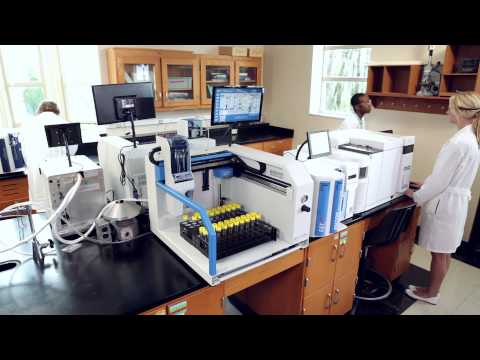
- Photo: EST Analytical: Automated Dilutions Using the Centurion Autosampler
- Video: EST Analytical: EST CENTURION | EST Analytical
Analysis of field samples in environmental laboratories can sometimes be complicated by how contaminated or “hot” the sample is. Many times “hot” samples have to be diluted in order to verify the level of contamination in the sample. The process of diluting samples is a time consuming process that can sometimes lead to human error when calculations are incorrect. A further problem is the loss of volatile organic compounds as the sample vial needs to be opened in order to perform the dilution.
This poster will examine the benefits of automated dilutions. Since the syringe option of this system has the unique ability to dilute samples from two times to 400 times the original concentration, this study will examine the precision and accuracy for an array of dilutions in this comprehensive range. The dilution data will be compared to a manually prepared 50ppb calibration standard in order to determine the accuracy of the results. The precision will be established by examining four sequential dilutions and the percent relative standard deviation of the compounds’ respective area counts. Furthermore, in order to demonstrate the linearity of the dilutions, a calibration curve will be presented using the automated dilution option to prepare 200ppb standards for a calibration range of 0.5ppb (400x) to 200ppb (1x).
Discussion
Environmental laboratories often have to dilute field samples due to the analytes of interest having concentrations over the highest calibration level of the curve. In order to dilute these samples, the vial has to be opened and a portion of the sample has to be diluted manually and re-analyzed. Opening the vial can compromise the integrity of the sample as volatiles are lost when the seal of the vial is broken.
EST Analytical has developed a syringe feature for the Centurion Autosampler that can dilute samples up to 400 times the original concentration. This feature is fully programmable and the sample vial does not have to be compromised in order to dilute the sample because the dilution process is automated. The sealed vial can be placed in the sample tray while the Centurion does all of the work.
Experimental
The Centurion WS autosampler was configured with an Encon Evolution concentrator. A Vocarb 3000 (K) trap was installed in the Evolution. Finally, the sampling system was connected to a GC/MS for sample analysis. The GC column employed for this study was an Rxi-624Sil MS 30m x 0.25mm x 1.4µm. Dilution Factors, Purge and Trap, and GC/MS parameters are listed below.
Standard Concentration & Dilution Factors
- 100ppb: 2x
- 250ppb: 5x
- 500ppb: 10x
- 2.5ppm: 50x
- 5ppm: 100x
- 10ppm: 200x
- 20ppm: 400x
Purge and Trap Parameters
- Concentrator: EST Encon Evolution
- Trap type: Vocarb 3000
- Valve oven temperature: 150 °C
- Transfer line temperature: 150 °C
- Trap temperature: 35 °C
- Moisture Reduction Trap (MoRT) temperature: 39 °C
- Purge time: 11 min
- Purge flow: 40 mL/min
- Dry purge Temp.: Ambient
- Dry Purge Flow: 40mL/min
- Dry Purge Time: 1.0 min
- Desorb pressure Control: ON
- Desorb Pressure: 5psi
- Desorb time: 0.5 min
- Desorb preheat delay: 5 sec
- Desorb temperature: 260 °C
- MoRT bake temperature: 230 °C
- Bake temperature: 265 °C
- Sparge vessel bake temperature: 120 °C
- Bake time: 8 min
- Bake flow: 40 mL/min
GC/MS Parameters
- System: Agilent 7890/5975
- Inlet: Split mode, 200 °C, 40:1 split ratio, 12.153 psi head pressure
- Column: Rxi-624Sil MS 30m x 0.25mm I.D. 1.4µm film thickness
- Oven program: 45 °C (1 min) → ramp 18 °C/min → 220 °C, hold for 0.3 min
- Column flow rate: 1 mL/min helium
- Total flow: 44.0 mL/min
- Source temperature: 230 °C
- Quadrupole temperature: 150 °C
- Transfer line temperature: 180 °C
- Scan range: m/z 35–265, 3.12 scans/sec
- Solvent delay: 0.7 min
A 9 point calibration curve was manually prepared and run from 0.5 to 200ppb with standards ordered from Restek. After a linear calibration curve was established, a 50ppb calibration standard was run to establish instrument response for the compounds being analyzed. Next, a series of dilutions were run and compared with the initial 50ppb calibration standard. Each dilution factor was run four times with blanks in between. The final concentration of each dilution was 50ppb. The precision and accuracy of the dilutions are listed in Tables 4 and 5 and Figures 1 and 2 display the chromatograms of two of the dilutions.
 EST Analytical: Figure 1 - Overlay of 50ppb (1X) and 2500ppb (50x) Standards
 EST Analytical: Figure 2 - Overlay of 50ppb (1X) and 10000ppb (200x) Standards
 EST Analytical: Table 4 - Experimental Results (2x, 5x, 10x, and 50x dilutions)
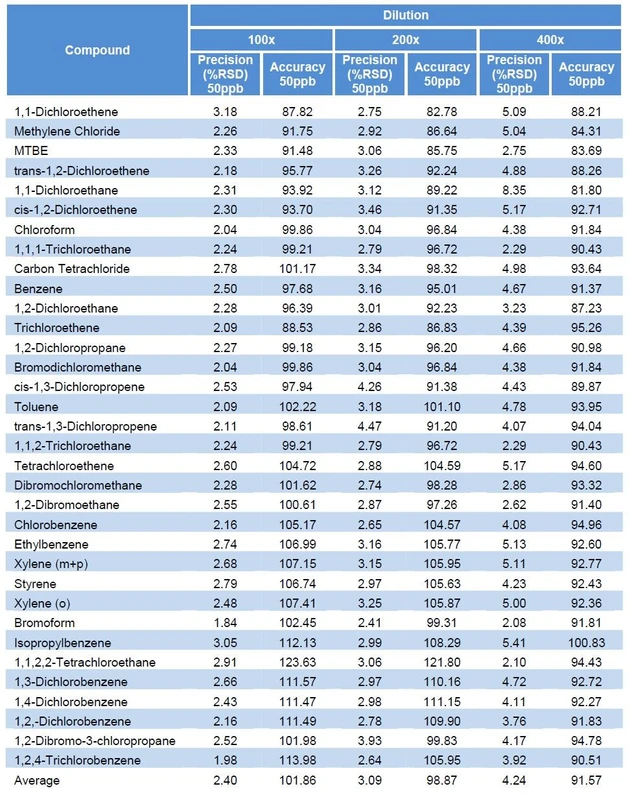 EST Analytical: Table 5 - Experimental Results (100x, 200x and 400x dilutions)
Finally, a nine point calibration curve was run by setting up the system to do the dilutions. The curve was run using nine 40ml vials filled to volume with a 200ppb calibration standard and doing serial dilutions on the standards. For example, the 200ppb was diluted 400x for the 0.5ppb standard, 200x for the 1.0ppb standard, etc. See Table 6 for the curve dilutions and Table 7 for the curve linearity and compound responses.
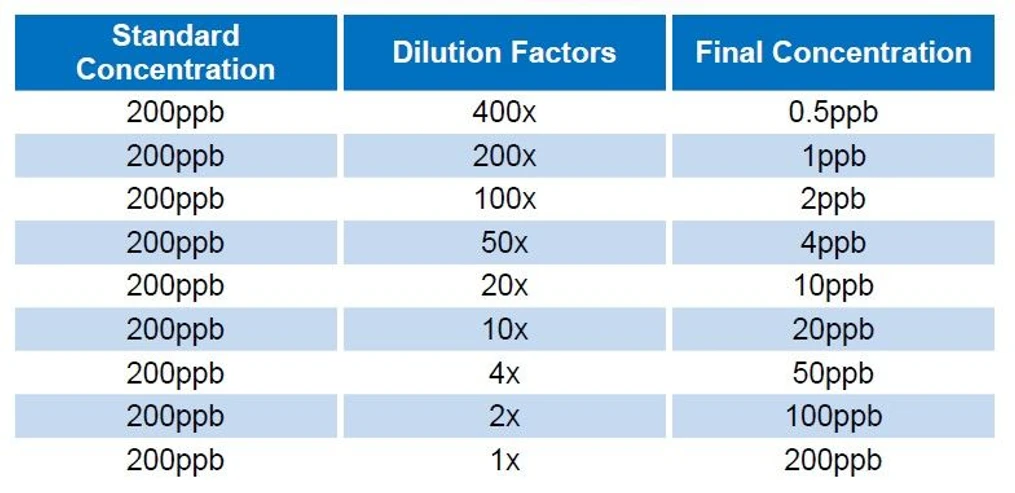 EST Analytical: Table 6 Syringe Curve Dilutions
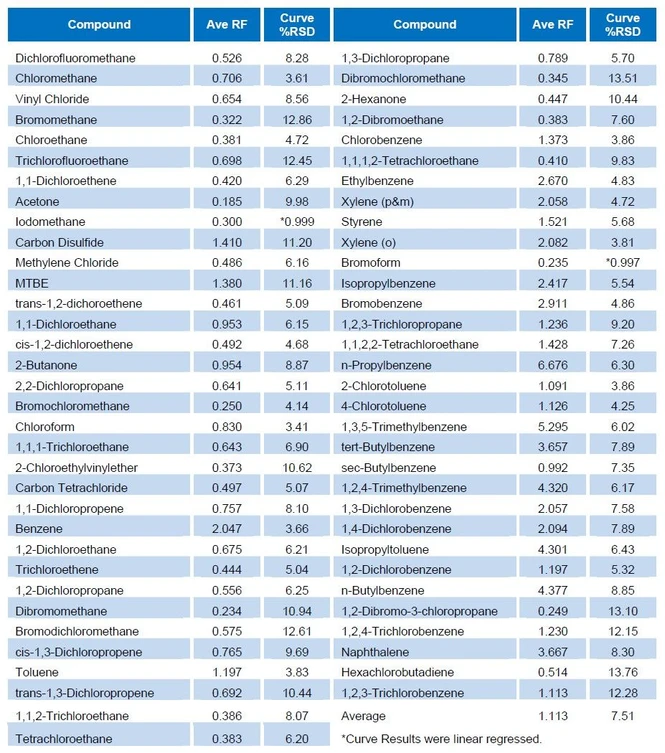 EST Analytical: Table 7 Automated Dilution Curve Results
Conclusions
The Centurion WS with the syringe option displayed remarkable precision and accuracy from as low as the 2x dilution to as high as 400x dilution. On the whole, the average precision of the instrument was less than 5%RSD while the overall accuracy was 90% to 110%. The system also is capable of curve automation with the average %RSD of below 10% for a 9 point curve from 0.5ppb to 200ppb. The automated dilution feature of the Centurion WS with the syringe option would enable laboratories to run samples more efficiently and the since the samples would not need to be compromised in order to perform dilutions, the accuracy of the experimental results would improve.