Author
Phenomenex
Phenomenex
Phenomenex is a global technology leader committed to developing novel analytical chemistry solutions that solve the separation and purification challenges of researchers in industrial, government and academic laboratories.
Tags
Article
Academy
LinkedIn Logo

Using Phase Ratio to Reduce Run Time
We, 5.11.2025
| Original article from: Phenomenex
Learn how column length, internal diameter, and film thickness work together to optimize phase ratio in GC. Discover how adjusting these parameters reduces run time while maintaining separation efficiency.
<p>LabRulez / AI: Using Phase Ratio to Reduce Run Time</p>

LabRulez / AI: Using Phase Ratio to Reduce Run Time

How Does Each Parameter of Your GC Column Affect Chromatography?

Length will have a big effect on the resolution of critical pairs, the longer the column the more theoretical plates you have available for interactions of your analyte with the column and the better the separation.

Columns with high numbers of theoretical plates will still require the interactions of the analyte with the stationary phase to be fast and efficient to give the greatest separation possible within the column length. The internal diameter of your column can ensure you achieve this. Narrow columns can provide more of these fast, efficient interactions and offer good separation and sharp peak shapes. You should, however, be mindful when reducing column ID that you will limit the loading capacity of your column and will have to work at a reduced flow rate.

The third parameter of a GC column that affects chromatography efficiency, is the film thickness. A thinner film will give a faster rate of mass transfer. When a thin film is used, the transition of an analyte into and out of the stationary phase is easier leading to shorter retention times. These parameters all work in harmony and can be used to reduce run time by working with the phase ratio of the column to optimize your method.

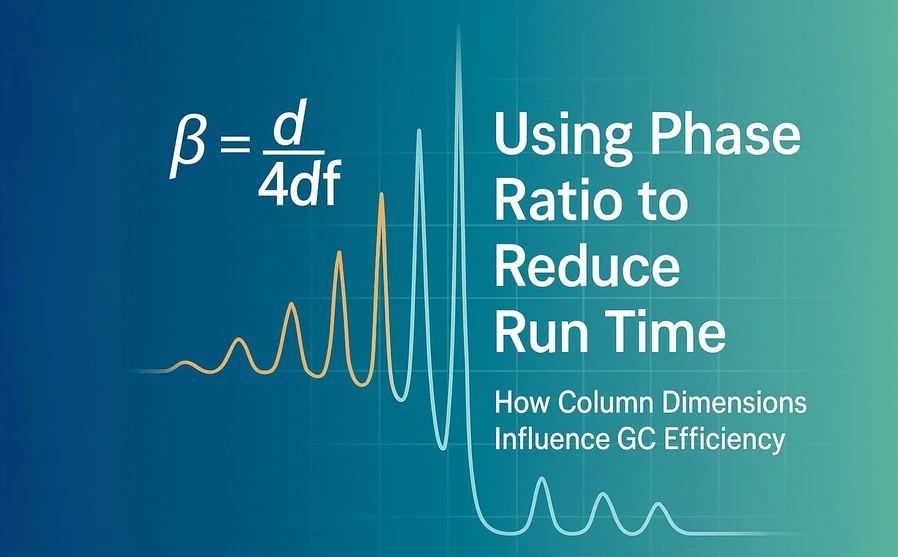
Phase ratio is calculated from the column ID and film thickness using this equation:

ß = d / 4df (where d = column diameter in mm and df = film thickness in µm)

Once you have the phase ratio of the column used in your separation, you can improve separation by increasing phase ratio. A higher ß value represents a higher efficiency separation which in turn allows you to use a shorter column to achieve the same separation.

As an example, the initial analysis has a phase ratio of (β) = 44.2 using a 30 m x 0.53 mm x 3.00 µm column. If the film thickness remains the same but the column ID is reduced (in theory to reduce the analysis time), this would result in a reduction in phase ratio and lead to a loss of efficiency. To maintain efficiency and reduce run time the film thickness also must be reduced which will then give the same efficiency but a faster analysis time.

In summary:

  • A smaller column ID will increase the frequency of interactions of the analyte with the stationary phase, which leads to an increase in efficiency.
  • A thinner film will increase the rate of mass-transfer, which also leads to an increase in efficiency through reducing diffusion within the liquid film.
  • Once you increase efficiency you can use a shorter column length to reduce run time whilst maintaining the original efficiency of your separation.

Through the optimization of your analysis using phase ratio you can reduce your GC analysis time, saving you time and producing a more efficient laboratory.

Phenomenex
LinkedIn Logo
 

Related content

High-Throughput BTEX Analysis in Nail Products by SPME and GC/TQ

Applications
| 2026 | Agilent Technologies
Instrumentation
GC/MSD, GC/MS/MS, GC/QQQ, SPME
Manufacturer
Agilent Technologies
Industries
Materials Testing

Accurate multi-component blast furnace gas analysis maximizes iron production and minimizes coke consumption

Applications
| 2026 | Thermo Fisher Scientific
Instrumentation
GC/MSD
Manufacturer
Thermo Fisher Scientific
Industries
Energy & Chemicals

Gas Chromatograph Nexis GC-2060

Brochures and specifications
| 2026 | Shimadzu
Instrumentation
GC
Manufacturer
Shimadzu
Industries
Other

Quantitative Volatile PFAS Analysis in Textiles

Applications
| 2026 | Agilent Technologies
Instrumentation
GC/MSD, GC/MS/MS, GC/QQQ
Manufacturer
Agilent Technologies
Industries
Materials Testing

Effectiveness of the MonoTrap Collection Method for VOC Analysis in Exhaled Breath Using GC-MS

Applications
| 2026 | Shimadzu
Instrumentation
GC/MSD, Thermal desorption, GC/SQ
Manufacturer
Shimadzu
Industries
Clinical Research
 

Related articles

Advantages and disadvantages of substitution of helium as carrier gas in gas chromatography by hydrogen. Part II. - Retention time and selectivity.
Scientific article | Academy

Advantages and disadvantages of substitution of helium as carrier gas in gas chromatography by hydrogen. Part II. - Retention time and selectivity.

This article is focused on the chromatographic parameters such as retention time and selectivity after switching to the use of hydrogen or nitrogen.
The journal Kvasny Prumysl
tag
share
more
What parameters should I consider when selecting a GC column for my application?
Article | Academy

What parameters should I consider when selecting a GC column for my application?

What parameters should I consider when selecting a GC column for my application?
Phenomenex
tag
share
more
Unlocking Comprehensive Two-Dimensional Gas Chromatography: Simplifying Method Development for Users
Interview | Video

Unlocking Comprehensive Two-Dimensional Gas Chromatography: Simplifying Method Development for Users

Katelynn Perrault Uptmor explains GC×GC fundamentals, method-development strategies, column selection, and real-world applications—from forensics to fuels—while sharing insights from her award-winning research.
Organomation
tag
share
more
How to Choose GC Column Dimensions
Article | Academy

How to Choose GC Column Dimensions

Guidance on selecting key GC column parameters — length, internal diameter, and film thickness — and their influence on resolution, retention, run time, and sample capacity.
Phenomenex
tag
share
more
 

Related content

High-Throughput BTEX Analysis in Nail Products by SPME and GC/TQ

Applications
| 2026 | Agilent Technologies
Instrumentation
GC/MSD, GC/MS/MS, GC/QQQ, SPME
Manufacturer
Agilent Technologies
Industries
Materials Testing

Accurate multi-component blast furnace gas analysis maximizes iron production and minimizes coke consumption

Applications
| 2026 | Thermo Fisher Scientific
Instrumentation
GC/MSD
Manufacturer
Thermo Fisher Scientific
Industries
Energy & Chemicals

Gas Chromatograph Nexis GC-2060

Brochures and specifications
| 2026 | Shimadzu
Instrumentation
GC
Manufacturer
Shimadzu
Industries
Other

Quantitative Volatile PFAS Analysis in Textiles

Applications
| 2026 | Agilent Technologies
Instrumentation
GC/MSD, GC/MS/MS, GC/QQQ
Manufacturer
Agilent Technologies
Industries
Materials Testing

Effectiveness of the MonoTrap Collection Method for VOC Analysis in Exhaled Breath Using GC-MS

Applications
| 2026 | Shimadzu
Instrumentation
GC/MSD, Thermal desorption, GC/SQ
Manufacturer
Shimadzu
Industries
Clinical Research
 

Related articles

Advantages and disadvantages of substitution of helium as carrier gas in gas chromatography by hydrogen. Part II. - Retention time and selectivity.
Scientific article | Academy

Advantages and disadvantages of substitution of helium as carrier gas in gas chromatography by hydrogen. Part II. - Retention time and selectivity.

This article is focused on the chromatographic parameters such as retention time and selectivity after switching to the use of hydrogen or nitrogen.
The journal Kvasny Prumysl
tag
share
more
What parameters should I consider when selecting a GC column for my application?
Article | Academy

What parameters should I consider when selecting a GC column for my application?

What parameters should I consider when selecting a GC column for my application?
Phenomenex
tag
share
more
Unlocking Comprehensive Two-Dimensional Gas Chromatography: Simplifying Method Development for Users
Interview | Video

Unlocking Comprehensive Two-Dimensional Gas Chromatography: Simplifying Method Development for Users

Katelynn Perrault Uptmor explains GC×GC fundamentals, method-development strategies, column selection, and real-world applications—from forensics to fuels—while sharing insights from her award-winning research.
Organomation
tag
share
more
How to Choose GC Column Dimensions
Article | Academy

How to Choose GC Column Dimensions

Guidance on selecting key GC column parameters — length, internal diameter, and film thickness — and their influence on resolution, retention, run time, and sample capacity.
Phenomenex
tag
share
more
 

Related content

High-Throughput BTEX Analysis in Nail Products by SPME and GC/TQ

Applications
| 2026 | Agilent Technologies
Instrumentation
GC/MSD, GC/MS/MS, GC/QQQ, SPME
Manufacturer
Agilent Technologies
Industries
Materials Testing

Accurate multi-component blast furnace gas analysis maximizes iron production and minimizes coke consumption

Applications
| 2026 | Thermo Fisher Scientific
Instrumentation
GC/MSD
Manufacturer
Thermo Fisher Scientific
Industries
Energy & Chemicals

Gas Chromatograph Nexis GC-2060

Brochures and specifications
| 2026 | Shimadzu
Instrumentation
GC
Manufacturer
Shimadzu
Industries
Other

Quantitative Volatile PFAS Analysis in Textiles

Applications
| 2026 | Agilent Technologies
Instrumentation
GC/MSD, GC/MS/MS, GC/QQQ
Manufacturer
Agilent Technologies
Industries
Materials Testing

Effectiveness of the MonoTrap Collection Method for VOC Analysis in Exhaled Breath Using GC-MS

Applications
| 2026 | Shimadzu
Instrumentation
GC/MSD, Thermal desorption, GC/SQ
Manufacturer
Shimadzu
Industries
Clinical Research
 

Related articles

Advantages and disadvantages of substitution of helium as carrier gas in gas chromatography by hydrogen. Part II. - Retention time and selectivity.
Scientific article | Academy

Advantages and disadvantages of substitution of helium as carrier gas in gas chromatography by hydrogen. Part II. - Retention time and selectivity.

This article is focused on the chromatographic parameters such as retention time and selectivity after switching to the use of hydrogen or nitrogen.
The journal Kvasny Prumysl
tag
share
more
What parameters should I consider when selecting a GC column for my application?
Article | Academy

What parameters should I consider when selecting a GC column for my application?

What parameters should I consider when selecting a GC column for my application?
Phenomenex
tag
share
more
Unlocking Comprehensive Two-Dimensional Gas Chromatography: Simplifying Method Development for Users
Interview | Video

Unlocking Comprehensive Two-Dimensional Gas Chromatography: Simplifying Method Development for Users

Katelynn Perrault Uptmor explains GC×GC fundamentals, method-development strategies, column selection, and real-world applications—from forensics to fuels—while sharing insights from her award-winning research.
Organomation
tag
share
more
How to Choose GC Column Dimensions
Article | Academy

How to Choose GC Column Dimensions

Guidance on selecting key GC column parameters — length, internal diameter, and film thickness — and their influence on resolution, retention, run time, and sample capacity.
Phenomenex
tag
share
more
 

Related content

High-Throughput BTEX Analysis in Nail Products by SPME and GC/TQ

Applications
| 2026 | Agilent Technologies
Instrumentation
GC/MSD, GC/MS/MS, GC/QQQ, SPME
Manufacturer
Agilent Technologies
Industries
Materials Testing

Accurate multi-component blast furnace gas analysis maximizes iron production and minimizes coke consumption

Applications
| 2026 | Thermo Fisher Scientific
Instrumentation
GC/MSD
Manufacturer
Thermo Fisher Scientific
Industries
Energy & Chemicals

Gas Chromatograph Nexis GC-2060

Brochures and specifications
| 2026 | Shimadzu
Instrumentation
GC
Manufacturer
Shimadzu
Industries
Other

Quantitative Volatile PFAS Analysis in Textiles

Applications
| 2026 | Agilent Technologies
Instrumentation
GC/MSD, GC/MS/MS, GC/QQQ
Manufacturer
Agilent Technologies
Industries
Materials Testing

Effectiveness of the MonoTrap Collection Method for VOC Analysis in Exhaled Breath Using GC-MS

Applications
| 2026 | Shimadzu
Instrumentation
GC/MSD, Thermal desorption, GC/SQ
Manufacturer
Shimadzu
Industries
Clinical Research
 

Related articles

Advantages and disadvantages of substitution of helium as carrier gas in gas chromatography by hydrogen. Part II. - Retention time and selectivity.
Scientific article | Academy

Advantages and disadvantages of substitution of helium as carrier gas in gas chromatography by hydrogen. Part II. - Retention time and selectivity.

This article is focused on the chromatographic parameters such as retention time and selectivity after switching to the use of hydrogen or nitrogen.
The journal Kvasny Prumysl
tag
share
more
What parameters should I consider when selecting a GC column for my application?
Article | Academy

What parameters should I consider when selecting a GC column for my application?

What parameters should I consider when selecting a GC column for my application?
Phenomenex
tag
share
more
Unlocking Comprehensive Two-Dimensional Gas Chromatography: Simplifying Method Development for Users
Interview | Video

Unlocking Comprehensive Two-Dimensional Gas Chromatography: Simplifying Method Development for Users

Katelynn Perrault Uptmor explains GC×GC fundamentals, method-development strategies, column selection, and real-world applications—from forensics to fuels—while sharing insights from her award-winning research.
Organomation
tag
share
more
How to Choose GC Column Dimensions
Article | Academy

How to Choose GC Column Dimensions

Guidance on selecting key GC column parameters — length, internal diameter, and film thickness — and their influence on resolution, retention, run time, and sample capacity.
Phenomenex
tag
share
more
Other projects
LCMS
ICPMS
Follow us
FacebookX (Twitter)LinkedInYouTube
More information
WebinarsAbout usContact usTerms of use
LabRulez s.r.o. All rights reserved. Content available under a CC BY-SA 4.0 Attribution-ShareAlike