Analysis of Coffee Flavors by Purge and Trap Sampling

LabRulez / AI: Analysis of Coffee Flavors by Purge and Trap Sampling
Abstract
Strong or weak, light or dark, black or with cream; everyone who drinks coffee has a preference. Today, there are not only the choices of what you would like in your coffee, but also how you would like it brewed. Do you prefer the old fashioned percolator or the straight forward brewed coffee? Or do you like the new coffee by the cup makers or the instant coffees? There are so many options! This study will analyze four different instant coffee blends for some of their respective flavors using a purge and trap concentrator.
Discussion
Most of us who drink coffee know our preferences. We know which blend we like, what strength and definitely what we like in our coffee. However, most of us do not think about the flavors that go into our coffee that help us define our preferences. Coffee manufacturers, on the other hand, are working diligently to create a new blend or a more satisfying flavor that would make us want to choose their coffee over another maker.
This study will look at four different blends of coffee and some of the compounds that contribute to the flavor of the blend. Using purge and trap sampling, the flavor compounds were purged out of the coffee and trapped onto an adsorbent trap. The analytes were then transferred to a Gas Chromatograph/Mass Spectrometer (GC/MS) for analysis. The study focused on six flavor compounds: the spicy smoky aroma of 2-methylfuran, the spicy caramel, almond odor of 5-methylfurfural, the buttery scent provided by the addition of 2,3-butanedione and 2,3-pentanedione, and the impact of the two and three methyl butanals giving the dark chocolate malty flavor to the coffee.
 EST Analytical: Encon Evolution Purge and Trap Concentrator and Centurion WS Autosampler
Experimental
The EST Analytical Encon Evolution Purge and Trap Concentrator and Centurion WS Autosampler were interfaced to a GC/MS. The Centurion WS was run in the soil mode and the purge and trap concentrator was configured with a Vocarb 3000 (K) analytical trap. The column selected for this study was an Rtx-1 60 m × 0.25 mm × 1 µm. Sampling method parameters and GC/MS parameters are listed below.
Purge and Trap Parameters
- Concentrator: EST Encon Evolution
- Trap type: Vocarb 3000
- Valve oven temperature: 150 °C
- Transfer line temperature: 150 °C
- Trap temperature: 35 °C
- Moisture Reduction Trap (MoRT) temperature: 39 °C
- Purge time: 11 min
- Purge flow: 40 mL/min
- Dry purge Temp.: Ambient
- Dry Purge Flow: 50mL/min
- Dry Purge Time: 1.0 min
- Desorb pressure Control: ON
- Desorb Pressure: 5psi
- Desorb time: 0.5 min
- Desorb preheat delay: 5 sec
- Desorb temperature: 260 °C
- MoRT bake temperature: 230 °C
- Bake temperature: 260 °C
- Sparge vessel bake temperature: 120 °C
- Bake time: 8 min
- Bake flow: 85 mL/min
Auto-Sampler (EST Centurion WS):
- Sample type: Soil
- Sample Fill Mode: loop
- Sample Volume: 10mL
- Sample Prime Time: 5 sec
- Loop Equilibration Time: 10 sec
- Sample Transfer Time: 15 sec
- Sample Loop Rinse: Off
- Sample Loop Sweep Time: 15 sec
- Number of Sparge Rinses: 1
- Rinse Volume: 5mL
- Rinse Transfer Time: 20 sec
- Rinse Drain Time: 20 sec
- Number of Foam Rinse Cycles: 1
- Water Heater Temp.: 85°C
- Sample Preheat Temp.: 40°C
- Soil Valve Temp.: 85°C
- Soil Transfer Line Temp.: 150°C
GC/MS Parameters
- System: Agilent 7890/5975
- Inlet: Split mode, 200 °C, 20:1 split ratio, 16.041 psi head pressure
- Column: Rtx-1 60m x 0.25mm I.D. 1.0µm film thickness
- Oven program: 35 °C (1 min) → ramp 4 °C/min → 230 °C, total run time of 49.75 min
- Column flow rate: 1 mL/min helium
- Total flow: 26.0 mL/min
- Source temperature: 230 °C
- Quadrupole temperature: 150 °C
- Transfer line temperature: 180 °C
- Scan range: m/z 35–265, 3.12 scans/sec
- Solvent delay: 0.0 min
The GC column was acquired from Restek while the instant coffees were purchased at a local retailer. The four roasts chosen for this study ranged from light to dark. One half of a gram of each coffee was dissolved in 40 mL of de-ionized water at room temperature. The vials were shaken in order to fully dissolve the coffee. Next, 5 mL of each coffee mixture were run in the soil mode using the Centurion WS autosampler and the Encon Evolution purge and trap concentrator. Each coffee was run in triplicate in order to verify the results. Figures 1 through 3 display a bar graph comparison of the flavors in each coffee blend. Chromatograms of the coffee blends are shown in Figures 4 through 7.
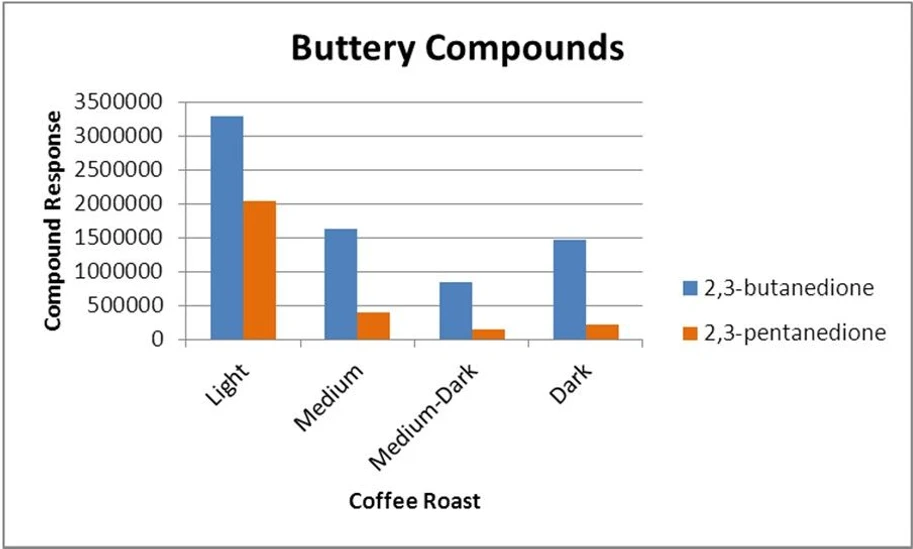 EST Analytical: Figure 1 Buttery Compound Comparison
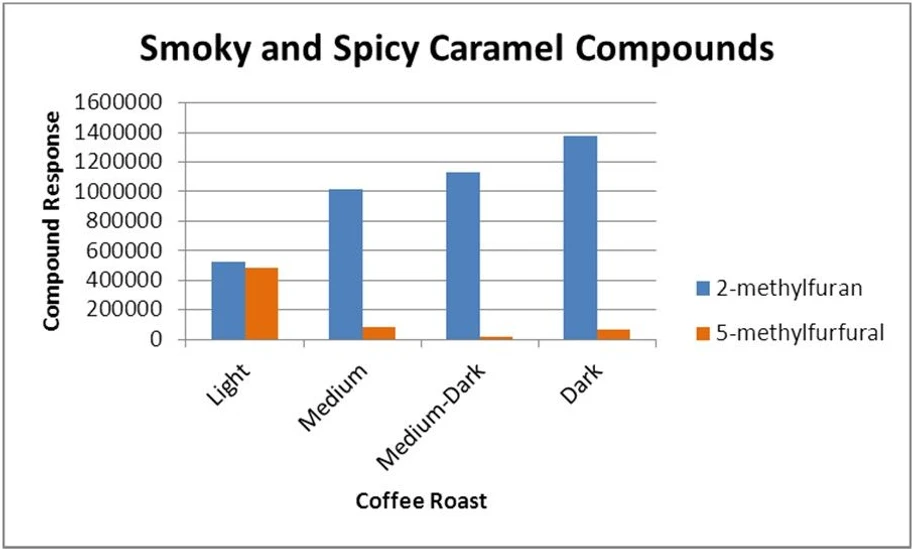 EST Analytical: Figure 2 Smoky and Spicy Caramel Compound Comparison
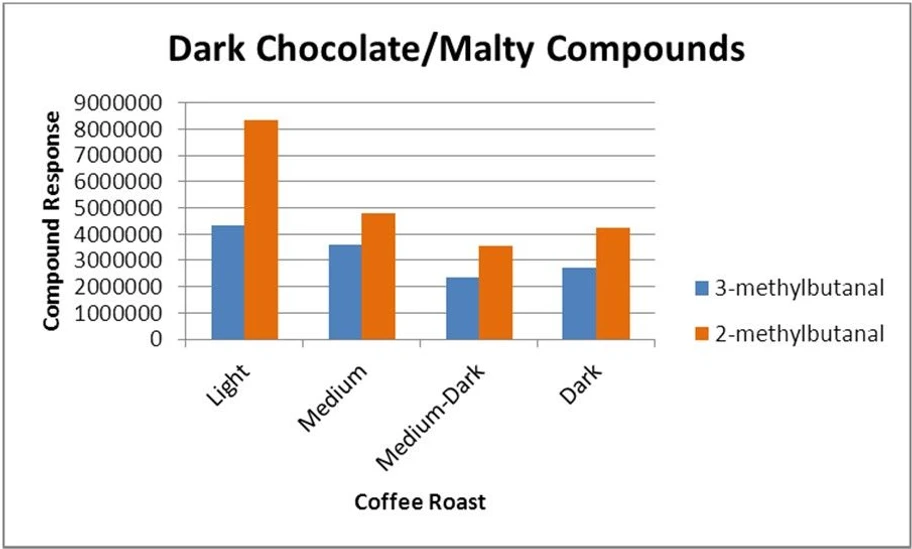 EST Analytical: Figure 3 Dark Chocolate - Malty Compound Comparison
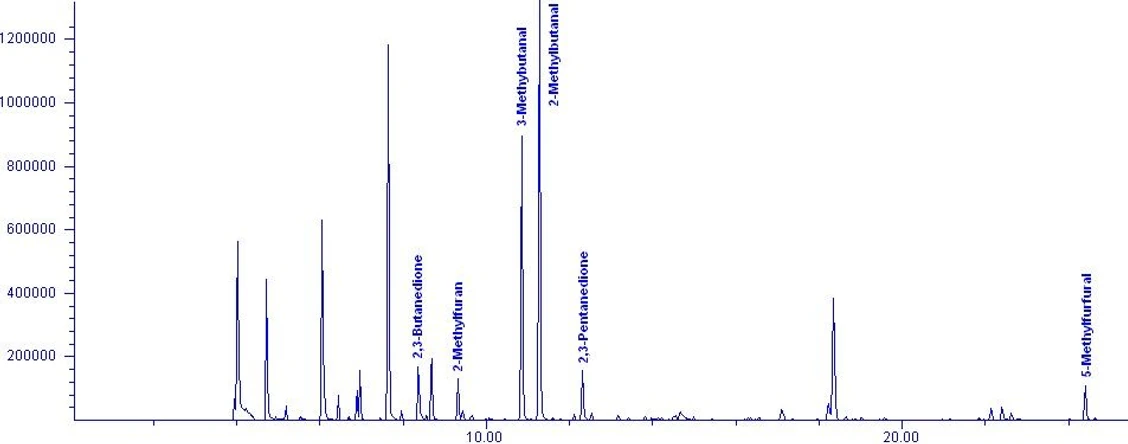 EST Analytical: Figure 4 Light Roast Chromatogram
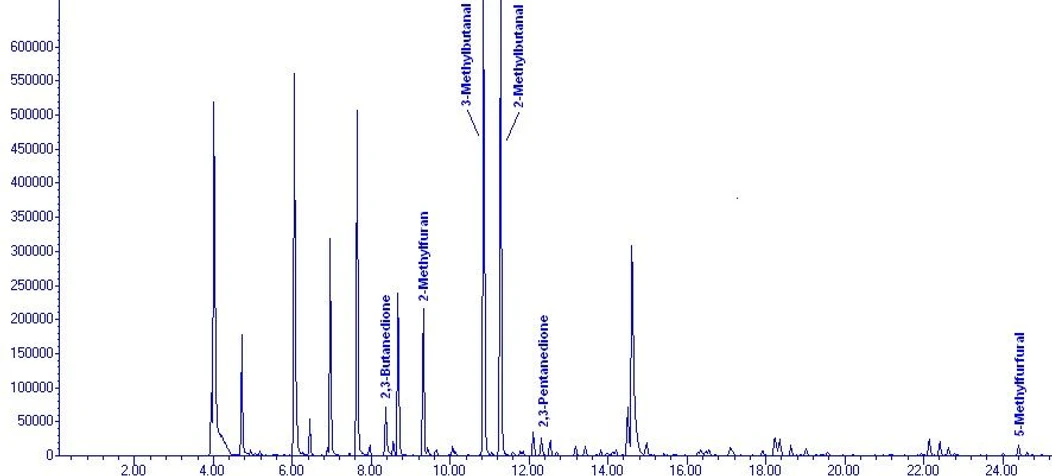 EST Analytical: Figure 5 Medium Roast Chromatogram
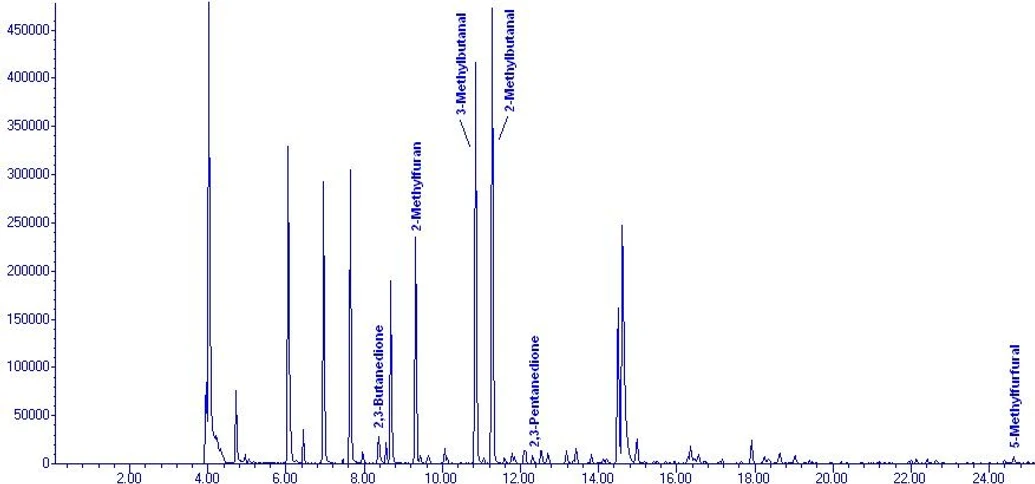 EST Analytical: Figure 6 Medium Dark Roast Chromatogram
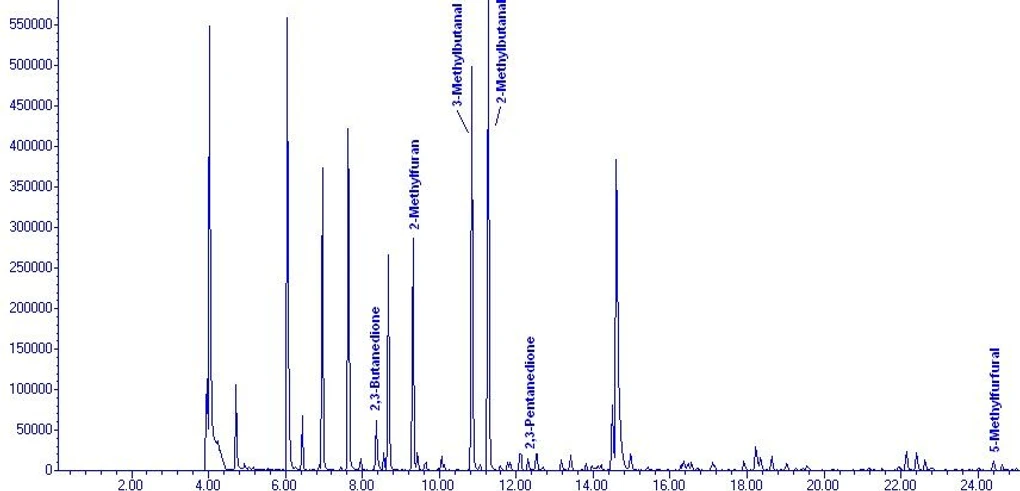 EST Analytical: Figure 7 Dark Roast Chromatogram
Conclusion
The lightest roast had the most buttery and dark chocolate/malty flavors while the darkest roast had more of the smoky flavor. Surprisingly, the darkest roast and the medium roast had similar proportions of the flavor compounds with the exception of the smoky flavor. While the light roast had large amounts of the flavors tested for, the chromatography of the light roast was much simpler than that of the darker roasts. Overall, the Encon Evolution Purge and Trap Concentrator in conjunction with the Centurion WS Autosampler proved to be an excellent system for sampling coffee. The results were reproducible and provided a lot of information on the flavors of the respective coffees.