GCMS
More information
WebinarsAbout usContact usTerms of use
LabRulez s.r.o. All rights reserved. Content available under a CC BY-SA 4.0 Attribution-ShareAlike
Author
EST Analytical
EST Analytical
We engineer and manufacture reliable analytical laboratory instruments that enable our partners to make the world a better place.
Tags
Article
Application
Video
Water
LinkedIn Logo

USEPA 524.2 Method Validation Using the Evolution Purge and Trap Concentrator and the Centurion WS Autosampler

Th, 11.9.2025
| Original article from: EST Analytical / Anne Jurek
Explore how the Evolution purge & trap and Centurion WS autosampler streamline USEPA 524.2 method validation, improving sensitivity, reducing moisture issues, and ensuring compliance.
Video placeholder
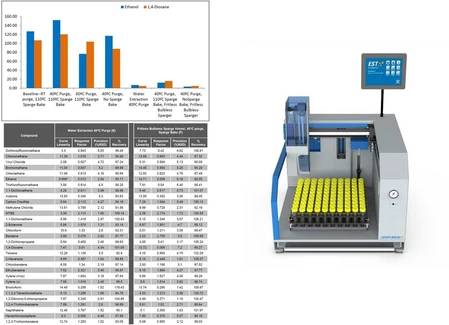
  • Photo: EST Analytical: USEPA 524.2 Method Validation Using the Evolution Purge and Trap Concentrator and the Centurion WS Autosampler
  • Video: EST Analytical: EVOLUTION 2 | EST Analytical

USEPA Method 524.2 calls for purge and trap sampling coupled with a Gas Chromatograph (GC) and Mass Spectrometer (MS) for separation and analysis. It has an extensive list of compounds and requires lower detection limits due to its use in drinking water testing. A 20% relative standard deviation for compound response factors is required across the calibration curve while the calibration check standard analytes have to be within 30% of the expected concentration. Currently, this method calls for a 5mL or 25mL purge volume and a four minute desorb time. These method requirements can pose a challenge for the analyst due to the amount of moisture that is created. 

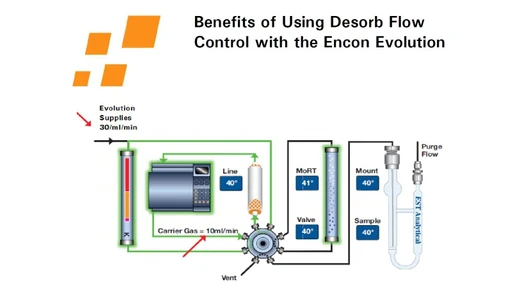
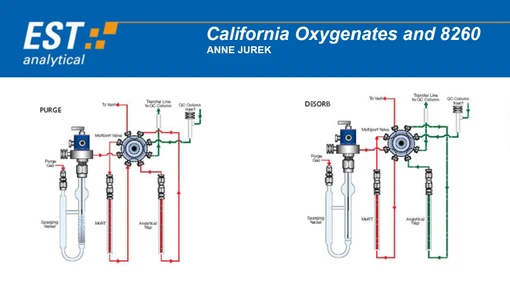
The negative effects of the increased water vapor include instability of the chromatography, band eluting and poor peak shape to name a few. A side effect of this instability is sample re-runs and lost laboratory productivity. In addition, a common practice for mitigating moisture is increasing the GC inlet split rate. This poses yet another difficulty as the increased split rate can result in reduced sensitivity. EST Analytical’s eight port valve in the Evolution purge and trap concentrator aids in limiting the water exposure because the water management of the system is not part of the desorb pathway. This feature also enables laboratories to use a smaller split ratio at the GC inlet thus increasing sensitivity.

Experimental: 

The sampling system used for this study was the EST Analytical Evolution purge and trap concentrator and the Centurion WS autosampler. The concentrator was affixed with a Vocarb 3000 trap and connected to an Agilent 7890A GC and 5975C inert XL MS. The GC was configured with a Restek Rxi-624 Sil MS 30m x 0.25mm x 1.4µm column. The purge and trap and GC/MS parameters used for this study are listed below.

Purge and Trap Parameters
  • Concentrator: EST Evolution
  • Trap type: Vocarb 3000
  • Valve oven temperature: 130 °C
  • Transfer line temperature: 130 °C
  • Trap temperature: 35 °C
  • Moisture Reduction Trap (MoRT) temperature: 39 °C
  • Purge time: 11 min
  • Purge flow: 40 mL/min
  • Dry purge Temp.: Ambient
  • Dry Purge Flow: 40mL/min
  • Dry Purge Time: 1.0 min  
  • Desorb pressure Control: ON
  • Desorb Pressure: 5psi
  • Desorb time: 4 min
  • Desorb preheat delay: 15 sec
  • Desorb temperature: 250 °C
  • MoRT bake temperature: 210 °C
  • Bake temperature: 260 °C
  • Sparge vessel bake temperature: 110 °C
  • Bake time: 6 min
  • Bake flow: 70 mL/min
Auto-Sampler (EST Centurion WS):
  • Sample type: Water
  • Water volume: 25 mL
  • Internal standard volume: 5 µL
GC/MS Parameters
  • System: Agilent 7890A GC / 5975C inert XL MS
  • Inlet: Split mode, 220 °C, 40:1 split ratio, 12.153 psi head pressure
  • Column: Restek Rxi-624Sil MS, 30 m × 0.25 mm × 1.4 µm
  • Oven program: 45 °C (1 min) → ramp 15 °C/min → 220 °C, hold 1.33 min (total run ~14 min)
  • Column flow rate: 1 mL/min helium
  • Total flow: 44 mL/min
  • Source temperature: 230 °C
  • Quadrupole temperature: 150 °C
  • Transfer line temperature: 180 °C
  • Scan range: m/z 35–300, 5.2 scans/sec
  • Solvent delay: 0.7 min

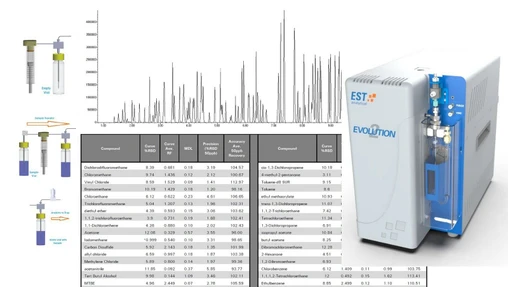
A calibration curve was established with a linear range of 0.25 to 40µg/L using the USEPA Method 524.2 standards from Restek. After the curve was determined, method detection limits were ascertained by running a series of seven replicate 0.25 µg/L standards and calculated using the procedure outlined in 40 CFR Part 136 Appendix B. Finally, seven 20 µg/L standards were examined in order to verify the precision and accuracy of the analysis. The results of this study are displayed in Tables 1 and 2 while Figure 1 presents a 20 µg/L standard GC/MS chromatogram.
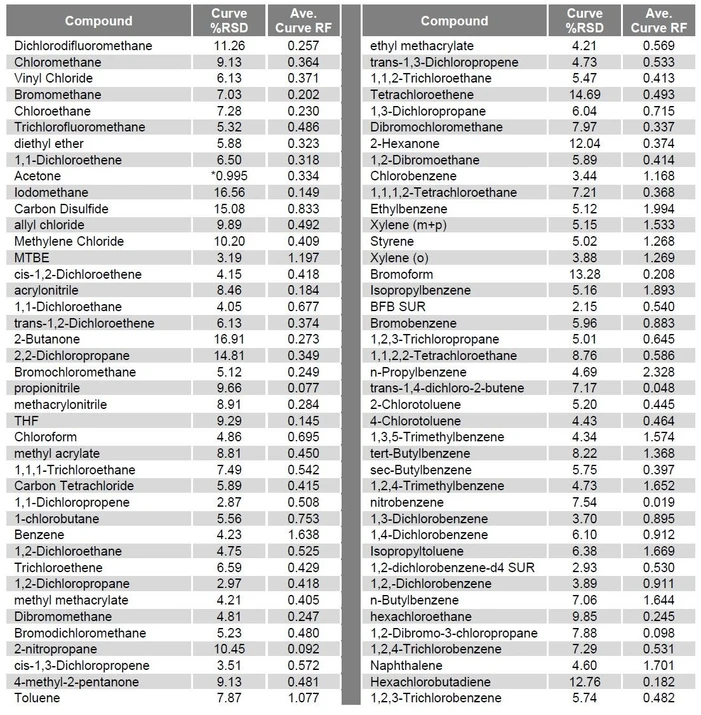
EST Analytical: Table 1 - Compound Linearity and Response Factor TableEST Analytical: Table 1 - Compound Linearity and Response Factor Table
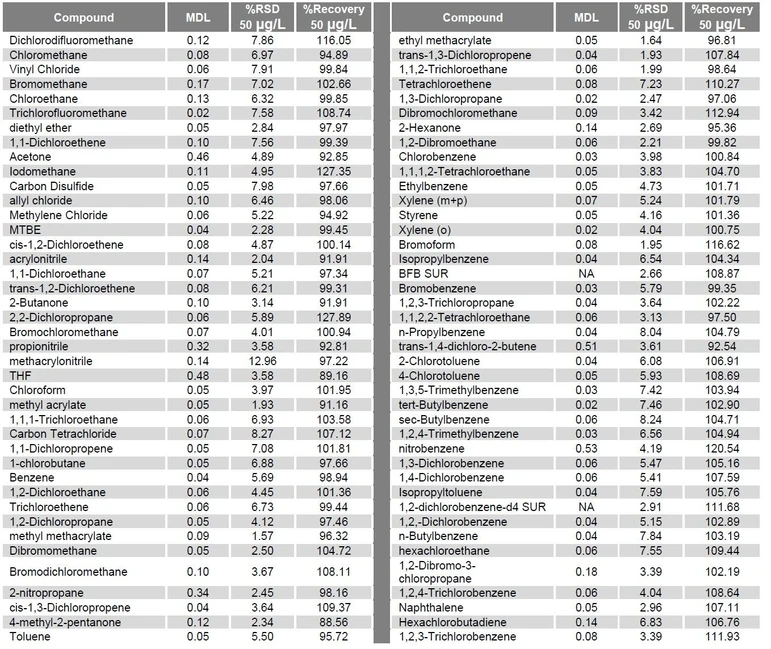
EST Analytical: Table 2 - MDL and Precision and Percent Recovery TableEST Analytical: Table 2 - MDL and Precision and Percent Recovery Table
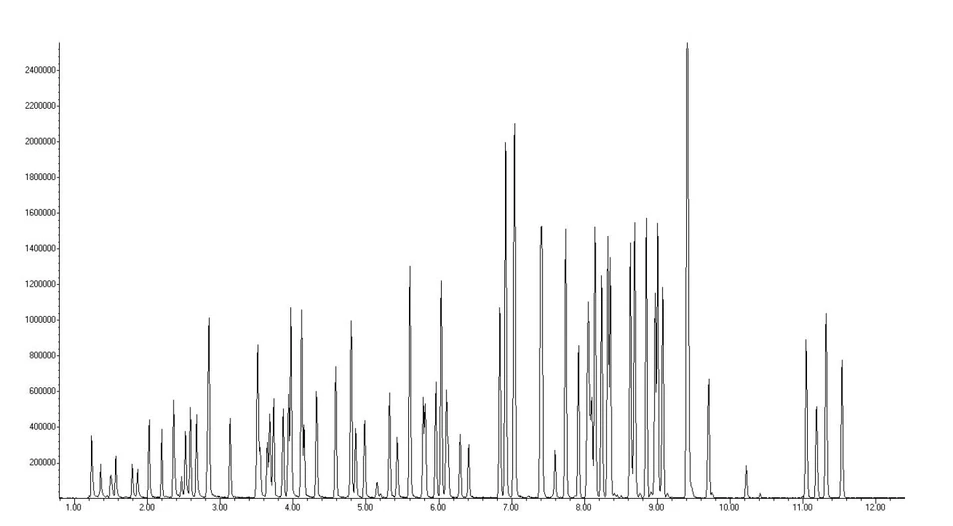
EST Analytical: Figure 1 - 20 µg/L Standard ChromatogramEST Analytical: Figure 1 - 20 µg/L Standard Chromatogram

Conclusions: 

This study demonstrated the effectiveness of the Evolution/Centurion purge and trap sampling system. The results passed all of the USEPA Method 524.2 criteria for both linearity and detection limits. Since the Evolution bypasses the water management trap during the four minute desorb process, the amount of water effecting the experiments was limited. Furthermore, the forty to one split ratio at the GC inlet provided excellent detection limits as the system was more sensitive to the low level standard requirements of the method. The lower split rate has an added benefit of reducing laboratory helium consumption when setting it against other system’s higher split ratios. Finally, the precision and percent recovery results showed the reliability of the system in producing accurate experimental findings.

Resources
  1. USEPA Method 524.2, “Measurement of Purgeable Organic Compounds in Water by Capillary Column Gas Chromatography/Mass Spectrometry, Revision 4.1, 1995. 

EST Analytical
LinkedIn Logo
 

Related content

Analysis of Aroma Components in Apples Using the Smart Aroma Database

Applications
| 2026 | Shimadzu
Instrumentation
GC/MSD, GC/SQ, HeadSpace
Manufacturer
Shimadzu
Industries
Food & Agriculture

Analysis of Acetaldehyde and Limonene in Recycled PET Using an HS-GCMS System (Carrier Gas: H2)

Applications
| 2026 | Shimadzu
Instrumentation
GC/MSD, GC/SQ, HeadSpace
Manufacturer
Shimadzu
Industries
Energy & Chemicals

What Causes GC Capillary Column Performance Degradation, and How Can I Prevent It?

Technical notes
| 2026 | Agilent Technologies
Instrumentation
Consumables, GC columns
Manufacturer
Agilent Technologies
Industries
Other

Aromatic Component Analysis of Gasoline According to ASTM D5580 Using the Brevis GC- 2050 Gas Chromatograph

Applications
| 2025 | Shimadzu
Instrumentation
GC
Manufacturer
Shimadzu
Industries
Energy & Chemicals

Micro GC Analysis of Permanent Gas Impurities in PEM Fuel Cell-Grade Hydrogen

Applications
| 2025 | Agilent Technologies
Instrumentation
GC
Manufacturer
Agilent Technologies
Industries
Energy & Chemicals
 

Related articles

JUNIOR STAR Grants at UCT Prague: Two talented women from abroad driving innovation in science
Article | Scientists

JUNIOR STAR Grants at UCT Prague: Two talented women from abroad driving innovation in science

Two outstanding early-career researchers at UCT Prague, Filipa Oliveira and Stella Gonsales, received prestigious GAČR JUNIOR STAR grants for innovative research in materials science and sustainable chemistry.
UCT Prague
tag
share
more
Research from IOCB Prague reveals a previously unknown mechanism of genetic transcription
Article | Science and research

Research from IOCB Prague reveals a previously unknown mechanism of genetic transcription

Scientists at IOCB Prague reveal a previously unknown mechanism that initiates gene transcription. Using cryo-EM, they uncover how alarmone molecules enable RNA synthesis under stress.
Institute of Organic Chemistry and Biochemistry of the Czech Academy of Sciences
tag
share
more
Webinars LabRulezGCMS Week 07/2026
Article | Webinars

Webinars LabRulezGCMS Week 07/2026

3 webinars: AI in manufacturing, fermentation, functional food, mAb production, metabolite monitoring, process Raman, process analytics
LabRulez
tag
share
more
QuEChERS Combined with Low-Temperature Partitioning and GC–MS as an Analytical Strategy for the Determination of Multiclass Pesticide Residues in Cocoa Beans
Scientific article | Science and research

QuEChERS Combined with Low-Temperature Partitioning and GC–MS as an Analytical Strategy for the Determination of Multiclass Pesticide Residues in Cocoa Beans

This study combines QuEChERS and low-temperature partitioning with GC–MS to determine multiclass pesticide residues in cocoa beans with good sensitivity and recoveries.
LabRulez
tag
share
more
 

Related content

Analysis of Aroma Components in Apples Using the Smart Aroma Database

Applications
| 2026 | Shimadzu
Instrumentation
GC/MSD, GC/SQ, HeadSpace
Manufacturer
Shimadzu
Industries
Food & Agriculture

Analysis of Acetaldehyde and Limonene in Recycled PET Using an HS-GCMS System (Carrier Gas: H2)

Applications
| 2026 | Shimadzu
Instrumentation
GC/MSD, GC/SQ, HeadSpace
Manufacturer
Shimadzu
Industries
Energy & Chemicals

What Causes GC Capillary Column Performance Degradation, and How Can I Prevent It?

Technical notes
| 2026 | Agilent Technologies
Instrumentation
Consumables, GC columns
Manufacturer
Agilent Technologies
Industries
Other

Aromatic Component Analysis of Gasoline According to ASTM D5580 Using the Brevis GC- 2050 Gas Chromatograph

Applications
| 2025 | Shimadzu
Instrumentation
GC
Manufacturer
Shimadzu
Industries
Energy & Chemicals

Micro GC Analysis of Permanent Gas Impurities in PEM Fuel Cell-Grade Hydrogen

Applications
| 2025 | Agilent Technologies
Instrumentation
GC
Manufacturer
Agilent Technologies
Industries
Energy & Chemicals
 

Related articles

JUNIOR STAR Grants at UCT Prague: Two talented women from abroad driving innovation in science
Article | Scientists

JUNIOR STAR Grants at UCT Prague: Two talented women from abroad driving innovation in science

Two outstanding early-career researchers at UCT Prague, Filipa Oliveira and Stella Gonsales, received prestigious GAČR JUNIOR STAR grants for innovative research in materials science and sustainable chemistry.
UCT Prague
tag
share
more
Research from IOCB Prague reveals a previously unknown mechanism of genetic transcription
Article | Science and research

Research from IOCB Prague reveals a previously unknown mechanism of genetic transcription

Scientists at IOCB Prague reveal a previously unknown mechanism that initiates gene transcription. Using cryo-EM, they uncover how alarmone molecules enable RNA synthesis under stress.
Institute of Organic Chemistry and Biochemistry of the Czech Academy of Sciences
tag
share
more
Webinars LabRulezGCMS Week 07/2026
Article | Webinars

Webinars LabRulezGCMS Week 07/2026

3 webinars: AI in manufacturing, fermentation, functional food, mAb production, metabolite monitoring, process Raman, process analytics
LabRulez
tag
share
more
QuEChERS Combined with Low-Temperature Partitioning and GC–MS as an Analytical Strategy for the Determination of Multiclass Pesticide Residues in Cocoa Beans
Scientific article | Science and research

QuEChERS Combined with Low-Temperature Partitioning and GC–MS as an Analytical Strategy for the Determination of Multiclass Pesticide Residues in Cocoa Beans

This study combines QuEChERS and low-temperature partitioning with GC–MS to determine multiclass pesticide residues in cocoa beans with good sensitivity and recoveries.
LabRulez
tag
share
more
 

Related content

Analysis of Aroma Components in Apples Using the Smart Aroma Database

Applications
| 2026 | Shimadzu
Instrumentation
GC/MSD, GC/SQ, HeadSpace
Manufacturer
Shimadzu
Industries
Food & Agriculture

Analysis of Acetaldehyde and Limonene in Recycled PET Using an HS-GCMS System (Carrier Gas: H2)

Applications
| 2026 | Shimadzu
Instrumentation
GC/MSD, GC/SQ, HeadSpace
Manufacturer
Shimadzu
Industries
Energy & Chemicals

What Causes GC Capillary Column Performance Degradation, and How Can I Prevent It?

Technical notes
| 2026 | Agilent Technologies
Instrumentation
Consumables, GC columns
Manufacturer
Agilent Technologies
Industries
Other

Aromatic Component Analysis of Gasoline According to ASTM D5580 Using the Brevis GC- 2050 Gas Chromatograph

Applications
| 2025 | Shimadzu
Instrumentation
GC
Manufacturer
Shimadzu
Industries
Energy & Chemicals

Micro GC Analysis of Permanent Gas Impurities in PEM Fuel Cell-Grade Hydrogen

Applications
| 2025 | Agilent Technologies
Instrumentation
GC
Manufacturer
Agilent Technologies
Industries
Energy & Chemicals
 

Related articles

JUNIOR STAR Grants at UCT Prague: Two talented women from abroad driving innovation in science
Article | Scientists

JUNIOR STAR Grants at UCT Prague: Two talented women from abroad driving innovation in science

Two outstanding early-career researchers at UCT Prague, Filipa Oliveira and Stella Gonsales, received prestigious GAČR JUNIOR STAR grants for innovative research in materials science and sustainable chemistry.
UCT Prague
tag
share
more
Research from IOCB Prague reveals a previously unknown mechanism of genetic transcription
Article | Science and research

Research from IOCB Prague reveals a previously unknown mechanism of genetic transcription

Scientists at IOCB Prague reveal a previously unknown mechanism that initiates gene transcription. Using cryo-EM, they uncover how alarmone molecules enable RNA synthesis under stress.
Institute of Organic Chemistry and Biochemistry of the Czech Academy of Sciences
tag
share
more
Webinars LabRulezGCMS Week 07/2026
Article | Webinars

Webinars LabRulezGCMS Week 07/2026

3 webinars: AI in manufacturing, fermentation, functional food, mAb production, metabolite monitoring, process Raman, process analytics
LabRulez
tag
share
more
QuEChERS Combined with Low-Temperature Partitioning and GC–MS as an Analytical Strategy for the Determination of Multiclass Pesticide Residues in Cocoa Beans
Scientific article | Science and research

QuEChERS Combined with Low-Temperature Partitioning and GC–MS as an Analytical Strategy for the Determination of Multiclass Pesticide Residues in Cocoa Beans

This study combines QuEChERS and low-temperature partitioning with GC–MS to determine multiclass pesticide residues in cocoa beans with good sensitivity and recoveries.
LabRulez
tag
share
more
 

Related content

Analysis of Aroma Components in Apples Using the Smart Aroma Database

Applications
| 2026 | Shimadzu
Instrumentation
GC/MSD, GC/SQ, HeadSpace
Manufacturer
Shimadzu
Industries
Food & Agriculture

Analysis of Acetaldehyde and Limonene in Recycled PET Using an HS-GCMS System (Carrier Gas: H2)

Applications
| 2026 | Shimadzu
Instrumentation
GC/MSD, GC/SQ, HeadSpace
Manufacturer
Shimadzu
Industries
Energy & Chemicals

What Causes GC Capillary Column Performance Degradation, and How Can I Prevent It?

Technical notes
| 2026 | Agilent Technologies
Instrumentation
Consumables, GC columns
Manufacturer
Agilent Technologies
Industries
Other

Aromatic Component Analysis of Gasoline According to ASTM D5580 Using the Brevis GC- 2050 Gas Chromatograph

Applications
| 2025 | Shimadzu
Instrumentation
GC
Manufacturer
Shimadzu
Industries
Energy & Chemicals

Micro GC Analysis of Permanent Gas Impurities in PEM Fuel Cell-Grade Hydrogen

Applications
| 2025 | Agilent Technologies
Instrumentation
GC
Manufacturer
Agilent Technologies
Industries
Energy & Chemicals
 

Related articles

JUNIOR STAR Grants at UCT Prague: Two talented women from abroad driving innovation in science
Article | Scientists

JUNIOR STAR Grants at UCT Prague: Two talented women from abroad driving innovation in science

Two outstanding early-career researchers at UCT Prague, Filipa Oliveira and Stella Gonsales, received prestigious GAČR JUNIOR STAR grants for innovative research in materials science and sustainable chemistry.
UCT Prague
tag
share
more
Research from IOCB Prague reveals a previously unknown mechanism of genetic transcription
Article | Science and research

Research from IOCB Prague reveals a previously unknown mechanism of genetic transcription

Scientists at IOCB Prague reveal a previously unknown mechanism that initiates gene transcription. Using cryo-EM, they uncover how alarmone molecules enable RNA synthesis under stress.
Institute of Organic Chemistry and Biochemistry of the Czech Academy of Sciences
tag
share
more
Webinars LabRulezGCMS Week 07/2026
Article | Webinars

Webinars LabRulezGCMS Week 07/2026

3 webinars: AI in manufacturing, fermentation, functional food, mAb production, metabolite monitoring, process Raman, process analytics
LabRulez
tag
share
more
QuEChERS Combined with Low-Temperature Partitioning and GC–MS as an Analytical Strategy for the Determination of Multiclass Pesticide Residues in Cocoa Beans
Scientific article | Science and research

QuEChERS Combined with Low-Temperature Partitioning and GC–MS as an Analytical Strategy for the Determination of Multiclass Pesticide Residues in Cocoa Beans

This study combines QuEChERS and low-temperature partitioning with GC–MS to determine multiclass pesticide residues in cocoa beans with good sensitivity and recoveries.
LabRulez
tag
share
more
Other projects
LCMS
ICPMS
Follow us
More information
WebinarsAbout usContact usTerms of use
LabRulez s.r.o. All rights reserved. Content available under a CC BY-SA 4.0 Attribution-ShareAlike